Start about a year out and move through six phases: foundation, build-out, promotion, final preparation, event week, and post-event follow-through. Lock three things first, in this order: your date, venue, and keynote. Everything else waits on those three decisions. If you are starting with less runway, compress the phases left to right, but never skip the sequence.
TL;DR:
- Securing your venue and keynote at least nine to twelve months in advance is crucial, as premier options often book early and keynote speakers are in demand a year ahead.
- Confirm your session speakers by month six, and finalize your venue and keynote by month nine to build a stable foundation for marketing and program development.
- Enforce deadlines for speaker content, AV specs, and accessibility guarantees early, with final accommodations locked four to six weeks before the event to prevent last-minute issues.
- Lock vendor contracts and create a detailed run-of-show at least one month before the event, ensuring coordinated communication and preventing last-minute surprises.
- Employ a single accountable team to manage all dependencies, ensuring the timeline stays on track and the event narrative remains coherent across all phases.
Table of Contents
- Phase 1: Foundation (Months 12 to 9)
- Phase 2: Build-Out (Months 9 to 6)
- Phase 3: Promotion (Months 6 to 3)
- Phase 4: Final Preparation (Months 3 to 1)
- Phase 5: Event Week
- Phase 6: Post-Event Follow-Through (Weeks 1 to 4)
- What a Turnkey Production Partner Locks Down
- Why Narrative Planning Outperforms a Checklist Mentality
- How King Sixteen Keeps Your Timeline on Track
- Timeline Templates and Accessibility Guidance Worth Bookmarking
- Sources
- FAQ
Phase 1: Foundation (Months 12 to 9)
Every conference planning timeline lives or dies on what happens in the first ninety days of work. This is where you decide what the event is actually for, and that decision determines the shape of everything that follows. Skip it or rush it, and you will spend months seven through three fixing problems that should have never existed.
Start with the goal, not the date. Are you generating leads, building community, launching a product, or driving revenue through registration and sponsorship? A conference built for lead generation looks different in venue size, session format, and even catering than one built to retain an existing member base. Name the audience and the format (in-person, hybrid, or virtual) before you touch a spreadsheet.
Next comes the budget, and it needs three numbers, not one. A single “total budget” figure invites confusion the moment sponsorship revenue starts fluctuating. Build:
- Maximum spend: the hard ceiling you cannot cross regardless of registration numbers.
- Expected revenue: registration income plus sponsorship, calculated conservatively.
- Target margin: the number that tells you whether the event was actually worth producing.
A conference budget breakdown with real per-attendee cost examples makes this exercise far less abstract than a blank template.
With goals and budget roughed out, pick tentative dates and immediately check them against major industry calendars, competing conferences, and holidays. Then form your organizing committee with named owners for programming, marketing, sponsorship, and operations. Vague ownership (“marketing will handle this”) is how deadlines get missed in month five.
The dependency logic matters more than most planners realize. Your venue choice constrains your capacity, your AV capabilities, and your catering options. Your keynote choice shapes your marketing narrative and your session themes. Foundation month decisions are not administrative housekeeping. They are the load-bearing walls for the other five phases.
Phase 2: Build-Out (Months 9 to 6)
This is the phase where your conference production timeline either locks into place or starts to wobble. Venue and speakers are the two anchors, and both take longer to secure than first-time organizers expect.
Start venue outreach at month 10 or 11. Premier venues in major U.S. markets often book 12 to 18 months in advance, and waiting until month eight to start calling risks losing your preferred dates to a competing event. Target a signed contract by month 9. That gives you a three-month cushion if your first-choice venue falls through and you need a backup.
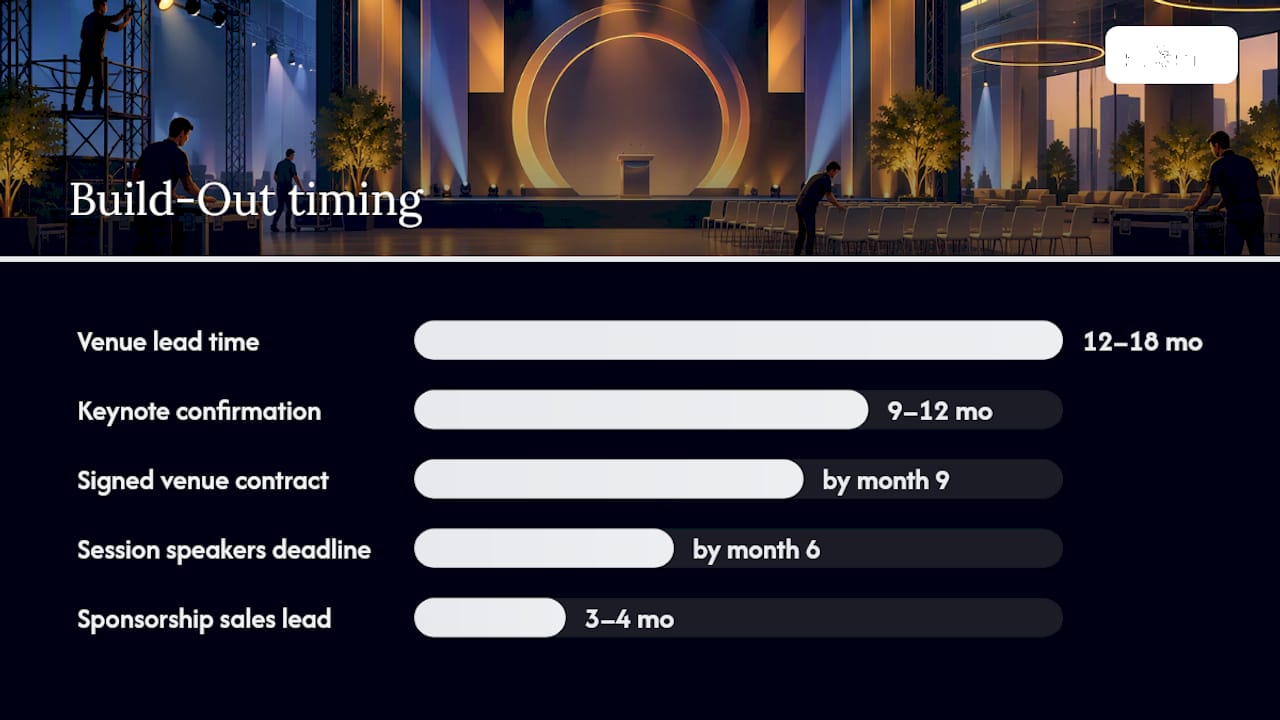
Keynote speakers follow a similar clock. Confirm your headline speaker between 9 and 12 months out, since in-demand speakers book their calendars a year ahead, and a confirmed keynote gives your marketing team something concrete to promote. Session speakers have more flexibility, but confirm them no later than month 6. Waiting longer creates a scramble in the promotion phase when you need bios, headshots, and session descriptions for your website.
Build-out is also when you run your Call for Proposals, if you use one, or finalize a curated program if you do not:
- Open your CFP window with a clear submission deadline and a review committee already assigned.
- Budget two to three weeks for review and selection, not two to three days.
- Notify accepted and rejected speakers on the same day to avoid awkward overlap in your marketing.
- Draft your sponsorship prospectus now, since sponsorship sales typically need three to four months of lead time before contracts close.
Most operational chaos traces back to this phase. Skipping a foundational milestone or failing to enforce a speaker content deadline creates problems that become unfixable once you hit final preparation. Enforce your deadlines here, even when a speaker asks for “just a few more days.”
Phase 3: Promotion (Months 6 to 3)
Registration opens, and your conference planning schedule shifts from internal logistics to public-facing momentum. This is the phase that determines whether your seats fill.
- Open registration around month 6. This gives you enough runway to market properly while collecting early revenue that funds deposits and vendor payments still coming due.
- Set your early-bird tier with a real deadline, not a symbolic one. Early-bird pricing works best when it closes a few months before the event, creating genuine urgency rather than a discount that quietly disappears. Price the gap between early-bird and standard registration wide enough that attendees feel the incentive. Ten dollars off will not move anyone; a meaningful percentage will.
- Launch your marketing push in a coordinated sequence. Email your past attendee list first, since they convert fastest. Follow with speaker announcement posts on LinkedIn, a press release if your keynote has news value, and paid channels once you have organic momentum built.
- Finalize your exhibitor floor plan. Sponsors need to see the layout before they commit to premium placement, and activation timing should be locked at least two months before the event.
- Collect speaker assets and AV specs now. Headshots, bios, slide decks, and technical requirements should be in hand well before final preparation begins. Waiting until month two means your production team is building blind.
The early-bird window is one of the strongest conversion levers you have, and it only works if the deadline is enforced publicly and consistently.
Phase 4: Final Preparation (Months 3 to 1)
This is where a conference planning checklist stops being a document and becomes a countdown. Every vendor contract, every accessibility guarantee, and every rehearsal needs to be locked before month one closes.
Confirm every vendor contract and finalize headcounts for catering, AV, and printed materials two to four weeks before the event. Caterers in particular need firm numbers early, since most contracts penalize late count changes. An event logistics checklist helps here, especially when you are coordinating multiple vendors on overlapping timelines.
Accessibility deadlines deserve their own attention, and they get skipped more often than any other item on this list. Publicize your accommodation policy early, not as a footnote buried on page four of your registration form. Guarantee core accessibility services, like captioning and interpreters, by roughly 12 weeks before the event. Individual accommodation requests are typically locked four to six weeks out, but the guarantee itself needs to be visible from the moment registration opens.
- Publish your accessibility and accommodation policy on the registration page, not a linked subpage.
- Assign a named contact for accommodation requests, and put that name in your confirmation emails.
- Confirm interpreter and captioning vendors by the 12-week mark, with a written cancellation policy.
- Send final accommodation confirmations to requesting attendees no later than four to six weeks out.
Speaker rehearsals belong here too. Digital and hybrid presenters need more preparation time than most planners budget for. Plan on two to three hours per speaker covering session development, platform training, and a full rehearsal. Multiply that across a dozen speakers and you can see why this task needs its own line on the calendar, not a rushed afternoon the week of the event.
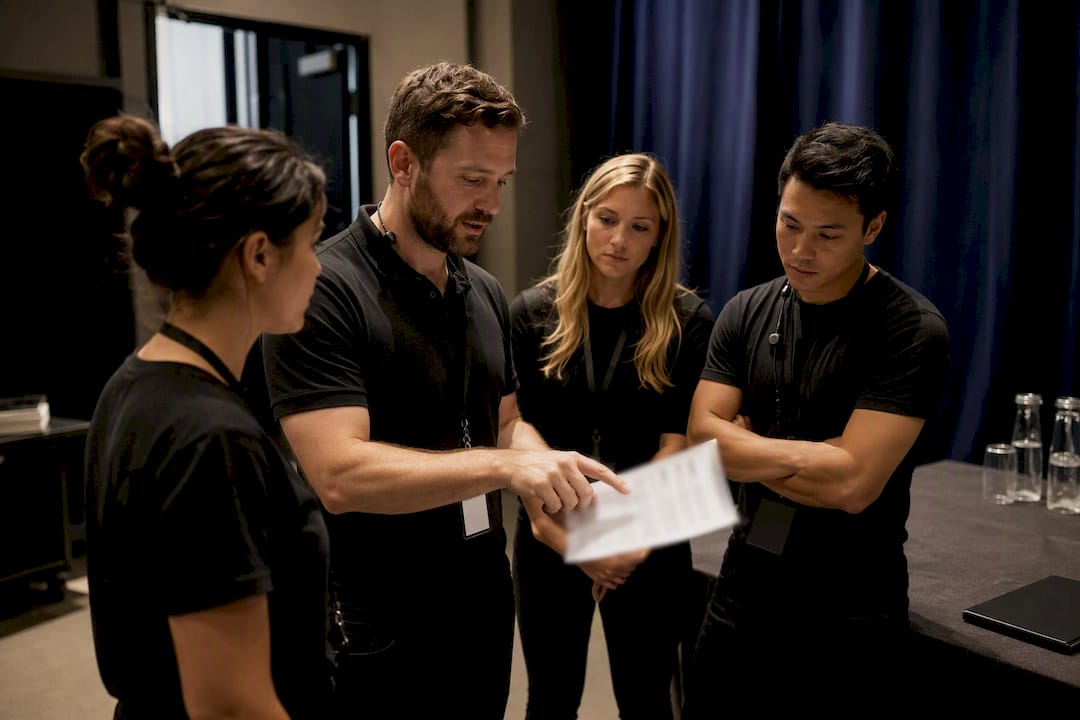
Pro Tip: Publish your run-of-show document and hold a staff briefing at least one week before the event, not the morning of. Staff who read the schedule cold on-site will miss cues that a five-minute briefing would have caught.
Phase 5: Event Week
On-site execution rewards planners who treat the week as a series of checkpoints rather than one long push. Break each day into three actions.
- Confirm setup and run technical rehearsals every morning before doors open. A mic that worked Tuesday might fail Wednesday if a different AV tech swapped a cable overnight. Check it fresh, every day.
- Designate escalation contacts before the first attendee walks in. Staff need to know exactly who handles a medical issue, a conduct complaint, or a vendor dispute without hunting through a phone tree. Publicizing your code of conduct and reporting process across signage and the event app reduces on-site confusion considerably, and staff who know the reporting path in advance respond faster when something actually happens.
- Manage exhibitor move-in and move-out with a dedicated liaison. Exhibitors have their own timeline pressures, and a single point of contact prevents forty separate booths from each escalating separately to your operations lead.
The strongest events treat the program as a continuous narrative rather than a stack of disconnected sessions. Designing for narrative coherence means your opening keynote should introduce a question your breakout sessions spend the day answering, and your closing session should tie the threads back together. Attendees notice the difference between a conference that feels like one coherent experience and one that feels like eight separate meetings sharing a hallway.
Phase 6: Post-Event Follow-Through (Weeks 1 to 4)
The work does not end when the last attendee leaves. What happens in the two to four weeks after your event determines whether you capture the learning and revenue the conference actually generated.
- Send attendee surveys within the first two weeks, while the experience is still fresh enough to produce honest, specific feedback.
- Schedule an internal debrief with your organizing committee and a separate check-in call with major sponsors to capture their read on the event.
- Complete vendor invoice reconciliation within two to four weeks, closing out every line item against your original three-number budget framework.
- Publish session recordings and repurpose keynote and panel content into blog posts, social clips, and email nurture sequences.
- Send sponsors a performance report with attendance data, engagement metrics, and lead capture numbers. A post-event reporting template makes this faster to assemble and more consistent year over year.
- Plan at least one follow-up community touchpoint, whether a webinar, a newsletter series, or a save-the-date for next year, so the relationship does not go cold the moment the event ends.
Measure everything against the budget numbers you set in month twelve. That comparison, more than any single satisfaction score, tells you whether the event delivered.
What a Turnkey Production Partner Locks Down
Experience running conference production has taught where timelines actually break, and it is rarely the venue contract or the catering count. It is the handoffs between teams that were never talking to each other.
The turnkey cadence works because one team owns the whole chain. Venue, fabrication, staffing, AV, and catering get locked on a single production calendar instead of multiple vendor calendars that only sync up by accident. Some aspects stay flexible, like creative direction on stage design and attendee flow, since those benefit from adjustment as speaker content and sponsor needs firm up closer to the event.
The most common failure mode is the silo. Marketing builds the promotional narrative without knowing what the AV team is planning for the stage. Programming confirms a speaker lineup without telling operations the AV specs each speaker requires. The fix is a central program editor, one person or one small team who owns the full agenda and every dependency attached to it, and enforced content deadlines that do not bend for a speaker’s “almost done” email.
- Lock vendor contracts and venue by month 9; leave creative execution flexible through month 2.
- Assign one program editor who signs off on every session change.
- Enforce speaker content deadlines in writing, with a hard cutoff for slide decks and AV specs.
- Brief on-site staff from a written run-of-show, not a verbal walkthrough.
The events that feel effortless on-site are almost never the ones with the biggest budgets. They are the ones where a single team owned the dependency chain from month one, so nothing arrived as a surprise in week fifty-one.
An event attendee experience guide breaks down how that ownership translates into the moments attendees actually remember.
Why Narrative Planning Outperforms a Checklist Mentality
The strongest conferences are not the ones with the longest speaker list. They are the ones where every session feels like it belongs to the same story. That is the piece most planners underweight when they treat a conference planning timeline as a series of deadlines to hit rather than a chain of creative decisions that build on each other.
Foundation-phase goals should already hint at the story you are telling. A conference built around innovation should have a keynote that opens a question, breakout sessions that explore different angles of it, and a closing panel that pulls the threads together. In agency work, the events that generate the most post-event buzz are almost always the ones where programming and creative direction sat in the same room from month nine onward, not the ones with the biggest production budget.
The prescriptive takeaway: build your six-phase timeline, but assign someone the job of protecting the narrative arc across every phase. That person’s only question at each milestone should be, “does this still fit the story?”
— Tyler
How King Sixteen Keeps Your Timeline on Track
Most conferences lose weeks to vendor coordination that nobody planned for. King Sixteen removes that entirely by managing design, fabrication, staffing, AV, catering, and logistics through one accountable team instead of six separate contracts you have to chase individually.
That turnkey structure means the milestones covered in this timeline, venue lockdown, speaker content deadlines, run-of-show production, staff briefings, get handled by people who have built this exact calendar for brands like Porsche, Audi, and Ray-Ban. When partners stay involved from proposal through execution, the plan you approve in month nine is more likely to be the plan that actually gets delivered on event day, not a version that quietly shifted because multiple vendors were never talking to each other.
If your team is heading into a conference build with a tight internal staff or a first-time production, reach out to King Sixteen for a proposal. You’ll get a scoped production plan mapped to your specific timeline, along with a clear breakdown of what King Sixteen handles versus what stays with your internal team.
Timeline Templates and Accessibility Guidance Worth Bookmarking
A few references are worth keeping open while you build your own schedule. The 12-month conference planning checklist lays out the six-phase structure this article follows, with month-by-month milestones. The month-by-month venue booking guide is useful specifically for venue outreach and contract timing. For accessibility, the PCMA guidance on planning for civility covers how to publicize codes of conduct and accommodation processes so attendees see them well before arrival, not buried in fine print.
Sources
- Conference Planning Timeline: Free 12-Month Checklist (2026)
- Conference Planning Timeline: Month-by-Month Checklist for Event Organizers | VenueSight
FAQ
How Long Does It Take to Plan a Conference?
Most mid-size conferences need a full 12 months, following the six-phase structure from foundation through post-event follow-through. Smaller or repeat events can compress to six or even three months, but venue and keynote outreach should still happen as early as possible since those two items have the longest lead times.
What Are the Six Phases of Event Planning?
The six phases are foundation (goals, budget, dates), build-out (venue, speakers, sponsorship), promotion (registration, marketing), final preparation (vendor lockdown, accessibility, rehearsals), event week (execution), and post-event follow-through (surveys, reporting, financial close). Each phase depends on decisions made in the one before it, so skipping ahead tends to create rework later.
When Should I Confirm My Keynote Speaker?
Confirm your keynote between 9 and 12 months before the event, since in-demand speakers often book a year of engagements in advance. Session speakers have more flexibility but should still be locked no later than month 6 to leave time for marketing and program design.
What If I’m Starting Less Than Six Months Out?
Compress the timeline by prioritizing the three anchors first: date, venue, and keynote, since those decisions constrain everything else. Run build-out and promotion tasks in parallel rather than sequentially, and consider working with a turnkey production partner like King Sixteen to manage vendor coordination while your internal team focuses on programming and marketing.
When Should Accessibility Accommodations Be Finalized?
Publicize your accessibility policy and guarantee core services like captioning and interpreters roughly 12 weeks before the event. Individual accommodation requests submitted by attendees are typically locked four to six weeks out, but the guarantee itself needs to be visible from the moment registration opens, not added as a late addition.
Recommended
- Planners: Conference Budget Breakdown, $2,731 Per Attendee, 3 Budgets
- Venue Sourcing Strategy: A Planner’s Process and Checklist
- Event Run of Show: 3 Templates Agencies Use and Planners Can Copy
- Conference Event Management: Strategies for Maximum Impact