A venue sourcing strategy is a repeatable, prioritized process that matches event objectives to venues, reduces cost and risk, and improves attendee outcomes. It is not a shopping trip. Here’s the one-line plan: prioritize your objectives, build a shortlist, send a structured RFP, evaluate with a scoring matrix, walk the space in person, negotiate the terms that actually move the needle, and then contract with protections in place.
Start the clock several months before your event date, earlier if you’re chasing a large convention center or a one-of-a-kind space with limited availability, according to Sched’s planning guidance. Planners who follow a defined sourcing process report 10 to 30 percent reductions in time and cost compared to ad hoc searches. Attendee engagement, rather than room rate, is increasingly the metric planners prioritize when weighing venue options.
A strong strategy always includes:
- Clear minimum requirements tied to attendee count and event goals
- A weighted scoring matrix for objective comparison
- A site-visit checklist that tests operations, not just aesthetics
- A contingency plan for weather, cancellations, and vendor failure
Key Takeaways
A venue sourcing strategy succeeds when it pairs a structured, timed workflow with objective scoring, verified compliance, and a real contingency plan.
| Point | Details |
|---|---|
| Start early | Begin sourcing 8 to 12 months out, earlier for large or unique venues. |
| Standardize your RFP | Request itemized pricing, floor plans, and tech specs from every venue equally. |
| Score objectively | Use a weighted 0-5 matrix across location, capacity, tech, cost, and compliance. |
| Verify in person | Site visits catch power, rigging, and access issues photos never show. |
| Build contingency | Keep a standby venue and weather decision deadline before you need them. |
| Consider a turnkey partner | King Sixteen consolidates venue, AV, staffing, and logistics into one contract and one point of contact. |
Table of Contents
- Why Venue Sourcing Strategy Has to Be Deliberate
- What Is the Venue Sourcing Process, Step by Step?
- How Do You Write an Effective Venue RFP?
- What Should You Check on a Venue Site Visit?
- Which Contract Terms and Compliance Items Actually Matter?
- What Does a Venue Really Cost Once You Add Everything Up?
- How Do You Plan for a Venue Falling Through?
- How Do Sourcing Tools and Technology Fit Into the Process?
- Checklist and Scoring Matrix for Final Venue Selection
- How a Turnkey Agency Approach Removes Sourcing Risk
- How King Sixteen’s Turnkey Sourcing Service Solves This
- Frequently Asked Questions
- Sources
Why Venue Sourcing Strategy Has to Be Deliberate
Picking a venue on gut feeling is how budgets blow up in month eleven. The room you choose determines how attendees move, how long lines form at registration, whether your AV vendor can actually rig what your creative team promised, and whether your catering minimum eats half your discretionary spend. None of that shows up on a floor plan PDF. It shows up on event day, when it’s too late to fix.
Venue decisions map directly to the KPIs marketing leaders actually get measured on. If your primary metric is attendee engagement, the venue needs breakout flexibility, informal gathering space, and tech infrastructure that supports interactive elements. If your KPI is cost per attendee, you’re optimizing for negotiated F&B minimums and off-peak dates. If it’s brand perception, a generic ballroom undercuts the story you’re trying to tell no matter how good your creative direction is.
Cvent’s planner survey found engagement has overtaken cost as the leading success metric among corporate planners, with more organizers choosing non-hotel venues that support interaction over traditional ballroom setups. That shift changes what “the right venue” even means. A space that scores well on price per square foot but forces attendees into rigid rows fails the engagement test before the first session starts.
You rarely get to maximize experience, cost, and operational reliability all at once. Rank them before you shortlist anything. A product launch built for press coverage needs a visually distinct space even at a cost premium. An internal sales kickoff can trade atmosphere for reliability and a lower per-head rate.
Pro Tip: Write your event’s single primary KPI at the top of your RFP brief before you contact a single venue. Every scoring decision that follows should trace back to that one line.
What Is the Venue Sourcing Process, Step by Step?
A structured workflow turns venue selection from a scramble into a series of checkpoints your team can execute in parallel. Here’s the sequence that works for most corporate events, along with who typically owns each stage.
- Define requirements (weeks 1 to 4). The event lead and marketing stakeholder lock attendee count, budget ceiling, date range, must-have amenities, and the event’s primary KPI. Deliverable: a one-page brief.
- Research and shortlist (weeks 4 to 8). Procurement or the event lead builds a list of 8 to 12 candidate venues using directories, past-event data, and referrals. Deliverable: a shortlist with location, capacity, and rate range for each option.
- Send RFPs (weeks 8 to 10). The event lead distributes a standardized RFP to every shortlisted venue simultaneously. Deliverable: itemized bids back from at least 5 to 6 venues.
- Evaluate with a scoring matrix (weeks 10 to 12). The core team scores each bid against weighted criteria. Deliverable: a ranked top-three list.
- Site visits (weeks 12 to 16). The event lead and a production or AV representative walk the top three in person or via guided virtual tour. Deliverable: a completed technical checklist per venue.
- Negotiate (weeks 16 to 18). Procurement and legal push on rate, concessions, and contract language. Deliverable: a term sheet.
- Contract and confirm (weeks 18 to 20). Legal finalizes the agreement; the event lead confirms with internal stakeholders. Deliverable: signed contract and deposit paid.
That timeline assumes a mid-size corporate event. Large conferences, multi-day summits, or anything requiring a custom-built environment should push the start date back further; unique venues with limited inventory get booked out a year or more in advance.
The scoring matrix is the piece most teams skip, and it’s the piece that saves them from choosing the venue with the best sales rep instead of the best fit. Score each finalist from 0 to 5 across your weighted criteria, tally the results, and use that ranked list as your starting point for the final decision, not the final word. Meetmaps recommends exactly this kind of weighted approach to strip subjectivity out of what’s otherwise a gut-feel decision.

Legal should enter the process no later than the negotiation stage, not after a term sheet is already signed. Waiting until contract review to loop in counsel is how planners end up stuck with cancellation clauses they never noticed.
How Do You Write an Effective Venue RFP?
An RFP that gets you comparable bids has to ask every venue the exact same questions in the exact same format. Loose, conversational RFPs get you loose, conversational answers you can’t stack against each other.
Build your RFP around these core sections:
- Event summary: goals, format, and expected attendee experience
- Dates and flexibility: preferred dates plus 2 to 3 backup date ranges
- Capacities and room setup: required square footage, seating configuration, breakout needs
- Technical specifications: power, internet bandwidth, rigging points, AV compatibility
- Catering requirements: meal periods, dietary accommodation, minimums
- Staffing and service levels: security, coat check, registration support
- Insurance and compliance: required certificates, ADA documentation, fire permits
- Pricing format: itemized line items, not a single bundled number
AMW’s venue selection guide emphasizes requesting itemized costs and standardized deliverables like floor plans and tech specs specifically because bundled quotes make apples-to-apples comparison nearly impossible.
A compact RFP template you can reuse looks like this: one paragraph stating your event summary and dates, one paragraph on space and capacity needs, one paragraph on technical and catering requirements, one paragraph requesting compliance documentation, and a final section demanding an itemized cost breakdown with a response deadline. Keep it to one page. Venues respond faster and more completely to a document they can scan in two minutes than to a ten-page questionnaire.
To speed response times, send RFPs to every venue on your shortlist the same day, give a hard deadline of 7 to 10 business days, and follow up by phone with any venue that goes quiet after 48 hours.
What Should You Check on a Venue Site Visit?
Photos and floor plans hide the problems that actually derail events. Site inspections surface load-in logistics, outlet placement, and back-of-house capacity that no marketing deck will show you, and multiple planner guides agree you shouldn’t book sight unseen when an in-person visit is possible.
Walk through with this checklist:
- Room dimensions, ceiling height, and column placement against your actual floor plan
- Loading dock access and back-of-house pathways for vendor staging
- Power circuit locations and total available amperage
- Internet speed, redundancy, and whether the venue or a third party controls it
- Rigging points, HVAC output, and ambient noise from adjacent spaces
- ADA-compliant access, restroom count, fire exits, and evacuation routes
If travel makes an in-person visit impossible, insist on a live guided video walkthrough, not a pre-recorded tour. Ask the venue rep to physically point the camera at outlets, loading doors, and the exact spot your general session stage would sit.
Pro Tip: Bring your AV vendor or production lead to the site visit whenever the event has any technical complexity. They will catch rigging and power issues that an event planner alone often misses.
Which Contract Terms and Compliance Items Actually Matter?
Most venue contracts bury their real risk in three places: the cancellation clause, the food and beverage minimum, and the exclusivity language around outside vendors. Read those sections twice before you read anything else.
Prioritize negotiating these terms:
- Hold type: push for an exclusive hold over a soft date hold once you’re serious, since soft holds can be bumped by a competing booking
- Cancellation windows: know exactly what percentage of the contract value you owe at each cutoff date
- Force majeure language: confirm it covers pandemics, severe weather, and government restrictions, not just “acts of God” in the narrowest sense
- Payment schedule: negotiate milestone payments tied to deliverables instead of one large deposit upfront
- Overtime rates: get the hourly overage rate in writing before you need it at 11 p.m. on event night
On compliance, request current fire safety certificates, health department permits if the venue handles food and beverage service, and ADA compliance documentation before you sign. Contract language should obligate the venue to maintain and provide proof of these on request, not just claim they exist.
Watch for exclusivity clauses that lock you into the venue’s in-house AV or catering provider at above-market rates. These are negotiable more often than venues initially let on, especially for multi-day bookings.
Pro Tip: Structure payment milestones around your own confidence checkpoints: deposit at signing, second payment after the final headcount is confirmed, balance due post-event. That keeps leverage on your side if something goes wrong.
What Does a Venue Really Cost Once You Add Everything Up?
The quoted rental rate is rarely the number that matters. Total cost includes rental fee, food and beverage minimums, service charges and gratuities, equipment rental, security, overtime labor, deposits, and applicable taxes. Add every line item before you compare two venues, because the one with the lower headline rate often loses once minimums and service fees are factored in.
Calculate cost per guest, not just total contract value, to compare venues with different capacities fairly. A $40,000 venue holding 500 people costs less per attendee than a $28,000 venue holding 250.
Hidden fees to ask about explicitly:
- Corkage fees if you’re bringing outside beverage service
- Security staffing minimums, especially for evening events
- Power surcharges for anything beyond standard outlet capacity
- Early load-in or late load-out hourly rates
Date flexibility is real leverage. Venues discount Tuesday through Thursday dates and off-peak months because they’re filling inventory that would otherwise sit empty, and planners following a structured negotiation process report 10 to 30 percent savings versus locking a date before shopping terms.
How Do You Plan for a Venue Falling Through?
Every sourcing strategy needs a backup plan the same way every event needs a fire exit. Waiting until a venue cancels to start looking for alternatives guarantees a worse outcome on every dimension: price, quality, and stress.
Build contingency into the process from the start:
- Keep your second-ranked scoring matrix finalist on informal standby with a soft hold, even after signing your primary contract.
- For outdoor components, book an indoor backup space or tent rental and set a firm weather decision deadline 48 to 72 hours out.
- Define the exact trigger that moves you to backup: contract breach, venue closure, or a weather threshold you set in advance.
- Confirm your contract includes force majeure language that lets you exit or relocate without full penalty under defined conditions.
A quick checklist for vendor contingency: confirmed backup AV vendor, backup catering option if the venue’s in-house provider fails, and a communications plan for notifying attendees fast if plans change.
How Do Sourcing Tools and Technology Fit Into the Process?
Venue directories, RFP platforms, and virtual tour tools each solve a different piece of the sourcing puzzle, and none of them replace the judgment calls a human still has to make. Discovery tools surface shortlist candidates faster than manual searching. RFP automation platforms distribute your standardized questionnaire to a dozen venues at once and organize responses side by side. RFP tools work best when planners keep using them through negotiation, not just for the initial discovery phase, since side-by-side bid comparisons make it obvious which venue has room to move on price.
AI-assisted search is increasingly common in venue discovery, and Cvent’s data shows growing planner reliance on it to narrow large candidate pools quickly. What AI and automation can’t do is walk the loading dock, judge whether the ceiling height actually works for your rigging plan, or read the tone of a venue sales director during negotiation.
A shortlist-plus-RFP tool beats an unmanaged search whenever you’re evaluating more than five or six venues at once. Below that number, a spreadsheet and direct outreach work fine.
Structured sourcing isn’t about replacing human judgment with software. It’s about giving your team enough clean, comparable data that the human judgment calls that remain are actually informed ones.
- Discovery platforms: narrow a large market to a workable shortlist
- RFP automation: standardize requests and speed comparison
- Virtual tour tools: pre-qualify venues before committing to travel
- Contract management software: track deadlines, deposits, and compliance documents in one place
Checklist and Scoring Matrix for Final Venue Selection
A one-page shortlist checklist keeps your final decision anchored to what actually matters instead of which venue had the best tour guide. Must-have criteria: confirmed capacity for your peak attendance, technical infrastructure matching your AV requirements, accessible compliance documentation, and a total cost within your approved range.
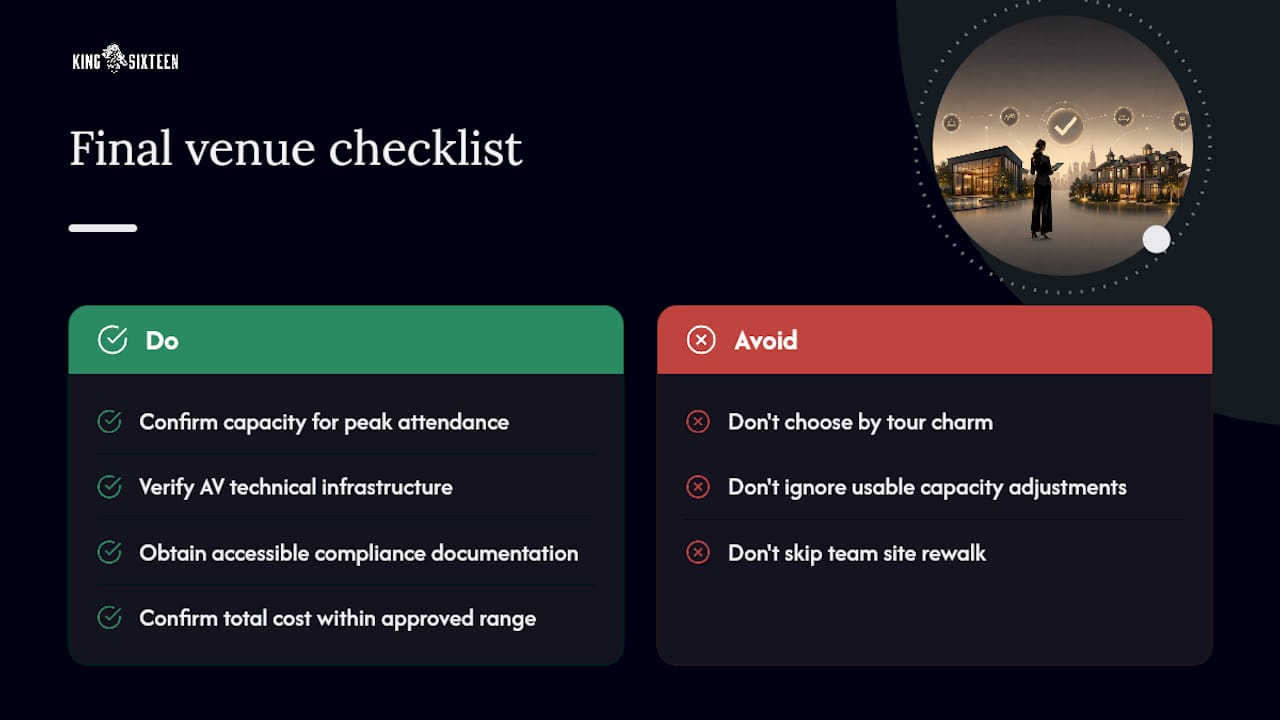
Layer a weighted scoring matrix on top of that checklist to strip out bias. Score each finalist from 0 to 5 on every criterion, multiply by weight, and total the results.
Apply the weighted scores to rank your top three, then walk each of them again with your team before finalizing. Numbers don’t catch everything. A venue that scores a point lower but where the sales director was proactive about solving your technical concerns during the site visit often outperforms the top scorer in actual execution. Usable capacity also deserves a second look here: stated capacity numbers rarely account for circulation space, breakout staging, or networking areas, so a room rated for 400 might comfortably hold 300 with your actual floor plan.
How a Turnkey Agency Approach Removes Sourcing Risk
Coordinating a venue, AV vendor, caterer, and staffing agency separately means four contracts, four timelines, and four points of failure. When one vendor slips, the other three don’t automatically adjust, and the planner absorbs that gap. A turnkey approach collapses that into a single point of accountability.
King Sixteen’s model runs venue sourcing through the same vendor network used for AV, fabrication, staffing, and catering, which means technical integration gets confirmed before a contract is signed rather than discovered during load-in. On past product launches and multi-day conferences, that single point of contact has meant fewer change orders during production week and faster turnaround between site visit and signed contract, since the same team that walks the venue is the team building the AV plan for it.
When venue, production, and staffing all report to one team, the coordination overhead that usually eats a planner’s last six weeks before an event largely disappears.
Outsourcing sourcing makes the most sense when the event is large, technically complex, tied directly to brand perception, or running on a compressed timeline that leaves no room for vendor miscommunication. Services that matter most during sourcing:
- Site negotiation backed by existing vendor relationships
- Technical integration confirmed before contract signature
- Logistics coordination across venue, AV, and staffing simultaneously
- Contingency execution if a primary venue or vendor falls through
A Planner’s Note on Recurring Sourcing Mistakes
The most common failure isn’t a bad venue. It’s letting aesthetics override operations, then discovering the loading dock can’t fit your set pieces two weeks out. Wifi and power get underestimated constantly. A venue that looks stunning in photos can still lack the amperage for a serious AV rig.
Pro Tip: Never trust a venue’s stated capacity number without asking how it was calculated.
What we always check before signing: back-of-house staging space, who legally controls AV during the event, and whether the fire marshal’s occupancy limit matches what sales quoted us.
How King Sixteen’s Turnkey Sourcing Service Solves This
Everything covered above, the RFPs, the site visits, the scoring matrices, the contract negotiations, takes a dedicated team weeks of focused work per event. King Sixteen runs that entire process as one coordinated engagement instead of a chain of separate vendor relationships you have to manage yourself.
That means a single point of contact instead of four, technical integration confirmed before you ever sign a venue contract, a faster timeline because sourcing and production planning happen in parallel rather than sequentially, and consolidated billing instead of reconciling invoices from a venue, an AV company, a caterer, and a staffing agency separately. It’s the difference between assembling a puzzle yourself and handing someone the finished picture.
Running sourcing internally still makes sense for smaller, lower-stakes internal meetings where the operational risk is low. Call in outside help once the event carries real brand weight, a compressed timeline, or technical complexity that a generalist planner shouldn’t have to solve alone. That’s precisely the gap King Sixteen’s experiential marketing and event production services are built to close, from venue negotiation through final execution.
If your next launch, conference, or activation needs sourcing handled by a team that already has the vendor relationships and technical playbook in place, get in touch with King Sixteen to scope your event and get a straight answer on timeline and cost.
Frequently Asked Questions
What is the first step in a venue sourcing strategy? Define your event’s primary KPI, attendee count, and minimum requirements before contacting a single venue. Every scoring and negotiation decision that follows traces back to that brief.
How far in advance should corporate planners start venue sourcing? Most planners should start 8 to 12 months before the event date, according to Sched’s guidance, with larger or more unique venues requiring even earlier outreach.
What should an RFP include to get comparable bids? An effective RFP standardizes event summary, capacity needs, technical specs, catering requirements, staffing, compliance documentation, and an itemized pricing format across every venue you contact.
What’s the biggest mistake planners make during site visits? Focusing on aesthetics over operations. Loading dock access, power circuits, and back-of-house space determine whether an event runs smoothly far more than how the room photographs.
When does it make sense to outsource venue sourcing to an agency? Outsourcing pays off for large, technically complex, or brand-critical events, or when your internal timeline is too compressed to run RFPs, site visits, and negotiations in sequence.
Sources
- How Venue Sourcing is Changing in 2026: Data From 1,650 Event Planners | Cvent Blog
- How to Choose an Event Venue | Selection Guide | AMW®
- Comparing places to hold events — Sched blog
- How to Choose the Perfect Venue for Your Event - Meetmaps Blog
Recommended
- Journey – Webflow HTML website template
- Onsite Event Logistics Guide for Planners in 2026
- Types of Event Experiences: A Planner’s 2026 Guide