A conference budget breakdown maps every dollar of an event against a defined planning unit, and that unit should be cost per attendee, not a single lump sum. Food and beverage, A/V production, and housing consistently absorb the largest share of the total, so those three categories deserve your attention first. What follows are the benchmarks, sample budgets, and a step-by-step process to build your own.
TL;DR:
- Food and beverage, A/V, and housing account for nearly two-thirds of the total conference budget, with their costs scaling differently as attendance varies.
- Fixed costs like venue and staffing remain flat with increased headcount, reducing per-attendee expenses at larger events, while variable costs grow proportionally.
- Average conference spending in the US is about $2,731 per attendee, with venue, staffing, marketing, and speakers forming the core cost categories.
- Building an accurate budget involves collecting multiple vendor quotes, classifying costs as fixed or variable, and continuously tracking actuals against estimates during planning.
- Engaging an experienced production partner is advisable when event complexity exceeds straightforward formats, particularly when custom builds and multi-day AV are involved.
Table of Contents
- What Goes Into a Conference Budget Breakdown?
- How Much Does the Average Conference Cost Per Attendee?
- How Do You Build Sample Budgets for Different Conference Sizes?
- How Do You Create a Conference Budget Step by Step?
- How Much Contingency Should a Conference Budget Include?
- What Do Experienced Producers Do Differently on Conference Budgets?
- When Does It Make Sense to Bring In a Production Partner?
- Get a Second Set of Eyes on Your Conference Budget
- Sources
- FAQ
What Goes Into a Conference Budget Breakdown?
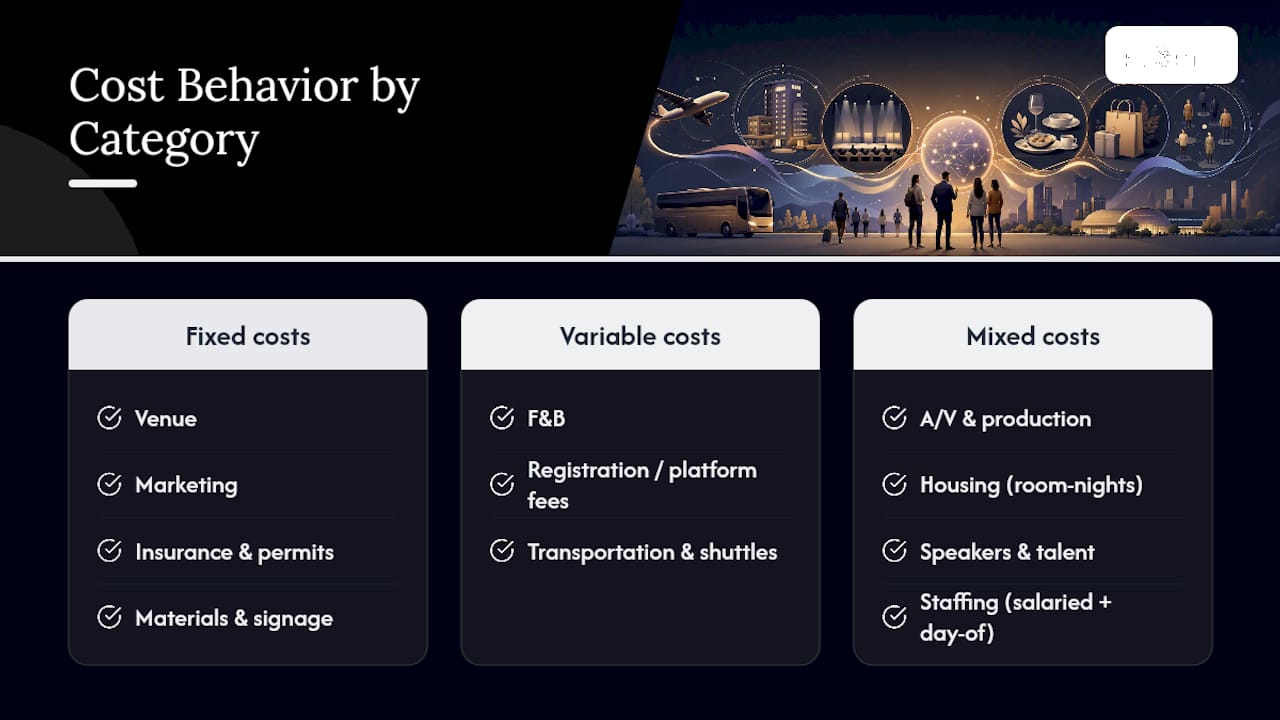
A conference budget is built from line items, and each one behaves differently as your headcount changes. Some costs are fixed no matter how many people show up. Others scale directly with every registration you sell. Knowing the difference is what separates a budget that survives contact with reality from one that blows up in month three.
Venue is usually fixed, tied to square footage and date, though some contracts add per-person food minimums. F&B is almost entirely variable and scales with headcount. A/V and production sits in between, a fixed production base plus variable rental days. Housing scales with room-nights booked, but attrition clauses can turn part of it fixed if you under-deliver on your room block. Speakers and talent range from flat fees to travel-plus-honorarium arrangements. Staffing includes both salaried planning time and variable day-of labor. Marketing is largely fixed, set by your channel mix. Transportation and shuttles scale with attendee count and venue distance. Materials and signage are mostly fixed print runs. Registration and platform fees are variable, often a percentage plus a flat charge per ticket. Insurance and permits are fixed. Contingency rounds out the list.
For estimating, pull three vendor quotes per major category before you lock anything. Ticketing platforms like Eventbrite, for instance, charge organizers roughly 3.7% plus $1.79 per paid ticket on top of payment processing, a variable cost planners frequently forget to model until the invoice lands. The IASA appendix is a useful cross-check if you want a line-item format to build from, since it lists notional unit costs across publications, dinners, and printing.
How Much Does the Average Conference Cost Per Attendee?
Managed U.S. conferences average $1.62 million in total spend for an event of 606 attendees, which works out to roughly $2,731 per attendee. That per-attendee figure is the number that actually travels across event sizes. A flat total budget tells you almost nothing about whether a 150-person event and a 1,500-person event are being run efficiently. Cost per head does.
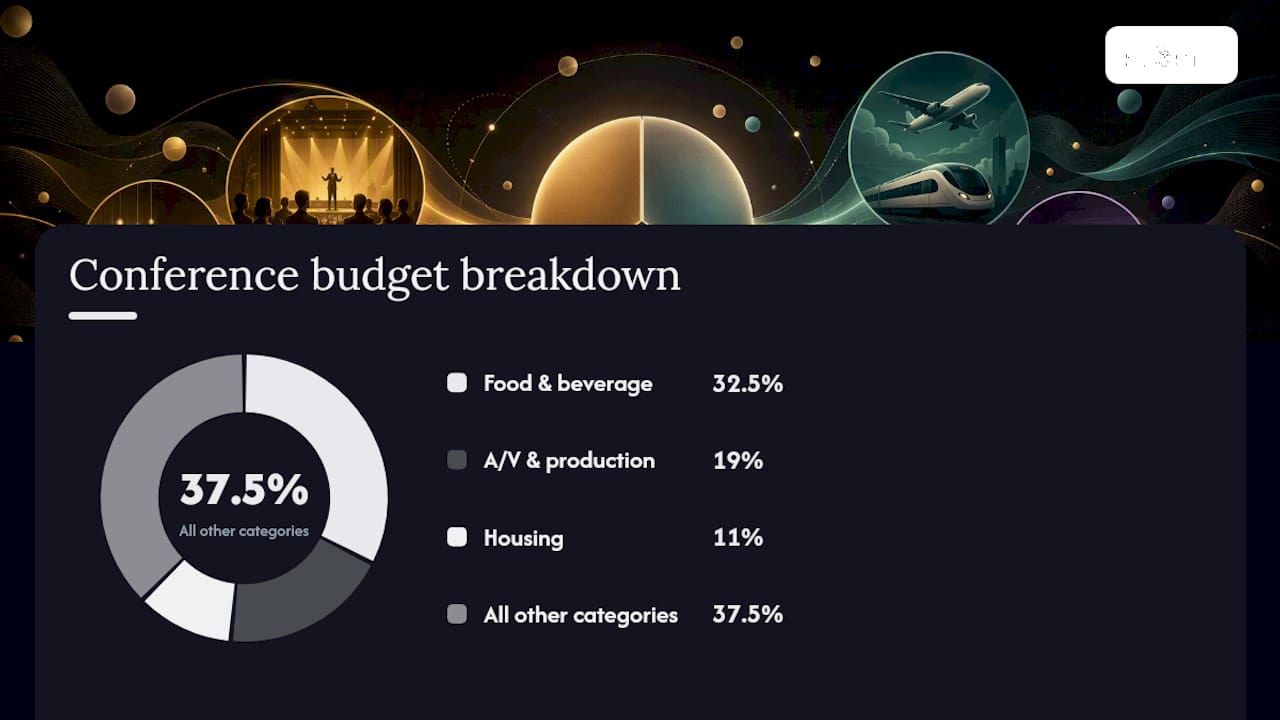
Category weighting tends to follow a consistent pattern regardless of scale. Everything else, venue, staffing, marketing, speakers, materials, and contingency, splits the remainder.
| Category | % of budget | $/attendee (at $2,731 avg.) |
|---|---|---|
| Food & beverage | 32.5% | ~$888 |
| A/V & production | 19% | ~$519 |
| Housing | 11% | ~$300 |
| All other categories combined | 37.5% | ~$1,024 |
These three categories alone eat nearly two thirds of a typical conference budget, before you’ve paid a single speaker fee or printed a badge.
Fixed costs stay flat as headcount grows, so per-attendee cost for those categories drops as your event scales up. Variable costs like catering and shuttles climb in lockstep with every additional badge you print.
How Do You Build Sample Budgets for Different Conference Sizes?
Scaling a budget is mostly arithmetic once you know your per-attendee benchmark and which lines are fixed. Here’s how three conferences of different sizes might break down, using the category percentages above as a guide.
- Small (about 100 attendees): Total typically ranges in the low hundreds of thousands. Venue and A/V eat a disproportionate share since fixed costs can’t spread across many badges; food and beverage typically account for a significant portion, as does A/V.
- Mid (several hundred attendees): Total budget generally falls in the mid six figures. Per-attendee cost drops as fixed venue and staffing costs spread further; food and beverage and housing capture meaningful shares.
- Large (1,000 attendees): Total approaching $1.5 million to $2 million, tracking close to the $2,731 per-attendee average. F&B alone can exceed $450,000.
To adapt a template to your own event:
- Replace the per-attendee unit rates with quotes from your own vendors, not industry averages.
- Flag each row as fixed or variable so your spreadsheet auto-adjusts totals when headcount changes.
- Keep separate estimate, actual, and variance columns, a format Exordo’s template uses well, so drift shows up early.
- Model sponsorship and exhibitor revenue as an offset column, not a reduction to your expense lines, so you can see gross cost before net cost.
How Do You Create a Conference Budget Step by Step?
Building the budget is a sequence, not a single spreadsheet session. Skip a step and you’ll find the gap during vendor negotiations, which is the worst possible time.
- Set your goals and scope first. Attendee count, event length, and program complexity all drive every line item downstream.
- Choose per-attendee as your planning unit and build every category estimate around it, even the fixed ones, so you can compare scenarios fast.
- List every line item and classify it fixed or variable, then assign an owner to each so accountability doesn’t get lost in a shared document.
- Collect at least three quotes per major category, model a low, expected, and high range for each, and build in contingency now rather than after contracts are signed.
- Track actuals against estimates continuously, not just at the end, and run a mid-planning forecast once 60% of your vendor contracts are locked.
- Reconcile fully after the event, comparing final actuals to your original estimate line by line to sharpen next year’s benchmarks.
IEEE’s guidance is worth following on one point specifically: get your budget approved before you sign a single vendor contract. A budget built after commitments are made isn’t a budget, it’s a rationalization.
Pro Tip: Build your contingency into the estimate column from day one, not as an afterthought bolted onto the total. A contingency line that’s visible throughout planning gets protected; one added at the end gets cut when someone needs to hit a number.
How Much Contingency Should a Conference Budget Include?
Contingency isn’t a flat percentage spread evenly across every line. It should concentrate where cost pressure actually shows up: food and beverage, labor, and A/V, the same three categories that dominate total spend.
- Weight contingency more heavily toward F&B and A/V than toward fixed costs like signage or insurance, since those are the categories most exposed to last-minute headcount changes and vendor price hikes.
- Negotiate deposit and cancellation terms into every major contract before signing, particularly for venue and catering, where penalties can be steep.
- Carry event cancellation and liability insurance as a fixed line rather than treating it as optional.
- Stress-test F&B and labor lines against a 2.5% to 3% cost inflation assumption, since those categories are the most sensitive to vendor pricing shifts year over year.
What Do Experienced Producers Do Differently on Conference Budgets?
Vendor relationships change your cost structure more than any spreadsheet trick. A production team running dozens of events a year has already negotiated rates, tested crews, and built trust with venues, which typically shows up as lower contingency needs and faster procurement timelines than a first-time planner working cold.
- Established vendor networks reduce the padding you’d otherwise need for unknown-quality suppliers.
- Custom fabrication and experiential build costs should get modeled separately from standard A/V, they carry their own labor, materials, and lead-time math.
- Decide outsource versus in-house on three axes: cost per hour of staff time, timeline risk if something goes wrong, and whether the output needs specialized craft (staging, custom builds) versus commodity execution (basic signage).
Pro Tip: If a line item requires specialized fabrication or a skill your internal team doesn’t have on staff, price the in-house option honestly, including the learning curve, before assuming it’s cheaper than a vendor quote.
When Does It Make Sense to Bring In a Production Partner?
Complexity is the real signal. A straightforward 100-person meeting rarely needs outside help, but once your budget starts carrying custom fabrication, multi-day AV, or real brand risk if execution slips, the math on hiring a partner usually flips in their favor. Scale amplifies every small budgeting error, and that’s exactly where experienced production teams earn their fee.
— Tyler
Get a Second Set of Eyes on Your Conference Budget
Running the numbers yourself gets you most of the way there, but a managed production partner changes what’s possible with the same total spend. An experienced production partner can handle conference and live event production end to end, stage design, A/V, run-of-show, vendor sourcing, and staffing, through a vendor network built over years of activations for leading brands. Such a vendor network offers leverage by reducing unknowns, tightening quotes, and lowering the padding needed in your contingency line.

A budget review with King Sixteen starts with your draft numbers and your goals, not a blank slate. We walk through your category breakdown, flag where your estimates are out of line with current vendor pricing, and show you where a bundled vendor relationship could free up budget for the experiential elements that actually make an event memorable. If your conference is carrying custom builds, multi-day production, or a headcount north of 500, request a scoping call and get a real second opinion on where your money is going before you sign a single contract.
Sources
Figures and templates above draw from GoGather’s 2026 cost breakdown, InEvent’s budgeting guide, and Exordo’s downloadable budget template.
- How Much Does Hosting a Conference Really Cost in 2026? Complete breakdown
- Appendix 2: Example of conference budget
- Building a Budget
- Conference Budget Template: Free Excel Download (2026)
FAQ
What Is the 70-10-10-10 Budget Rule?
There’s no single standardized “70-10-10-10” framework specific to conference budgeting; definitions vary by source. A more reliable planning approach for conferences is per-attendee benchmarking combined with category percentages, such as the roughly 32.5% F&B, 19% A/V, and 11% housing split found in industry benchmarking.
What Is the Average Budget for a Conference Event?
Managed U.S. conferences average $1.62 million total for roughly 606 attendees, about $2,731 per attendee. Smaller events scale down proportionally, with fixed costs like venue and staffing making up a larger share of the per-attendee total.
What Are the 7 Categories of a Conference Budget?
Most conference budgets group costs into venue, food and beverage, A/V and production, staffing, speakers and talent, marketing, and housing and transport, with insurance, materials, and contingency often tracked as additional lines depending on event complexity.
What Is the 50/30/20 Rule for Business?
The 50/30/20 rule is a personal finance framework for splitting income between needs, wants, and savings; it doesn’t map directly onto conference budgeting, where costs are project-based rather than recurring income allocations. Planners are better served by the per-attendee and category-percentage benchmarks used throughout this guide.
Should I Use a Template or Build My Conference Budget From Scratch?
A template saves time and reduces missed line items, especially one with separate estimate, actual, and variance columns like Exordo’s format. Start from a template, then customize the fixed versus variable flags to match your specific vendor contracts.
Recommended
- Conference Fabrication Services: A Planner’s Guide
- Keynote Speaker Fees: Real Ranges and Budgeting Tips for 2026
- Event Logistics Checklist for Planners: Timeline + Templates
- Conference Event Management: Strategies for Maximum Impact