A room block contract is a written agreement between a group and a hotel that reserves a set number of guest rooms at a negotiated rate for specific dates, and the single detail that determines your financial exposure is whether that block is courtesy or contracted. Courtesy blocks release unbooked rooms at the cut-off date with no penalty to you. Contracted, guaranteed blocks make you financially responsible for any shortfall. Most weddings lean courtesy; larger conferences and multi-night group events often end up contracted.
TL;DR:
- Many contracts allow pickup to fall to 70% to 80% before penalties apply; confirm how cancellations, early departures, and resale credits reduce liability.
- Require a duty to mitigate clause so the hotel must document resale efforts before charging for rooms your guests did not book.
- Book once your venue and date are confirmed, ideally nine to twelve months ahead for weddings; peak season destination events may need earlier commitments.
- Review force majeure, deposits, cancellation terms, room substitutions, and rate formulas; complex agreements covering multiple nights or hotels warrant attorney review.
- Cutoff dates often fall 30 to 90 days before the event, and planners commonly reserve 5% to 10% of estimated room revenue for attrition.
Table of Contents
- Types of Room Blocks: Courtesy, Contracted, and Negotiated Rates
- Key Contract Terms Planners Must Check
- Attrition: How Fees Get Calculated and What to Expect
- Negotiation Checklist: Levers That Lower Your Risk
- Timeline and Costs: When to Lock In Your Block
- Contract Clause Checklist: A Red-Line Starter for Planners
- How a Turnkey Partner Handles Room Block Risk
- Reduce Your Room Block Risk With King Sixteen
- FAQ
- Sources
Types of Room Blocks: Courtesy, Contracted, and Negotiated Rates
A courtesy or release block holds rooms at a group rate until the cut-off date, after which the hotel simply releases whatever hasn’t been booked. There’s no liability on your end, which is why most wedding room blocks fall into this category. The tradeoff is that hotels offer thinner discounts and less flexibility on room types for courtesy arrangements.
A contracted or guaranteed block works differently. The hotel commits a firm inventory and rate, but you’re on the hook for attrition if pickup falls short. Hotels generally ask for guaranteed blocks when the group is large, the dates overlap peak demand, or the event spans multiple nights.
A few other variants come up often:
- Negotiated group rates: a lower per-night rate tied to a minimum pickup commitment rather than a hard room count.
- Split blocks: rooms divided across two or more hotels, useful for destination weddings where one property can’t absorb the full guest list.
- Rack-rate carve-outs: a block priced at a fixed discount off the hotel’s standard rate rather than a flat number, which protects you if rack rates rise.
A local Saturday wedding usually calls for a small courtesy block. A destination wedding spanning three or four nights, with welcome dinners and brunch, often needs a contracted block simply because the hotel wants certainty on revenue.
Key Contract Terms Planners Must Check
Before signing anything, read the clauses that actually determine your risk, not just the room count and rate.
- Room block size and type mix: how many king, queen, and suite rooms are reserved, and whether substitutions are allowed.
- Rate guarantee: whether your group rate is fixed or tied to a formula.
- Cut-off date: the day unbooked rooms revert to the hotel’s general inventory.
- Attrition clause: the formula used to calculate penalties for pickup shortfalls.
- Deposit and cancellation terms: what’s due, when, and what’s refundable.
- No-show credit: whether cancellations and early departures reduce your attrition liability.
Force majeure language deserves close attention. According to Venable LLP’s hotel contract guidance, vague force majeure wording is a common source of disputes when weather, travel disruptions, or venue issues arise. Indemnity clauses matter too: ask whether the hotel’s insurance requirements extend to your vendors, and review event insurance options before you sign anything that shifts liability onto your event.
Wording changes meaning. “The hotel will make rooms available for reservation” is not the same as “the group guarantees pickup of X rooms.” The second phrase creates financial liability; the first doesn’t.
Pro Tip: Highlight every instance of “guarantee,” “warrant,” or “shall” in your draft contract. These words typically signal a binding obligation, not a courtesy arrangement.
Attrition: How Fees Get Calculated and What to Expect
Attrition is the gap between the rooms you contracted for and the rooms your guests actually booked. Industry guidance from Venable’s contract analysis notes that contracts commonly allow a shortfall down to 70% to 80% of the blocked rooms before penalties kick in, and fees can be reduced by credits for no-shows, cancellations, and early departures.
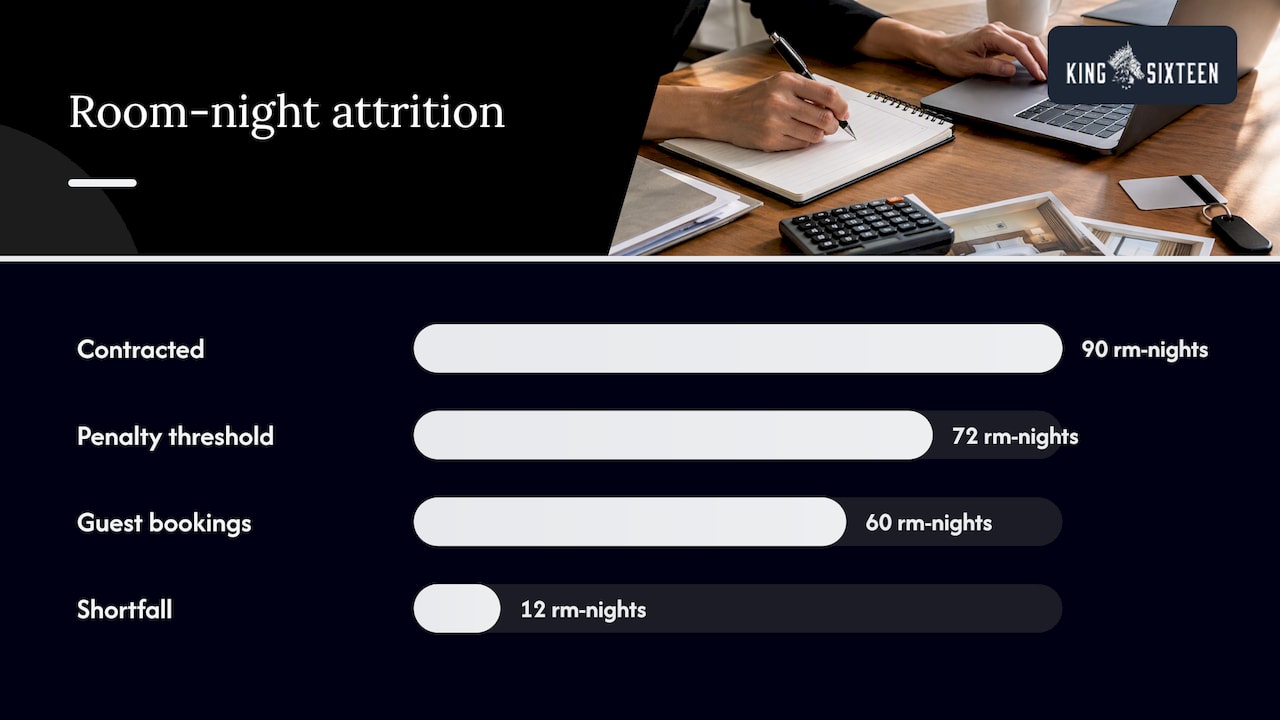
Contracts commonly allow pickup as low as a large majority of the blocked rooms before fees apply, according to Venable’s guidance on hotel contracts, which means a modest shortfall usually costs you nothing.
A simplified example, using illustrative numbers only:
- Say you contract 30 rooms per night for three nights, 90 room-nights total.
- Say the hotel’s allowable shortfall is 80%, meaning you need to pick up 72 room-nights to avoid fees.
- Say your guests book only 60 room-nights, a shortfall of 12 room-nights below the 72-night threshold.
- The hotel charges attrition on those 12 room-nights at the contracted rate, minus any resale or no-show credits it recovers.
Push for a duty-to-mitigate clause that requires the hotel to prove it tried reselling the released rooms before charging you full price.
Negotiation Checklist: Levers That Lower Your Risk
Hotels expect negotiation, and a few specific asks move the needle more than others.
- Request a lower attrition percentage or a wider allowable shortfall window.
- Ask for an extended cut-off date, especially for weddings where RSVPs trickle in late.
- Negotiate a reduced deposit or a payment schedule tied to milestones instead of a lump sum.
- Request F&B minimums in exchange for better room terms, since hotels often value banquet revenue more than room revenue.
- Push for a reverse cancellation clause that lets you cancel without penalty if the hotel fails to deliver promised services.
Package your asks. Offering a guaranteed welcome reception or a minimum catering spend gives the hotel something to trade against a lower attrition rate. Three sample lines worth sending to hotel sales: “Can we move the cut-off to 14 days out given our guest list timeline?” “Would a $5,000 F&B minimum support a reduction in our attrition percentage?” “Can we add a mutual cancellation clause tied to force majeure events?”
Pro Tip: If a hotel won’t budge on attrition terms, ask for proof-of-mitigation language instead. It’s often an easier concession to win and still protects your budget.
When the back-and-forth gets technical, or you’re managing multiple proposals at once, that’s usually the point to bring in project management tools for event planners that help streamline contract negotiations and proposal tracking.
Timeline and Costs: When to Lock In Your Block
Book your room block as soon as your venue and date are confirmed, ideally nine to twelve months out for weddings and even earlier for peak-season destination events. Waiting too long limits your negotiating leverage and your room selection.
- Cut-off dates typically fall 30 to 90 days before the event, depending on hotel policy and season.
- Deposits are often due at signing, with a second payment tied to the cut-off date.
- Final attrition charges, if any, are usually invoiced after the event based on actual pickup.
- Set aside a budget contingency, commonly 5% to 10% of your room revenue estimate, to cover potential attrition exposure.
Building that contingency into your event budget early prevents a surprise invoice from derailing other spending categories, something worth mapping out alongside your broader event logistics checklist.
Contract Clause Checklist: A Red-Line Starter for Planners
Before you sign, run your draft against this list and flag anything missing or vague:
- Group name, event dates, and billing contact information.
- Room count, room type mix, and any substitution rights.
- Rate guarantee formula, including how future-year rates are capped.
- Cut-off date and what happens to unsold rooms after it.
- Attrition formula, including allowable shortfall and credit deductions.
- Deposit schedule, cancellation terms, and refund conditions.
- Force majeure language covering weather, travel disruption, and venue closures.
- Indemnification and insurance requirements, including ADA compliance obligations for accessible rooms and meeting space.
Complex, multi-night, multi-hotel agreements usually warrant attorney review or a production partner who handles these terms regularly.
How a Turnkey Partner Handles Room Block Risk
When we manage venue sourcing for a client, room block negotiation is part of the job, not an afterthought. We track pickup against cut-off dates, flag attrition exposure before it becomes a bill, and negotiate the formulas that protect our clients’ budgets. For a wedding or corporate event with multiple hotels, overlapping vendor contracts, and tight timelines, having one team own that coordination removes a layer of risk most planners don’t have bandwidth to manage alone.
Reduce Your Room Block Risk With King Sixteen
Negotiating attrition formulas and chasing hotel sales teams for better cut-off terms takes time most planners don’t have, especially when venue sourcing, catering, and staffing all need attention at once. Our turnkey event production model handles that coordination as one package: venue sourcing, contract negotiation, and pickup tracking run through a single accountable team instead of across scattered vendors.

That means fewer surprise invoices and one point of contact instead of five. If you’re planning a wedding or corporate event with room blocks at stake, reach out through our services page to request a proposal.
- We handle venue sourcing and room block negotiation as part of event production.
- We track pickup and attrition exposure throughout the planning timeline.
- We coordinate vendors, staffing, and logistics alongside the hotel contract.
FAQ
Do I pay for a hotel room block?
You only pay for a room block if it’s contracted or guaranteed and your group falls short of the agreed pickup threshold. Courtesy blocks carry no financial obligation since unbooked rooms simply release at the cut-off date.
Is a hotel reservation a contract?
A single hotel reservation is a basic booking agreement, but a room block arrangement for a group is a separate, more detailed contract covering room counts, rates, deadlines, and attrition terms. The room block contract is what creates financial obligations beyond an individual guest’s reservation.
What are management contracts in hotels?
Management contracts are agreements between a hotel owner and an operating company that runs the property, which is a different arrangement entirely from the room block contracts planners sign for group events. If you’re booking rooms for a wedding or conference, you’re dealing with a room block agreement, not a management contract.
What does a courtesy block mean?
A courtesy block, also called a release block, holds a set number of rooms for your group at a negotiated rate until a specific cut-off date. After that date, any unbooked rooms return to the hotel’s general inventory with no penalty owed by the group.