Send segmented follow-up promptly within a few days, with one primary call to action and a named owner for every high-priority contact. Hot leads get a personal note quickly; general attendees get a recap and short survey shortly after; no-shows get a direct nudge pointing them to what they missed. The single most important step is assigning ownership before the event ends, not after.
TL;DR:
- Follow-up within 72 hours is essential, with hot contacts receiving personal outreach from a named owner within 24 hours of the event.
- Segment attendees into hot, warm, and no-shows to tailor messaging, ensuring each group receives relevant content and specific calls to action.
- Measure success through both process metrics like contact coverage and reply rates, and outcome metrics such as opportunities sourced and conversion rates at 90 and 270 days.
- Prioritize building templates, tagging structures, and routing rules before the event to ensure fast, effective follow-up, rather than creating workflows post-event.
- Using a turnkey partner can streamline capture, tagging, and content delivery when internal bandwidth is limited, helping maintain quality within the critical 72-hour window.
Table of Contents
- What Should a Post Event Follow Up Sequence Look Like in the First 72 Hours?
- How Do You Segment Contacts and Hand Them Off to CRM Owners?
- What Metrics Actually Prove Your Follow-Up Worked?
- Which Post-Event Content Assets Should You Publish First?
- What Should Your Follow-Up Emails and Survey Questions Actually Say?
- King Sixteen’s Practitioner Checklist for Fast Follow-Up
- How Do You Handle Negative Feedback During Follow-Up?
- Do GDPR and Privacy Rules Apply to Your Follow-Up Emails?
- Author Perspective: Balancing Speed and Personalization
- An Honest Alternative: When to Bring in a Turnkey Partner
- Sources
- FAQ
What Should a Post Event Follow Up Sequence Look Like in the First 72 Hours?
The window between “great event” and “wasted event” is narrower than most teams think. Speed decides deals: in B2B contexts, the first company to present a relevant solution after an event often wins the business, which means your follow-up sequence isn’t a courtesy, it’s a competitive lever. Here’s the day-by-day breakdown your team should be running before the confetti even settles.
Day 0 (same day). Confirm actual attendance against your registration list and tag every record with the event name and edition. This provenance tag sounds small, but it’s what lets you attribute pipeline back to this specific event six months from now instead of a vague “conference leads” bucket.
Day 1. Relationship owners send personal outreach to hot contacts. Keep it to five sentences, reference the actual conversation you had, and end with one clear next step. Do not attach a deck, a survey, and a meeting request in the same email. Pick one.
Day 2 to 3. Send session highlights and recordings to full attendees along with a short survey (more on question design below). Simultaneously, send a “we missed you” message to no-shows that acknowledges their absence and points directly to the one session most relevant to why they registered in the first place.
Here’s the sequence in order:
- Confirm attendance and apply the event provenance tag to every contact record.
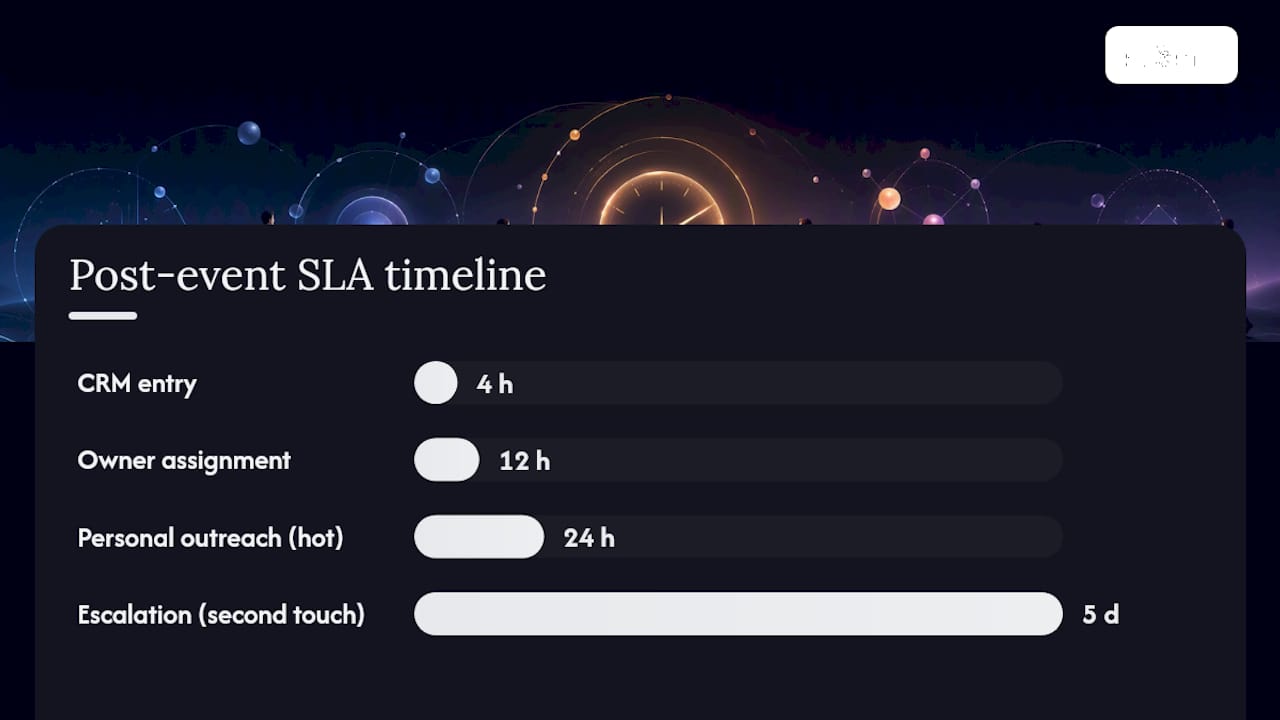
- Route hot contacts to their named owner for personal outreach within 24 hours.
- Send the attendee recap and survey by day two or three.
- Send the no-show recovery message with a direct link to relevant content.
- Escalate any unanswered hot-contact note with a second touch by day five.
Your checklist for making this actually happen:
- Write routing rules before the event, not during the post-event scramble.
- Assign a named owner to every segment, not just a department.
- Set a minimal service level agreement, such as CRM entry within four hours of session end and owner assignment within 12 hours.
- Pre-build templates so day-one outreach doesn’t wait on a copywriter.
- Confirm someone owns the no-show list specifically, since it’s the segment most often ignored.
Pro Tip: Build your CRM tagging structure and template library two weeks before the event, not two days. Teams that write sequences and routing rules in advance consistently hit the 72-hour window; late follow-up is almost always a symptom of building the workflow after the show floor closes.
How Do You Segment Contacts and Hand Them Off to CRM Owners?
Not every attendee deserves the same message, and treating them identically is one of the fastest ways to waste a good event. Separate contacts into those who had a meaningful conversation, those who attended without engaging directly, and registered no-shows, because each group needs a different proof point and a different call to action.
Your three core segments break down like this:
- Hot contacts (had a substantive conversation, showed clear buying intent): personal email from a named owner within 24 to 48 hours, one CTA, ideally proposing two specific meeting times.
- Warm contacts (attended sessions, engaged with content, no deep conversation yet): recap plus a lower-friction CTA like a resource download or a short survey.
- Registered no-shows: a brief, no-guilt message acknowledging they missed it, with a pointer to the single most relevant asset.
The handoff quality determines whether any of this works. Relationship owners need a compact context record, not a raw spreadsheet dump: event tag, attendance status, sessions visited, a conversation note, expressed interest, survey signals, the named owner, and one recommended next action with a due date. That’s the minimum viable record. Anything less forces the owner to reconstruct context from memory, and momentum dies in that reconstruction gap.
The AMA recommends grading leads on an A/B/C scale and activating that data in CRM and marketing automation immediately rather than letting it sit in a spreadsheet until the post-event debrief. Grading forces the prioritization conversation to happen once, at handoff, instead of every time someone opens the contact list.
One number worth sitting with: teams that treat event data as something to activate quickly, rather than archive, are the ones who actually convert it. Follow-up only becomes valuable when it’s captured consistently and pushed into CRM fast enough to trigger the right journey, which is a different discipline than simply collecting business cards.
Routing rules matter as much as the data itself. Set a hard rule that no contact receives two competing CTAs in the same week, and specify who breaks the tie when sales and marketing both want to own a hot lead. Our trade show lead capture guide walks through the handoff mechanics in more depth if you’re building this from scratch.
What Metrics Actually Prove Your Follow-Up Worked?
Opens and clicks tell you almost nothing about whether an event generated revenue. You need two categories of metrics working together: process KPIs that show whether your team executed, and outcome KPIs that show whether execution mattered commercially.
Process KPIs answer “did we do the work”:
- 72-hour coverage: the share of hot and warm contacts actually contacted within the window.
- First-email reply rate, segmented by hot versus warm versus no-show.
- Meetings booked as a percentage of hot contacts reached.
Outcome KPIs answer “did the work pay off”:
- Opportunities sourced and tagged back to the specific event.
- Pipeline value influenced by that event tag.
- Conversion to closed-won measured at day 90 and again at day 270, since enterprise sales cycles rarely close inside a single quarter.
The AMA frames this as measuring both process and outcomes together: process metrics tell you if your team ran the play, outcome metrics tell you if the play was worth running.
Here’s how the reporting cadence typically breaks down:
| Metric type | Metric | Measurement window |
|---|---|---|
| Process | 72-hour contact coverage | Days 1 to 3 |
| Process | First-email reply rate | Days 0 to 5 |
| Process | Meetings booked | Days 1 to 14 |
| Outcome | Opportunities sourced by event tag | Days 1 to 90 |
| Outcome | Pipeline influenced | Days 1 to 90 |
| Outcome | Closed-won conversion | Day 90 and day 270 |
For the actual tracking mechanics, attach UTM parameters to every link you send and use short links or QR codes to unify clicks and scans into one dataset. Without unified tracking, you end up with three disconnected numbers (email clicks, landing page visits, CRM notes) instead of one coherent picture of what drove action. Our event data guide and post-event reporting template both go deeper on building that unified report if you want a starting structure.
Which Post-Event Content Assets Should You Publish First?
Not all recap content deserves equal urgency. Prioritize by how fast the asset decays in relevance, and build in tracking from the start rather than bolting it on later.
Week 1 is for the recap page and highlight reel. Attach trackable short links or QR codes to both so you know exactly who engaged and can route that signal back to the owner. This is also when momentum is highest, so don’t sit on it.
Week 2 covers session recordings, slide decks, and speaker clips. These serve attendees who want depth and prospects who couldn’t attend live but are still warm enough to convert on the content alone.
Weeks 3 and 4 shift toward nurture content and community activation, things like a follow-up newsletter segment or an invitation to a smaller, related gathering.
Each asset should map to a specific CTA, not a generic “learn more”:
- Recap page → book a meeting with the relevant owner.
- Highlight reel → download the extended session library.
- Speaker clips → register interest in next year’s event.
- Nurture content → request a scoped conversation with sales.
Tag every asset with the same event provenance code you used in CRM, so a click on a week-three nurture email still attributes back to the original event when someone finally converts in month four. Our guide on engaging event attendees has more specifics on matching content format to audience behavior.
Pro Tip: Build the recap page and one QR-coded highlight asset before the event even starts. Waiting until the event ends to build your content shell adds two to three days of delay you can’t get back in a 72-hour window.
What Should Your Follow-Up Emails and Survey Questions Actually Say?
Templates save time, but generic templates read as generic, and generic follow-up gets ignored. Every message below should have personalization slots filled in with real, specific detail: the session they attended, the booth they stopped at, the exact thing they said.
1. Attendee thank-you template. Subject line references the event by name. Body: thank them, mention one specific session or moment if you have it, give one CTA (view the recap, download the deck), and close with a single line inviting reply if they want to talk further.
2. No-show template. Acknowledge they couldn’t make it, no guilt, no over-apologizing on their behalf. Offer the recording of the one session most tied to their stated interest at registration. One CTA: watch the recording.
3. Hot-lead personal note. Five sentences, maximum. Reference the actual conversation. State one clear next step. Propose two specific meeting times rather than asking “when works for you”, since open-ended scheduling questions are where replies go to die.
4. Non-responder nudge sequence. Two steps: a brief check-in at day five referencing the original note, then a final, low-pressure “still worth a conversation?” message at day 10 to 12. After that, move them into general nurture.
For surveys, resist the urge to ask ten questions about satisfaction. Short, focused surveys that route answers to specific owners generate more operational value than a generic Net Promoter Score. Aim for five to seven questions:
- Which session was most valuable to you?
- What’s the biggest challenge you’re facing related to [your topic]?
- Would you like a follow-up conversation with our team? (yes/no, routes directly to an owner)
- What would make next year’s event better?
- Are you evaluating a solution in this space in the next quarter?
Each answer should trigger something, not just populate a dashboard. A “yes” on question three should auto-create a task for the named owner, not sit in a spreadsheet until someone remembers to check it.
King Sixteen’s Practitioner Checklist for Fast Follow-Up
Enterprise events generate volume that overwhelms teams without a plan built in advance. King Sixteen’s production teams write sequences, routing rules, and owner assignments before the event opens, and CRM tags and templates get built into the run-of-show, not added afterward.
The real bottleneck isn’t creativity in the follow-up message. It’s capture discipline during the event itself. If your production team isn’t recording conversation notes, session attendance, and booth interactions in real time, your marketing team is reconstructing a story from memory three days later.
When capacity is genuinely limited, prioritize ruthlessly rather than spreading effort evenly:
- Give deep, personal follow-up to your top-tier contacts first, even if that means a smaller list gets the five-sentence treatment.
- Move everyone else into a targeted nurture stream with strong content rather than a thin, generic touch.
- Coordinate recording, photo, and conversation-note capture through a single production point of contact so nothing gets lost between vendors.
- Hand off compiled context to marketing and sales the same day the event ends, not the following week.
How Do You Handle Negative Feedback During Follow-Up?
Negative feedback in a post-event survey or reply is a gift you should never bury. Route it immediately to a named owner, not a general inbox, and respond within 24 hours whenever possible. Silence after a complaint reads as confirmation that the concern didn’t matter.
Acknowledge the specific issue before offering any fix. If a session ran late, the AV cut out, or a speaker’s content missed the mark, name it directly in your response rather than a generic “sorry you had a poor experience.” Specificity signals you actually read what they wrote instead of running an auto-reply.
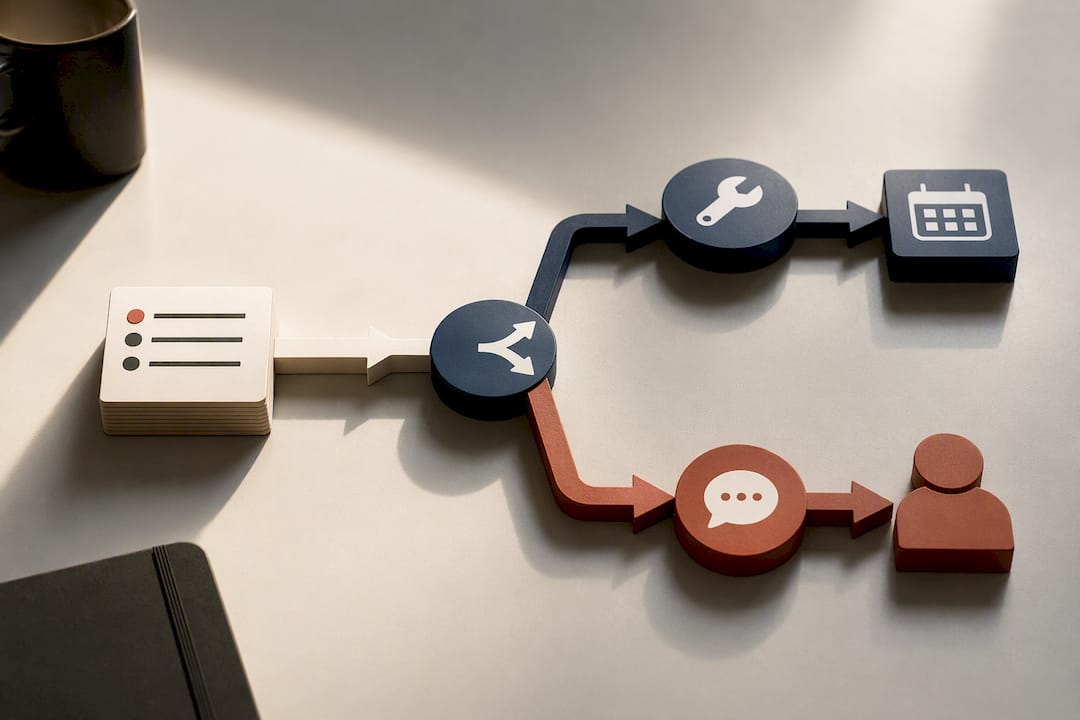
Separate operational complaints (bad WiFi, cramped seating, confusing signage) from relationship complaints (a bad sales interaction, a broken promise from a sponsor). Operational issues can usually be answered with a fix commitment for next time. Relationship issues need a human conversation, ideally a phone call, not another email.
Never argue with the feedback in writing, even when you think it’s unfair. Thank them, address what you can control, and if appropriate, offer a small gesture like early access to next year’s event or a complimentary upgrade. Track complaint volume and theme over time the same way you track positive KPIs. A recurring complaint across three events is a pattern worth fixing at the production level, not a one-off to smooth over.
Do GDPR and Privacy Rules Apply to Your Follow-Up Emails?
If any attendees are in the European Union or European Economic Area, GDPR governs how you can contact them after the event, regardless of where your company is based. Consent captured at registration must be specific enough to cover marketing follow-up, not just event logistics, and attendees need a clear, easy way to opt out of future communications.
For contacts outside the EU, similar principles apply under laws like the CAN-SPAM Act in the United States, which requires a working unsubscribe mechanism and accurate sender identification in every marketing email. The safest practice is to build your consent capture to the stricter standard regardless of where a specific attendee lives, since events routinely draw an international audience you may not fully anticipate at registration.
Practical steps worth building into your sequence: confirm your registration form captured explicit marketing consent, not just an event confirmation checkbox. Keep an accurate record of when and how each contact consented, since that record is your defense if a complaint is ever filed. Honor unsubscribe requests immediately and suppress that contact across every list, not just the one they unsubscribed from. If your event involved a sponsor or partner sharing contact lists, confirm the consent language covered that sharing explicitly before you send anything on the sponsor’s behalf.
Author Perspective: Balancing Speed and Personalization
The 72-hour window isn’t a best practice, it’s a competitive edge most teams squander through poor planning, not lack of effort. When staff is thin, protect personal attention for your hottest contacts and let strong nurture content carry the rest. Paste this sequence into your next event playbook and measure it.
— Tyler
An Honest Alternative: When to Bring in a Turnkey Partner
Everything above works if your team has the bandwidth to write sequences, tag CRM records, and produce recap content on a 72-hour clock while also running the next event on your calendar. Most marketing teams don’t have that bandwidth every quarter, and that’s exactly when follow-up quality quietly collapses.
A turnkey experiential and event production partner can coordinate capture, staffing, and post-event asset delivery under one point of accountability, streamlining the management of photos, recordings, and lead lists after the show ends. With production teams involved from proposal through execution, CRM tagging structures and content sequencing can be planned before the event, avoiding last-minute scrambling. If your next conference, product launch, or brand activation needs an execution partner who treats follow-up as part of production, not an afterthought, start with a scope call through King Sixteen to talk through your event calendar and where a single accountable partner would save your team the most time.
FAQ
What Is the Ideal Timing for Post Event Follow Up?
Send segmented follow-up within 24 to 72 hours of the event ending, with hot contacts hearing from a named owner on day one. Speed matters because the first company to present a relevant solution after an event often wins the deal.
How Should You Segment Attendees for Follow-Up?
Separate contacts into hot (had a real conversation), warm (attended but no deep engagement), and registered no-shows, since each group needs a different message and CTA. Hot contacts get personal outreach; warm contacts get recap content; no-shows get a brief, direct nudge toward relevant material.
What Metrics Prove a Post-Event Follow-Up Worked?
Track process metrics like 72-hour contact coverage and reply rate alongside outcome metrics like opportunities sourced and closed-won conversion at day 90 and day 270. The AMA recommends measuring both process and outcomes together to separate execution quality from commercial impact.
How Long Should a Hot-Lead Follow-Up Email Be?
Keep it to five sentences maximum, reference the actual conversation you had, and propose two specific meeting times rather than an open-ended scheduling question. Multi-CTA messages convert worse than a single, clear next step.
Can King Sixteen Handle Post-Event Follow-Up Execution?
King Sixteen coordinates capture, CRM tagging, and asset delivery as part of its turnkey event production model, giving marketing teams a single accountable partner instead of several disconnected vendors. Pricing depends on scope, and current details are available directly through King Sixteen.
Recommended
- Event Run of Show: 3 Templates Agencies Use and Planners Can Copy
- Event Logistics Checklist for Planners: Timeline + Templates
- Stage Backdrop Ideas That Turn a Launch Into an Event