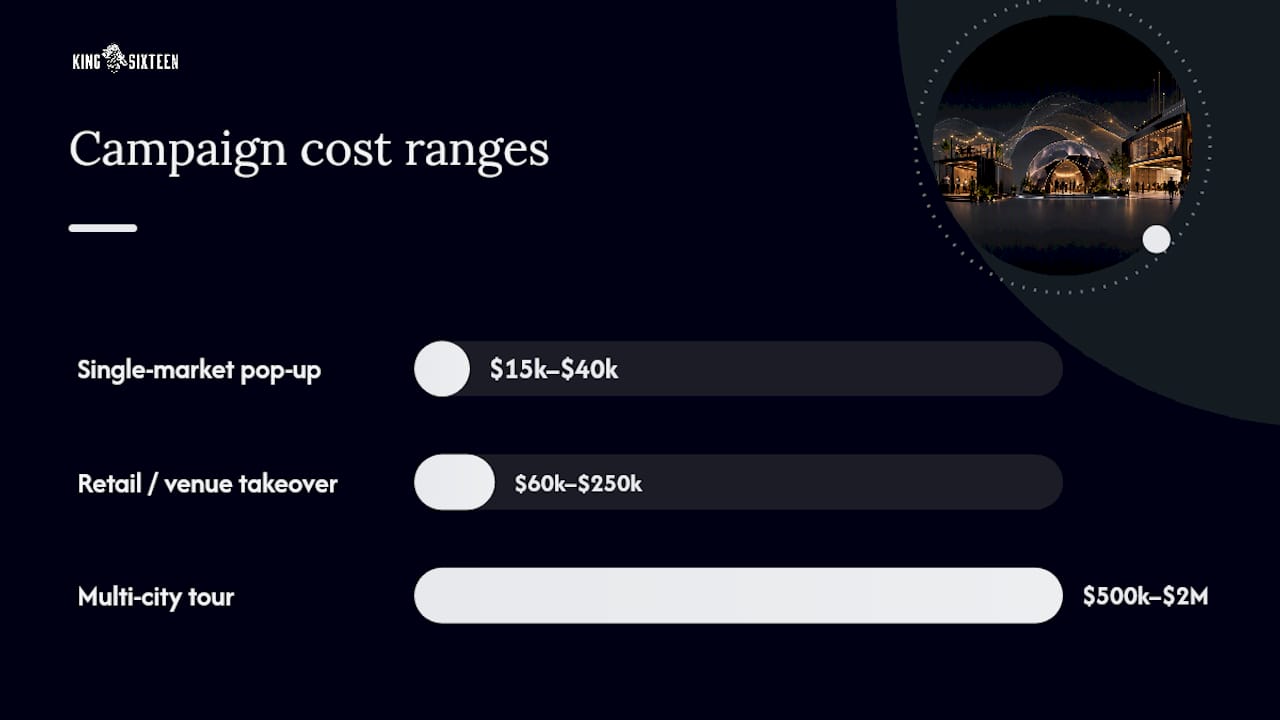
A single-market pop-up runs $15,000 to $40,000. A retail takeover lands between $60,000 and $250,000. A multi-city tour needs $500,000 to $2 million, and a flagship brand house starts at $1 million and climbs from there. The number that matters more than any of those bands is cost-per-meaningful-contact: what you spend divided by the people who actually engaged, not just walked past. Build a contingency into every one of these tiers before you present a number to finance.
TL;DR:
- A single-market pop-up costs between $15,000 and $40,000, typically resulting in $6 to $12 per meaningful contact depending on engagement levels.
- Custom fabrication and high-end AV significantly inflate budgets, especially for flagship brand houses and multi-city tours, where costs can reach into the millions.
- Contingency planning of 15% to 25% is essential across all tiers to account for scope creep, logistics, and unforeseen expenses.
- Vendor quotes should clearly separate labor, materials, and markup to avoid hidden costs, especially when managing multiple vendors or complex activation components.
- ROI from experiential campaigns depends on pairing contacts with a tracked conversion path, targeting a minimum 5% conversion rate to justify spending levels.
Table of Contents
- How Much Does Experiential Marketing Cost by Campaign Tier?
- What Are the Real Line-Item Costs Behind an Activation?
- What Do Sample Experiential Marketing Budgets Look Like?
- What Drives Experiential Marketing Costs Up or Down?
- How Do You Finalize an Experiential Marketing Budget?
- What ROI Should You Expect From Experiential Marketing?
- When Is a Turnkey Agency Worth the Fee?
- The Budgeting Mistakes That Actually Cost You
- Get a Scoped Estimate for Your Next Activation
- Sources
- FAQ
How Much Does Experiential Marketing Cost by Campaign Tier?
Budget conversations usually start with ambition, not arithmetic. A brand director pictures a flagship activation and only later discovers the number attached to that vision. Working backward from proven tiers saves that awkward moment in front of the CFO.
A single-market pop-up typically costs $15,000 to $40,000. That buys a modest footprint, usually one weekend or one week, a simple build, minimal staffing, and a narrow geographic footprint. It’s the right tier for testing a mechanic or launching in one city before scaling.
A retail or venue takeover climbs to $60,000 to $250,000, according to CMO Mag’s cost breakdown. This tier adds custom fixtures, a longer run, dedicated brand ambassadors, and often a negotiated venue fee that eats a bigger share of the budget than most first-time planners expect.
A multi-city tour runs $500,000 to $2 million. The jump isn’t just multiplication. Freight, driver logistics, repeated setup and teardown labor, and regional staffing all compound the base cost of a single stop.
A flagship brand house starts at $1 million and has no real ceiling. Long lead times, custom fabrication amortized across a multi-week or multi-month run, and premium real estate push these into seven figures fast.
Here’s how those tiers translate into meaningful contacts:
- A $30,000 pop-up drawing 3,000 genuine engagements costs roughly $10 per meaningful contact.
- A $150,000 takeover generating 10,000 engagements lands near $15 per contact, often justified by higher-value interactions like product trials.
- A $1.2 million tour reaching 80,000 people across five cities averages $15 per contact, assuming the mechanic actually drives participation rather than passive foot traffic.
Those numbers only mean something if you define “meaningful contact” before the campaign starts, not after the invoices arrive.
What Are the Real Line-Item Costs Behind an Activation?
Every experiential marketing cost estimate breaks down into the same handful of categories, whether the total is $20,000 or $2 million. Knowing the national benchmarks for each one lets you interrogate a vendor quote instead of accepting it on faith.
Venue and location rental averages roughly $22,630 per day nationally, according to EventMarketer’s cost benchmarking report, though prime retail corridors and event-season dates push well past that. A parking lot activation in a secondary market might run a fraction of that; a flagship space during a major trade show weekend can exceed it several times over.
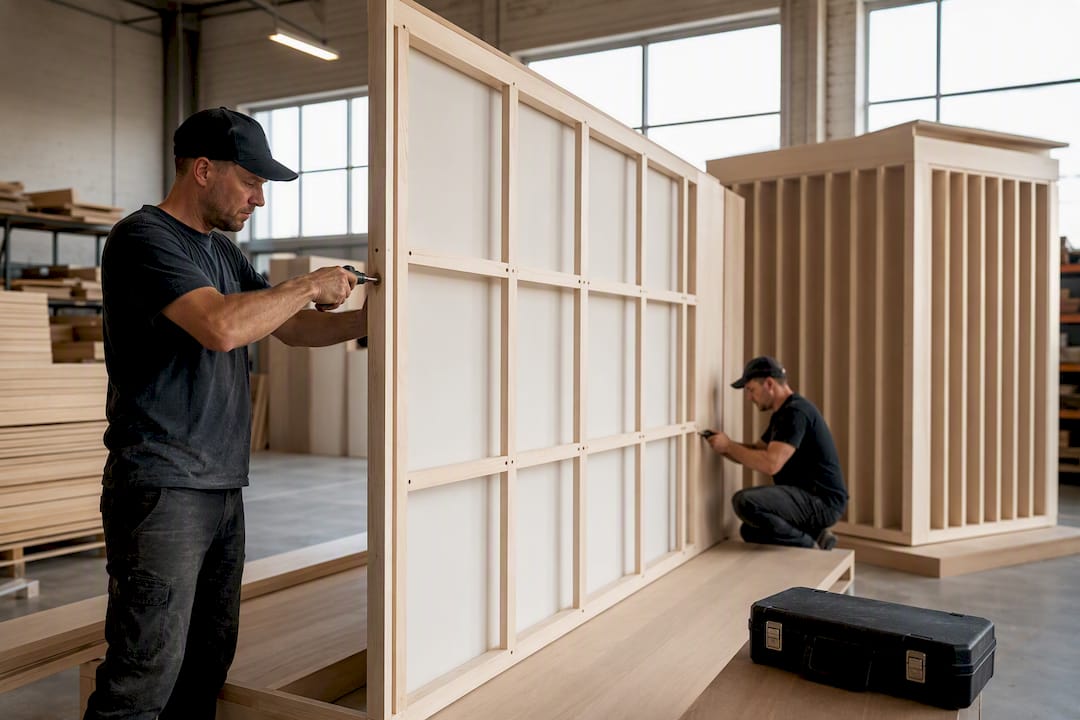
Design and fabrication splits into two paths. Modular rental systems keep costs predictable and reusable across markets. Custom builds cost more up front but create a distinct look competitors can’t replicate, which matters more for a flagship launch than a regional test.
Audio-visual shows the widest spread of any category. A basic package might run a few thousand dollars; a mid-tier AV package averages around $99,445, and a high-end, tech-heavy build averages $231,715, with the ceiling reaching into the millions for immersive projection and interactive walls. AV is where budgets quietly balloon.
Staffing and brand ambassadors carry hourly benchmarks from roughly $26 for entry-level talent to $53 or more for high-experience ambassadors who can run a demo, capture data, and represent the brand under pressure. Our own breakdown of brand ambassador rates covers how experience level and market size shift that number further.
Talent and influencer fees vary by reach, not just follower count. A useful rough rule ties fee to projected engagement rather than audience size alone, a distinction covered well in this influencer marketing breakdown.
Registration and kiosk technology, including digital check-in tools like EntryWatch, typically runs a few hundred dollars per unit for rental up to several thousand for a purchased, branded setup. Lead-capture accuracy at this stage directly feeds your ROI math later.
Logistics, freight, and storage get underestimated constantly.
Food and beverage ranges widely by service style. A seated banquet averages about $96.67 per person, while a buffet setting averages closer to $63.30 per person.
Insurance and permits vary by city and venue, so confirm local fee schedules early. Nothing derails a launch date faster than a permit office that closes applications two weeks before your event.
What Do Sample Experiential Marketing Budgets Look Like?
Templates make abstract benchmarks usable. Here’s how each tier breaks down in practice, with rough meaningful-contact math attached.
- Single-market pop-up ($15,000 to $40,000): Venue for one weekend ($3,000 to $8,000), modular fixtures ($4,000 to $10,000), two to four brand ambassadors for three days ($2,500 to $5,000), basic AV ($1,500 to $4,000), F&B or sampling ($2,000 to $6,000), permits and insurance ($500 to $1,500), and 15% contingency. At 2,500 to 4,000 engagements, cost-per-meaningful-contact lands near $6 to $12.
- Retail or venue takeover ($60,000 to $250,000): Venue fee ($10,000 to $40,000), custom fabrication ($20,000 to $80,000), mid-tier AV ($15,000 to $40,000), five to ten staff for a two-week run ($15,000 to $30,000), F&B ($5,000 to $15,000), and 20% contingency. Expect 8,000 to 15,000 engagements, putting cost-per-meaningful-contact around $12 to $20.
- Multi-city tour ($500,000 to $2 million): Five to eight market stops, custom trailer or modular build reused across cities ($150,000 to $400,000), freight and travel ($80,000 to $200,000), staffing scaled per city ($100,000 to $250,000), AV ($75,000 to $200,000), and 20% to 25% contingency given the moving-parts risk. Cost-per-meaningful-contact typically settles between $10 and $18 at scale.
- Flagship brand house ($1 million-plus): Long-lead custom build amortized over a multi-week run, premium venue, full-time staffing roster, high-end AV, and a data-capture infrastructure that feeds post-event nurture campaigns. Contingency should sit at 20% or higher given the longer timeline and greater exposure to scope creep.
What Drives Experiential Marketing Costs Up or Down?
Scale, run length, and location are the three biggest multipliers on any experiential marketing budget. A one-day activation in a secondary market costs a fraction of the same concept run for three weeks in a top-ten media market, and location alone can swing venue and labor costs by double digits.
Custom fabrication versus modular rental is the next major fork. Build custom when the brand needs a signature look for a flagship moment or a multi-year platform; lean on modular systems when speed and repeatability matter more than originality.
AV and production choices create the steepest cost curve in the entire budget. Moving from a basic screen-and-sound setup to an immersive, sensor-driven experience can multiply that single line item several times over, which is exactly what EventMarketer’s 2026 trend coverage flags as the biggest pressure point on budgets this year.
Labor rules deserve their own line of scrutiny. When a venue requires union labor, hourly estimates need to account for overtime and labor burden, not just a flat rate multiplied by hours, or the final invoice will run well past the original quote.
Ways to cut cost without cutting impact:
- Partner with a complementary brand to split venue and staffing costs.
- Reuse fabrication assets across multiple markets instead of building new for each stop.
- Source local vendors for F&B and staffing instead of shipping talent city to city.
- Negotiate multi-day venue rates instead of paying daily rates for a weeklong run.
Pro Tip: Ask every vendor quote to separate labor, materials, and markup into three visible lines. A vendor who resists that breakdown is usually hiding margin in the materials number.
How Do You Finalize an Experiential Marketing Budget?
A working budget needs sign-off from more than marketing. Legal, procurement, and finance all touch different pieces of the number before a contract goes out.
- Clarify the objective first. Awareness, lead generation, and sales activation carry different cost profiles, and a mismatched objective wastes spend on the wrong line items.
- Choose the campaign tier that matches that objective and confirm it against the ranges above.
- Walk through every line item category and flag anything the vendor quote is missing, especially logistics and storage.
- Confirm vendor allocation and payment terms, including deposit schedules and cancellation clauses.
- Set contingency at 15% to 25% of total spend, leaning toward the higher end for multi-city or first-time activations where scope creep is likely.
- Route the final number through legal for contract review, procurement for vendor terms, and finance for cash flow timing before locking the budget.
Agency fees and soft costs like insurance riders, travel per diems, and post-event storage often hide outside the headline number. Ask for those explicitly before you sign anything.
What ROI Should You Expect From Experiential Marketing?
Cost-per-meaningful-contact only earns its keep as a metric if you pair it with a real conversion path. Track that path with holdout comparisons, unique promo codes, brief post-event surveys, and dedicated tracked URLs tied to each activation stop.
Here’s a conservative worked example: a $150,000 takeover generates 10,000 meaningful contacts at $15 each. If even 5% convert to a $200 average order, that’s 500 conversions worth $100,000 in trackable revenue, plus whatever lifetime value follows. That single campaign doesn’t fully pay for itself on direct sales alone, but it rarely needs to when brand lift and data capture are factored in.
Marketers are increasingly shifting budget toward mechanics that demand real participation rather than a photo backdrop, because participation-driven activations correlate with stronger measured ROI than passive brand exposure.
Finance cares about trackable downstream revenue and conversion rate. Impressions and social mentions are useful color, but they rarely survive a budget defense meeting on their own. Our deeper walkthrough on understanding experiential ROI covers the measurement framework in more detail.
When Is a Turnkey Agency Worth the Fee?
A turnkey partner bundles venue sourcing, fabrication, AV, staffing, catering, and logistics under one contract instead of ten. That consolidation removes the procurement overhead of managing separate vendor relationships, each with its own payment terms and failure points.
Hire an agency when the activation spans multiple cities, involves custom fabrication, or carries a brand profile where execution mistakes are visible and costly. Manage vendors in-house only when the footprint is small, local, and low-risk.
When evaluating an agency proposal, check for scope clarity, transparency about which vendors are subcontracted versus owned, and clear KPI alignment with your stated objective. Some agencies have built activations for brands including Porsche, Audi, Ray-Ban, and Churchill Downs, where the margin for execution error was effectively zero.
The Budgeting Mistakes That Actually Cost You
The blind spot I see most often isn’t the headline number. It’s the mechanic itself getting shortchanged after fabrication and AV eat the lion’s share of budget, which guts the exact interaction meant to drive conversion. Close behind that: teardown, storage, and follow-up data analysis get treated as afterthoughts instead of line items.
If you want a sample template scoped to your specific activation type, that’s a conversation worth having before the RFP goes out.
— Tyler
Get a Scoped Estimate for Your Next Activation
King Sixteen is the alternative to juggling ten separate vendor contracts for one activation. Instead of sourcing a venue, hiring a fabrication shop, booking AV separately, and staffing brand ambassadors through three different agencies, you get one contract, one point of accountability, and pricing shaped by a vendor network built over years of running high-stakes launches.
That turnkey model covers design, fabrication, staffing, AV, catering, venues, and digital integration under a single scope, which is exactly the consolidation the budgeting checklist above recommends when complexity or brand profile raises the stakes. If your activation involves multiple cities, custom builds, or a launch where there’s no room for a vendor to drop the ball, that’s the moment to bring in a partner instead of managing it in-house.
Start by requesting a scoped estimate for your experiential program, and come with your objective, target tier, and rough timeline. That’s enough for a real number, not a placeholder range.
Sources
- EventMarketer cost benchmarking report (2019 data summary PDF)
- Experiential Marketing Guide 2026: Costs & ROI · CMO Mag
FAQ
What Is the 70/20/10 Rule for Marketing Budgets?
The 70/20/10 rule allocates 70% of marketing spend to proven tactics, 20% to emerging channels, and 10% to experimental ideas, a general guideline some brands adapt when deciding how much of their overall budget goes toward experiential programs.
Does Experiential Marketing Pay Well as a Career?
Roles in experiential marketing, from field marketing managers to activation producers, tend to pay competitively relative to broader marketing, especially at agencies managing complex, multi-city programs where production and logistics expertise commands a premium.
What Exactly Is Experiential Marketing?
Experiential marketing is the practice of creating immersive, in-person brand experiences, such as pop-ups, activations, and product launches, designed to generate direct engagement and measurable participation rather than passive ad exposure.
Is Experiential Marketing on the Rise?
Yes. Industry trend reporting for 2026 shows continued growth in experiential spend, with rising investment specifically in custom fabrication and tech-heavy activations as brands shift budget toward mechanics that drive real participation.
Recommended
- Experiential marketing strategies for high-end brands
- Experiential marketing that elevates luxury brand engagement
- Brand moments: Why experiential marketing outperforms ads
- Understanding Experiential ROI: A 2026 Guide for Marketers