Expect to pay brand ambassadors between $14 and $35 per hour, with a US median around $21 to $22 hourly depending on the source. Monthly retainer programs typically run $200 to $1,500 for nano-tier ambassadors, $800 to $5,000 for micro-tier talent, and $3,000 to $15,000 or more for mid-tier and above. Experience, market size, and exclusivity terms swing these numbers fast.
TL;DR:
- Hourly rates for brand ambassadors in the US typically range from $14 to $35, with a median around $21 to $22, depending on experience and location.
- Retainer programs vary widely, from $200 to $1,500 monthly for nano-tier, up to $15,000 or more for mid-tier and above, based on exclusivity and deliverables.
- Pricing depends heavily on experience, location, scope, usage rights, and urgency, with premiums of 20% to 40% often added for exclusivity and content rights.
- Contract costs are often inflated by overlooked clauses like deliverable counts, usage windows, cancellation fees, and performance bonuses, which must be clarified upfront.
- Agency-managed staffing typically costs 15% to 35% more than direct hire due to added coordination, contingency planning, and quality control expenses.
Table of Contents
- What Are Typical Brand Ambassador Rates in the US Right Now?
- How Hourly, Salary, Per-Event, and Retainer Pricing Differ
- What Actually Drives a Quote Up or Down
- How to Calculate a Fair Offer and Negotiate It
- Contract Terms That Change the Real Price
- A Worked Example: Three Months, Two Appearances
- Why Agency-Managed Staffing Costs More and Reduces Risk
- How Long Do Ambassador Programs Typically Run?
- How Do Rates Compare Outside the US?
- Digital Ambassadors vs. In-Person Brand Reps
- Does Industry Change What Ambassadors Charge?
- What Bonuses and Incentives Get Layered On Top
- Where Rate Negotiations Go Wrong
- An Event Lead’s Take on Budgeting for Ambassadors
- How King Sixteen Handles Ambassador Staffing and Production
- Sources
What Are Typical Brand Ambassador Rates in the US Right Now?
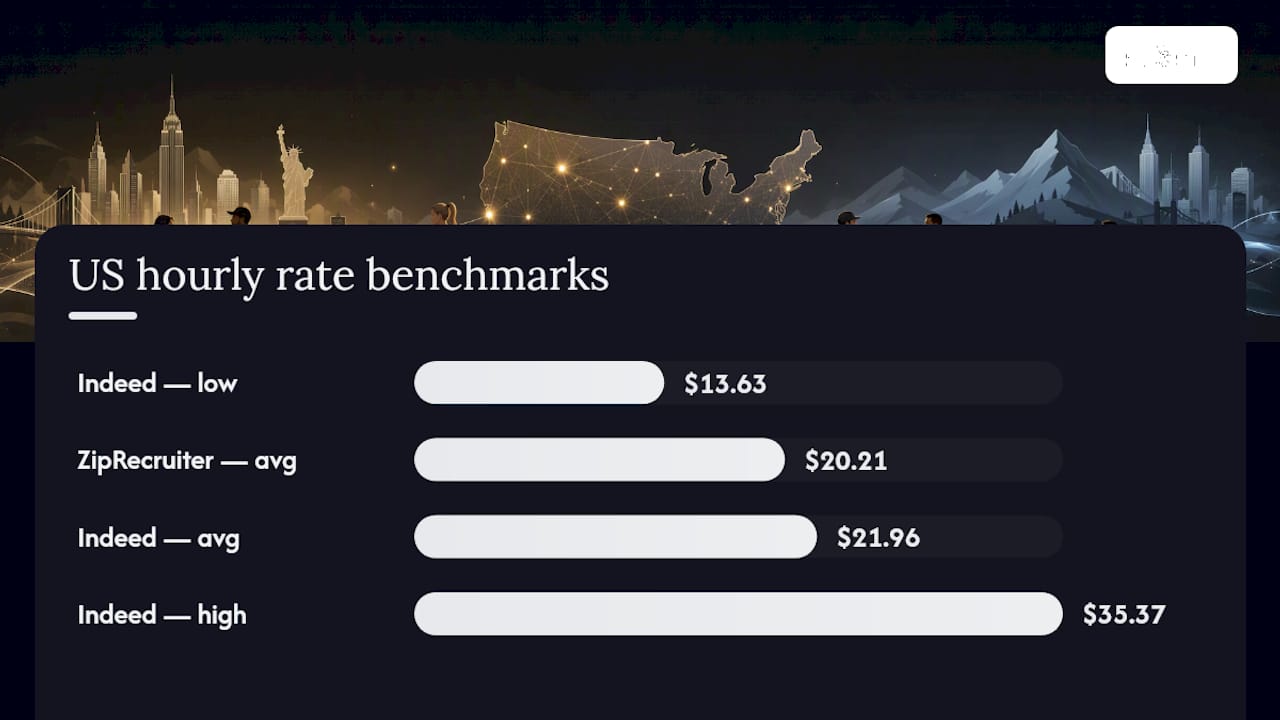
The numbers move depending on who is counting, and that spread matters when you build a budget. Indeed’s salary data puts the average brand ambassador hourly pay at $21.96, with a low around $13.63 for entry-level or short-shift work and a high near $35.37 for experienced hires in competitive markets. ZipRecruiter’s figures land close by, at $20.21 an hour on average, translating to a median annual salary near $42,047 for people in full-time ambassador roles.
Salary.com tells a different story once you shift from hourly gig work to salaried, career-track positions. Its data shows a median annual base near $58,810, which works out to roughly $28 an hour, with the 25th percentile at $52,215 and the 90th percentile reaching $71,023. That gap between aggregators isn’t a data error. It reflects two different labor markets wearing the same job title.
Retainer-based ambassador programs follow a separate pricing logic entirely. Nano-tier ambassadors typically run $200 to $1,500 per month, micro-tier climbs to $800 to $5,000, and mid-tier partnerships land between $3,000 and $15,000 monthly before exclusivity or usage premiums.
How Hourly, Salary, Per-Event, and Retainer Pricing Differ
The pricing model you choose should match the shape of your campaign, not the other way around. Picking retainer pricing for a two-day trade show, or hourly staffing for a year-long ambassador relationship, is how budgets get blown.
- Hourly or temp staffing fits short activations, retail sampling, and trade show floors. Expect $14 to $28 an hour depending on skill level, with rates trending toward the higher end for product knowledge or bilingual staff.
- Salaried or full-time ambassadors make sense when a brand needs consistent on-site presence across many months. Base pay tends to track the Salary.com annual figures, roughly $52,000 to $71,000, plus benefits.
- Per-event or appearance fees vary widely based on the ambassador’s following, the event’s visibility, and travel demands. A single appearance can run anywhere from a few hundred dollars for a local influencer to several thousand for someone with a genuine following and media reach.
- Monthly retainers cover ongoing content, appearances, or brand advocacy. According to InfluencerFee’s pricing guide, these bands scale from $200 for nano-tier creators up past $25,000 for mega-tier partners, and they usually bundle a set number of deliverables rather than open-ended hours.
Match the model to the deliverable. A retainer that pays for four Instagram posts a month is a completely different financial commitment than one that pays for weekly in-store appearances.
What Actually Drives a Quote Up or Down
Two ambassadors with the same follower count or the same years of experience can quote wildly different numbers. The difference usually comes down to five levers.
- Experience and specialized skills. An ambassador who can run live product demos, speak knowledgeably about technical specs, or hold a food handler certification commands a premium over someone doing basic sampling.
- Location. Ambassadors in New York, Los Angeles, or Miami routinely charge more than talent in smaller metros, partly because cost of living is higher and partly because competitive events keep local demand elevated.
- Scope. Multi-day events, travel requirements, and any request for produced content (not just live appearances) all add cost layers that a simple hourly quote won’t capture.
- Usage rights and exclusivity. Asking an ambassador to sit out competitor deals for a defined period, or to hand over full usage rights to their content, typically adds 20% to 40% for exclusivity and 15% to 30% for usage rights on top of the base fee.
- Urgency and seasonality. Booking a week before a launch, or trying to staff during the holiday retail rush, pushes rates up simply because supply tightens.
Pro Tip: Ask every candidate to break out their base fee separately from exclusivity and usage add ons. Bundled quotes make it nearly impossible to negotiate individual line items later.
How to Calculate a Fair Offer and Negotiate It
Start with a formula instead of a guess. For hourly staffing, multiply the base market rate by a multiplier for skill and location, then add a flat travel or prep fee if relevant. A basic version looks like this: base hourly rate ($20) × skill multiplier (1.2 for demo experience) + $50 prep fee = your target hourly offer.
For retainer conversions, take the ambassador’s typical one-off appearance or post rate, multiply by the number of deliverables you want monthly, then layer on the exclusivity premium if you need it.
- Set your anchor first. Open negotiations with a number based on the Indeed or ZipRecruiter hourly average for your market tier, not the top of the range.
- Trade deliverables for fee, not the reverse. If an ambassador wants more money, ask for an additional social post or a longer appearance window instead of just raising the number.
- Price exclusivity separately. Never fold an exclusivity request into the base fee. Quote it as its own line item so both sides can see what it costs.
- Build a one-page justification. Finance and stakeholders respond to a short breakdown: base rate, market comparison, scope adjustments, and the specific business reason for any premium.
Reference recent experiential ROI benchmarks when justifying spend internally. A rate that looks high in isolation often looks reasonable next to the value it’s driving.
Contract Terms That Change the Real Price
The rate on a quote sheet rarely matches what you actually pay once a contract is signed. These clauses are where the real cost lives.
- Deliverable counts and revisions. Specify exact numbers, not “a few posts,” and cap free revisions before extra charges kick in.
- Usage rights. Define which platforms, and for how long, the brand can reuse content. Broader usage windows justify the 15% to 30% premium mentioned earlier.
- Exclusivity scope. Name the competing categories, not just competitor brands by name, and set a clear time window.
- Payment schedule and cancellation terms. A 50% deposit with net-30 on the balance is standard; cancellation fees protect both sides if an event gets scraped.
- Travel, per diem, and insurance. Build these into the contract explicitly rather than assuming they’re covered by the base fee.
- Performance bonuses. Tie any bonus structure to measurable KPIs you can pull from post-event reporting, not vague engagement goals.
A Worked Example: Three Months, Two Appearances
Assume a mid-tier ambassador at $3,000 a month, a two-event, three-month retainer with light exclusivity.
- Base retainer: $3,000/month × 3 months = $9,000.
- Appearance fees: $1,200 per event × 2 events = $2,400.
- Travel and per diem: $600 for one out-of-market event.
- Exclusivity premium: 25% of the base retainer = $2,250.
- Usage rights (social reposting, 90 days): 20% of base retainer = $1,800.
Total campaign cost: $16,050, or roughly $5,350 a month. That’s the number to bring into a budget meeting, not the $3,000 sticker price on the retainer alone.
Why Agency-Managed Staffing Costs More and Reduces Risk
Direct-hire ambassador rates look cheaper on paper until something goes wrong on-site. Turnkey staffing through an agency adds coordination, quality control, and a backup plan if an ambassador cancels last minute, none of which shows up in a simple hourly quote.
Agency budgets typically build in 15% to 35% above direct-staff pay rates to cover vendor coordination time, contingency staffing, equipment handling, and on-site management hours. That premium buys something specific: a single point of accountability instead of a patchwork of individually contracted talent.
Some agencies scope staffing the same way they scope full production, with contingency built in before the contract is signed, not after a no-show. For programs where the ambassador is one piece of a larger activation, the coordination overhead usually pays for itself the first time a vendor issue gets solved before the client even hears about it.
How Long Do Ambassador Programs Typically Run?
Most ambassador relationships aren’t one-off transactions. Shopify’s pricing guidance frames a genuine ambassador partnership as a 3 to 12 month commitment, built around a fixed monthly retainer and a steady content cadence, usually two to four posts a month.
Shorter commitments, anything under three months, tend to behave more like extended campaign contracts than true ambassador relationships. Brands use these for product launches or seasonal pushes where the goal is a concentrated burst of visibility rather than sustained advocacy. The pricing usually reflects that: expect to pay closer to the appearance-fee end of the scale even if you’re calling it a retainer.
Programs that stretch past six months start behaving differently. Ambassadors who stay on that long typically renegotiate, either asking for a rate increase tied to renewed exclusivity, or asking to reduce deliverables while keeping the same fee once the relationship becomes more brand-integrated than transactional. Building a renewal checkpoint into the original contract, say, at the four-month mark, avoids an awkward renegotiation happening mid-campaign when you have the least leverage.
Retail and campus ambassador programs run on a different clock entirely. University-based programs, like UDC’s Pepsi student ambassador initiative, often follow the academic calendar, structuring pay as semester-long stipends rather than open-ended monthly retainers. If your program touches campus or retail environments, budget in academic terms, not standard fiscal quarters.
The practical takeaway: match your contract length to what you actually need. A three-month test run with a renewal option protects you better than a twelve-month commitment signed before you know if the ambassador and the brand are a real fit.
How Do Rates Compare Outside the US?
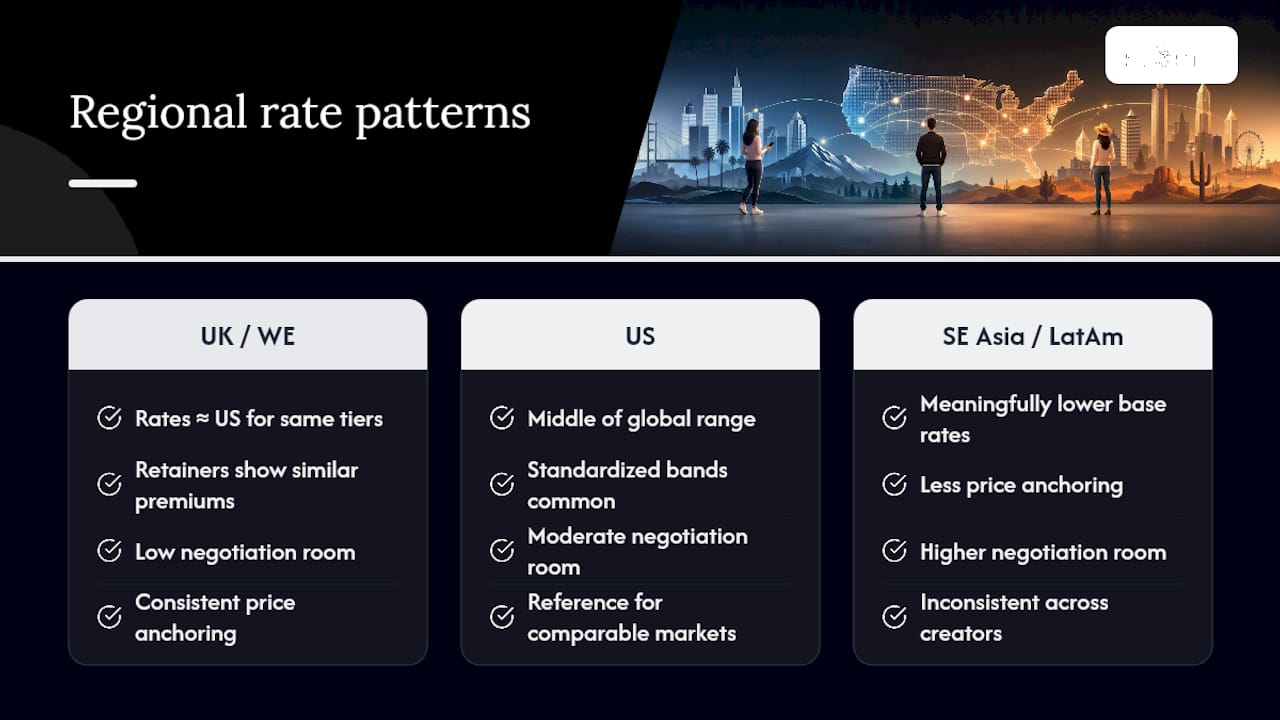
US rates sit in the middle of the global range, not at the top. Ambassador and influencer pricing in the UK and Western Europe tends to track close to US numbers for comparable follower tiers and deliverables, with retainer bands showing similar percentage premiums for exclusivity and usage rights.
Markets in parts of Southeast Asia and Latin America often show meaningfully lower base rates for comparable follower counts, a fact that matters if your brand runs global ambassador programs and tries to apply one flat rate card across regions. A micro-tier ambassador quote that looks reasonable by US standards can be well above local market rate elsewhere, which creates friction with regional teams who know the local pricing reality better than headquarters does.
Currency and cost-of-living differences explain part of the gap, but platform maturity plays a role too. Markets where influencer marketing arrived more recently tend to have less price anchoring, so rates vary more from creator to creator even at similar follower counts. That means more negotiation room, but also more inconsistency if you’re trying to standardize a rate card.
For US-based marketing teams running domestic-only programs, the practical impact is limited. But for teams managing a global ambassador roster, the lesson is to build region-specific rate bands rather than exporting the US numbers wholesale. A rate that clears internal approval as “fair” in New York can either overpay or underpay talent elsewhere, and either mistake creates a problem: overpaying strains budget across a large roster, and underpaying damages the brand’s reputation with creators in that market.
Digital Ambassadors vs. In-Person Brand Reps
Social media and in-person roles get lumped under the same “brand ambassador” label, but they price differently because the deliverable is fundamentally different.
Digital or social ambassadors are compensated primarily for content and reach, following Hootsuite’s engagement-based pricing model, where engagement rate often matters more than raw follower count. A creator with 15,000 highly engaged followers can command a higher retainer than one with 50,000 passive followers, because the brand is paying for attention that converts, not just impressions. CollabKit’s platform benchmarks show meaningful rate differences across Instagram, TikTok, and YouTube even at the same follower tier, which matters when you’re converting a one-off post rate into a monthly retainer.
In-person brand reps are compensated for time, physical presence, and often specialized skills like product demonstration or technical knowledge. Their pricing tracks much closer to the hourly benchmarks from Indeed and ZipRecruiter, because the deliverable is measured in hours worked, not posts published or impressions generated.
The hybrid role, an ambassador who does both social content and in-person appearances, usually commands a premium over either role alone. That premium reflects the coordination cost of managing two different deliverable types under one contract, not just the sum of two separate rate cards.
Does Industry Change What Ambassadors Charge?
Yes, and the gap between industries can be wide enough to blow a budget built on generic benchmarks. Tech and consumer electronics brands often pay a premium for ambassadors who can speak credibly about product specs and answer technical questions on the spot, pushing rates toward the higher end of the Salary.com percentile bands.
Fashion and beauty sit at the more competitive end of the market. High visual demand and a large pool of aspiring talent keep entry-level rates lower, but the ceiling for ambassadors with genuine style credibility or a strong personal following climbs fast, often outpacing rates in less visually driven categories.
Food and beverage activations, sampling events, product launches, tastings, tend to run closer to the hourly staffing benchmarks rather than retainer pricing, because the deliverable is usually a single event or a short campaign window rather than an ongoing partnership. Automotive and luxury goods brands, by contrast, often pay premium rates specifically because the sales cycle is longer and the brand needs an ambassador who can hold sustained credibility across months, not just show up for one launch weekend.
The practical lesson: don’t import a rate card from one industry into another without adjusting for how that industry actually structures its deliverables. A food and beverage sampling rate applied to a luxury product launch will undershoot badly, and a tech-industry retainer applied to a one-day tasting event will overshoot just as badly.
What Bonuses and Incentives Get Layered On Top
Base pay is rarely the full story once performance incentives enter a contract. Commission structures tied to trackable sales, unique promo codes, affiliate links, are increasingly common for ambassadors with any e-commerce tie-in, typically running a percentage of attributed revenue on top of the base fee or retainer.
Content performance bonuses reward an ambassador when a specific post or video clears an engagement threshold, structured as a flat bonus rather than a percentage. This works well for brands that want upside without renegotiating the base retainer every time a piece of content overperforms.
Renewal bonuses show up in longer programs, a flat payment or rate bump offered when an ambassador re-signs for another term, functioning as a retention tool more than a performance reward. Referral incentives are common too. Ambassadors who bring in other qualified talent for a program sometimes receive a flat finder’s fee, which can be cheaper than sourcing new talent through a formal casting process.
The catch with any incentive structure is measurement. A bonus tied to an ambiguous metric, “brand awareness” without a defined benchmark, creates disputes at payout time. Structure every incentive around a number both sides can verify independently, ideally pulled from the same reporting source you’re already using to track the campaign.
Where Rate Negotiations Go Wrong
The most expensive mistakes rarely show up in the base rate. They show up in what wasn’t specified.
Vague scope is the biggest offender. A quote for “social content” without a defined post count, platform list, or content type leaves room for both sides to disagree later about what was actually promised. Get specifics in writing before a number gets discussed.
Bundled exclusivity is another common trap. When an ambassador’s quote includes exclusivity without a separate line item, brands frequently overpay because they can’t see what they’re actually buying. Unbundle it every time.
Ignoring usage rights until after content is delivered creates real risk. If a brand wants to run an ambassador’s content in paid ads, that’s a different (and typically pricier) usage right than organic social reposting, and negotiating it after delivery gives the ambassador all the leverage.
Anchoring on follower count instead of engagement is a costly habit. As noted in Hootsuite’s pricing framework, high engagement at a lower follower tier often delivers better campaign results than a large, passive following, and paying purely on follower count wastes budget.
Finally, watch for rate inconsistency across a roster. If five ambassadors on the same program are quoting wildly different rates for similar deliverables, that’s usually a sign the scope wasn’t communicated the same way to everyone, not that the talent pool has that much genuine variance.
An Event Lead’s Take on Budgeting for Ambassadors
The mistake teams make most often isn’t underpaying. It’s failing to separate the base rate from the add ons before a number ever reaches a spreadsheet. A $2,000 quote with hidden exclusivity and usage fees is not cheaper than a transparent $2,800 quote. It just looks cheaper until the invoice arrives.
The second mistake is treating every ambassador program like a one-off hire instead of a relationship with a real onboarding cost. And the third is skipping a written scope document because the conversation “felt” aligned. It rarely is.
Before signing anything, run through a short checklist: deliverable count, usage window, exclusivity terms, payment schedule, cancellation clause. If your team can’t answer all five without checking a group chat, you’re not ready to sign. If your program is complex enough that this checklist feels thin, that’s usually the signal to bring in a staffing estimate from a team that scopes this for a living.
— Tyler
How King Sixteen Handles Ambassador Staffing and Production
King Sixteen exists for brands that would rather hand off the staffing puzzle entirely than manage five separate ambassador contracts, a travel budget, and a last-minute cancellation on their own.
Where a direct hire leaves you managing exclusivity clauses, usage rights, and a no-show contingency plan by yourself, King Sixteen bundles ambassador staffing into full experiential production, pairing talent sourcing with vendor management, AV, and on-site logistics under one accountable team. That means one contract, one point of contact, and a contingency plan already built before the first ambassador ever shows up on-site.
If your program is straightforward, a single ambassador, a defined scope, a short timeline, direct hiring works fine. But once you’re staffing multiple markets, coordinating a product launch around ambassador appearances, or blending talent with a larger activation, the coordination overhead an agency absorbs is worth more than the premium it costs. Reach out through King Sixteen’s site to get a staffing and production estimate scoped for your specific program.
Sources
Hourly and salary figures came from Indeed, ZipRecruiter, and Salary.com. Retainer bands and exclusivity premiums came from InfluencerFee’s pricing guide, with additional context from Hootsuite’s influencer pricing primer and Babylovegrowth’s ROI analysis.
This article is general information, not a substitute for advice from a qualified financial advisor. Consult a qualified financial professional about your own circumstances before acting on anything here.
- Brand ambassador salary in United States — Indeed
- Brand Ambassador Salary — ZipRecruiter
- Salary
- Brand ambassador rates — InfluencerFee
Recommended
- Keynote Speaker Fees: Real Ranges and Budgeting Tips for 2026
- Catering Cost per Person: What Event Planners Should Budget
- Event staffing process: A step-by-step guide for brand impact
- Brand Event Trends 2026: What Marketers Need to Know