If your show uses Class 3B or Class 4 lasers in US public spaces, you need an approved FDA variance before production begins. You also need to follow ANSI and ILDA safety practices, notify the FAA when beams travel outdoors, and appoint a Laser Safety Officer who keeps a complete show binder on site. Skip any one of these and you are not running a legal show, you are running a liability…
TL;DR:
- A laser light show using Class 3B or 4 lasers requires an FDA variance, approved before production begins, in addition to FAA notification for outdoor beams.
- Safety must be controlled through engineering measures like beam stops and interlocks, with crossing safety standards such as ANSI Z136 and OSHA guidance.
- The Nominal Hazard Zone and Maximum Permissible Exposure levels determine audience restrictions and barrier placements during planning.
- An empowered Laser Safety Officer must oversee all safety procedures and maintain a detailed show binder with approvals, logs, and diagrams.
- Filing deadlines for FDA variance and FAA outdoor laser permits call for early scheduling, and thorough incident records are essential for post-incident reviews.
Table of Contents
- What US regulations govern laser light shows
- Understanding laser classes, MPE, and NHZ
- Building engineering and administrative controls that work
- Who signs off: LSO duties, operator training, and your show binder
- Filing with the FAA for outdoor laser operations
- Your pre-show checklist and planning timeline
- Responding to a laser incident and preserving records
- Why safety planning has to start before the creative brief
- Running compliant laser shows without the compliance headache
- FAQ
- Sources
What US regulations govern laser light shows
The FDA treats laser light shows as electronic products subject to federal performance standards, and that means paperwork before a single beam fires. The agency’s guidance on laser light shows makes clear that anyone producing a display with Class 3B or Class 4 lasers must hold an approved variance, filed as Form 3147, before production starts. The variance process typically also requires Form 3640, the Laser Light Show Report, and Form 3632, the Laser Product Report, unless the manufacturer already has one on file with the FDA.
Production cannot legally begin until the FDA issues the variance approval letter. Manufacturers and dealers are not supposed to deliver projectors to a producer who lacks that approval, which is worth knowing if you are renting equipment and assume the vendor has already handled compliance. They have not; the variance belongs to the show, not the hardware.
For producers, the practical implications come down to timeline and evidence. Variance review takes time, and incomplete submissions, vague beam-path documentation, or missing safety control descriptions are common reasons for delay or denial. A few things to check well before your event date:
-
Confirm your state’s radiation control office does not require a separate registration or inspection, since several states layer their own requirements on top of federal rules.
-
Contact local permit offices early, especially for outdoor venues near public rights of way.
-
Build variance lead time into your production schedule rather than treating it as a formality.
Understanding laser classes, MPE, and NHZ
Most professional show lasers fall into Class 3B or Class 4, and the difference matters. Class 3B units can injure eyes with direct or specular beam exposure but generally will not ignite materials or burn skin on contact. Class 4 lasers can do all of that: eye injury, skin burns, and fire ignition, which is why they dominate large-venue productions and also demand the most rigorous controls.
Two concepts anchor every safety plan. Maximum Permissible Exposure (MPE) is the exposure level below which injury is not expected, and it’s a central concept in the ANSI Z136 series, the accepted US consensus standard for laser safety. The Nominal Hazard Zone (NHZ) is the physical space where exposure could exceed MPE, and mapping it during planning tells you exactly where barriers, beam stops, and audience restrictions need to go.
Non-beam hazards deserve equal attention:
- Fire risk from beam contact with fabric, scenic materials, or dry vegetation at outdoor venues.
- Fumes from fog or haze machines used to make beams visible, which can affect air quality in enclosed spaces.
- High-voltage components inside projector power supplies, a frequent cause of technician injury during setup.
OSHA references ANSI Z136 standards when evaluating laser installations, and its laser hazard guidance covers the same control measures producers need for Class 3B and 4 systems. OSHA does not issue a separate laser show permit, but its enforcement authority over workplace safety means these standards carry real weight on a job site.
Building engineering and administrative controls that work
Safety on show day comes down to controls you can test and document, not good intentions. Start with the physical layer, then layer procedure on top of it.
- Install beam stops or terminators at the end of every beam path so stray light never reaches an uncontrolled area.
- Use apertures and beam masks to shape output and keep the beam within its intended zone.
- Wire scan-fail interlocks so the system shuts down automatically if scanning mirrors stop moving, preventing a stationary beam from holding on one spot.
- Connect all projectors to a master stop circuit through interlock connectors, giving one person the ability to kill every beam at once.
Administrative controls fill the gaps hardware cannot cover. Written SOPs for setup and alignment, key-switch access limited to trained operators, restricted entry during alignment, and audible or visual warnings before activation all reduce the chance of someone wandering into a beam path at the wrong moment.
Protective eyewear has a role, but it is a backup, not a substitute for engineering controls. Eyewear must carry the correct optical density (OD) rating, matched to the specific wavelength in use, since the wrong OD or wavelength match offers no real protection and can create false confidence.
Monitoring approaches vary by show complexity. A trained operator or LSO watching the beam path continuously works for most productions, while large-scale or audience-scanning shows increasingly use electronic observers or automated shutoff systems as a second layer.
Pro Tip: Test your scan-fail interlock and master stop circuit during every rehearsal, not just at initial setup. A system failure caught in rehearsal costs you time. One caught mid-show costs you a lot more.
Who signs off: LSO duties, operator training, and your show binder
Every show needs one empowered Laser Safety Officer, and that person’s authority is not symbolic. Industry guidance on LSO responsibilities makes clear the LSO must be able to suspend or terminate a show immediately when safety protocols fail. Treat that authority as absolute during the event itself.
Typical LSO responsibilities include:
- Performing the Nominal Hazard Zone analysis and confirming beam heights meet approved limits.
- Approving SOPs and specifying any required protective eyewear for crew.
- Maintaining calibration and instrument logs throughout the production.
Operators carry their own obligations: continuous observation of the beam path, immediate shutdown on any unsafe condition, and alignment work restricted to personnel who have been specifically trained for it. Recognized LSO or laser-safety training courses are worth the investment, and larger operations sometimes include medical surveillance for staff who work near Class 4 systems regularly.
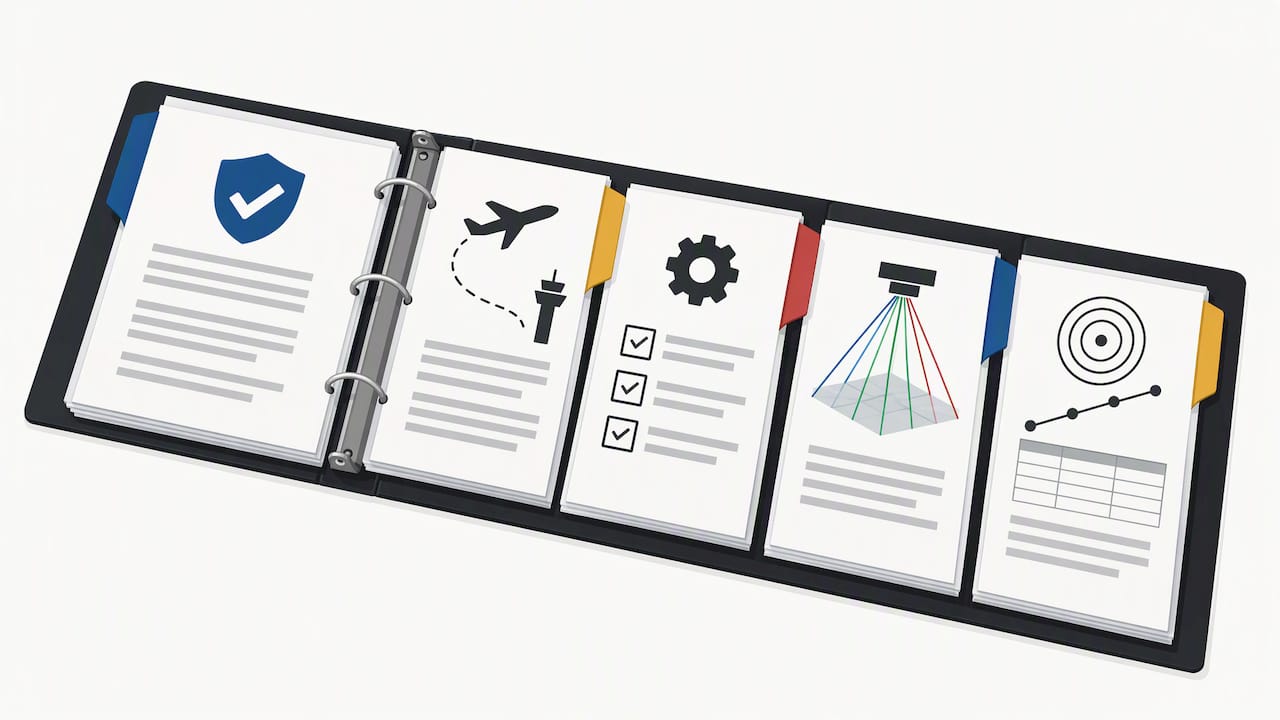
Your show binder needs to travel with the production and should hold the FDA variance approval letter, FAA notification proof for outdoor shows, current SOPs, beam-path diagrams, and calibration logs for every measurement instrument used. Inspectors ask for this binder first, before they ask anything else.
Filing with the FAA for outdoor laser operations
Outdoor beams that could reach navigable airspace require FAA review. The agency’s Advisory Circular on outdoor laser operations asks proponents to file Form 7140-1 and recommends submitting it at least 30 days before the event to allow time for aeronautical study.
A few distances matter here, and they are not the same as NOHD or NHZ used for ground-level safety:
- SZED (sensitive zone exposure distance), CZED (critical zone exposure distance), and LFED (laser-free exposure distance) all measure visual interference risk to pilots, not direct beam injury.
- Accepted control measures include terminating beams on building surfaces, posting human observers, or using radar or imaging systems that meet SAE AS6029 standards.
- An FAA non-objection letter often becomes a condition of your FDA variance for outdoor shows, so treat the two filings as connected rather than sequential.
Your pre-show checklist and planning timeline
Work backward from your event date. Submit the FDA variance application as early as your production schedule allows, since review takes weeks, not days. File FAA Form 7140-1 at least 30 days out for any outdoor beam work, and confirm local permits and vendor availability on a similar lead time.
In the final days before the show:
- Calibrate every measurement instrument and log the results.
- Run scan-fail and interlock tests on each projector.
- Validate beam termination points match your approved diagrams.
- Complete a full rehearsal with alignment controls active and restricted access enforced.
- Get LSO sign-off against your documented criteria before opening doors to the public.
Keep the venue, local authorities, and emergency services informed of your laser setup ahead of time, and consider hiring an experienced event photographer and videographer to document your show and ensure accurate evidence capture. Our risk management guide for events covers how to structure that communication alongside broader equipment and emergency-response planning.
Responding to a laser incident and preserving records
If something goes wrong, stop all emissions immediately, secure the equipment, and get medical help to anyone affected before doing anything else. Preserve the beam configuration and all logs exactly as they were at the time of the incident.
Reporting depends on what happened: FDA expectations apply to variance violations, FAA reporting is required if aircraft were involved, and some states or municipalities have their own reporting rules.
- Preserve instrument logs, operator statements, and any available video.
- Keep maintenance and calibration records alongside your variance and FAA correspondence.
- Document the incident in writing the same day, while details are fresh.
Thorough records support faster corrective action and reduce your exposure if a regulator or insurer asks questions later. Our event security planning playbook covers related documentation practices for access control and emergency response.
Why safety planning has to start before the creative brief
Laser safety is often treated as a late-stage compliance task bolted onto a finished creative concept, and that sequencing is backward. The beam heights, scan patterns, and audience positioning decisions that matter most for an FDA variance are exactly the decisions a creative team makes first, which means safety input needs a seat at the table from day one, not a review pass at the end.
The trade-off that trips up most producers is visual impact versus margin. A tighter beam angle looks more dramatic and also shrinks your Nominal Hazard Zone, which can mean a faster variance review.
— Tyler
Running compliant laser shows without the compliance headache
Laser safety planning should be integrated into production from the proposal stage, not added late. Coordinating LSO oversight, vendor vetting, and documentation alongside other aspects of activation helps prevent compliance issues close to the event date.

If you are planning a brand activation, conference, or live production that involves laser effects, our experiential production services fold safety planning into the same timeline as staging, AV, and fabrication. Reach out through our main site to talk through your event and get a production plan that treats compliance as part of the design, not an afterthought.
FAQ
What are the OSHA guidelines for laser safety?
OSHA references the ANSI Z136 series and requires controls for Class IIIB and Class IV lasers including interlocks, area posting, written SOPs, and fire-resistant enclosure materials, as described in its laser hazard guidance. These controls are meant to keep exposure at or below the Maximum Permissible Exposure level and to reduce fire risk from diffuse reflections.
Are laser shows legal in the United States?
Yes, laser shows are legal when the producer holds an FDA-approved variance for Class 3B or Class 4 lasers, as outlined in the FDA’s laser light show guidance. Outdoor shows also need FAA notification through Form 7140-1 when beams could reach navigable airspace.
What is the number one problem with laser eyewear?
The most common failure is a mismatch between the eyewear’s optical density rating and the laser’s actual wavelength, which leaves the wearer with no real protection despite looking protected. Eyewear also cannot substitute for engineering controls like beam stops and interlocks, since it only protects the person wearing it in that moment.
Which organ is most vulnerable to laser radiation?
The eye is the most vulnerable organ, since laser light can focus onto the retina and cause damage even at exposure levels too brief or low-powered to affect skin. This is why beam-path control, audience distance requirements, and the Nominal Hazard Zone concept from the ANSI Z136 standard center on protecting eye exposure first.
Sources
- FDA — Laser light shows
- FAA Advisory Circular AC 70-1B: Outdoor Laser Operations
- Purdue University Laser Safety Manual (draws on ANSI Z136.1-2022)
- Laser safety: protective eyewear, hazards and LSO role (PMC article)
- OSHA — Laser hazards and control measures
Recommended
- Avoid Shutdowns: 5 NYC Agencies Brands Must Notify for Pop Up Permits
- Alcohol Permits for Events: A State-by-State Planning Guide