The working baseline is one bartender per 50 to 75 guests, a range that covers most cocktail receptions and dinners with a bar. Tighten that to roughly one bartender per 40 to 50 guests for a full cocktail program with mixed drinks, and loosen it to about one per 75 to 100 for a beer-and-wine-only event. The sections below break that baseline into per-size charts, adjustment factors, and a formula you can drop straight into a budget.
TL;DR:
- Staffing should be adjusted based on menu complexity, arrival pattern, and bar layout, with more staff needed for intricate cocktails or concentrated arrivals.
- Distributing stations and adding support staff such as barbacks and runners often improves throughput more cost-effectively than simply increasing bartender counts.
- Operational strategies like pre-batching drinks, limiting the menu, and creating express lanes can significantly reduce lines without hiring additional staff.
- A practical formula helps ensure adequate staffing: estimate total drinks, compute total build minutes, and divide by event duration and bartender minutes to determine headcount.
- Effective event planning involves aligning staffing with actual flow and layout rather than relying solely on ratio guidelines or guest count.
Table of Contents
- Working baseline ratio and quick rules of thumb
- Sample staffing plans by common guest counts
- Factors that change how many bartenders you actually need
- When and how to use barbacks, runners, and supplemental servers
- Tactics to shorten lines without automatically hiring more bartenders
- A simple calculator formula and buffer rules planners can use
- Practitioner perspective: expertise from King Sixteen
- What actually matters when you’re setting the ratio
- How King Sixteen handles staffing so you don’t have to
- Sources
- FAQ
Working baseline ratio and quick rules of thumb
The 1-to-50-75 ratio exists because of throughput, not tradition. A skilled bartender can build a straightforward drink, a glass of wine, or a draft pour in well under a minute, but a proper cocktail with fresh juice, a shake, and a garnish can take two to three times as long. Multiply that build time across a guest list arriving in a short window, and the ratio becomes a math problem before it’s a staffing decision.
Practitioner guidance across the event staffing industry consistently lands in these ranges:
A few factors will push you toward the tighter end of any range before you even get to menu design:
- A short cocktail hour that compresses most drink orders into a brief period.
- A single entry point that creates one concentrated arrival surge instead of a staggered flow.
- An open bar with no consumption limits, which tends to generate more orders per guest than a ticketed or cash bar.
Once you know your program type, the next step is mapping that ratio to an actual guest count and bar layout.
Sample staffing plans by common guest counts
A ratio only becomes useful once it turns into a headcount you can put in a contract. The table below applies the baseline ranges to the guest counts planners deal with most often, assuming a mixed-menu bar with a standard two to three hour service window.
| Guests | Min bartenders | Typical | Max bartenders | Bar stations |
|---|---|---|---|---|
| 50 | 1 | 1 | 1 | 1 |
| 100 | 1 | 2 | 2 | 1 to 2 |
| 150 | 2 | 2 to 3 | 3 | 2 |
| 200 | 3 | 3 to 4 | 4 | 2 to 3 |
| — | 4 | 5 | 3 | 3 to 4 |
A few notes shape how you’d actually deploy those numbers on site:
- At 100 guests, two bartenders on one station outperforms one bartender split across two, since a single point of service keeps the line visible and manageable.
- At 200 guests and above, distribute stations rather than adding heads to one bar, since a single long line slows service more than the raw ratio suggests.
- Add one barback per station once you cross 150 guests, since restocking ice, garnish, and glassware becomes a full job on its own at that volume.
- Build in a 15 to 20 minute staffing bump right at doors-open, since arrival surges create the sharpest queue of the entire event even when the rest of the night runs light.
These are starting points. The next section covers what actually moves you up or down within (or beyond) these ranges.
Factors that change how many bartenders you actually need
The baseline ratio assumes an average event. Few events are actually average, and the gap between “average” and “your event” usually comes down to four variables.
Menu complexity is the biggest lever. A bar pouring beer, wine, and two batched cocktails moves guests through in seconds. A bar building eight different craft cocktails to order, each with fresh-squeezed juice or a hand-cut garnish, can double the minutes-per-drink and effectively cut your bartender capacity in half.
Arrival pattern matters almost as much. A wedding cocktail hour where every guest shows up in a 15-minute window needs more bar heads than a corporate open house where people trickle in over two hours, even at identical total guest counts.
Bar layout changes what a given headcount can actually deliver. A single central bar creates one line and one bottleneck; two or three distributed stations spread demand and shorten waits without adding a single bartender.
Duration and service style round out the list:
- A short, high-intensity cocktail hour needs a denser ratio than a long dinner reception with the same guest count.
- An open bar with no limits generates more orders per guest than a drink-ticket or consumption-controlled event.
- A guest profile skewed toward younger, more social drinkers tends to push order volume up compared with a formal seated dinner crowd.
Pro Tip: Walk your floor plan before you finalize bartender counts. A bar tucked in a corner with poor sightlines will always queue longer than one placed on a natural traffic path, regardless of staffing.
When and how to use barbacks, runners, and supplemental servers
A bartender who never leaves the well to fetch ice, garnish, or a fresh case of wine will pour drinks noticeably faster than one who does. That’s the entire case for support staff: they don’t serve guests, they keep the person who does fully stocked and moving.
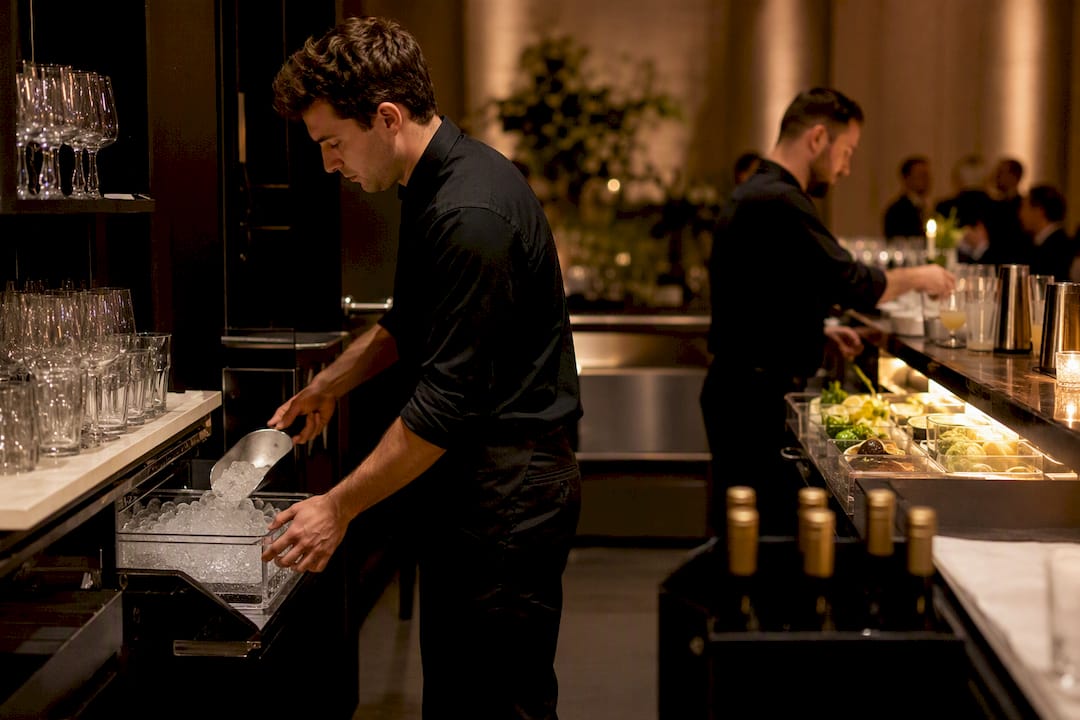
Barbacks restock ice, glassware, garnish, and liquor, and handle trash and spills, letting the bartender stay at the rail. Runners carry drinks to seated tables or distant areas of a venue, freeing the bar itself from foot traffic. Wine servers handle tableside pours at seated dinners, pulling that volume off the main bar entirely.
A common working ratio is one barback for every two bartenders once you’re running a multi-station bar or a high-volume cocktail hour. Add a runner once your bar sits more than a short walk from a significant portion of seating.
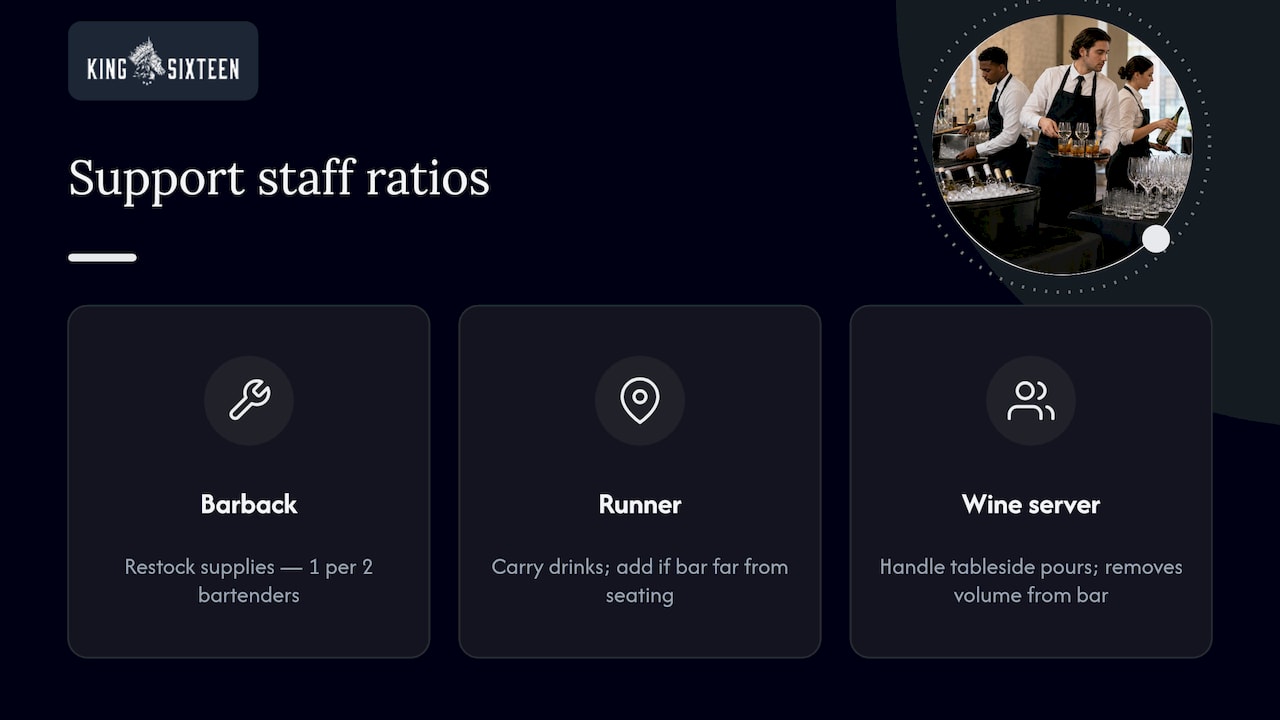
The math often favors support staff over another bartender: a barback costs less per hour than a bartender, yet the throughput gain from keeping one station fully stocked can match or beat what a second full bar station would deliver.
Tactics to shorten lines without automatically hiring more bartenders
Adding bartenders is the most expensive way to fix a slow line. Several operational changes fix the same problem for less.
- Pre-batch your cocktails. Mixing base spirits, juices, and modifiers in bulk before service cuts build time per drink dramatically, since the bartender is pouring and garnishing rather than measuring and shaking each order.
- Limit the cocktail menu. Four well-chosen cocktails move faster than a twelve-drink list, and guests rarely miss the options they never saw.
- Set up a dedicated express lane for beer, wine, and one signature drink, separate from a full-menu station, so guests who want something simple aren’t stuck behind a complex order.
- Use a fast, dedicated POS or tab system at each station instead of routing every transaction through one register, and consider digital signage at the bar to route guests to the right line before they queue.
- Stagger service where possible, using drink tickets or timed openings to spread demand instead of letting the entire guest list hit the bar at once.
Pro Tip: A limited menu announced before the event, on the invitation or signage, sets guest expectations and prevents the slowdown that comes from a bartender explaining ingredients to every third person in line.
A simple calculator formula and buffer rules planners can use
The ratio chart gets you close. A quick calculation gets you exact.
- Estimate total drinks: guests × expected drinks per guest for the service window.
- Estimate total pour-and-build minutes: total drinks × average minutes per drink.
- Divide by the length of your service window in minutes to get bartender-minutes needed, then divide by the minutes available per bartender to get your headcount.
Worked example: 150 guests at 1.5 drinks per guest over a 90-minute cocktail period, averaging 2 minutes per drink.
| Step | Calculation | Result |
|---|---|---|
| Total drinks | 150 × 1.5 | 150 drinks |
| Total build minutes | 150 × 2 | 300 minutes |
| Bartenders needed | 300 ÷ 90 | 5 bartenders |
That lands right in the “typical” range from the earlier chart for 150 guests. Add a 10 to 25% buffer for no-shows, surges, and slower-than-planned service. At smaller events, one extra bartender covers that buffer more reliably than a percentage calculation does.
Practitioner perspective: expertise from King Sixteen
At King Sixteen, staffing math never lives on its own. We pair bartender counts with the run-of-show, the stage timing, and the vendor coordination happening everywhere else on site, because a perfect ratio on paper still fails if the bar isn’t placed where the guest flow actually moves.
On a recent multi-day activation, the initial plan called for a single central bar sized to the baseline ratio. Watching the floor plan against the arrival schedule showed a concentrated surge at one entrance, so the team split the same headcount into two smaller stations instead. Wait times dropped without adding a single bartender.
A few habits carry across most of our events:
- Staffing counts get finalized against the actual floor plan, not just the guest list.
- Barback ratios get locked in before bartender counts, not after.
- Every bar brief includes a menu limit, agreed in advance with the client.
What actually matters when you’re setting the ratio
Most planners over-index on bartender count and under-index on layout. Two extra bartenders on one poorly placed bar will still produce a long line, while the right station count in the right spots often beats a bigger headcount on a bad floor plan.
Spend more on speed (extra bartenders, extra stations) when your event has a hard time constraint, like a one-hour cocktail reception before a seated dinner. Spend on operations instead (pre-batching, menu limits, layout) when your budget is tight but your timeline has more give.
A few things worth locking into every vendor contract:
- A staffing minimum tied to guest count, not a flat headcount regardless of turnout.
- A peak-hour clause specifying additional staff during arrival windows or scheduled toasts.
- A final bar brief covering menu, station layout, and barback assignments before doors open.
— Tyler
How King Sixteen handles staffing so you don’t have to
Getting the ratio right is only half the job. Booking the bartenders, barbacks, and runners, briefing them on the menu and floor plan, and coordinating them with everyone else running the event is the other half, and it’s where most in-house teams lose time.

King Sixteen’s turnkey event production model puts one team behind staffing, hospitality operations, vendor coordination, and the rest of the production under a single point of accountability. That means the bartender count, the barback assignments, and the bar layout get planned alongside staging, AV, and run-of-show instead of as a separate line item someone has to chase down. If you’re planning a private event or a brand activation and want the staffing plan handled as part of the full production, explore our private events services and request a quote.
Sources
Standard drink sizes and consumption guidance come from the National Institute on Alcohol Abuse and Alcoholism, which also covers drinking level definitions relevant to pour policy. Baseline staffing ratios draw on event staffing placement guidance. For budget context, see our breakdown of what a bar package actually costs and our state-by-state alcohol permit guide.
- Bartender Staffing for Events: Ratios and Placement
FAQ
What is the 50% rule in bartending?
It’s a planning heuristic rather than a fixed standard, so pair it with your own arrival pattern.
What is the 3:2:1 rule in bartending?
This is an informal guideline some bar teams use to describe a typical drink mix at a mixed event: roughly 3 parts beer or wine, 2 parts cocktails, and 1 part non-alcoholic or specialty drinks. Definitions vary by source, so treat it as a starting point for menu planning rather than a fixed rule.
How many drinks do you need for 100 guests?
Using the 1 to 1.5 drinks per guest estimate common for a one to two hour cocktail period, 100 guests would need roughly 100 to 150 drinks for that window. A longer reception with an open bar typically pushes that number higher, so adjust based on your event’s duration and service style.
What is the 2:1:1 rule for cocktails?
The 2:1:1 rule is a classic cocktail-building ratio, commonly cited as 2 parts base spirit to 1 part sweet and 1 part sour, used to speed up consistent drink building rather than to set staffing levels. It affects staffing indirectly by simplifying builds, which can shorten pour time per drink.
How many bartenders do I need for a 150-guest event?
Based on the working baseline, a 150-guest event typically needs 2 to 3 bartenders for a mixed-menu bar, split across two stations. A full cocktail program at the same guest count often calls for closer to 3 bartenders to keep build times manageable during peak arrival.
Recommended
- What an Event Bar Package Actually Costs Your Brand