
Drayage fees are the short-haul and material-handling charges that appear when containers or exhibit freight move from a terminal or loading dock to final staging. They come from terminals, ocean carriers, and show contractors, not one universal price sheet, and they can multiply fast once accessorials pile on. The single best way to control them: get free-time windows and accessorial assumptions confirmed in writing before the truck ever moves.
TL;DR:
- Containership drayage costs are highly dependent on accessorial charges like detention and demurrage, which often inflate the final bill unexpectedly.
- Accurate documentation, including certified weights and gate timestamps, is essential for validating and disputing drayage invoices effectively.
- Strategic operational choices, such as consolidating shipments and booking advance warehouses, can lower overall drayage expenses more than rate negotiations.
- Regional port congestion, seasonal demand swings, and port-specific surcharges significantly impact drayage pricing, requiring proactive planning.
- Digital tools improve rate visibility and scheduling accuracy but must be paired with thorough documentation for reliable cost management.
Table of Contents
- What Drayage Fees Cover in Container Shipping vs. Trade Shows
- How Drayage Rates Get Calculated
- The Drayage Accessorial Glossary: What’s Negotiable and What Isn’t
- Typical U.S. Cost Ranges by Port and Trade-Show Market
- Auditing a Drayage Invoice: Documents and Checklist
- Cutting Drayage Costs: Operational and Contractual Levers
- How Turnkey Event Production Avoids Drayage Surprises
- Regulatory and Compliance Pressures Behind Drayage Pricing
- Container Size and Type: Why 20ft and 40ft Loads Price Differently
- Seasonal Demand Swings and Their Effect on Drayage Pricing
- Digital Tools for Estimating and Managing Drayage Costs
- What Actually Moves Drayage Costs, and What Doesn’t
- How King Sixteen Keeps Drayage Off Your Invoice Surprises
- Where to Verify Drayage Facts and Rates
- Sources
What Drayage Fees Cover in Container Shipping vs. Trade Shows
The word “drayage” carries two distinct meanings in American logistics, and mixing them up causes real budgeting mistakes. In container shipping, drayage is the short truck haul that moves a container from a marine terminal or rail ramp to a warehouse, distribution center, or rail yard. In the trade-show world, drayage refers to material handling: unloading exhibit freight from the truck, storing it, delivering it to the booth, and reversing the process at teardown.
Different players charge each type. Ocean carriers, port terminals, and independent trucking companies bill container drayage. General service contractors (GSCs) bill trade-show material handling, often as the largest single line item on an exhibitor’s invoice. Both share a structural risk: the quoted base rate rarely reflects the final bill. A single missed appointment window or an unexpected weight adjustment can push costs up by hundreds or thousands of dollars before anyone notices, because most of the real spend hides in accessorials layered on top of the move itself.
How Drayage Rates Get Calculated
Container drayage typically starts with a base linehaul rate tied to distance bands from the terminal, then adds fuel surcharges, chassis fees, and per-diem charges once free time expires. Trade-show material handling works differently: contractors bill by hundredweight (CWT), meaning every 100 pounds of freight crossing the dock costs a set rate, regardless of how it is packed.
Two “clocks” drive most disputes. Terminal free time is the window a container can sit at the port before demurrage kicks in. Equipment free time is the window before the trucking company’s chassis or container incurs per-diem charges. These clocks run independently, and Maersk notes that a quote without clear accessorial assumptions is incomplete because fuel surcharges, chassis rental, pre-pull, and driver wait time rarely appear in the headline number.
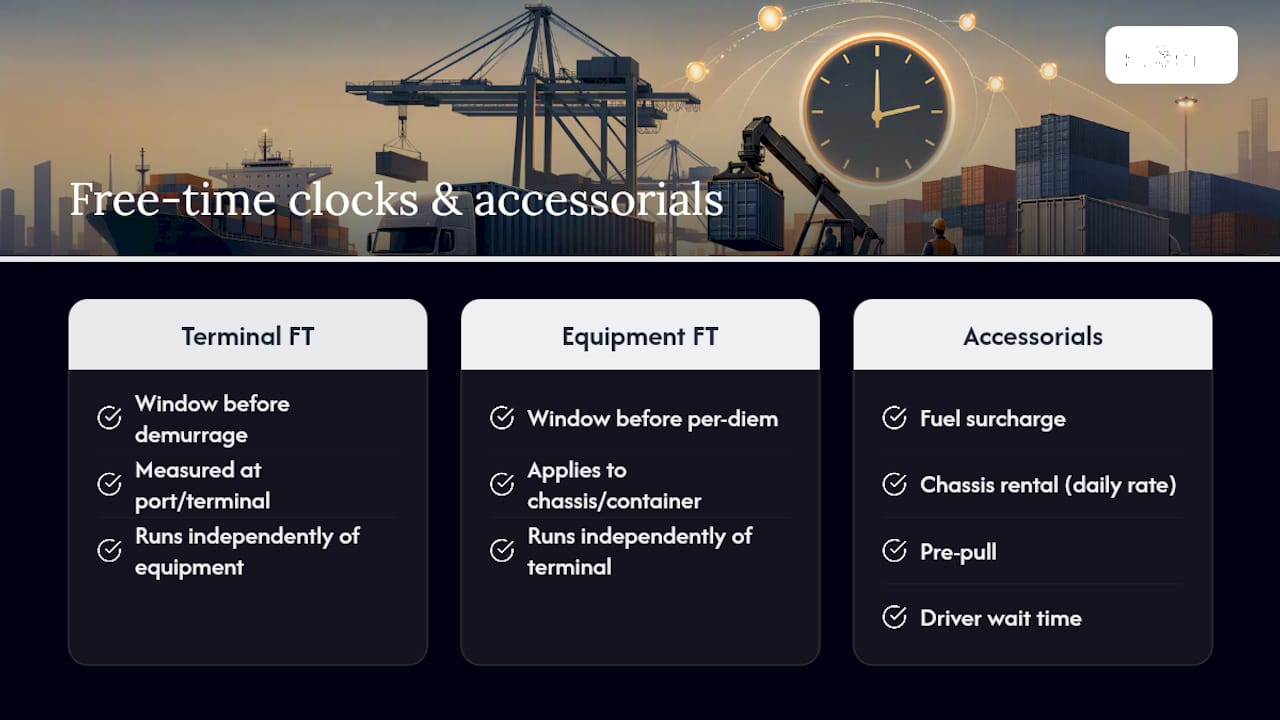
Before signing any quote, demand these in writing: free waiting time in minutes, chassis ownership and daily rate, yard storage rates per day, and whether pre-pull is included or billed separately.
The Drayage Accessorial Glossary: What’s Negotiable and What Isn’t
Accessorials are where drayage invoices go from predictable to painful. Industry guides describe the base rate plus accessorial stack as the true final invoice, and knowing which charges you can push back on separates a controlled budget from a blown one.
- Detention: Per-day fee charged when a container or chassis stays past free time, usually while still loaded. Somewhat negotiable through extended free-time clauses.
- Demurrage: Similar to detention, but billed by the terminal for containers sitting on port property. Rarely negotiable once the clock starts; the fix is operational, not contractual.
- Chassis split: Extra fee when the chassis and container arrive at different locations, requiring a second trip. Often avoidable with better carrier coordination.
- Pre-pull: Charge for pulling a container off the terminal early and storing it at a yard to beat congestion. Negotiable as a flat rate if requested in advance.
- Waiting time: Billed hourly when a driver sits idle at a dock or warehouse. Highly avoidable through scheduling discipline.
- Dry run: Fee charged when a truck arrives but cannot complete the move (closed gate, missing paperwork, no appointment). Entirely avoidable with pre-checks.
- Special handling: Added charge for crated, oversized, or hazardous freight requiring extra labor. Fixed by freight characteristics, not negotiable.
Waiting time, dry runs, and empty-return failures inflate invoices most often because they accrue by the hour and depend almost entirely on how well the shipper’s own operation runs, not on carrier pricing.
Typical U.S. Cost Ranges by Port and Trade-Show Market
Container drayage varies widely by port congestion, distance bands, and regional trucking capacity. Ports like Los Angeles/Long Beach and Savannah post higher linehaul rates during peak season than smaller regional rail ramps, largely because of chassis scarcity and yard congestion.
Trade-show material handling follows its own math. Representative CWT ranges commonly run $75 to $210 per hundredweight, depending on the venue and whether freight ships to an advance warehouse or direct to show site. Advance-warehouse shipments generally price lower per CWT than direct-to-show freight, which pays a premium for compressed handling windows.
Chassis daily fees typically run in the $20 to $35 range once free time expires, though rates shift by region and provider. The gap between a well-planned move and a rushed one often shows up entirely in these accessorial lines, not in the base rate.
Auditing a Drayage Invoice: Documents and Checklist
Every dispute starts with paperwork. Certified weight tickets, gate receipts, bills of lading, and timestamped records form the evidence base for any challenge to a drayage bill.
- Request the full document set before paying: certified weight ticket, gate in/out receipts, BOL, and timestamped delivery records.
- Verify the base rate against the original quote, checking for unauthorized rate changes.
- Reconcile weights on the invoice against the certified weight ticket. Weight disputes are among the most common billing errors.
- Confirm free-time application by comparing gate timestamps against the contracted free-time window.
- File disputes promptly with full documentation attached. Well-supported disputes typically resolve within 30 to 60 days.
Cutting Drayage Costs: Operational and Contractual Levers
Reducing drayage spend takes moves on three fronts: how freight is packed, how contracts are written, and how the loading dock runs day to day.
- Consolidate crates into fewer, denser shipments to cut billable weight and handling units.
- Ship through an advance warehouse rather than direct to show site; this alone commonly saves 15 to 30 percent on material handling.
- Improve dock throughput with dedicated staff during receiving windows to avoid waiting-time charges.
- Negotiate free waiting time explicitly into carrier contracts, not as an assumed courtesy.
- Lock in yard-storage rates and fuel-surcharge formulas before the move, not after the invoice arrives.
- Use appointment systems with terminals and warehouses to eliminate dry runs entirely.
Lightweight, modular exhibit systems cut material-handling weight significantly compared to custom architectural builds, and that saving compounds across every repeat show a brand runs.
Pro Tip: Call the terminal or GSC two business days before delivery to confirm appointment windows and dock availability. A five-minute call prevents the single most common accessorial: a dry run billed because nobody checked first.
How Turnkey Event Production Avoids Drayage Surprises
Agencies that run experiential campaigns treat drayage as a planning problem, not a line item to absorb after the fact. Choosing lightweight, modular builds over custom architecture, consolidating shipments into fewer crates, and routing freight through advance warehouses all cut material-handling exposure before a truck ever reaches the venue. King Sixteen’s vendor network exists specifically to coordinate pack-out specs and shipping logistics across every activation, catching the assumptions that turn a clean quote into a padded invoice.
Regulatory and Compliance Pressures Behind Drayage Pricing
Environmental and port-authority rules increasingly shape what a drayage carrier charges, and logistics managers who ignore them get blind sided by surcharges that have nothing to do with distance or weight. Ports in California, for example, enforce emissions standards on drayage trucks that push older diesel fleets out of service, forcing carriers to invest in cleaner equipment and pass that cost through as a fuel or compliance surcharge. Truckers running non-compliant equipment simply cannot enter certain terminal gates, which shrinks available capacity and pushes rates up during tight windows.
Port authorities also layer on their own fees independent of federal rules: congestion surcharges during peak import season, chassis pool fees tied to regional equipment shortages, and infrastructure charges that fund yard improvements. These vary by port and change with little warning, which is why any drayage quote should specify which surcharges are locked and which float with published tariffs.
Shippers who want a hedge against rising compliance costs can look toward carriers enrolled in EPA SmartWay, a voluntary freight-efficiency program that tracks fuel use and emissions performance. Carriers with strong SmartWay metrics tend to run newer, more compliant fleets, which means fewer surprise surcharges tied to emissions retrofits or port access restrictions. It is not a guarantee of lower rates, but it is a reasonable signal of operational stability in a market where compliance costs shift year to year.
Container Size and Type: Why 20ft and 40ft Loads Price Differently
Container drayage pricing does not scale in a straight line with size. A 40-foot container typically costs more to move than a 20-foot container, but not double, because the linehaul portion of drayage is priced per move, not per pound or per cubic foot. The truck, driver, and chassis cost the same whether the box is half full or packed to the ceiling.
Where size matters most is in accessorials. Heavier 40-foot loads, especially those near the 44,000-pound gross weight threshold common on U.S. highways, sometimes trigger overweight permits or split-load handling, both of which add cost outside the base rate. Specialized equipment, like flat racks, open tops, or refrigerated containers, carries its own premium because it requires different chassis and, often, different terminal handling procedures.
For shippers moving smaller volumes, consolidating into a single 40-foot container instead of two 20-foot containers usually reduces total drayage cost, since it collapses two linehaul moves and two sets of accessorials into one. The math only breaks down when the consolidated load pushes into overweight territory, at which point the savings on linehaul get eaten by permit fees and possible chassis split charges. Always ask a drayage provider to quote both configurations before committing to a load plan.
Seasonal Demand Swings and Their Effect on Drayage Pricing
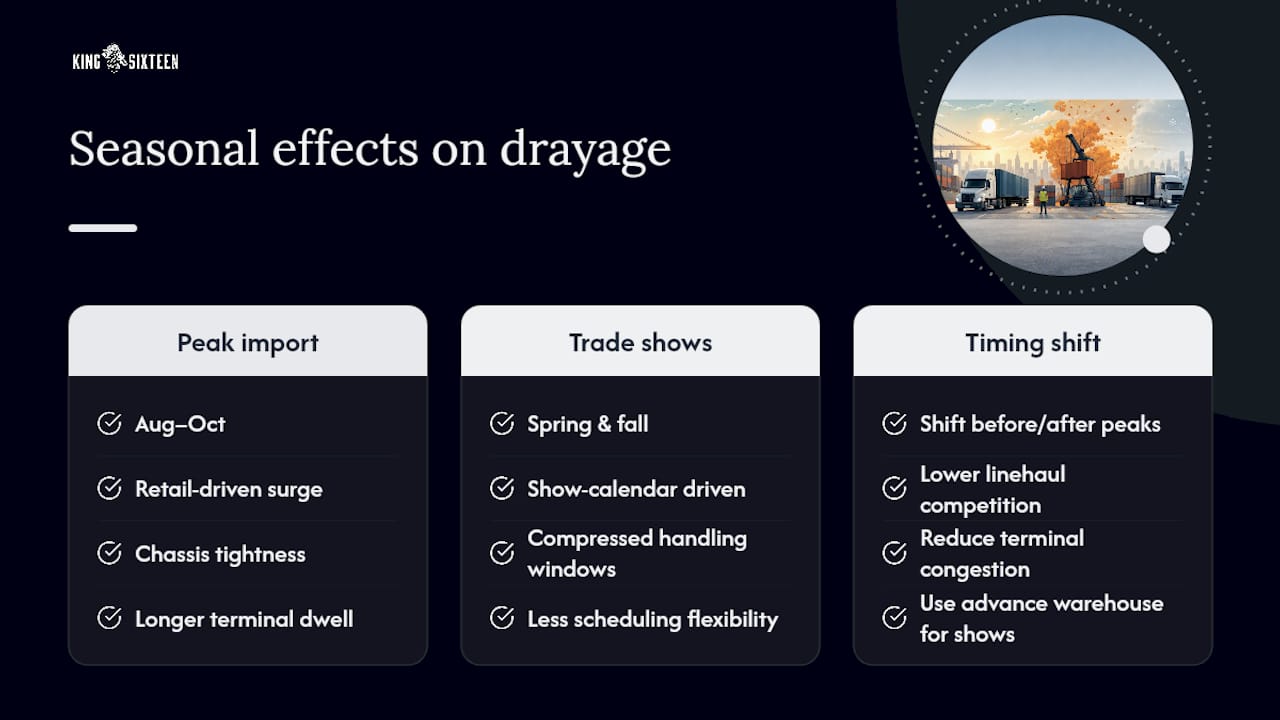
Drayage pricing moves with the calendar in ways that catch unprepared shippers off guard every year. Peak import season, roughly August through October ahead of the winter retail push, drives container volume up sharply at major ports, which tightens chassis availability and extends terminal dwell times. Longer dwell times mean more containers bump against free-time limits, which pushes demurrage and detention exposure up across the board, not because rates rise but because operational friction increases.
Trade-show demand follows a different rhythm tied to convention calendars rather than retail cycles. Major industry shows cluster in spring and fall, and venues in high-demand markets book material handling crews accordingly. Booking material handling services close to a show date in a popular market often means less scheduling flexibility, which raises the odds of paying for expedited or off-hour handling.
Shippers who can shift timing gain real leverage. Moving container freight just ahead of or just behind the peak season window, when capacity allows, tends to reduce both linehaul competition for trucks and the odds of terminal congestion charges. For trade shows, shipping early enough to use an advance warehouse rather than direct-to-show delivery sidesteps the compressed handling windows that drive up direct-to-show CWT rates during a show’s busiest setup days. Neither tactic eliminates seasonal pricing pressure, but both reduce exposure to the accessorials that seasonal congestion tends to generate.
Digital Tools for Estimating and Managing Drayage Costs
Rate visibility used to depend entirely on a broker’s relationships and memory. That has shifted. Transportation management systems now pull live chassis availability, terminal dwell data, and carrier rate tables into a single view, letting a logistics manager compare linehaul and accessorial exposure across multiple providers before booking a move. Some platforms flag containers approaching free-time expiration automatically, which turns demurrage avoidance from a manual tracking task into a system alert.
For trade-show material handling, digital exhibitor portals increasingly let show organizers upload freight specs and get CWT estimates before the show opens, replacing the old process of calling a GSC and waiting for a faxed rate sheet. That transparency helps event teams budget accurately instead of discovering the real number on move-in day.
None of these tools remove the need for a human to read the fine print. A dashboard can flag that free time is expiring, but it cannot negotiate a better chassis rate or catch a mislabeled accessorial on an invoice. The most reliable approach pairs software visibility with the same document-based audit discipline covered earlier: certified weights, gate timestamps, and written accessorial terms. Technology narrows the information gap; it does not replace the paperwork that actually wins a dispute.
What Actually Moves Drayage Costs, and What Doesn’t
Most advice on drayage fees focuses on rate negotiation, and that’s the wrong starting point. Rates matter, but the research is consistent: waiting time, dry runs, and empty-return failures drive the real cost overruns, and those are operational problems, not pricing problems. A shipper who negotiates a great linehaul rate but shows up without an appointment will still lose money.
The conventional advice to “shop around for better drayage rates” undersells how much control sits inside a shipper’s own operation. Confirming container availability, booking appointment windows, and consolidating freight into fewer, denser shipments prevent more cost overruns than any rate negotiation ever will. For trade-show teams specifically, the choice between advance warehouse and direct-to-show, and between custom builds and modular systems, matters more than which GSC gets hired.
If there’s one thing worth prioritizing first, it’s documentation discipline: certified weights, gate timestamps, and written accessorial terms before the move, not after the invoice arrives. Everything else, from carrier selection to chassis negotiation, works better once that foundation is in place.
— Tyler
How King Sixteen Keeps Drayage Off Your Invoice Surprises
King Sixteen is the alternative to juggling GSCs, terminals, and freight brokers separately for your next activation. Because pack-out specs, vendor coordination, and shipment consolidation happen under one turnkey plan, the accessorial surprises that hit shippers managing logistics piecemeal rarely make it to your final invoice.

Our vendor network builds toward lightweight, modular exhibit systems that cut billable weight before freight ever reaches a dock, and our production teams book advance-warehouse routing and appointment windows as standard practice, not an afterthought. That planning discipline is the same reasoning covered in the trade show booth materials guide and applies whether you’re running a single activation or a full show circuit through partners like Opti Arts.
If your next product launch or trade-show activation needs logistics handled without the guesswork, get a quote through our experiential marketing services and see how a coordinated plan changes what shows up on your final bill.
Where to Verify Drayage Facts and Rates
Check carrier emissions credentials through EPA SmartWay, compare demurrage benchmarks on Statista’s port charge data, and request the exhibitor manual rate schedule before any trade-show shipment.
Sources
- Participate in SmartWay | US EPA
- Drayage costs and charges | Maersk
- Drayage Accessorial Charges Explained
- What Is Drayage? Meaning, Types and Costs | Platton