For most U.S. events, catering per person cost lands between $20 and $120 — and the single biggest driver of where you fall in that range is service style, not menu quality. Here’s the quick breakdown before we get into the details:
- Drop-off / delivery: $20–$40 per person
- Staffed buffet: $45–$65 per person
- Plated, full service: $65–$85 per person
- Premium / white-glove: $100+ per person
Every figure above is food-only, before tax, service charge, rentals, and alcohol. Adding those layers commonly causes the actual invoice to be notably higher than the menu line alone, with the increase varying by service style.
Pro Tip: Write your working budget in two columns from day one: “menu cost × guests” and “estimated all-in.” The gap between those two numbers is where most planners get surprised.
Key Takeaways
Most U.S.
| Point | Details |
|---|---|
| Per-person ranges by style | Drop-off runs $20–$40; buffet $25–$65; plated $40–$85; premium $100+ before add-ons. |
| All-in multiplier | Multiply food cost by 1.25–1.45x for buffet and 1.45–1.80x for plated to estimate your real invoice. |
| Service charge vs. gratuity | The 18%–22% service charge is a company fee, not a server tip — confirm whether gratuity is expected separately. |
| Biggest savings lever | Switching from plated to buffet service can reduce labor cost by $2,000–$4,000 for a 100-person event. |
| King Sixteen approach | King Sixteen bundles catering, staffing, AV, and production into one scope — one budget, one contact, no vendor gaps. |
Table of Contents
- How catering price per guest changes by service style
- What 50, 100, and 150 guests actually costs
- What a catering quote normally includes — and what’s usually extra
- How staffing levels and service style affect per-person cost
- Beverage options and how they shift your per-person budget
- Menu choices that move the per-person number the most
- Hidden fees and contract items to confirm before you sign
- Practical cost-saving strategies that actually move the needle
- Budgeting and booking timeline: when to get quotes and what you need ready
- How full-service brand events change the per-person math
- Where to spend and where to pull back
- King Sixteen handles catering and production as one integrated package
- Sources
How catering price per guest changes by service style
Service style is the clearest predictor of where your per-person budget lands. The table below maps each style to a realistic range and what that price typically covers.
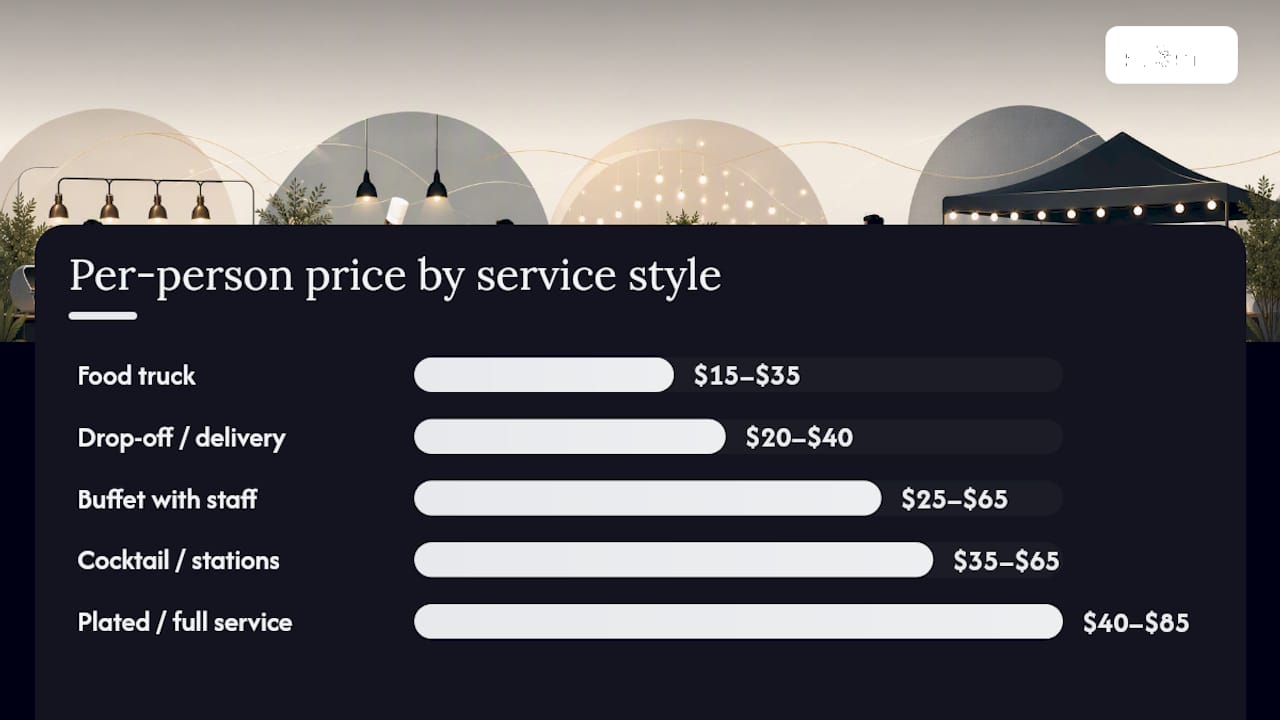
| Service Style | Per-Person Range | Typical Inclusions |
|---|---|---|
| Drop-off / delivery | $20–$40 | Food only, disposable packaging, no staff on-site |
| Buffet with staff | $25–$65 | Food, serving staff, chafing equipment, setup |
| Plated / full service | $40–$85 | Food, servers, plating, full setup and breakdown |
| Cocktail / stations | $35–$65 | Passed appetizers, action stations, light staffing |
| Food truck | $15–$35 | Food from truck, minimal setup, no venue staffing |
| Luxury / white-glove | $100+ | Multi-course menu, sommelier, premium rentals, full crew |
Calculator benchmarks confirm these ranges and show how guest count creates economies of scale within each tier. A food truck at a 200-person corporate event, for example, often negotiates a lower per-head rate than the same truck at a 40-person private party.

Why does service style move the number so dramatically? Labor. Plated service requires precise timing, a larger crew, and equipment that buffet service simply doesn’t need. Cocktail stations fall in the middle because staffing is lighter, but specialty stations (carving, raw bar, live-fire cooking) add cost fast.
Two quotes at the same per-person headline rate can differ by more than $1,000 for a 50-person event depending on whether staffing and rentals are bundled or billed separately. That’s why comparing quotes at the line-item level matters more than comparing the per-person number alone.
Pro Tip: Ask every caterer to confirm whether their per-person rate is food-only or all-in. If it’s food-only, request a sample invoice showing staffing, rentals, and fees added — then compare that all-in figure across vendors, not the headline rate.
What 50, 100, and 150 guests actually costs
Per-person ranges are useful for orientation, but planners need to see what those numbers look like as invoice totals. The table below uses three guest counts and three budget tiers for food-only estimates, followed by worked all-in examples.
Exact food-only and all-in cost estimates for specific guest counts and budget tiers vary widely by vendor and location. Planners should expect ranges consistent with previously described service style bands, understanding that minimum spend, guest count, and additional fees influence the final total.
All-in estimates apply the UseCalcPro multiplier guidance: roughly 1.25–1.45x food cost for buffet/drop-off and 1.45–1.80x for plated service, accounting for staffing, rentals, service charge, and taxes.
A few scale effects worth knowing:
- Minimums cut both ways. Many caterers set a minimum spend (often $1,500–$3,000 for staffed events). At 50 guests, that minimum may represent a higher per-person cost than the same caterer’s rate at 150 guests.
- Fixed fees spread out. Delivery, setup, and kitchen fees are often flat. At 150 guests, those fixed costs represent a smaller per-person slice than at 50 guests.
- Wedding catering runs higher. The Knot’s wedding catering benchmarks show per-person averages that typically exceed private-party rates at the same service level, partly because of venue requirements, longer service windows, and more complex logistics.
What a catering quote normally includes — and what’s usually extra
Reading a catering quote accurately is a skill. Most quotes bundle some costs and itemize others, and the line between “included” and “extra” varies by vendor.
Typically included in a catering quote:
- Menu items (food preparation and ingredients)
- On-site service staff for the event duration
- Setup and breakdown of food stations or tables
- Chafing dishes, serving utensils, and basic serving equipment
- A service charge (usually 18%–22% of the food and labor subtotal)
Commonly billed as extras:
- Linens, china, glassware, and flatware rentals
- Cake-cutting fee (often $2–$5 per person)
- Corkage fee if you supply your own wine or spirits
- Travel or delivery fees outside a standard radius
- Permit fees (health department, liquor license, venue-specific)
- Overtime charges if service extends past the contracted window
- Gratuity for servers (separate from the service charge)
- Event insurance or certificate of insurance requirements
The service charge deserves special attention. Chefry’s catering cost guide notes that caterers commonly apply a service charge of 18%–22% that covers company overhead and staffing costs — and this charge is not always passed directly to servers as a tip. Ask explicitly how the service charge is distributed and whether a separate gratuity is expected.
Pro Tip: Request a sample “all-in” invoice from each caterer before you commit. Tell them your guest count, service style, and venue, and ask them to show you what a real invoice looks like with every line item. This single step eliminates most budget surprises.
How staffing levels and service style affect per-person cost
Labor is the line item that separates a $35-per-person buffet from an $85-per-person plated dinner. Understanding server-to-guest ratios helps you read staffing charges on invoices and negotiate them intelligently.
Typical ratios by service style:
- Buffet: 1 server per 25–30 guests
- Plated / full service: 1 server per 10–15 guests
- Cocktail / passed appetizers: 1 server per 20–25 guests
- Bar service: 1 bartender per 50–75 guests (1 per 35–50 for a busy open bar)
Beyond servers, a full-service event often includes labor-driven line items that planners overlook:
- Executive or on-site chef: flat fee or hourly, often $150–$300+ for the event
- Expeditor / kitchen coordinator: manages timing between kitchen and floor
- Bartenders: typically billed per shift or per hour
- Event captain or lead: supervises the crew, often billed at a premium rate
- Overtime: most contracts specify a per-staff-member hourly rate after the contracted window closes
That’s why event staffing planning deserves as much attention as menu selection. Choosing buffet over plated service for a 150-person event can reduce staffing costs by $1,500–$3,000 on its own.
Beverage options and how they shift your per-person budget
Alcohol is the fastest way to move a catering budget. A food-only quote at $55 per person can become $90–$110 per person once a full beverage package is added. Here’s how the main models compare:
- Open bar (hosted, flat package): $25–$75 per person for a 4–5 hour event, depending on spirit tier and duration
- Beer and wine only: $15–$35 per person, a common middle-ground choice
- Consumption bar (you pay per drink consumed): unpredictable total; works well for smaller, controlled guest lists
- Cash bar (guests pay their own drinks): lowest cost to the host, though guest experience varies
- Corkage (you supply wine, caterer opens and serves): typically $10–$25 per bottle; confirm whether this covers all bottles or just those over a minimum
A few variables that move beverage cost significantly: event duration (a 6-hour reception costs more than a 3-hour cocktail hour), spirit tier (well vs. premium vs. top-shelf), and whether the bartender fee is included in the package or billed separately.
Pro Tip: Ask your caterer for a “per-hour” beverage estimate and request a spending cap option. Some caterers will set a dollar ceiling on consumption bars, which gives you cost predictability without committing to a flat package that may overshoot your actual consumption.
Menu choices that move the per-person number the most
The menu is where you have the most direct control over per-person cost. Protein selection alone can shift your food cost by $15–$30 per person.
Key cost drivers to know:
- Premium proteins: Filet mignon, lobster, and whole fish are the fastest way to push per-person food cost above $60. Chicken, pork, and pasta-based mains typically land $15–$25 lower per person.
- Imported or specialty ingredients: Truffle, burrata, imported charcuterie, and out-of-season produce carry a significant markup over domestic, seasonal alternatives.
- Multi-course plated menus: Each additional course (amuse-bouche, intermezzo, dessert plated vs. buffet) adds labor and ingredient cost. A three-course plated dinner costs meaningfully more than a two-course with a dessert station.
- Specialty action stations: Live carving, sushi rolling, pasta-making, or raw bar stations add both ingredient cost and a dedicated station attendant.
- Dietary accommodations: A small number of custom plates (vegan, gluten-free, severe allergy) is standard. If 30%+ of your guest list requires a separate menu, expect a cost premium.
Smart swaps that preserve guest experience while lowering cost:
- Replace a beef entrée with a carved pork loin or salmon — similar visual impact, lower food cost
- Swap a plated appetizer course for a passed-appetizer cocktail hour, which reduces plate-service labor
- Use seasonal, local produce rather than imported or out-of-season items
Pro Tip: Ask your caterer which proteins are currently in season or locally sourced. Caterers who work with seasonal menus often pass a portion of the savings to clients, and the food quality is frequently better.
Hidden fees and contract items to confirm before you sign
The gap between a quoted per-person rate and your final invoice often comes down to fees that weren’t discussed upfront. Before signing any catering contract, confirm these line items in writing:
- Service charge vs. gratuity: The service charge (18%–22%) is a company fee, not necessarily a server tip. Ask whether gratuity is expected on top of it.
- Delivery and travel fees: Many caterers charge a flat delivery fee or a per-mile rate beyond a standard radius. For venues outside a metro area, this can add $150–$500+.
- Overtime charges: Confirm the contracted service window and the per-staff overtime rate. A 30-minute overrun on a 10-person crew adds up quickly.
- Kitchen rental or commissary fees: If your venue lacks a commercial kitchen, the caterer may need to rent one and pass that cost to you.
- Health department permits: Required in many jurisdictions for off-premise catering. Some caterers include this; others bill it separately.
- Event insurance / COI: Many venues require the caterer to carry a certificate of insurance naming the venue. Confirm who pays for it.
- Cake-cutting fee: If you’re bringing an outside cake, expect a per-person cutting and plating fee.
- Linen and rental minimums: Some rental companies require a minimum order value; if your guest count is small, you may pay for more than you need.
Pro Tip: During negotiation, ask which pass-through fees are negotiable. Travel fees, cake-cutting charges, and overtime rates are often flexible, especially when you’re booking a larger event or committing to a multi-year relationship with a vendor.
Practical cost-saving strategies that actually move the needle
Cutting catering cost doesn’t have to mean cutting guest experience. The strategies below tend to produce real savings, not just marginal ones.
- Change service style first. Moving from plated to buffet for a 100-person event can save $2,000–$4,000 in labor alone, without touching the menu.
- Manage your guest count tightly. Per-person costs are fixed; every additional guest is a direct cost. Trimming 15 guests from a 150-person list at $75 per person all-in saves $1,125.
- Schedule earlier in the day. Brunch and lunch receptions typically cost 20%–30% less than dinner service because food costs are lower and alcohol consumption is reduced.
- Limit alcohol to beer, wine, and a signature cocktail. This alone can cut beverage cost by $15–$25 per person compared to a full open bar.
- Combine service styles. A cocktail-hour buffet followed by a plated main course gives guests a premium experience while reducing the number of plated courses and associated labor.
- Negotiate rentals separately. Caterers often mark up rental items. Getting a direct quote from a rental company and coordinating delivery yourself can reduce that line item by 10%–20%.
The single highest-impact lever is service style. Planners who lock in a plated format early and then try to cut costs elsewhere rarely recover as much as those who reconsider the service model from the start.
Pro Tip: If you’re committed to plated service for a wedding or premium event, ask your caterer whether a “modified plated” format — plated entrée with buffet-style salad and dessert stations — is available. It preserves the formality of a plated main while reducing labor on the courses guests care least about.
Budgeting and booking timeline: when to get quotes and what you need ready
Timing your outreach correctly gets you better quotes and more vendor options. Here’s a practical framework:
When to start getting quotes:
- Weddings and large formal events: 9–12 months in advance; top caterers in major markets book out a full year.
- Corporate events and conferences: 4–8 weeks minimum; 3–6 months for events over 200 guests or with complex production needs.
- Private parties and small events: 2–4 weeks for drop-off or food truck; 4–6 weeks for staffed service.
- Weekday and off-peak events: Shorter lead times are often workable, and you may negotiate better rates.
What to have ready before you request a quote:
- Estimated guest count (give a range: “90–110 guests”)
- Preferred service style (buffet, plated, cocktail, drop-off)
- Beverage plan (open bar, beer/wine, none)
- Venue name and any kitchen or vendor restrictions
- Event date, start time, and expected end time
- Budget range (sharing this upfront saves everyone time)
Payment schedule norms to expect:
- Deposit at signing: typically 25%–50% of the estimated total
- Final guest count deadline: usually 5–10 business days before the event
- Final payment: commonly due 3–7 days before the event date
- Cancellation windows: most contracts specify a sliding scale of penalties (full deposit forfeited within 30–60 days of the event)
For a detailed event logistics checklist that covers timeline and vendor coordination, that resource walks through the full planning sequence from initial outreach to day-of execution.
How full-service brand events change the per-person math
When catering is part of a larger experiential or brand activation, the per-person calculation changes significantly. The food cost is still the baseline, but production overhead layers on top of it in ways that a standard catering quote doesn’t capture.
Consider a 150-person product launch with a staffed buffet at $55 per person in food cost. The all-in per-person figure for a managed brand event looks more like this when you integrate with Google and ChatGPT traffic on autopilot:
- Food and beverage: $55 per person
- AV and staging: $15–$25 per person (amortized across guest count)
- Custom fabrication / brand environment: $20–$40 per person
- Production staffing and coordination: $10–$20 per person
- Event management and agency fees: $15–$30 per person
- Rentals, permits, and logistics: $10–$20 per person
That brings a $55 food cost to a realistic all-in range of $125–$190 per person for a fully produced brand event. The food line hasn’t changed; the production infrastructure around it is what drives the number.
Key production cost lines that planners often underestimate:
- Project management and production coordination (often 10%–15% of total budget)
- Rehearsal time and pre-event production days
- Premium vendor rates for union venues or high-demand markets (New York, Los Angeles, Chicago)
- Brand-specific fabrication that can’t be reused or rented
Pro Tip: Bundling catering and production through a single agency gives you one point of accountability and often better pricing than sourcing each vendor independently. When a production company controls the catering vendor relationship, they can negotiate staffing overlaps — crew members who handle both setup and service — that reduce total labor hours.
For planners managing experiential marketing events, understanding how production costs layer onto catering is the difference between a budget that holds and one that blows past approval.

Where to spend and where to pull back
The conventional wisdom in event planning is to protect the guest experience at all costs. That sounds right, but it leads planners to overspend on the wrong things.
In practice, guests remember two things: whether they felt welcomed and whether the food was good. They rarely remember whether the entrée was plated or served from a buffet, whether the linens were rented or owned, or whether the bar had top-shelf spirits or a curated selection of mid-tier options. The formality of the service model matters far less than the quality of the food and the warmth of the execution.
Where we consistently see planners overspend: locking in plated service for events where the guest list and venue don’t require it, committing to a full open bar for a 4-hour afternoon event, and accepting the first rental quote without negotiating. Where we see them underspend in ways that hurt: skimping on staffing ratios (a short-staffed buffet creates long lines and cold food), choosing the lowest-cost caterer without requesting an itemized all-in quote, and booking too late to have real vendor options.
The most durable advice we can offer: get three fully itemized quotes, compare them at the all-in level, and spend the money you save on service style on better food quality or one more server per table. That trade almost always produces a better guest experience than the reverse.
King Sixteen handles catering and production as one integrated package
Planning a brand event, product launch, or private experience where catering is one piece of a larger production? King Sixteen’s turnkey event production model bundles catering sourcing, staffing, AV, fabrication, and logistics under one roof — which means one budget conversation, one point of contact, and no gaps between vendors.

For planners who’ve spent time coordinating between a caterer, a rental company, an AV team, and a venue, the value of a single agency managing all of it is concrete: fewer miscommunications, faster problem-solving on event day, and pricing that reflects the full production scope rather than four separate markups. We’ve executed events for Porsche, Audi, Ray-Ban, and Churchill Downs with exactly this model.
If you’re planning a private event or a brand activation and want a proposal that covers catering alongside full production, reach out to King Sixteen for a consult. We’ll give you a clear, itemized scope before you commit to anything.
Sources
- Catering Cost Per Person ($20–$120) | The Catering Finder
- How Much Does Catering Cost? Per-Person Pricing by Event (2026) | Chefry
- Catering Service Cost Calculator — 2026 Per-Person Pricing | UseCalcPro
- Average Wedding Catering Cost for Different Guest Counts
Recommended
- Advantages of Turnkey Event Services for Planners
- Onsite Event Logistics Guide for Planners in 2026
- Step-by-step event staffing: your guide to flawless brand experiences