Venue buyout costs in the United States often range from roughly $3,000 at the low end, $8,000 to $50,000 or more for mid-market and larger events, with estate properties, weekend takeovers, or peak-season weddings generally costing in the higher part of this range. The number depends on several factors: venue type, guest count, food and beverage minimums, date on the calendar, and how much revenue the venue forfeits by blocking other business. Before you sign anything, ask the venue for the minimum spend in writing, along with a plain-language list of what counts toward it.
TL;DR:
- Venue buyout costs in the US generally range from $3,000 for small spaces to over $50,000 for large or exclusive properties, depending on size and location.
- Most quotes include multiple line items such as site rental, food minimums, staffing, AV, permits, insurance, and overtime, with service charges and taxes often adding significant extra fees.
- Buyout pricing often uses a formula based on displacement revenue, multiplied by 1.25 to 1.4, plus a 15% to 25% access premium, varying by venue type and date.
- Larger events like weddings and multi-day rentals typically cost more per guest, with corporate buyouts averaging $150 to $300 per guest depending on included services.
- Hiring an agency can streamline negotiations, reduce line-item surprises, and incorporate branding or production elements for a more integrated event experience.
Table of Contents
- What Does a Venue Buyout Cost in the US? Real Ranges and Examples
- What Drives the Price? Breaking Down a Buyout Quote
- How Do Venues Actually Calculate Buyout Prices?
- How Venue Type and Guest Count Change the Price
- How to Budget, Quote, and Negotiate a Buyout
- Sample Venue Buyout Rate Sheet Snapshots
- When Does It Make Sense to Hire an Agency for a Buyout?
- Let King Sixteen Handle Your Next Venue Buyout
- Sources
- FAQ
What Does a Venue Buyout Cost in the US? Real Ranges and Examples
The spread between a cheap buyout and an expensive one is enormous, and most of that gap comes down to square footage and exclusivity, not luxury finishes.
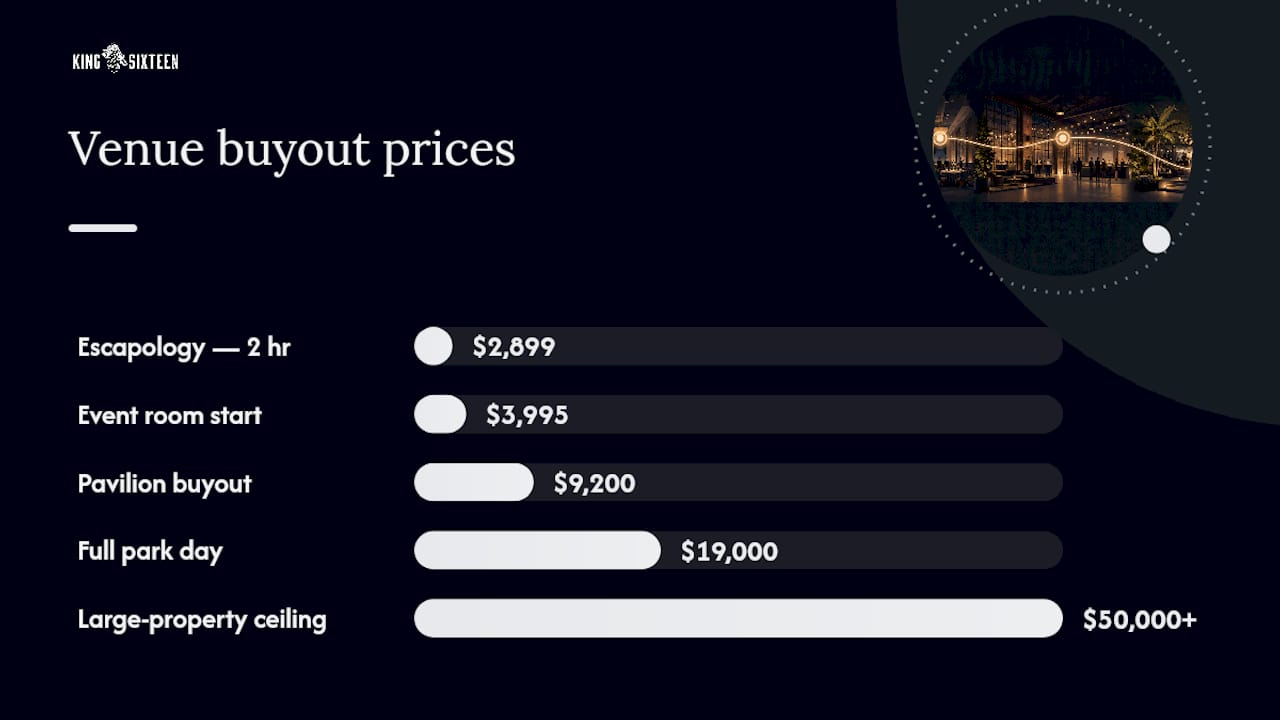
At the small end, entertainment venues sell fixed-time buyouts that read almost like a menu. Escapology’s Plantation, Florida location lists a 2-hour venue buyout at $2,899 and a 3-hour version at $3,899, which works out to roughly $960 to $1,300 per hour for full exclusivity of a small entertainment space. That’s a useful anchor for any planner sourcing a compact, capacity-limited venue for a launch party or small activation.
Move into banquet and event-hall territory and pricing shifts to time-band structures. This Is the Place, a multi-room event venue, posts starting rates near $3,995 for certain rooms and time blocks, with add-on fees (one example: $395) triggered when a client brings in a caterer outside the venue’s preferred list. That single line item is worth remembering: outside vendors almost always cost extra, and it rarely shows up until the second draft of a quote.
At the top of the range, public parks and pavilions post some of the highest flat-fee numbers you’ll see, precisely because they’re renting out an entire outdoor footprint for a full day. Riverfront Spokane’s rate sheet shows a full park rental at $19,000 for the day and a pavilion buyout at $9,200. Industry guides generally frame the national ceiling around $50,000+ for large or exclusive properties, with the $3,000 to $50,000+ range capturing most of what you’ll encounter.
City matters more than most planners expect. A buyout that costs $8,000 in a secondary market can run double that in Los Angeles, Manhattan, or Miami during peak wedding or conference season, simply because the venue’s best comparable nights are worth more.
What Drives the Price? Breaking Down a Buyout Quote
A buyout quote isn’t one number. It’s a stack of line items, and understanding each one is how you catch overcharges or missing inclusions before you sign.
- Room or site rental (the flat buyout fee). This is the base charge for exclusive use of the space, independent of food and drink.
- Food and beverage minimum. Many venues, especially restaurants and hotels, waive or reduce the rental fee if you commit to spending a set amount on catering.
- Displacement or access premium. This is the fee that compensates the venue for turning away its normal walk-in or a la carte business during your event window.
- Staffing. Bartenders, servers, a banquet captain, and security are usually billed separately, often per person or per hour.
- AV, cleaning, and permits. Sound systems, projection, post-event cleaning crews, and any city or fire permits required for exclusive use.
- Insurance. Most venues require a certificate of general liability insurance, which can be a one-time cost through an event insurance provider.
- Overtime. Run past your contracted end time and expect an hourly penalty, commonly $150 to $400 per hour depending on market and venue tier.
Two costs get buried more than any others: service charges and sales tax. Service charges typically run around 18% to 24% on top of food and beverage totals, and many states apply sales tax to both the rental fee and the service charge, not just the catering bill.
Pro Tip: Ask every venue to show you the math behind the total, not just the bottom line. A quote that separates rental, F&B minimum, service charge, and tax is a sign of a well-run operation. A single lump number, with no breakdown, is where hidden fees like outside-caterer surcharges tend to hide.
How Do Venues Actually Calculate Buyout Prices?
Most experienced venue operators don’t pull a buyout number out of thin air. They run it through a formula, and knowing that formula tells you whether a quote is fair or padded.
The method starts with a displacement floor, the average revenue the venue would have earned across its best comparable recent nights if it hadn’t handed the space over to you. From there, operators typically apply a buyout multiplier of roughly 1.25 to 1.4 on top of the food and beverage minimum, then layer on an access premium of 15% to 25% of that minimum, to account for the fact that exclusivity has its own value beyond lost sales.
Sharper venues take this further with structured pricing tools:
- Two-tier quoting, offering a base package and a premium package so you can see the value gap between them.
- Seasonal grids, publishing discounted shoulder-date rates alongside peak-season premiums instead of negotiating case by case.
- Multi-day or repeat-client discounts, often listed directly on a venue’s published rate sheet rather than offered only when asked.
Venues that price this way tend to capture materially more revenue than ones quoting a single flat number off the F&B minimum alone, which also means their quotes are usually more defensible if you push back.
How Venue Type and Guest Count Change the Price
Event type reshapes the buyout math almost as much as location does.
- Wedding weekend buyouts run highest because they often lock the venue for two or three days, not one evening, and national venue-only averages typically land in the $8,500 to $12,000 range before multi-day premiums, with wide state-by-state swings.
- Corporate single-evening buyouts tend to sit in the mid-range band, since a five-hour launch event or client dinner carries far less displacement cost than a full weekend.
- Restaurant buyouts are often quoted as a flat package for groups under 100, bundling rental and catering into one number rather than itemizing every line.
- Estate and park buyouts carry the largest flat all-day fees, since you’re renting acreage and infrastructure, not a fixed room count.
For quick math, a mid-market corporate buyout with catering, staffing, and AV often lands somewhere between $150 and $300 per guest, all in. Weddings frequently run higher once florals, rentals, and multi-day access get added on top of the venue line.
How to Budget, Quote, and Negotiate a Buyout
Getting an accurate number before you commit comes down to asking the right questions and giving yourself leverage on timing.
- Ask whether the minimum is F&B-only or fully inclusive. Some venues count only food and drink toward the minimum; others fold in rental and service fees.
- Get the overtime rate in writing. At $150 to $400 an hour, a two-hour overrun can quietly add four figures to your final invoice.
- Confirm what counts toward the minimum. Corkage, cake-cutting, and audiovisual rentals sometimes count, sometimes don’t.
- Read the cancellation and rescheduling terms closely. Deposits are frequently nonrefundable, and rescheduling within a certain window can trigger a second deposit.
- Ask for the seasonal rate grid, not a verbal quote. A published grid removes guesswork and gives you shoulder-date options to negotiate toward.
Booking lead times vary by venue type: restaurants and small event spaces often confirm four to eight weeks out, while estates, parks, and premium wedding venues frequently book six months to a year ahead for peak dates.
Pro Tip: If a quote comes in below what the venue’s own displacement math would suggest, ask them to itemize exactly what’s included. A below-floor quote usually means something got left off the page, not that you found a deal.
Sample Venue Buyout Rate Sheet Snapshots
| Venue / Rental Type | Headline Price | Source and Date Notes |
|---|---|---|
| Escapology (Plantation, FL) — 2-hour venue buyout | $2,899 | Escapology rate sheet |
| Escapology (Plantation, FL) — 3-hour venue buyout | $3,899 | Escapology rate sheet |
| This Is the Place — event room, starting rate | $3,995 | This Is the Place pricing |
| Riverfront Spokane — pavilion full rental | $9,200 | Riverfront Spokane rates |
| Riverfront Spokane — full park rental, all day | $19,000 | Riverfront Spokane rates |
These are representative snapshots pulled from published rate sheets, not live quotes. Confirm current pricing directly with each venue before budgeting against them.
When Does It Make Sense to Hire an Agency for a Buyout?
Once a buyout involves branded staging, multi-vendor coordination, or a reputation on the line, the venue fee stops being the hard part. King Sixteen consolidates AV, fabrication, staffing, and catering into one production fee, which keeps total cost predictable instead of ballooning line by line during negotiation. That’s the real value: fewer vendors to chase, one point of accountability, and a brand experience built to scale with the buyout itself.
— Tyler
Let King Sixteen Handle Your Next Venue Buyout
An agency can be the alternative to piecing together a buyout yourself, one vendor call at a time. Instead of separately negotiating room fees, catering minimums, AV, staffing, and security, you get one turnkey team that sources the venue, negotiates the displacement math on your behalf, and builds the branded environment inside it.

That includes venue sourcing, talent booking, custom fabrication, catering and staffing, and geoframe digital advertising for the event itself, all run through a vendor network built over years of high-stakes activations for brands like Porsche and Ray-Ban. If your buyout needs to double as a brand activation rather than just a rented room, that’s a different scope than most venues quote for, and it’s exactly where a private events team earns its fee. Reach out for a consultation and get a real quote against your date and guest count before you commit to a venue’s number alone.
Sources
- Restaurant Buyout Pricing: How Venues Should Quote
- How much does it cost to hire an entire venue for an event?
- Rates — Riverfront Spokane venue rentals
- Venue Buy Out Escape Room Packages
FAQ
What is a realistic budget for a 100-person wedding?
A 100-guest wedding with a venue-only cost near the $8,500 to $12,000 national average typically lands in a higher total budget once catering, staffing, and rentals are added, though city and season shift that range significantly.
How much can a venue buyout cost?
Buyouts range from roughly $3,000 at the low end to $50,000 or more at the high end, driven mainly by venue size, guest count, and how much the venue’s displaced revenue is worth on that date.
What is the average cost of a wedding venue in the US?
Venue-only averages commonly fall between $8,500 and $12,000, though major metro markets and peak-season Saturdays often push that figure well above the national average.
How profitable is owning a wedding venue?
Profitability depends heavily on how well a venue prices its buyouts against its displacement floor. Venues that publish seasonal rate grids and use multiplier-based pricing tend to capture more revenue per event than those quoting a flat number off a single F&B minimum.
Is a full venue buyout worth it over a partial rental?
A full buyout makes sense when privacy, branding, or guest count requires the entire space, while a partial rental or shared space works for smaller groups willing to share common areas and typically costs less than a full displacement fee.
Recommended
- Corporate Buyout Events: Your Executive Strategy Guide
- Top 5 Exclusive Corporate Event Buyout Agencies 2026
- Top 4 Private Corporate Retreat Buyout Agencies 2026
- What an Event Bar Package Actually Costs Your Brand