Sustainable event production is the practice of treating environmental impact as a core production discipline: setting measurable targets, binding suppliers through contracts, and reporting outcomes against a recognized framework like ISO 20121. The three moves that matter most right now are naming an accountable owner with real targets, writing sustainability requirements into vendor contracts, and measuring results after every show. We apply that discipline across every production we run.
TL;DR:
- Set a named owner, numerical targets, and review dates before budgets and venues lock; finalize power, staging, and catering decisions six to nine months ahead.
- Require vendors to document environmental claims, accept material take back terms, and submit sustainability records before final payment, including sourcing proof or reuse inventories.
- A zone based power audit can size generators to 60% to 80% load; solar and battery systems can cut runtime 30% to 50% at festivals.
- Staff three stream sorting stations at roughly one per 100 attendees, then audit actual diversion; unstaffed bins can contaminate recyclable material.
- Track on site fuel and purchased power first, then establish a baseline for attendee travel, freight, and accommodation, which are harder to control.
Table of Contents
- Core principles of sustainable event production
- Building sustainability into the planning phase
- Choosing vendors and venues that meet sustainability criteria
- Reducing power use and emissions during production
- Designing out waste before it happens
- Measuring results against recognized standards
- How we apply production discipline on-site
- Why sustainability has to be a production line item, not a slogan
- Partner with a team that builds sustainability into production
- FAQ
- Sources
Core principles of sustainable event production
Sustainable event production rests on a handful of pillars, and each one needs its own owner and budget line. Governance comes first: without a named decision maker and a written policy, sustainability goals drift. Sourcing covers materials, catering, and fabrication choices made before the event ever opens its doors. Energy addresses how power gets generated and consumed on-site. Waste covers everything from serviceware to signage disposition. Transport spans freight, staff travel, and attendee commuting. Social legacy looks at what the event leaves behind for the host community.
ISO 20121 frames all of this as a continual improvement cycle rather than a one-time checklist, which matters because perfection on the first event is never the goal.
- Waste diversion target: often a high percentage depending on venue infrastructure
- GHG reduction target: commonly a year-over-year percentage tied to a baseline event
- Local sourcing target: a defined share of catering and materials from regional vendors
Building sustainability into the planning phase
Sustainability has to enter the production timeline at the same point as budget and venue decisions, not after the run-of-show is locked. An event sustainability policy names an accountable owner, sets review dates, and states targets in numbers rather than intentions.
- Draft a one-page sustainability policy naming an owner and a review cadence.
- Set measurable targets: a waste diversion percentage, an energy source mix, a local sourcing share.
- Build sustainability clauses into every RFP: reusable serviceware requirements, material take-back obligations, and documentation of sourcing.
- Lock infrastructure-heavy decisions, power systems, modular staging, catering contracts, six to nine months out so vendors can plan around them.
Pro Tip: Attach your sustainability targets as an appendix to the master production timeline so every department sees them at the same milestones as budget and staffing.
Choosing vendors and venues that meet sustainability criteria
Vendor selection is where sustainability commitments either hold or collapse. A catering partner claiming compostable serviceware means little without documentation, and a fabricator claiming modular design means little without a reuse inventory to prove it.
- Ask every vendor for certifications or documentation behind sustainability claims, not just marketing language.
- Favor fabrication partners that build modular, reusable systems over single-use builds.
- Tie final payment to delivery of sustainability documentation rather than paying in full upfront.
- Include take-back clauses requiring vendors to remove and repurpose their own materials.
- Consolidate shipments and prioritize regional vendors to cut freight-related transport emissions.
EPA green meeting procurement guidance requires waste diversion metrics and food and beverage sustainability attributes as standard contract terms, a useful baseline for any RFP.
Reducing power use and emissions during production
Power is one of the fastest wins in event production because it is almost always oversized. A zone-based power audit, mapping actual draw per area rather than nameplate capacity, typically shows generators running at a fraction of rated load. Right-sizing generators to a 60 to 80 percent load target cuts fuel burn and noise without touching show quality.
- Run a zone-based power audit before finalizing generator orders.
- Pair solar and battery systems for base loads, reserving biodiesel or HVO generators for peak draw.
- Switch to LED fixtures and efficient AV gear, then schedule high-draw moments to avoid simultaneous peaks.
Hybrid solar-battery systems with right-sized backup generators can cut generator runtime by 30 to 50 percent at festival scale. That reduction shows up directly in fuel costs and noise complaints, which makes the audit worth the extra planning week.
Designing out waste before it happens
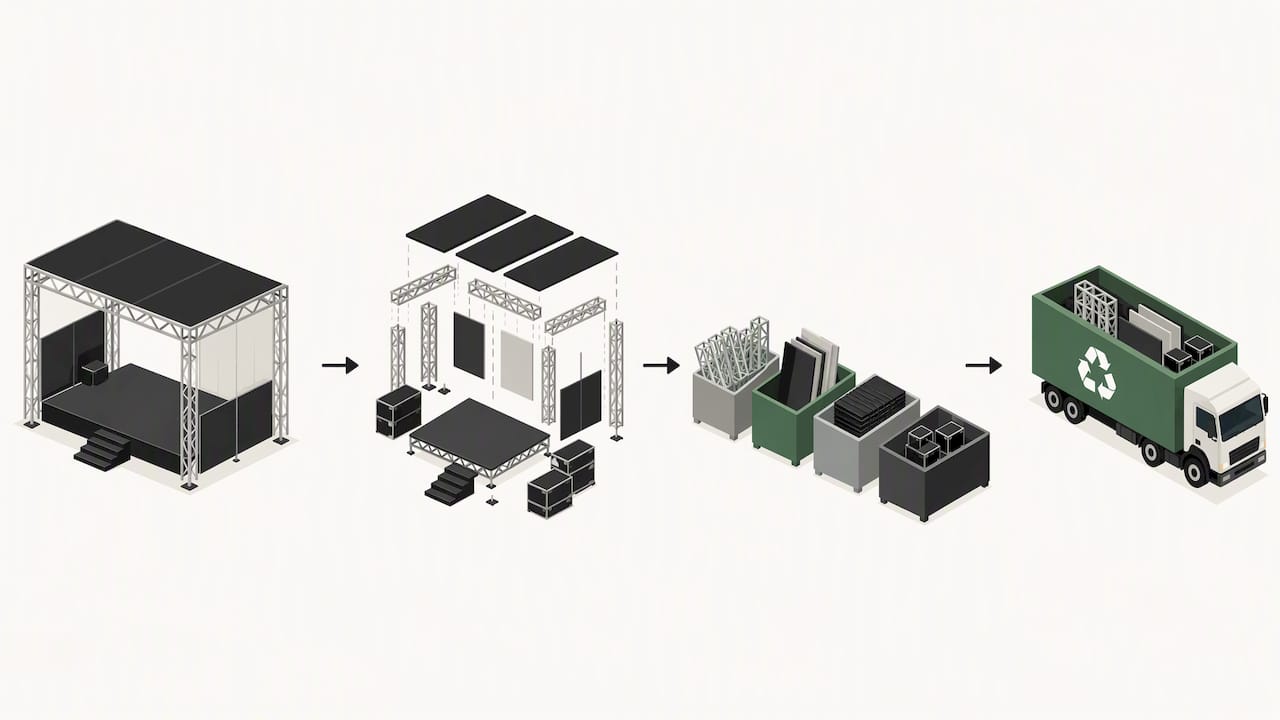
The cheapest waste to manage is the waste that never shows up. Design rules that favor modular, reusable assemblies over composite materials prevent landfill-bound builds from entering the production in the first place.
- Specify reusable, modular staging and signage wherever the budget allows.
- Require compostable serviceware meeting ASTM D6400 standards in every catering contract.
- Staff three-stream sorting stations at a ratio of roughly one station per 100 attendees.
- Build post-event disposition into contracts: donation, reuse, or recycler partnerships, with documentation required.
- Run a post-event waste audit measuring actual diversion against your target.
Pro Tip: Staffed sorting stations consistently outperform unstaffed bins on stream purity, which is the difference between material that actually gets recycled and material that gets rejected at the sorting facility.
The UNDP’s Making MICE Circular toolkit documents these circular practices in detail, from modular design through recycler partnerships, as a reference for building your own waste plan.
Measuring results against recognized standards
What gets measured is what actually improves year over year. Event emissions typically fall into three categories worth tracking separately: direct on-site fuel use, purchased power, and the broader footprint from attendee travel, freight, and accommodation.
- Track direct fuel and power use as your baseline, easiest to measure, easiest to improve first.
- Track attendee travel, freight, and accommodation as the larger, harder-to-control category.
- Select a baseline year early so every future event has a fixed comparison point.
- Pull data from vendor invoices, power logs, and waste hauler reports rather than estimates.
The Events Industry Council’s Sustainable Event Standards use a tiered Bronze through Platinum structure covering climate action, supply chain management, and materials circularity, giving producers a verifiable benchmark rather than a self-reported claim. ISO 20121 complements that structure by embedding the management system itself into how an organization plans future events.
How we apply production discipline on-site
Running creative, fabrication, staffing, and logistics through one accountable partner removes a source of waste that rarely gets discussed: redundant materials ordered by vendors who never talk to each other. A turnkey model consolidates those decisions under one production team, which means fewer duplicate builds and fewer last-minute freight runs.
On-site, our production teams work from a standing checklist:
- Set modular fabrication targets so staging and signage can be redeployed across future events.
- Maintain a reuse inventory tracked between projects instead of rebuilding from scratch.
- Consolidate transport routes across vendors to cut freight trips.
- Staff waste operations directly rather than relying on unsupervised bins.
Why sustainability has to be a production line item, not a slogan
Sustainability efforts fail when they live in a marketing deck instead of a budget. Naming an owner and assigning a real line item forces the same rigor applied to staffing or AV. The payoff is not just reputation, it is reduced operational risk and an event legacy that holds up under scrutiny. Progress measured honestly against last year beats a polished claim that nobody can verify.
— Tyler
Partner with a team that builds sustainability into production
We handle turnkey event production, modular fabrication, vendor management, and on-site operations through one accountable team, which means sustainability requirements get built into contracts and builds from day one instead of bolted on afterward. A single partner managing design, staffing, and logistics also reduces vendors duplicating materials and freight runs across the same event.
For digital event materials like signage or printed programs, pairing production with a partner like Coleman Web Designs for video and digital assets can replace print runs entirely. When you are ready to plan a production that treats sustainability as a discipline rather than an afterthought, explore our experiential services and start the conversation.
FAQ
What is sustainable event production?
Sustainable event production treats environmental impact as a managed discipline within the production process itself, covering sourcing, energy, waste, and transport. It relies on measurable targets and frameworks like ISO 20121 rather than one-off green gestures.
How does ISO 20121 apply to events?
ISO 20121 is an international management-system standard that guides organizations in embedding sustainability into event governance, supplier requirements, and continual improvement. It does not certify a single event so much as the system an organization uses to plan every event going forward, according to ISO’s standard documentation.
How can event planners reduce waste on-site?
Staffed three-stream sorting stations, compostable serviceware meeting ASTM D6400 standards, and mandatory post-event disposition clauses in vendor contracts together cut landfill-bound waste significantly. A post-event waste audit confirms whether the diversion target was actually met.
What services are offered for sustainable production?
We provide turnkey event production, including custom fabrication, vendor management, and on-site operations, through a single accountable team rather than multiple disconnected vendors. Pricing is available on request through our main services page.
Sources
Attendee travel, freight, and accommodation typically represent the largest and hardest-to-control emissions categories for events, while on-site fuel and power use are usually the easiest to measure and reduce first. Prioritizing local sourcing and vendor consolidation addresses both the transport and freight components directly, a practice documented in the UNDP circular toolkit.
- EIC Sustainable Event Standards (Event Industry Council Insights)
- ISO 20121: Event sustainability management systems — Requirements with guidance for use
- Making MICE Circular toolkit (UNDP, June 2026)