The most reliable material strategy combines modular aluminum frames with dye-sublimation fabric graphics and engineered cardboard or FSC-certified wood counters, giving you a booth that packs light, reconfigures easily, and holds up across dozens of shows. Renting makes sense if you exhibit once a year or less; buying wins for anyone hitting the floor three or more times annually. The breakdown below walks through every material category, cost range, and sourcing question you need before signing a purchase order.
TL;DR:
- Modular aluminum frames are more cost-effective over multiple shows and easily reconfigured, compared to renting or buying single-use systems.
- Dye-sublimation fabric offers vivid, wrinkle-resistant graphics, while vinyl is less durable and more prone to damage under exhibition conditions.
- Reusing frames, choosing recycled materials, and reducing printed literature significantly lower long-term costs and waste compared to disposable solutions.
- Customized fabrication requires longer lead times and higher costs, but shipping efficiency benefits from flat-packed designs and early planning.
- Smart material choices should prioritize reuse potential and operational discipline to maximize durability, cost savings, and environmental impact.
Table of Contents
- What are the best trade show booth materials for durability and portability?
- Which frame system fits your booth strategy?
- Which printing method holds up best under show lights?
- How do sustainable materials reduce booth costs?
- What should you budget for booth materials and lead time?
- How do you source or rent booth materials without getting burned?
- What safety rules apply to trade show booth materials?
- How do lighting and venue conditions affect material choice?
- What new materials and technology are changing booth design?
- Why sustainability and reuse should drive every material decision
- Let King Sixteen Handle Your Booth Materials and Logistics
- Sources
What are the best trade show booth materials for durability and portability?
Every booth element has a job to do, and the material you choose should match that job rather than default to whatever looks good in a catalog photo. Fabric, rigid panels, engineered paper products, and wood each solve a different problem, and mixing them intentionally is how experienced exhibitors get both a premium look and a manageable shipping crate.
Fabric is the workhorse of modern booth design. Dye-sublimation polyester tension fabric infuses ink directly into the fibers rather than layering it on top, which is why the color stays vivid through repeated folding and washing. You can order it as a pillowcase style that slips over a frame like a fitted sheet, or finish it with a silicone-edge graphic (SEG) treatment for a taut, borderless surface that reads as high-end from ten feet away.
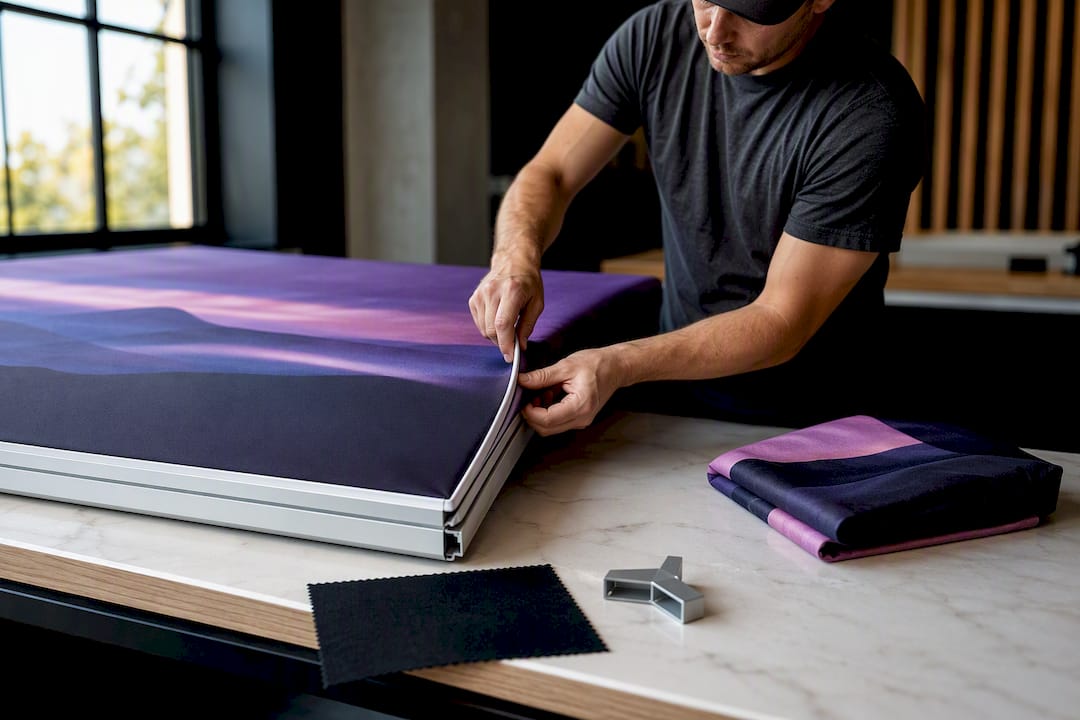
Rigid substrates cover the jobs fabric can’t. PVC and foam board hold sharp edges for small signage and directional panels, but they crack under repeated flexing and add real weight to a shipping crate. Corrugated plastic splits the difference: cheaper than PVC, more forgiving in transit, but still not something you want to fold.
Engineered paper and wood round out counters, risers, and reception desks:
- Honeycomb cardboard delivers rigidity at a fraction of solid wood’s weight and recycles far more easily than PVC or MDF.
- FSC-certified wood veneer gives a premium tactile finish for counters that face heavy public contact.
- Both options beat single-use MDF on long-term cost once you account for disposal fees after the show.
Weigh finish quality against pack size before locking in a material. A gorgeous solid-wood reception counter photographs well, but if it triples your drayage bill, the math rarely works in your favor.
Which frame system fits your booth strategy?
The frame underneath your graphics determines how fast your crew installs, how far your kit travels, and whether you can reconfigure the booth for a different footprint next quarter. Three system types dominate the market, and each has a distinct sweet spot.
- Pop-up systems collapse into a rolling case and typically go from box to finished backwall in 15 to 30 minutes, making them the default for small booths and single-day setups.
- Modular aluminum frames take longer to build, usually one to three hours depending on configuration, but they enable repeated reconfiguration across shows without buying new hardware every time your footprint changes.
- Multi-frame kits stack modular components into larger islands and peninsulas, often requiring a labor crew and a half-day install window, but they scale from a 10x10 to a 20x20 without a full rebuild.
If you’re testing a new market or exhibiting once, rent a pop-up or a basic modular kit and skip the capital investment entirely. Once you’re committing to three or more shows a year, buying a modular aluminum frame and ordering fresh fabric skins each season costs less over time than repeat rental fees, and you own an asset that adapts as your booth design evolves.
Pro Tip: Ask any modular frame vendor whether their connectors are tool-free. Systems that snap together without an Allen wrench cut install time dramatically and reduce the odds of a missing part derailing your morning.
Which printing method holds up best under show lights?
Print quality is where booths win or lose their first impression, and the substrate you print on matters as much as the artwork itself.
- Dye-sublimation fabric produces saturated, wrinkle-resistant color and folds flat for shipping, making it the standard for backwalls, tension displays, and hanging structures.
- Vinyl costs less upfront and works well for rigid panels and floor graphics, but it’s heavier, prone to curling in humid halls, and harder to pack without creasing.
- SEG finishing stretches fabric into a frame channel using a silicone edge strip, eliminating the visible border and producing the seamless look premium brands favor for photography.
Whatever method you choose, request a small proof panel before committing to a full print run. SEG in particular requires tight print-to-size tolerances, and a proof catches color drift or stretch issues before they show up on a 10-foot backwall. Apply a UV-protective laminate on anything facing direct light for multiple days, and budget for one full graphic replacement every two to three years even if the frame itself keeps going.
How do sustainable materials reduce booth costs?
Sustainability in booth design isn’t a marketing angle bolted onto your build. It’s a set of practical choices that reduce both waste and your recurring spend, and the two goals usually point in the same direction.
- Reuse the same aluminum frame across multiple shows and order only new fabric skins when your messaging changes.
- Choose recycled polyester textiles and FSC-certified wood over virgin plastic laminates wherever the application allows it.
- Rent flooring instead of buying it, since carpet and padding rarely survive shipping well enough to justify ownership.
- Swap printed literature for QR codes or a kiosk, which cuts paper waste and gives your marketing team real-time lead data instead of a stack of unread brochures.
Eco-conscious booth programs built around these habits consistently show lower waste and lower long-term cost than one-off custom builds. Track two numbers to prove it: how many times a given frame gets reused, and how much your shipped cubic footage drops year over year. Both are easy to log in a spreadsheet, and both give you a real number to show a sustainability-minded client or internal stakeholder.
What should you budget for booth materials and lead time?
Price ranges swing enormously based on scale, and knowing where your project lands on that spectrum before you request quotes saves a lot of back-and-forth.
- Entry-level banner stands and small pop-up backwalls run under $300.
- Modular kits for a standard 10x10 or 10x20 typically land in the low to mid thousands.
- Custom islands with fabricated counters, lighting, and specialty finishes can climb into the tens of thousands.
Lead time follows a similar logic. Custom fabrication projects generally need several weeks, and that window stretches further with specialty finishes, overseas printing, or last-minute design changes. Shipping cost tracks crate volume directly, so a flat-packed, nested design almost always beats a bulky one on drayage fees even when the materials cost the same. Watch for hidden line items too: protective laminate coatings, off-season storage between shows, and expedited shipping charges when a deadline slips can quietly add 15 to 20 percent to a quote that looked reasonable on paper.
How do you source or rent booth materials without getting burned?
Start with a simple decision: rent for a single show or unpredictable frequency, buy for three or more shows a year, and commission a custom build only when your brand needs a footprint no off-the-shelf kit can deliver.
- Confirm domestic printing capability if your timeline is under four weeks. Overseas print runs almost always blow past a tight deadline.
- Ask for a physical proof panel, not just a digital rendering, before approving a full production run.
- Request the supplier’s damage and replacement cost policy in writing before the show, not after something arrives cracked.
- Confirm storage fees if you’re leaving frames or crates with the vendor between events.
Pro Tip: Put every one of these questions in your RFP template so you’re comparing suppliers on identical terms. A vendor who hesitates on storage fees or warranty language is telling you something before the contract is even signed.
Hand your procurement team a checklist covering lead time, proof approval dates, and drayage estimates well before your show date, so nothing gets discovered the week of install. Reviewing modular booth construction options before you finalize a purchase order also helps you avoid locking into a frame system that can’t grow with your program.
What safety rules apply to trade show booth materials?
Fire codes govern almost every material decision on the show floor, and most convention centers require flame-retardant certification for fabric, carpet, and any draping used in a booth. Ask every fabric or carpet supplier for a certificate of flame resistance before the graphic goes into production, since replacing an uncertified backwall the morning of load-in is a problem you don’t want.
Structural stability matters just as much once you’re building above eye level. Tall structures, hanging signs, and multi-level booths typically require engineering sign-off from the show’s general contractor, and rules vary by venue and by show organizer. Confirm your structure’s height and rigging requirements against that specific show’s exhibitor manual rather than assuming last year’s rules still apply.
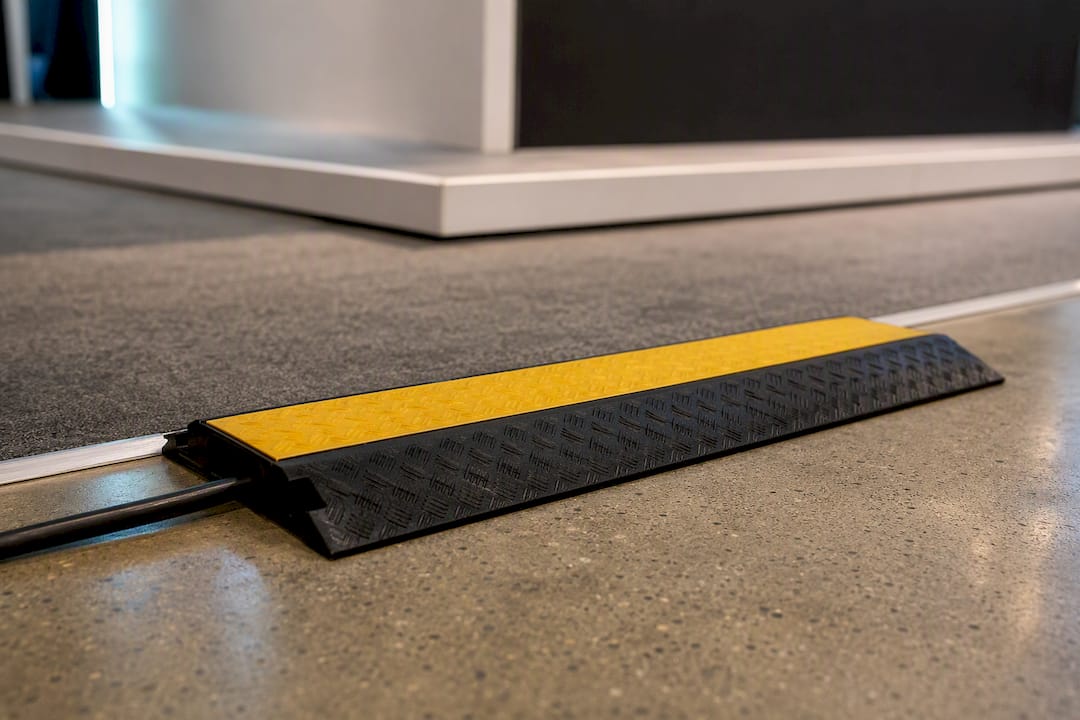
Weight distribution deserves attention too. A heavy monitor mounted on a lightweight modular frame can create a tipping hazard if the base isn’t rated for it, and aisle clearance rules mean protruding counters or floor graphics can’t extend past your contracted booth line. Cable management is the most overlooked safety item on the list: any cord crossing a walkway needs a rated cable ramp, not just tape, to satisfy most venue safety inspectors and keep attendees from tripping during a busy show.
How do lighting and venue conditions affect material choice?
Convention hall lighting varies wildly from one venue to the next, and a booth that looked crisp under one show’s fluorescent grid can look washed out or overly warm under another’s LED wash. Fabric graphics handle this better than vinyl because the ink sits within the fiber rather than reflecting off a glossy surface, which reduces glare under harsh overhead lighting.
Backlit SEG panels paired with integrated low-power LED are increasingly popular for exactly this reason. They control their own light source instead of depending on whatever the venue provides, giving you consistent color and contrast whether you’re in a dim ballroom or a hall flooded with natural light from a glass ceiling. That consistency matters most for brands running photography or video content at their booth, since inconsistent ambient light is the fastest way to make product shots look unprofessional in post.
Humidity and temperature swings inside convention centers also affect material performance over a multi-day show. Vinyl is more prone to curling at the edges in humid halls, while properly tensioned fabric resists that shift because the frame keeps it taut regardless of ambient moisture. If your show calendar includes venues in humid climates, factor that into your material choice rather than treating every hall as climate-neutral.
What new materials and technology are changing booth design?
Integrated LED has moved from a novelty add-on to a standard spec on premium modular systems, with backlit SEG panels now common enough that most frame manufacturers build the wiring channel directly into the extrusion. That means lighting is no longer a separate installation step bolted on after the fact. It’s part of the frame’s core design, which cuts install time and reduces the number of loose components a crew has to manage on site.
Low-power LED strips have also made battery-powered lighting realistic for booths without easy access to venue power, which matters more than it sounds for peninsula and island configurations where a power drop can be a scheduling headache with the general contractor. Expect to see more frame systems shipping with LED pre-wired as a standard option rather than a costly upgrade within the next few show seasons.
On the sustainability side, recycled-content aluminum extrusions and fully recyclable fabric blends are starting to appear from manufacturers responding to client pressure for lower embodied carbon, as explained in sustainable branding and materials choices. None of this replaces the fundamentals covered above. It layers on top of a modular frame and fabric graphic foundation that still does the heavy lifting for durability and reuse.
Why sustainability and reuse should drive every material decision
Most booth guides treat sustainability as an add-on: a nice-to-have once the “real” decisions about frame type and graphics are settled. That gets the order backwards. Reuse potential should be the first filter you apply to any material choice, because it’s the variable that actually controls your cost curve over a multi-year exhibiting program.
The conventional advice tells planners to chase the cheapest per-show price, which pushes people toward disposable pop-ups and vinyl graphics that look fine once and then get thrown away. A modular frame costs more upfront, but amortized over three, four, or five shows, it beats rental fees and disposable materials on every measure that matters: cost, waste, and crew familiarity with the setup.
What gets underestimated is how much operational discipline, storage, tagging, flat-pack habits, matters compared to material selection alone. You can buy the most recyclable fabric on the market and still waste money if nobody tracks which crate holds which panel. Prioritize a system built for reuse first, then optimize the materials within it. That order of operations is where most exhibitors get it backwards, and it’s the single change that pays off fastest.
— Tyler
Let King Sixteen Handle Your Booth Materials and Logistics
Sourcing frames, fabric, and finishes on your own means juggling print vendors, storage contracts, and drayage estimates on top of your actual marketing work. King Sixteen removes that entire layer. As a turnkey experiential partner, we design, fabricate, and manage booth materials end to end, including the storage and inventory tracking that keeps a modular system reusable show after show instead of ending up in a landfill after one activation.
That turnkey model matters most for brands running multiple shows a year or coordinating a rollout across several markets at once, where a missed lead time or a mismatched frame system turns into a real budget problem. If your next activation needs a custom build, a reliable rental program, or simply a team that owns the whole process from concept to load-in, start a conversation about your experiential program and get a plan built around your show calendar, not a generic template.
Sources
- Displayit — all trade show displays
- T3 Systems — Somfy YED 2026 sustainable exhibition stand
- Forest Nation — A comprehensive guide to eco-friendly event booth ideas
- Design Radiant — Paper and Wood exhibition case