Strategic events convert experiential investment into measurable pipeline, revenue, and brand equity. Unlike a one-off activation or a tactical sponsorship, a strategic event is designed from the start to serve a specific business objective: accelerating deals, deepening customer retention, building thought leadership, or enabling partners. Governed by frameworks like SOSTAC and integrated with CRM and marketing automation, these programs produce outcomes you can defend in a board meeting.
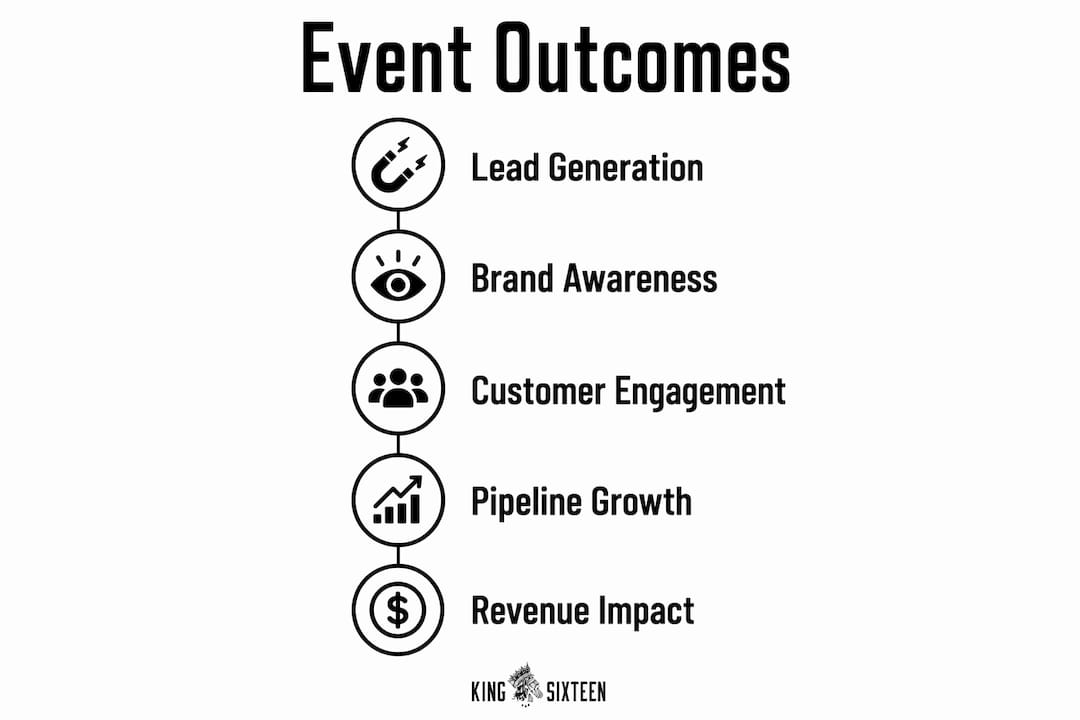
The primary outcomes strategic events are built to deliver:
- Pipeline acceleration through qualified prospect engagement at product launches and trade shows
- Brand equity growth via immersive experiences that shift perception at scale
- Customer retention and expansion through executive summits and loyalty programs
- Partner enablement and co-sell momentum from industry conferences
- Thought leadership positioning that shortens future sales cycles
Table of Contents
- Why strategic events are a growth channel, not a line item
- What roles do strategic events play in your marketing strategy?
- How do you measure the real impact of strategic events?
- How should you organize governance for a strategic event program?
- What does the event lifecycle actually look like?
- What tech stack do you actually need to make events measurable?
- How Kingsixteen delivered measurable outcomes for a high-value brand
- Common pitfalls that kill strategic event ROI
- Should you run a strategic event or invest elsewhere?
- What trends are reshaping how strategic events work?
- Key Takeaways
- Why we treat every event as a strategic product
- How Kingsixteen builds strategic events that move the needle
- Useful sources and further reading
Why strategic events are a growth channel, not a line item
Most marketing budgets treat events as a cost center. That framing is the first mistake. Strategic event management positions events as a repeatable growth channel where every decision, from format to pricing to content, ladders up to enterprise objectives like pipeline, revenue, and retention.
The difference between a tactical event and a strategic one comes down to intent and governance. A tactical event fills a calendar slot. A strategic event has a defined business objective, a cross-functional owner, a measurement framework, and a post-event activation plan before the venue deposit is paid.
According to Bizzabo, 97% of B2B marketers and 72% of event organizers consider in-person events critical to business strategy and central to their 2026 planning. That consensus reflects a real shift: events are no longer merely a “nice to have” in the marketing mix.
Three concrete outcomes illustrate the difference in practice. A product launch tied to a pipeline goal can generate qualified opportunities the sales team can work within 30 days. A customer summit with structured success-story content can lift renewal rates by reinforcing value at the right moment in the contract cycle. An industry conference with curated executive meetings can produce signed partnership agreements before attendees leave the building.
What roles do strategic events play in your marketing strategy?
Strategic events serve distinct roles, and matching the right event type to the right objective is where most programs either win or waste budget.
- Demand generation: Product launches and trade shows generate net-new leads and qualified pipeline. Primary KPI: sourced pipeline value and cost per qualified lead.
- Pipeline acceleration: Executive briefings and hosted buyer programs move stalled deals. Primary KPI: deal velocity and stage progression rate.
- Brand building: Large-scale experiential activations shift perception and earn media. Primary KPI: brand lift scores and share of voice.
- Customer retention and expansion: Customer summits and user conferences reinforce value and surface upsell opportunities. Primary KPI: renewal rate and net revenue retention.
- Partner enablement: Industry conferences and co-hosted events build co-sell relationships. Primary KPI: partner-sourced pipeline and joint deal registrations.
- Executive alignment: Internal summits and leadership retreats align cross-functional teams on strategy. Primary KPI: decision velocity and program adoption.
The event-to-role mapping is worth keeping visible. Trade shows are lead-volume engines. Customer summits protect and grow lifetime value. Executive retreats compress internal decision cycles. Each format has a natural home in the events-drive-revenue ecosystem, and forcing the wrong format onto the wrong objective is one of the fastest ways to burn budget.

How do you measure the real impact of strategic events?
Strategic event management improves outcomes when KPIs map directly to business objectives rather than vanity metrics like total registrations or social impressions. The table below gives you a working framework.
| Business objective | Event type | Primary KPI | Data source |
|---|---|---|---|
| Pipeline generation | Product launch, trade show | Sourced pipeline ($) | CRM opportunity record |
| Deal acceleration | Executive briefing, hosted buyer | Stage progression rate | CRM deal stage log |
| Brand awareness | Experiential activation | Brand lift score | Pre/post survey |
| Customer retention | Customer summit | Renewal rate, NRR | CRM / CS platform |
| Partner enablement | Industry conference | Partner-sourced pipeline | Partner portal / CRM |
| Sponsor ROI | Sponsored conference | Sponsor cost-per-lead | Lead scan + CRM sync |
Pro Tip: Tag every event registration as a lead source in your CRM on day one. When a registrant later appears on an opportunity, that event gets credited as an influenced touchpoint. Without that tag, attribution becomes guesswork and your event budget loses its business case at renewal time. For a deeper look at connecting attendance data to revenue, see event data and marketing outcomes.
How should you organize governance for a strategic event program?
Strategic events fail when they are owned by one team and ignored by everyone else. The fix is cross-functional sponsorship from the start, with a steering committee that includes marketing, sales, customer success, finance, and operations.
A SOSTAC-style governance model keeps everyone aligned. Situation analysis confirms the business case. Objectives are set before the venue is booked. Strategy defines the audience, format, and content approach. Tactics cover production, promotion, and partner sales. Action assigns owners. Control defines the measurement cadence and escalation path.
- Goals and business case: Marketing and Sales jointly own; approved by CMO and CRO.
- Budget approval: Finance signs off; contingency line (typically 10–15%) is pre-approved.
- Content and programming: Marketing owns; Sales and Customer Success review for relevance.
- Sponsor sales enablement: Sales owns; Marketing provides collateral and pricing.
- Data integration: Marketing Ops owns; IT reviews CRM and automation connections.
- On-site execution: Event lead owns; Operations and staffing partners execute.
- Post-event activation: Marketing Ops owns; Sales follows up within 48 hours.
Recommended cadence: steering committee meets monthly during planning, weekly in the final six weeks, and within five business days post-event for a data review. Skipping the post-event debrief is where most programs lose the compounding value of their data.
What does the event lifecycle actually look like?
Treat the event lifecycle as a loop, not a project with an end date. Feasibility assessment comes first, before any production spend, and post-event data feeds the next iteration.
| Event type | Recommended lead time | Why it matters |
|---|---|---|
| Large conference | Several months | Venue procurement, sponsor sales, speaker commitments |
| Product launch | 4–6 months | Fabrication, media coordination, sales enablement |
| Customer summit | Several months | Executive scheduling, content development, travel logistics |
| Executive retreat | 3–4 months | Venue exclusivity, curated programming |
Budget line items to plan from the start: venue and F&B, production and AV, custom fabrication, talent and speakers, staffing, marketing and promotion, digital integration, and a contingency reserve. Zero-based budgeting works well here: justify each line against the event’s primary KPI rather than carrying forward last year’s numbers. For a detailed breakdown of production investment rationale, see event production and brand ROI.
What tech stack do you actually need to make events measurable?
Clean, connected data is the single most important technical requirement for a strategic event program. Without CRM integration, every attendance record is an island.
Core stack components:
- Registration and ticketing platform: Captures lead data and consent at the point of sign-up.
- Mobile event app: Tracks session attendance, engagement, and networking activity.
- Badge scanning and onsite analytics: Connects physical presence to digital identity.
- CRM integration: Syncs registrant and attendee records to contact and opportunity objects.
- Marketing automation: Triggers pre-event nurture, post-event follow-up, and re-engagement sequences.
- Identity resolution: Matches anonymous web visitors to known contacts using event UTM parameters.
Wire CRM sync and UTM/lead-source mapping first. Badge-scan and session-tracking come next. Audience engagement measurement only compounds in value when the underlying data infrastructure connects events to the full funnel.
How Kingsixteen delivered measurable outcomes for a high-value brand
Kingsixteen was engaged by a premium automotive brand to produce a multi-day product launch experience designed to generate qualified dealer and media pipeline, not just press coverage.
The strategic alignment was clear from the brief: the client needed sourced pipeline and brand lift, not attendance numbers. Kingsixteen applied a SOSTAC-structured approach, beginning with a situation analysis that mapped the target audience, competitive context, and existing CRM data. Objectives were set in revenue terms before a single venue was shortlisted.
Execution included custom-fabricated brand environments, full AV and stage production, curated guest programming, and geoframe digital advertising that extended the event’s reach beyond the physical footprint. Post-event, all attendee data was synced to the client’s CRM, with influenced-opportunity tags applied within 24 hours of the event closing.
Key outcomes:
- Qualified pipeline sourced within 30 days of the event
- Measurable brand lift confirmed via pre/post perception survey
- Post-event content repurposed across paid, owned, and earned channels for 90 days
The data from that program fed directly into the next event cycle, shortening planning time and sharpening audience targeting. That compounding effect is what makes strategic brand experiences worth the investment.
Common pitfalls that kill strategic event ROI
Most event programs don’t fail on execution. They fail on governance and measurement setup.
- Vanity KPIs only: Fix this by mapping three revenue-linked KPIs (pipeline sourced, deal velocity, renewal rate) before the event brief is finalized.
- No CRM integration: Fix this by requiring a CRM sync plan as a condition of budget approval.
- Missing steering committee: Fix this by scheduling the first cross-functional meeting before venue selection begins.
- Under-priced sponsorships: Fix this by building a sponsor ROI model that shows cost-per-lead and brand exposure value, not just logo placement.
- Content not repurposed: Fix this by assigning a post-event content owner during planning, not after the event closes.
Pause or re-scope an event when: the business objective cannot be expressed as a measurable KPI, cross-functional sponsorship is absent, the budget covers production but not measurement infrastructure, or the lead time is too short for proper vendor procurement and sponsor sales.
Should you run a strategic event or invest elsewhere?
Strategic events are the right investment when a measurable business objective justifies the cost and lead time. Use this checklist before committing budget.
- Is there a defined business objective tied to pipeline, revenue, retention, or brand equity?
- Does the budget cover production, measurement infrastructure, and post-event activation?
- Is there cross-functional sponsorship from marketing, sales, and at least one C-suite owner?
- Are three or more revenue-linked KPIs defined and trackable in your CRM?
- Is there capacity to integrate event data into marketing automation and run post-event follow-up?
- Does the lead time allow for proper vendor procurement and sponsor sales?
If two or more items fail, consider a smaller pilot event, a digital campaign, or a hosted executive dinner before committing to a full production budget. The networking and relationship-building value of even a modest, well-governed event often outperforms a large but poorly measured one.
What trends are reshaping how strategic events work?
Hybrid and virtual models are no longer a pandemic workaround. They are a permanent format choice that expands audience reach while reducing per-attendee cost for certain event types. The strategic question is not whether to go hybrid, but which audience segments benefit from remote access and which require in-person presence to move commercially.
AI-driven personalization is changing pre-event targeting and on-site session recommendations, allowing event teams to serve each attendee a more relevant experience without proportionally increasing production cost. Predictive analytics tools are also being used to score attendee intent before the event, giving sales teams a prioritized follow-up list on day one.
Sustainability requirements are now part of the venue and vendor selection process for most enterprise brands, with procurement teams asking for carbon reporting alongside production quotes. Custom fabrication that uses modular, reusable structures reduces both cost and environmental footprint across a multi-event program calendar.
Key Takeaways
Strategic events produce measurable business outcomes only when they are governed by cross-functional teams, measured against revenue-linked KPIs, and integrated with CRM and marketing automation from day one.
| Point | Details |
|---|---|
| Tie events to business objectives | Define pipeline, retention, or brand-equity KPIs before the venue is booked. |
| Build CRM integration first | Tag every registrant as a lead source on day one to protect attribution across the funnel. |
| Govern cross-functionally | A steering committee with marketing, sales, finance, and ops prevents scope drift and missed ROI. |
| Treat the lifecycle as a loop | Post-event data and content should feed the next program to compound brand equity over time. |
| Kingsixteen as your execution partner | Kingsixteen delivers turnkey strategic events, from fabrication and AV to CRM-connected data activation, for high-value brands. |
Why we treat every event as a strategic product
At Kingsixteen, we’ve seen what happens when a brand invests in a spectacular event that has no measurement framework behind it. The room looks great. The guests are impressed. And six weeks later, no one can tell the CFO what it produced. That gap between experience and evidence is exactly what we’re built to close.
Every program we take on starts with the business objective, not the floor plan. Our turnkey model covers design, fabrication, AV, staffing, catering, venues, logistics, and digital integration, so the client’s team can stay focused on strategy while we handle execution without margin for error. We’ve done this for brands like Porsche, Audi, Ray-Ban, and Churchill Downs, and the discipline is the same regardless of scale.
How Kingsixteen builds strategic events that move the needle
When your next event needs to do more than fill a room, Kingsixteen delivers end-to-end production built around your business objectives. From product launches that generate qualified pipeline to conferences that create lasting brand authority, we handle every element, including custom fabrication, AV, staffing, and digital integration, through a trusted vendor network refined over years of high-stakes work.
Ready to turn your next event into a measurable growth program? Explore Kingsixteen’s experiential marketing services or reach out to discuss a feasibility study for your next program.
Useful sources and further reading
- Loopyah: Strategic Event Management Explained — Covers SOSTAC governance, KPI frameworks, and the continuous-loop lifecycle model for strategic programs.
- EVM Institute: Key Elements of Strategic Event Planning — Detailed feasibility study methodology and go/no-go decision criteria.
- Bizzabo: Event Strategy Guide — Industry data on in-person event prioritization and tech stack recommendations for 2026.
- Cvent: Event Strategy Guide — Program-level advice on event types, audience strategy, and metrics frameworks.
- Lyyti: How Strategic Event Management Improves Outcomes — Practical guidance on goal setting, KPI alignment, and continuous improvement cycles.
- Kingsixteen: Experiential ROI Guide — Deep dive on attribution models and measurement frameworks for experiential programs.
- Kingsixteen: Event Data and Marketing Outcomes — Practical guide on connecting attendee engagement data to CRM and downstream revenue metrics.
Recommended
- Strategic brand experience for high-impact recognition
- The Importance of Live Event Branding for Strategists
- Event brand identity: strategies for revenue-driving experiences
- The Role of Event Design in Brand Experiences