Use RFID badges when you need frictionless entry, tiered access control, or exhibitor lead capture at scale. They’re the right call for multi-track conferences, cashless festivals, and any activation where speed at the door and clean attendee data matter more than the lowest possible line-item cost. The tradeoff: you need real read-zone planning and a clear privacy disclosure to make them work.
TL;DR:
- RFID badges are most effective for large-scale events with multiple access tiers or high attendee volume, where operational efficiency justifies hardware costs.
- Proper planning of read zones, integration testing, and equipment placement are critical to avoid data chaos and ensure reliable tracking on event day.
- Cost savings can be achieved by reusing credentials, renting hardware, and implementing hybrid QR-plus-RFID solutions for lower-tier access points.
- Attendee data collected through RFID requires clear disclosure, limited retention, and secure handling to comply with privacy obligations.
- Hardware choices, badge design, and integration with existing software must be carefully confirmed to maximize RFID value and security.
Table of Contents
- What Are RFID Event Badges, and Which Credential Type Fits Your Event?
- What Are the Real Benefits and Limitations of RFID at Events?
- What Hardware and Integrations Do You Actually Need?
- How Do You Plan and Deploy RFID Badges Without Chaos on Show Day?
- What Does RFID Actually Cost, and Where Can You Trim Budget?
- How Should You Handle Attendee Data and Privacy With RFID?
- How Does an Agency Actually Deploy RFID on Show Day?
- How Much Can You Customize RFID Badge Design and Branding?
- Will RFID Integrate With Your Existing Event Software?
- How Secure Are RFID Badges Against Counterfeiting?
- Are RFID Badge Materials Sustainable?
- Is RFID Overkill, or Is Everyone Else Underusing It?
- How King Sixteen Builds RFID Into Full Event Production
- Where to Learn More About RFID Event Systems
- Sources
What Are RFID Event Badges, and Which Credential Type Fits Your Event?
RFID event badges use a small embedded chip and antenna to communicate with a reader without physical contact. At events, that translates into a tap or walk-through instead of a scan-and-squint at a QR code. Two frequency types dominate: HF, which includes NFC, reads at a few inches and suits close-range interactions like a handshake tap at a booth; UHF reads from several feet away and powers the walk-through portals you see at festival gates and conference entrances.
The credential itself comes in a few flavors, and the right pick depends on your event format:
- Printed badge with embedded inlay — best for conferences and trade shows where branding, name visibility, and lanyard use matter.
- Wristband — the standard for festivals and multi-day cashless events; durable, waterproof, hard to transfer between people.
- Card — good for staff, vendors, and reusable access across a series of events.
- Lanyard tag — a lower-cost add-on when you already have printed badges but want to bolt on RFID capability.
Comfort, reusability, and how tightly you need to protect brand real estate on the credential should drive the final call, more than raw read distance.
What Are the Real Benefits and Limitations of RFID at Events?
The upside is well documented: faster throughput at entry points, contactless access control across tiered zones, cashless payment processing, and richer exhibitor lead capture than a badge scan ever delivered. Attendee data gets better too. Session attendance, booth dwell time, and entry timestamps all become measurable instead of estimated.
Limitations are just as real. Hardware costs add up fast once you’re renting or buying readers and antennas. Crowded zones can create read crosstalk, where multiple tags trigger a reader at once and produce messy data. And every deployment needs planned read zones plus extra staff for setup and on-site testing, which works best when your event has defined flows and controlled read zones rather than open, chaotic floor plans.
RFID tends to pay off when you’ve got real attendee volume, exhibitors chasing lead-capture ROI, or multiple access tiers (VIP, general, staff, press) that manual checks can’t manage cleanly.
Pro Tip: If your event has fewer than 500 attendees and a single access tier, RFID’s operational overhead often outweighs the payoff. Save it for events with genuine complexity.
What Hardware and Integrations Do You Actually Need?
Every RFID deployment rests on the same core stack: readers or entry portals, antennas tuned to your frequency, check-in kiosks, and printers or encoders for badge production. Placement matters more than most planners expect. A reader mounted too high, too far from the flow of foot traffic, or too close to metal structures will miss reads no matter how expensive the hardware is.
Frequency choice shapes your hardware needs directly:
- UHF covers longer read ranges and supports walk-through portals and booth-level tracking, which is why it’s common for conference and exhibition floor deployments.
- HF/NFC covers short-range taps, ideal for cashless kiosks and single-point access checks.
Most systems follow ISO 18000-6C standards for UHF tags, which matters when you’re sourcing hardware from multiple vendors and need it to talk to the same backend.
On the software side, RFID attendee tracking depends on tying badges, readers, antennas, and kiosks into one dashboard that feeds your registration platform in real time. Before you commit to hardware, confirm printer compatibility with your chosen encoding workflow and check whether your ticketing platform has a documented API for RFID integration. Pre-encoding badges before the event saves on-site time; on-site encoding gives you flexibility for late registrations but adds staffing needs at check-in.
How Do You Plan and Deploy RFID Badges Without Chaos on Show Day?
A working RFID deployment follows a predictable sequence, and skipping steps is where most planners run into trouble on-site.
- Define your goals first. Are you solving for speed, access control, cashless payments, or lead capture? The answer shapes everything downstream.
- Select your credential type based on event format and branding needs.
- Test integrations between your registration platform, RFID software, and payment processor well before the event.
- Run a site survey to map read zones against your actual floor plan, not a rendering.
- Order hardware and supplies with lead time built in, since readers and antennas often ship from limited stock during peak conference season.
- Schedule dry runs with staff before doors open.
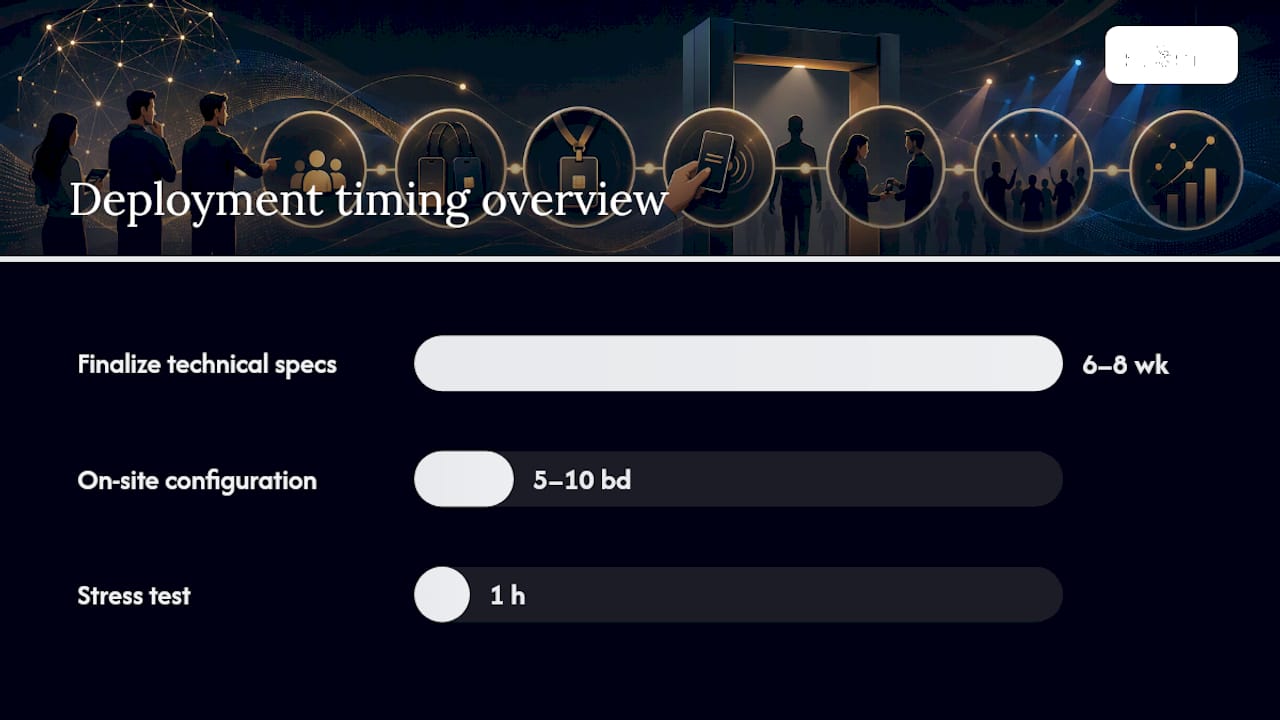
Timeline-wise, finalize your technical specs 6 to 8 weeks out from the event. Hardware lead times vary by vendor, but final on-site configuration, including kiosk setup and portal placement, typically takes 5 to 10 business days once your registration platform is confirmed compatible.
On-site testing is not optional. Validate every read zone, run a one-hour stress test at your expected peak flow (usually right at doors-open), and confirm kiosks are provisioned before staff training begins.
Pro Tip: Run your stress test with staff walking through in a tight cluster, not one at a time. That’s when crosstalk and dead zones actually show up.
What Does RFID Actually Cost, and Where Can You Trim Budget?
Cost swings widely based on credential type, customization, and whether you’re renting or buying readers outright. The biggest drivers are the credential itself (a plain wristband costs far less than a fully branded printed badge with an embedded inlay), encoding method, software licensing fees, and on-site staffing to manage check-in and troubleshooting.
Rough budget bands to think in:
- Small events (under 1,000 attendees): lean toward wristbands or simple lanyard tags, rented hardware, minimal staffing.
- Mid-size conferences (1,000 to 5,000 attendees): printed badges with inlays, a mix of owned and rented readers, dedicated on-site technical support.
- Large festivals or multi-day activations: reusable wristbands, purchased hardware for cost efficiency across multiple days, full-time RFID technicians on-site.
To trim spend, consider a hybrid QR-plus-RFID model for lower-tier access points, rent hardware instead of buying for one-off events, and reuse credentials across a recurring event series rather than ordering new stock every time. Our comparison of QR check-in versus RFID breaks down when the hybrid approach makes financial sense.
How Should You Handle Attendee Data and Privacy With RFID?
RFID systems typically capture entry and exit timestamps, session attendance, booth visits, and point-of-sale transactions. That data usually maps cleanly into CRM fields like attendance status, engagement score, and purchase history, which is exactly why exhibitors love it.
But collecting that much attendee behavior data comes with real obligations:
- Disclose what you’re collecting and why at the registration stage, not buried in fine print.
- Offer a limited opt-out path for attendees who don’t want session-level tracking, even if full opt-out isn’t practical for entry control.
- Retain only the records you actually need for reporting or compliance, and set a deletion timeline.
- Secure any data exports, especially exhibitor lead lists, with access controls rather than open spreadsheets.
Where possible, aggregate or anonymize data for general analytics (crowd flow, peak times) rather than tying every data point to an individual. Documenting your data flow, who touches it, how long it’s kept, and where it’s exported, makes legal review and vendor audits far less painful later. Our guide on event data and experiential marketing covers how that data should feed back into post-event marketing responsibly.
How Does an Agency Actually Deploy RFID on Show Day?
RFID can be built into a turnkey event production model that includes design, fabrication, staffing, AV, logistics, and credential integration, all coordinated through a single vendor network rather than multiple separate contracts. For complex events like brand launches or multi-day conferences, RFID reader placement should be integrated with other event elements such as stage and booth layouts and the check-in experience, rather than added on afterward.
The value an agency adds isn’t the RFID chip itself. It includes knowing where the reader may fail under high traffic, providing on-site technical support to diagnose issues quickly, and delivering clean data exports rather than raw data.
Operationally, the value includes vendor coordination across hardware suppliers, on-site troubleshooting when read zones underperform, and providing clean data exports usable by marketing teams without additional processing.
How Much Can You Customize RFID Badge Design and Branding?
Branding on an RFID badge isn’t an afterthought bolted onto a chip. Printed badges accept full-color printing, custom die-cut shapes, and premium finishes like matte lamination or foil accents, giving you the same visual control you’d expect from any printed collateral.
Wristbands offer less print surface but still support brand colors, event logos, and tier-specific color coding, useful for distinguishing VIP from general admission at a glance without anyone needing to read anything. Cards split the difference: enough surface for a logo and name, durable enough for multi-day or multi-event reuse.
The practical constraint is the inlay itself. The chip and antenna sit inside the credential, and design choices, especially foil accents or metallic inks, can interfere with read performance if placed directly over the antenna coil. Any reputable badge printer will flag antenna placement during proofing, but it’s worth asking about explicitly before finalizing artwork.
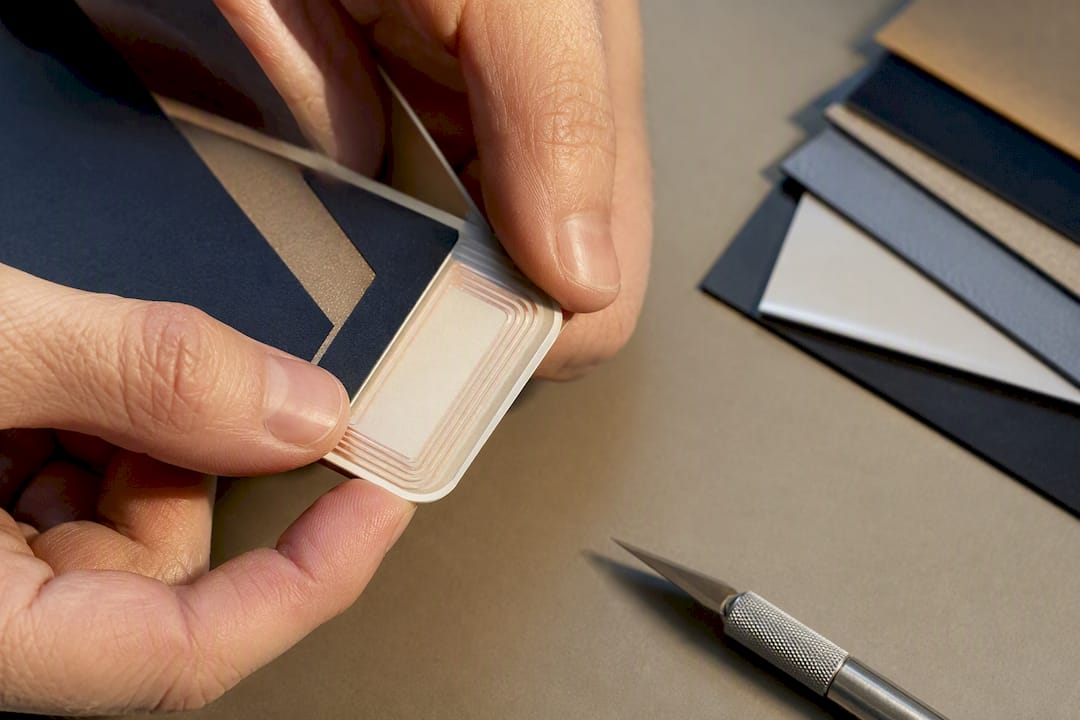
Sponsor logos, QR code hybrids for secondary functions, and tier color-coding are the three customization requests we see most often from brands running conferences and product launches. None of them compromise the RFID function as long as the antenna zone stays clear. For events layering RFID onto a broader engagement strategy, our post on attendee engagement tactics that drive results covers how badge design ties into the bigger experience.
Will RFID Integrate With Your Existing Event Software?
The badge is only half the system. The other half is whether your registration platform, CRM, and RFID software actually talk to each other in real time, and that’s where a lot of planners get burned by assuming compatibility instead of confirming it.
RFID attendee tracking systems combine badges, readers, antennas, kiosks, and dashboard software to capture check-in, session attendance, and visitor analytics as they happen. That dashboard needs a documented API connection to whatever registration platform you’re already using, whether that’s a dedicated event ticketing tool or a broader marketing CRM. Ask your RFID vendor directly whether they have an existing integration with your platform or whether it requires custom middleware, because custom builds add both cost and time to your pre-event timeline.
The payoff for getting this right is real-time visibility: session attendance feeding straight into a speaker’s post-event report, booth visit data landing in an exhibitor’s CRM the same day, and cashless transaction totals reconciling automatically instead of requiring a manual export. For trade show exhibitors specifically, this is where RFID earns its cost. Our breakdown of trade show lead capture walks through exactly how that booth-level data should flow into a sales pipeline.
How Secure Are RFID Badges Against Counterfeiting?
RFID credentials are harder to counterfeit than a printed badge with a barcode, mainly because duplicating the embedded chip and its encoded ID requires specialized equipment most bad actors don’t have. Each tag carries a unique identifier that’s checked against your database in real time, so a photocopied badge or a badge photo on a phone simply won’t trigger a valid read.
That said, RFID isn’t immune to abuse. Tag cloning is technically possible with the right hardware, and badge sharing (one person passing a wristband to a friend after checking in) remains a human problem no chip solves on its own. Encrypted tags and rotating encoding keys reduce the cloning risk further, and some vendors offer tamper-evident wristbands that visibly break if removed, which discourages sharing more effectively than any software fix.
The practical security layer most events skip is read validation against expected flow. If a single tag ID registers at two entry points four seconds apart, that’s a signal worth flagging automatically rather than discovering after the fact. Pairing RFID with staff spot-checks at high-value access points, VIP lounges, backstage, sponsor areas, closes the gap between “technically secure” and “actually enforced” on show day.
Are RFID Badge Materials Sustainable?
Most RFID credentials are built from PVC, PET, or paper-based substrates with an embedded chip and antenna, and the environmental footprint varies a lot depending on which one you choose. PVC wristbands and cards are durable and cheap but don’t break down easily and typically aren’t recyclable through standard streams because of the embedded electronics.
Paper-based RFID badges with a thin inlay are increasingly available and compost or recycle more easily than PVC, though they trade off some durability for multi-day or wet-weather events. For festivals specifically, that durability gap matters: a paper wristband degrading in a rainstorm creates a different kind of problem than a sustainability win.
The more practical lever for most events is reuse, not material choice. Cards and some wristband styles can be collected, wiped, and reissued across a recurring event series, which cuts material waste far more than switching substrate types ever will. If sustainability is a stated brand value for your event, ask your vendor directly about take-back or recycling programs for used credentials, and build a collection point into your exit flow rather than assuming attendees will bring badges back on their own.
Is RFID Overkill, or Is Everyone Else Underusing It?
The conventional advice treats RFID as a security upgrade: better access control, harder to fake, faster lines. That framing undersells what actually matters. The real value is data you can act on before the event ends, not after. Session attendance that flags which talks are overcrowded in real time. Booth dwell data that tells an exhibitor to redeploy staff at hour three instead of learning it in a post-event report nobody reads.
Most planners treat RFID as a check-in tool and stop there, leaving the analytics layer unused because nobody assigned someone to watch the dashboard during the event. That’s the gap worth closing first, before spending more on hardware or credential customization. A cheaper wristband with someone actually monitoring the data beats an expensive branded badge feeding a dashboard nobody opens until the following week.
Prioritize the read-zone design and the integration test over the badge’s finish. Everything else, foil accents, sponsor logos, premium lamination, is real but secondary. Get the flows right first, and the branding decisions become easy.
— Tyler
How King Sixteen Builds RFID Into Full Event Production
RFID-enabled activations can be designed and run as part of single turnkey production, with badge design, reader placement, staffing, AV, and data exports coordinated by one team rather than multiple separate contracts.
When building a brief for a conference, product launch, or branded activation, it’s important to consider expected attendee count, desired tracked interactions (such as access tiers, cashless payments, exhibitor lead capture), data export needs, and timeline. This information helps determine if RFID fits the event scale or if a hybrid approach may be more cost-effective without sacrificing the experience.
Ready to scope it out? Visit our experiential marketing page to start the conversation on your next event.
Where to Learn More About RFID Event Systems
For deeper technical detail, Atlas RFID Store’s attendee tracking guide covers UHF implementation specifics. Syncotek’s overview breaks down the full hardware and software stack behind real-time analytics.
Sources
- Navon Innovations | Event Registration & AI Engagement Tech
- RFID Attendee Tracking – Real-Time Event Visibility | CYKEO
- RFID event attendee tracking | Atlas RFID Store
- RFID Attendee Tracking: Smarter Event Check-In, Access Control, and Visitor Analytics | Syncotek
Recommended
- QR Code Check-In: The Agency Playbook for Guestflow at Scale
- Event Asset Storage for Event Managers: Centralized and Secure
- How to Fabricate Brand Assets for Events That Land