Choose an LED wall when ambient light, cameras, or continuous high-impact visuals are non-negotiable. Choose a projector when you need massive scale, a temporary install, or a tighter budget, and you can control the room’s lighting. The variable that decides almost every case is ambient light control.
TL;DR:
- LED walls provide significantly higher brightness levels, with 800 to 1,500 nits indoors, compared to projectors’ 250 to 350 nits even at high lumens.
- Projection is generally more cost-effective for very large, single-use venues beyond 300 inches, but LED panels are better for camera-friendly, repetitive, or multi-day events.
- LED systems have lower ongoing maintenance costs and longer engine life, typically lasting 80,000 to 100,000 hours, whereas projectors need engine replacement around 20,000 hours.
- Installation and setup for LED walls are more complex, requiring rigging, structural support, and calibration, while projectors can be deployed quickly with minimal crew.
- The choice depends heavily on ambient light control, screen size, viewer proximity, camera use, and event duration, with hybrid solutions increasingly common.
Table of Contents
- LED Wall vs Projector: A Quick Comparison
- What Each Technology Does Well (and Where It Falls Short)
- What Does LED Wall vs Projector Actually Cost Over Time?
- Why Nits, Lumens, and Pixel Pitch Determine What You Actually See
- What Does It Take to Install and Run Each System?
- How Do You Choose Between LED and Projection?
- Lessons from Producing Events With Both Technologies
- Does Heat and Noise Change the Right Choice?
- How Much Energy Does Each Display Actually Use?
- Is Your Display Technology Ready for HDR and High Refresh Rates?
- Can You Scale the Screen to Any Size or Aspect Ratio?
- A Practitioner’s Take on the Real Trade-Off
- Let King Sixteen Handle the Display Decision for You
- Sources
LED Wall vs Projector: A Quick Comparison
The fastest way to shortlist the right technology is to line up the variables that actually change the outcome: light, cost, image behavior, and logistics.
- Brightness: LED walls run 800 to 1,500 nits indoors; a 20,000-lumen laser projector on a large screen typically produces only 250 to 350 nits.
- Cost: Projector rental generally runs cheaper per day, though LED rental is only 2 to 3 times the projector rate, and that gap narrows on multi-day bookings.
- Image quality: LED delivers deeper contrast and cleaner color under lights; projectors need a dim or controlled room to hold contrast at all.
- Camera friendliness: LED panels emit their own light, so there’s no shadowing when a presenter walks in front. Projected images throw a shadow the moment anyone crosses the beam.
- Operations: LED needs more rigging, power, and calibration time; projectors set up and strike faster, especially for one-off events.
- Best-for cases: Trade show booths and keynotes lean LED. Outdoor movie nights, projection mapping, and single-session auditoriums lean projector.
For a stage backdrop specifically, the choice often comes down to whether the surface needs to survive stage lighting washes without looking flat. Stage backdrop planning usually settles that question fast once lighting design is locked.
What Each Technology Does Well (and Where It Falls Short)
LED walls win on brightness and reliability. They’re emissive, meaning every pixel makes its own light instead of reflecting a projected beam, which is why dvLED has become the go-to choice for modern commercial and event spaces. No shadows, no washed-out sections under house lights, and modular panels that scale to almost any shape. The tradeoff is upfront cost, plus real structural and power requirements, and panels are heavy to freight.
Projectors still make sense at extreme scale. For canvases beyond 300 inches or full-room projection mapping, a projector remains the more cost-effective tool, and modern laser engines have cut the old lamp-replacement headache substantially. The catch hasn’t changed: any ambient light degrades contrast, and anything crossing the beam casts a shadow across your content.
- LED strengths: brightness, camera friendliness, modularity, long service life
- LED weaknesses: capex, weight, structural demands
- Projector strengths: low cost per inch at scale, portability, mapping flexibility
- Projector weaknesses: light sensitivity, shadowing, engine wear
Pro Tip: If your event has any filmed or livestreamed component, default to LED. Cameras exaggerate projector shadow and hotspot issues far more than the naked eye does.
What Does LED Wall vs Projector Actually Cost Over Time?
Sticker price tells you almost nothing about which technology wins on budget. LED hardware costs more upfront, driven by pixel pitch, video processors, rigging, and power distribution. Projection’s costs sit in the projector units themselves (sometimes multiple, edge-blended units for one canvas), screens, lenses, and recurring engine replacement over the display’s life.
That maintenance gap matters more than most buyers expect. LED modules typically hold 50% brightness out to 80,000 to 100,000 hours, while laser projector engines often need attention around 20,000 hours. Run the math on a fixed installation and the crossover where LED’s higher purchase price pays for itself against a projector’s ongoing replacement costs usually lands around year five to seven.
| Cost factor | LED wall | Projector |
|---|---|---|
| Typical use pattern | Fixed install or frequent rental | Temporary or single-event use |
| Engine/module life before major service | ~80,000 to 100,000 hours | ~20,000 hours |
| Rental day rate vs projector | 2 to 3 times higher | Baseline |
| Best cost fit | Multi-day or recurring events | One-off or very large canvas |
If you’re building a five-year AV budget rather than a one-off event line item, it’s worth reading how experiential ROI gets modeled before committing capital either direction.
Why Nits, Lumens, and Pixel Pitch Determine What You Actually See
Lumens and nits measure different things, which is why comparing spec sheets side by side is misleading. Lumens describe total light output from a projector; nits measure brightness at the screen surface, factoring in screen size and ambient light. A 20,000-lumen laser projector spread across a large screen can deliver as little as 250 to 350 nits, a fraction of what an LED panel produces natively.
Pixel pitch is the other spec that trips up first-time buyers. A simple field rule: multiply the pixel pitch in millimeters by roughly 1 to 1.2 to get the comfortable minimum viewing distance in meters. A P2.6 panel wants viewers roughly 2.6 to 3.1 meters back; tighter pitches like P1.2 support close-up trade show interaction, while wider pitches like P4 are fine for a stage backdrop viewed from rows back. Our pixel pitch primer breaks down the full range.
- Projectors scale resolution advantageously on huge, flat canvases where pixel density matters less than raw coverage.
- LED wins when viewers sit close or when the display is also a camera subject, since panel refresh rates handle broadcast capture more cleanly than projected light.
What Does It Take to Install and Run Each System?
The operational gap between these two technologies shows up in your production schedule, not just your budget.
- A 16 by 9 foot LED wall typically needs a rigging or ground-support structure, dedicated power circuits, and a crew of two to four working several hours for setup and calibration.
- A comparable projector setup, one unit on a truss or stand with a screen, can go up in under an hour with a smaller crew.
- Fixed LED installs require structural engineering sign-off for weight and load; projectors mainly need to throw distance and a clean sightline.
- LED services from the front or back depending on panel design, and spare modules swap in minutes; projectors need spare lamps or engines on hand and more downtime to replace one.
- When load-in windows are under two hours or the event runs a single session, projector speed becomes the deciding factor regardless of image quality preferences.
How Do You Choose Between LED and Projection?
Run these six questions before specifying anything:
- Can you control ambient light in the room or space?
- How large does the image genuinely need to be?
- How close will most viewers sit to the screen?
- Will the display appear on camera or livestream?
- Are you renting for one event or buying for repeated use?
- How much load-in and strike time do you actually have?
Score two or more answers toward brightness, camera use, and repeat ownership, and LED is your answer. Score two or more toward uncontrolled scale, tight budget, and fast turnover, and projection wins. Event planners often run a version of this as a dark-room, backdrop, polish, budget checklist, and it holds up well in practice.
Pro Tip: Don’t force a binary choice. Hybrid setups, LED as the primary backdrop with projection mapped onto adjacent surfaces, are gaining ground precisely because they let one event use both technologies where each performs best.
Lessons from Producing Events With Both Technologies
Coordination is where most display plans fall apart, not the display itself. AV, lighting, staging, and camera teams all need the same brightness and pixel-pitch specs before load-in, or you get last-minute conflicts over rigging points and power draw. On real contracts, King Sixteen weighs rental LED against purchase and against projection mapping based on the event’s repeat frequency and camera requirements, not just the room size. Any RFP should require a spares list, calibration time, and a named vendor contact before signing. Our projection mapping cost breakdown is a useful reference point when comparing bids.
Does Heat and Noise Change the Right Choice?
Projectors generate substantial heat from their lamp or laser engines and typically run internal fans that add measurable noise to a room, an issue in any venue where the audience sits close to the projector or the unit shares space with a stage mix position. LED panels run warm but distribute that heat across many small components rather than one hot engine, and they operate silently since there’s no fan noise competing with your program audio.
In a house of worship or theater where a quiet ambient bed matters, that noise difference is not trivial to production audio. A projector rated at a loud fan noise level sitting 20 feet from a stage microphone can bleed into a livestream mix in ways a silent LED wall never will. Heat also affects venue HVAC load: a bank of projectors running for a multi-day conference adds real cooling demand that facility teams need to plan for, while LED’s distributed heat is easier to manage with standard room airflow.

This is a detail that rarely makes the initial spec sheet but shows up fast once the room fills with warm bodies and running gear. If your event runs multiple sessions across a long day, factor both heat buildup and fan noise into your venue walkthrough, not just brightness and resolution.
How Much Energy Does Each Display Actually Use?
Energy draw scales with brightness and screen size for both technologies, but the profile differs. LED walls draw continuous power across every panel and tend to run more efficiently per lumen produced than lamp-based projectors, though laser projector engines have closed much of that gap in recent years. A large LED installation running for a multi-day conference will pull more total wattage than a single projector simply because there’s more active surface area generating light.
Environmental impact isn’t just about power draw while running. LED panels last far longer before needing replacement, which reduces manufacturing and disposal waste over a display’s working life. Projector engines and lamps get swapped more frequently, and older lamp-based units in particular generate replacement waste that laser engines have started to reduce. For organizations tracking sustainability commitments as part of event production, the choice between renting a projector for a single night versus committing to an LED purchase carries a real difference in long-term material footprint, not just the electric bill.
Neither technology is inherently “green.” The honest comparison depends on how often the display runs, how long it stays in service, and whether it’s rented once or owned for years.
Is Your Display Technology Ready for HDR and High Refresh Rates?
HDR content and higher refresh rates are pushing both technologies, but not at the same pace. LED panels have moved faster here because higher-end panels now support wider color gamuts and refresh rates well above what’s needed to avoid camera banding, which matters directly for broadcast and livestream capture. Projectors have made real gains too. Laser light engines improved color accuracy and reduced the maintenance burden that older lamp-based units carried, as noted in projector industry coverage of modern laser engine advantages.
The limitation that hasn’t gone away for projectors is ambient light. No refresh rate or HDR certification fixes the fundamental physics: a projected image still loses contrast the moment room light hits the screen. LED sidesteps that limitation entirely because it’s emissive rather than reflective, which is part of why dvLED adoption has accelerated across commercial and event spaces even as projector technology keeps improving on paper.
For content strategy, both technologies benefit from thinking through motion and visual pacing before you shoot or design assets, a point covered well in general visual storytelling guidance for large-format displays.
Can You Scale the Screen to Any Size or Aspect Ratio?
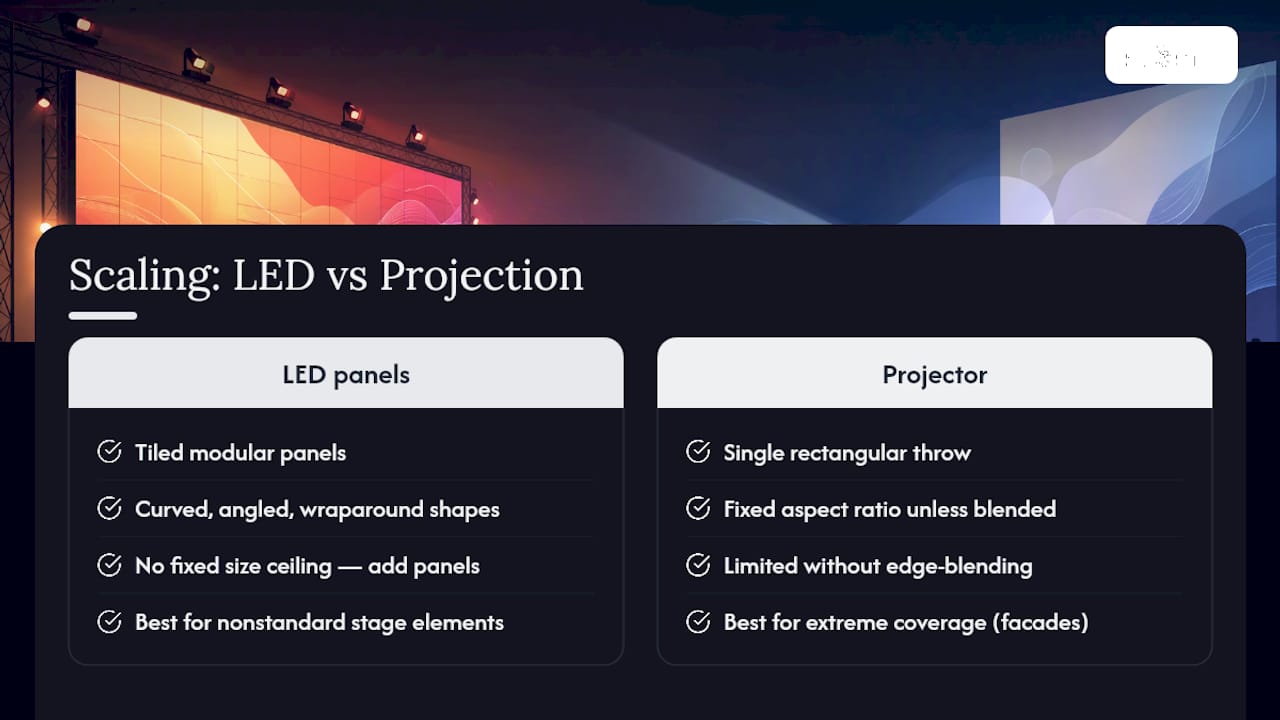
LED’s modular design is its biggest scalability advantage. Panels tile together in almost any configuration, curved, angled, wraparound, or an unconventional aspect ratio built specifically for a stage set. There’s no fixed “screen size” ceiling the way there is with a single projected image; you simply add more panels.
Projectors scale differently. A single unit is locked to a rectangular throw and a fixed aspect ratio unless you invest in edge-blending multiple projectors across one canvas, which adds cost and calibration complexity. Where projection genuinely wins is raw coverage per dollar at extreme scale, wrapping an entire building facade or mapping a complex architectural surface is often more practical with projection than trying to rig LED panels across an irregular shape.
If your event calls for a nonstandard shape, a rounded backdrop, an angled corner stage, or a ceiling-mounted element, LED’s modularity typically solves the problem faster than trying to force a projected rectangle into an unconventional space.
A Practitioner’s Take on the Real Trade-Off
Two scenarios settle most of these debates for us. A multi-day branded keynote with cameras rolling calls for LED, full stop, because shadow-free brightness and camera friendliness outweigh the higher cost. A single-night outdoor screening with a controlled dark backdrop and a fixed budget almost always calls for projection.
The mistake we see most in procurement is specifying brightness in lumens without asking what nits that actually produces on the final screen size. That single conversion error causes more mismatched expectations on show day than any other spec on the sheet.
— Tyler
Let King Sixteen Handle the Display Decision for You
Picking between LED and projection is only half the problem. The harder part is executing it correctly under a real event timeline, with rigging, power, camera integration, and a dozen vendors who all need to hit the same load-in window. Full production stack, design, AV, custom fabrication, and logistics are managed through a vetted vendor network built for high-stakes brand events.
Reach out when your timeline is tight, your event spans multiple days, or your content needs to survive a livestream camera without shadowing or brightness complaints. The right display technology will be specified for your room. Get in touch through our experiential marketing services page and tell us what you’re building.
Sources
Signal compatibility rarely makes the highlight reel of a comparison, but it decides whether your event runs smoothly on the day. Both LED walls and projectors accept standard signal types, HDMI, SDI, and DisplayPort, through a video processor, so most modern content sources connect to either technology without custom conversion.
Where it gets more complex is on the LED side: large walls typically route through a dedicated video processor that maps content across every panel, and that processor needs to match your pixel pitch and resolution or you’ll see banding or scaling artifacts. Projectors are simpler here since a single unit just needs a matched resolution and throw distance calculation.
For events pulling content from multiple sources, a livestream feed, a slide deck, and a motion graphics package cutting between them, confirm your switcher and processor support every signal type before load-in. This is a smaller technical hurdle than brightness or contrast, but it’s the one that causes the most on-site scrambling when it’s overlooked.
- LED display vs projector for large venues: when each one is the right choice - Doit Vision
- LED Video Wall vs Projector: Which Is Right for Your Event? - Mitey AV
- Five reasons to invest in an office projector - Projector Central
- LCD vs LED video walls: why dvLED has become the go-to choice for modern spaces - ViewSonic
- Video wall or projection? - Projector Central
Recommended
- Stage Backdrop Ideas That Turn a Launch Into an Event
- Projection Mapping Cost: A Budget Guide for Marketers