Pixel pitch is the distance, in millimeters, between the centers of two adjacent LED pixels. The one rule that governs almost every buying decision: pick the finest pitch your closest viewer actually needs, using formulas like the 10× rule or Visual Acuity Distance as your starting point. Camera-facing stages and boardrooms with fixed seating are the exceptions where those baseline formulas need adjusting.
TL;DR:
- Finer pixel pitch is beneficial only for close-viewing, small text, or camera filming, but offers little value beyond 20 to 30 feet for most audiences.
- The 10× rule and Visual Acuity Distance formulas provide practical minimum viewing distances, with stricter requirements for broadcast and livestream stages.
- Cost increases sharply as pixel pitch tightens; selecting a pitch beyond necessary viewing distance results in wasted budget and limited perceptible benefit.
- When specifying LED walls, verify brightness, refresh rate, uniformity, service access, and warranty details to ensure suitability for the environment and use case.
- Production factors like camera lenses and staging significantly influence optimal pixel pitch, requiring coordination between hardware choices and event setup.
Table of Contents
- What is LED wall pixel pitch and why does it matter?
- How do you calculate viewing distance for a given pixel pitch?
- Which pixel pitch fits your application?
- How does pixel pitch affect cost and what else should you verify?
- What should you check before signing off on a vendor?
- What do producers know that spec sheets don’t tell you?
- How does King Sixteen apply these rules on real projects?
- Practitioner perspective on pixel pitch decisions
- Sources
What is LED wall pixel pitch and why does it matter?
Pixel pitch is written in “P” notation, like P1.2 or P2.5, where the number is the center-to-center spacing between LED clusters in millimeters. Pixel pitch determines pixel density: tighter spacing packs more pixels into the same physical panel, which raises resolution and shrinks the minimum distance at which the image looks sharp rather than dotted.
This is why pixel pitch, not PPI, is the spec that matters for direct-view LED. PPI assumes a fixed screen size with pixels baked into glass, like a monitor. LED walls are modular, built from tiles that lock together, so total resolution scales with both pitch and the number of panels you use. A wall built from P2.5 tiles at 10 feet wide carries a different pixel count than the same physical size built from P4.
A few things worth knowing before you spec anything:
- Pixel pitch is fixed by panel design. A used P2.5 panel performs identically to a new one at that spacing, assuming it’s maintained. Degradation shows up as brightness inconsistency, not a pitch change.
- Finer pitch is genuinely useful when viewers stand close, when content includes small text or data, or when a camera is filming the wall.
- Finer pitch is overkill when your audience views from 20, 30, or 100 feet back. You’ll pay a real premium for resolution nobody in the room can perceive.
How do you calculate viewing distance for a given pixel pitch?
Three formulas dominate industry guidance, and each answers a slightly different question.
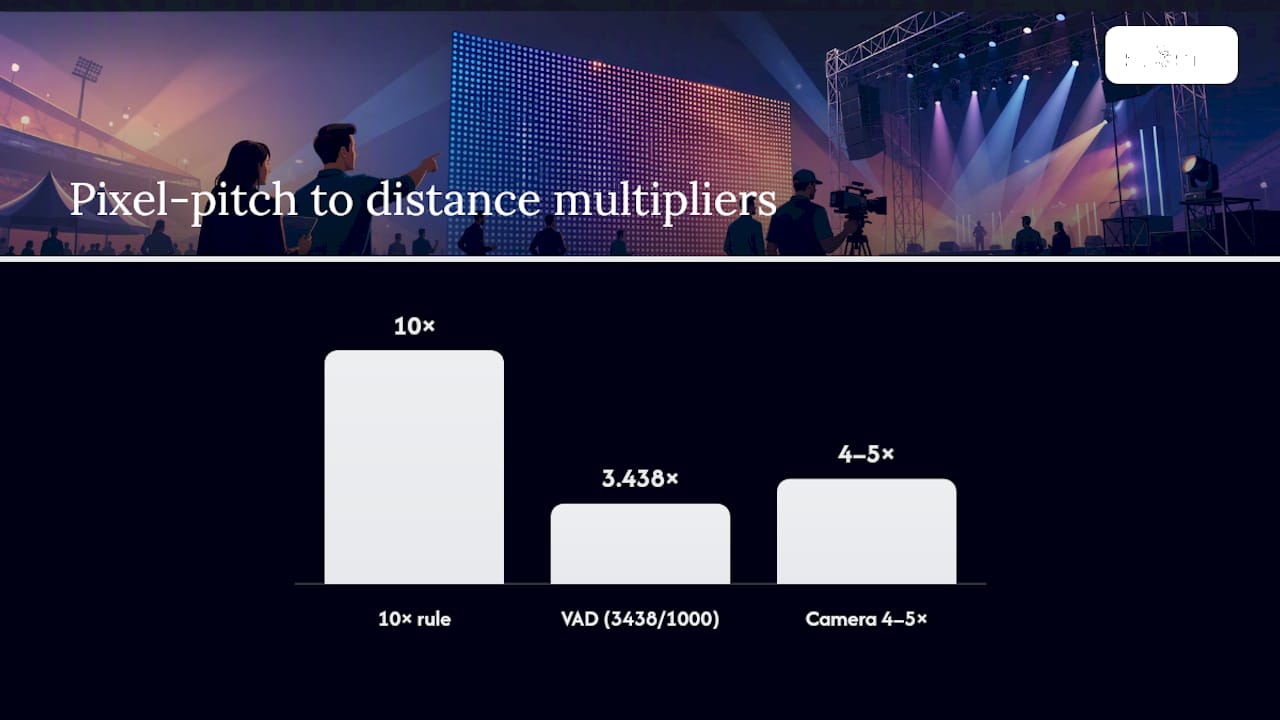
The 10× rule is the fastest gut check: multiply the pixel pitch in millimeters by 10 to get the minimum viewing distance in feet. A P4 wall wants viewers standing at least 40 feet back before the image reads as smooth rather than pixelated.
Visual Acuity Distance (VAD) gets more precise. The formula is pixel pitch × 3438, divided by 1000, giving you the distance in feet at which the average eye stops resolving individual pixels. It accounts for human visual acuity rather than a flat multiplier, which makes it the better tool when you’re defending a spec choice to a client or finance team.
Average Comfortable Viewing Distance (ACVD) shifts the question from “when do pixels disappear” to “when does the image feel comfortable to watch for an extended period.” It tends to land farther back than VAD, which matters for anything a viewer sits in front of for more than a few minutes, like a boardroom presentation or a conference keynote.
Pro Tip: Run all three numbers before you commit to a pitch. If VAD says 8 feet but your front row sits at 6, you’re not fine-tuning, you’re under-specced.
| Pixel Pitch | 10× Rule (min. distance) | Approx. VAD |
|---|---|---|
| 0.7mm | approximately 8 feet (about 2.5 meters) | 8 feet |
| 1.9mm | 20 to 60 feet | 20 to 60 feet |
| 2.5mm | 8 to 15 feet | 8 to 15 feet |
| 4mm | at least 40 feet | 8 to 15 feet |
| 6mm | 20 to 60 feet | 20 to 60 feet |
| 10mm | roughly 100 feet (approx. 30 meters) | 20 to 60 feet |
One caveat that trips up a lot of first-time buyers: if the wall is on camera, the math above doesn’t hold. Producers shooting a stage for broadcast or livestream typically push toward a stricter 4× to 5× multiplier to avoid moiré patterning on the lens, well beyond what the 10× rule or VAD would suggest for a live audience alone.
Which pixel pitch fits your application?
Fine-pitch LED, generally 0.7mm to 2.9mm, exists for environments where people stand or sit close to the wall and need to read detail. Standard and outdoor pitches run 3mm and up, trading resolution for the brightness and durability that long-distance viewing demands.
Here’s how that breaks down by real-world use, drawing on common industry mapping:
- P1.2 to P1.9 for broadcast studios and command/control rooms, where operators sit a few feet from dense data feeds and text has to stay crisp.
- P2.0 to P2.9 for boardrooms, corporate lobbies, and close-view retail displays, where viewers are typically 8 to 15 feet away.
- P3.0 to P5.9 for conference stages, trade show booths, and mid-size event venues, where the audience sits 20 to 60 feet back.
- P6 and above for arenas, building facades, and outdoor signage, where distance is measured in dozens or hundreds of feet and brightness (often 5,000 nits or more outdoors) matters as much as resolution.
A trade show backdrop viewed from 15 feet away doesn’t need P1.2. A boardroom screen eight feet from the table doesn’t need P4. Matching pitch to the nearest real viewer, not the farthest possible one, is the entire game.
How does pixel pitch affect cost and what else should you verify?
Cost rises sharply as pitch tightens, and it’s not a marginal bump. Tighter spacing means more LEDs packed into the same panel area, which drives up component count, manufacturing complexity, and price per square meter. Dropping from P4 to P2.5 for a wall that never gets viewed closer than 30 feet is a common way agencies see budgets blow past scope for zero visible gain.
Pitch is also just one line item in a much longer spec sheet. Before signing a quote, verify:
- Brightness (nits): indoor walls typically run 800 to 1,500 nits; outdoor and daylight-facing installs need 5,000 or higher.
- Refresh rate: critical for anything on camera, since a low refresh rate causes visible banding or flicker on recorded footage.
- Uniformity: how consistent brightness and color stay panel to panel across the full wall.
- Service access: front or rear serviceable, which affects how fast a dead pixel gets fixed mid-event.
- Warranty terms and power/thermal specs: especially relevant for outdoor or multi-day activations running long duty cycles.
Pro Tip: Samsung’s guidance on fine-pitch displays makes a point worth repeating to any stakeholder pushing for “the sharpest option available”: resolution nobody can perceive is a cost, not a feature.
What should you check before signing off on a vendor?
Before you approve a spec or sign a rental agreement, run through this list:
- Measure the closest viewer’s actual distance from the wall, not an estimate.
- Identify content type: static text and dashboards need tighter pitch than motion video or ambient brand visuals.
- Confirm whether the wall will be filmed; if so, apply the 4× to 5× multiplier instead of the 10× rule.
- Check ambient light conditions, especially for anything near windows or outdoors.
- Set a brightness target based on that ambient light, not a generic default.
- Confirm on-site maintenance access and turnaround time for panel replacement.
- Get warranty terms and SLA response windows in writing.
Ask vendors directly: What’s the refresh rate? What’s peak brightness versus sustained brightness? Can you provide references from an install at a similar viewing distance? Red flags worth walking away from: no refresh-rate spec offered unprompted, and no comparable on-site reference to check against your own use case.
What do producers know that spec sheets don’t tell you?
Formulas assume a stationary eye. Live production doesn’t work that way. When a stage is being filmed, camera sensors pick up moiré patterns that a human eye standing at the same distance would never notice, which is why producers often push the multiplier to 4× or 5× the pitch rather than trusting the 10× rule.
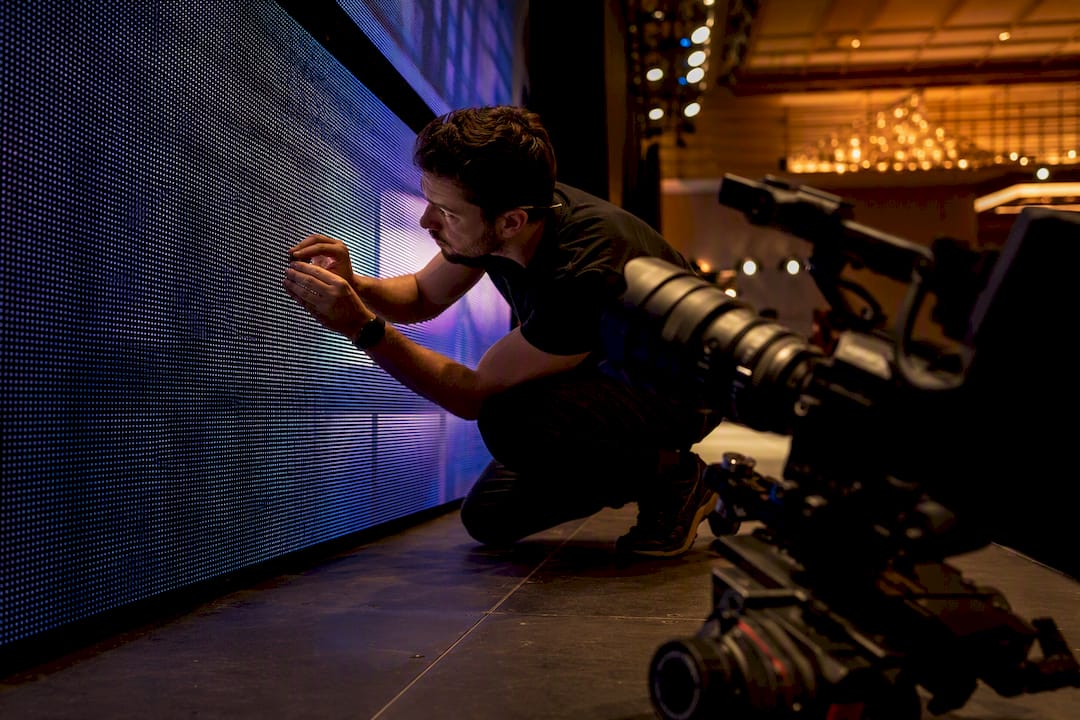
Lens choice and aperture matter here too. A tighter aperture can outrun even a conservative pitch choice if the camera sits closer than blocking anticipated. King Sixteen builds this into staging plans on every camera-facing activation, coordinating pitch, blocking, and lens specs together rather than treating pixel density as an isolated line item, which is exactly the kind of detail that gets missed when specs are chosen in a vacuum before staging is finalized.
How does King Sixteen apply these rules on real projects?
We size pitch to the nearest fixed viewer, every time. A trade show backdrop viewed from the aisle rarely needs finer than P3, while an immersive brand lobby with guests standing arm’s length away often justifies P1.9 or tighter. See how this plays out in experiential brand activations.
Practitioner perspective on pixel pitch decisions
The biggest mistake we see isn’t choosing the wrong formula. It’s skipping the formula entirely and defaulting to “get the sharpest wall we can afford,” which is how budgets get spent on resolution nobody in the room will ever perceive. The VAD and ACVD numbers exist precisely because eyesight has physical limits, and no amount of premium pricing changes what a human retina can resolve from 40 feet back.
What the spec sheets miss is the staging layer. A pitch chosen correctly for a seated audience can still fail on camera if nobody accounted for lens aperture or blocking, which is a production problem, not a hardware one. Treating pixel pitch as a pure procurement decision, disconnected from how the event is actually shot and staged, is where good specs turn into disappointing footage. The videography considerations that shape camera framing deserve a seat at the same table as the pitch conversation, not a follow-up email after panels are already ordered.
— Tyler
Sources
- What is Pixel Pitch and Why Does It Matter? | Planar
- What Is Pixel Pitch? How to Calculate Pixel Pitch | AVIXA Xchange
- What Is Pixel Pitch: How to Choose the Right One for Your LED Video Wall | AVGear