Projection mapping pricing in the U.S. follows a clear tiered structure: small indoor activations typically cost in the lower thousands range, mid-size facade or festival shows cost tens of thousands, and large architectural productions commonly cost well over several tens of thousands, depending on surface scale and content complexity. According to industry benchmarks, those ranges hold across most U.S. markets, with the majority of budget variation driven by three factors:
- Equipment (projectors + media server): 30–50% of total budget
- Content creation: 20–40% of total budget
- Labor (installation, calibration, operation): 15–30% of total budget
Your immediate next steps: measure your projection surface, photograph the site at the time of day the show will run, note ambient light conditions, and request a formal site survey from at least two vendors. King Sixteen offers a turnkey path from concept through delivery if you want a single point of accountability.
Key Takeaways
Projection mapping cost is primarily determined by projector lumens tier, content complexity, and labor scope — not by surface size alone.
| Point | Details |
|---|---|
| U.S. cost tiers | Small activations run $5k–$15k; mid-size facades $15k–$75k; large architectural shows $75k–$250k+. |
| Top budget drivers | Equipment takes 30–50%, content 20–40%, and labor 15–30% of total spend. |
| Rental vs. purchase | Renting is smarter below roughly 4–6 uses per year; buying makes sense for permanent installs. |
| RFP must-haves | Specify lumens per unit, media server model, redundancy, crew days, and permits in every quote request. |
| King Sixteen option | King Sixteen delivers turnkey projection mapping from concept through post-show reporting under a single contract. |
Table of Contents
- What factors drive projection mapping cost?
- How an estimate is structured: line items and percentage splits
- Sample budgets by scope: small, medium, and large
- Turnkey agency vs. assembling your own vendor team
- What to include in your RFP for accurate, comparable quotes
- Typical timeline from brief to show night
- How to measure ROI and justify the projection mapping budget
- King Sixteen case summaries: scope, budget, and outcomes
- How do projection mapping costs vary by U.S. region?
- Pricing negotiations and contract terms: what you need to know
- What production teams wish clients understood before asking for a quote
- King Sixteen handles projection mapping end-to-end
- Sources
What factors drive projection mapping cost?
Equipment brightness is the single biggest hardware cost lever. Each lumens tier jump typically multiplies per-unit rental cost by roughly 2–4×, which means controlling ambient light is often the most cost-effective decision you can make before you even call a vendor. Darken the site or shift the show window to dusk, and you may drop an entire lumens tier, saving thousands on projector rental alone.
Beyond brightness, here are the primary cost drivers to evaluate in any vendor proposal:
- Projector count and lumens tier: 3k–5k lumen units suit small controlled interiors; 25k–40k+ lumen units command premium daily rental rates of $2,500–$7,000+ per unit in some U.S. markets.
- Media server tier: Entry-level setups (MadMapper, Resolume) work for single-output shows; show-grade servers (Disguise, Watchout, Modulo) step costs up roughly 3–5× per tier and affect both rental and operator day rates.
- Content scope: A simple looping graphic costs a fraction of a scripted, multi-chapter 3D mapped show with custom audio.
- Technical labor: Site survey, rigging, calibration, on-site operator, and teardown are often quoted separately. Confirm which crew days are included.
- Venue costs: Power distribution, scaffolding or crane rental, weatherproof housings, and permits can add 10–25% to outdoor projects.
- Show duration and performance count: Multi-night runs reduce per-night cost but increase logistics, housing, and equipment-holding fees.
- Redundancy: Backup projectors and media servers are non-negotiable for high-stakes shows. Confirm they are in the quote.
Pro Tip: Ask your venue or city contact about permit timelines before you finalize your show date. Permitting delays are the most common cause of budget overruns on outdoor architectural shows, and rush-processing fees can add thousands with little warning.
How an estimate is structured: line items and percentage splits
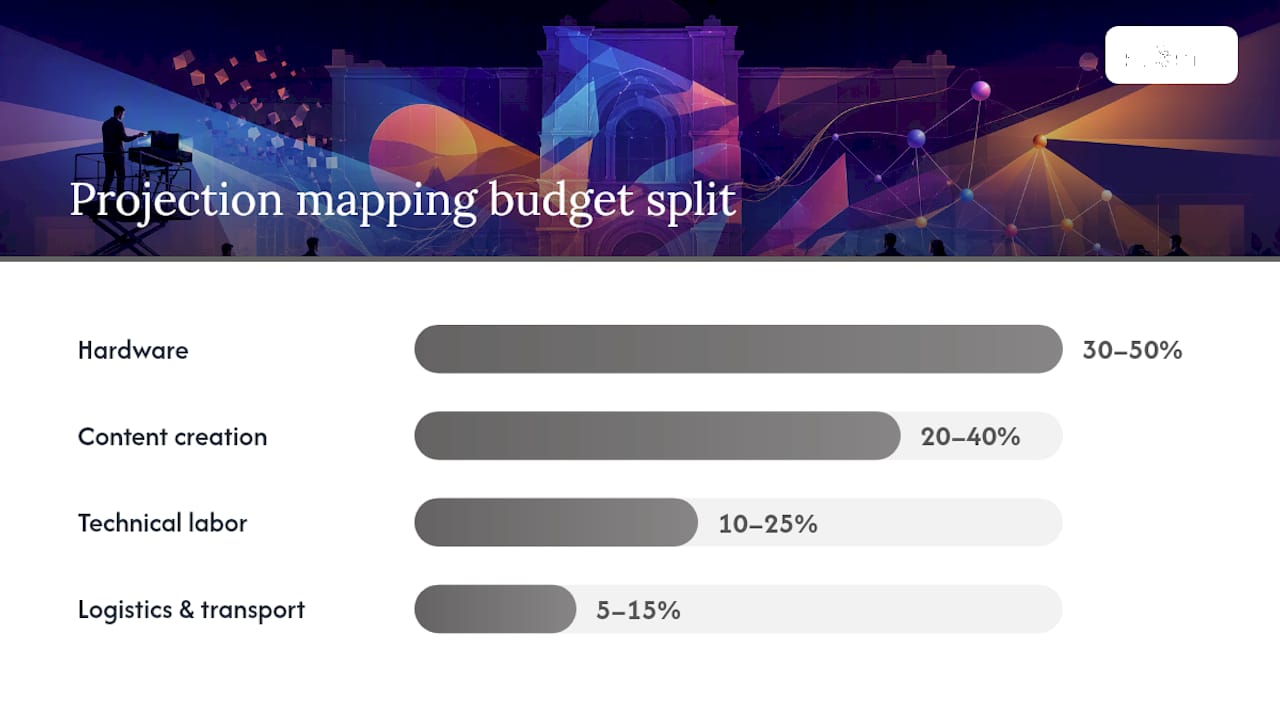
Understanding how vendors structure their quotes helps you compare proposals accurately. Budget share guidance allocates roughly 30–50% to hardware, 20–40% to content, 10–25% to technical labor, and 5–15% to logistics, though those percentages shift by project type.
| Line Item | Typical % of Budget | Notes |
|---|---|---|
| Projector rental/purchase | 20–35% | Verify lumens per unit and rental days |
| Media server + software | 10–15% | Confirm outputs and redundancy |
| Lenses and mounts | 3–5% | Often bundled; ask if itemized |
| Content creation | 25–40% | Scope revisions and file formats upfront |
| Rigging and mounting | 5–10% | Crane or lift adds cost |
| Cabling and power | 3–5% | Generator rental if venue power is insufficient |
| Transportation and logistics | 5–15% | Can reach ~25% on monumental outdoor projects |
| Labor (install, calibration, ops) | 10–20% | Confirm number of crew days |
| Permits and insurance | 3–7% | Required for most outdoor U.S. activations |
| Contingency | 5–10% | Non-negotiable on outdoor or multi-night shows |
Watch for vague line items like “systems rental” with no lumens specification or redundancy detail. A credible proposal names the projector model, lumen output, and rental duration for every unit.
Sample budgets by scope: small, medium, and large
These three examples give you internal benchmarks. Adjust assumptions to match your site.
-
Small indoor activation ($5,000–$15,000). Assumptions: controlled interior, one or two 5k–7k lumen projectors, MadMapper or Resolume media server, simple looping content, one-day install and one show night, no permits required. Typical split: equipment 40%, content 35%, labor 25%. Best for retail pop-ups, product launch vignettes, or conference environments.
-
Mid-size facade or festival activation ($15,000–$75,000). Assumptions: single outdoor facade up to roughly 3,000 sq ft, two to four 15k–20k lumen projectors, show-grade media server, custom multi-scene content, two to three crew days, standard city permit. Real-world line-item totals for this scope commonly land in the $34,000–$85,000 range once projector rental, media server, rigging, content, labor, and permits are aggregated. Logistics often account for 10–20% of the total.
-
Large architectural show ($75,000–$250,000+). Assumptions: monument or building facade exceeding 10,000 sq ft, four to eight 25k–40k+ lumen projectors, Disguise or Watchout server with full redundancy, scripted multi-chapter show with original audio, crane or scaffolding, multi-night run, city or state permitting. Permanent installations carry a different cost profile entirely: initial investments often exceed $40,000–$150,000+, with annual operating costs running approximately 10–15% of that initial investment per year for electricity, maintenance, and content refresh.
The rental-vs-purchase break-even point for most projector classes sits at roughly 4–6 uses per year. Below that threshold, renting is almost always the smarter financial call.
Turnkey agency vs. assembling your own vendor team
The headline cost of a turnkey agency is higher. The total cost of ownership often is not.
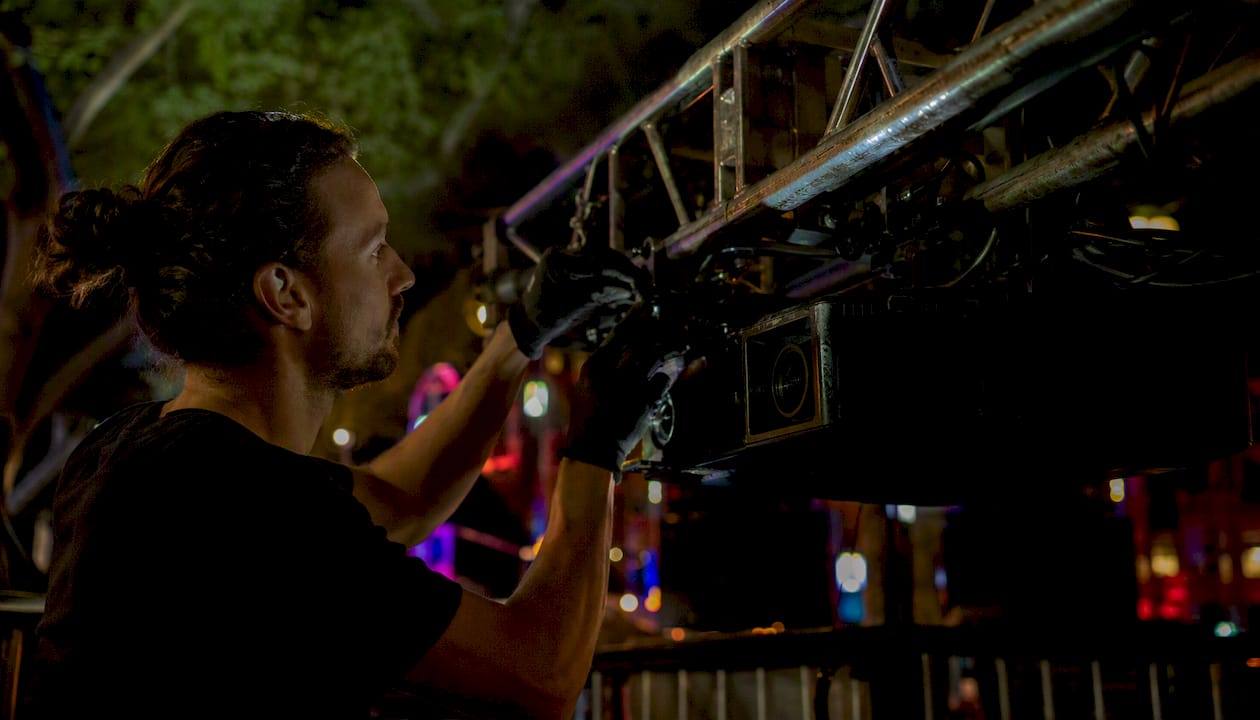
When you manage separate rental, content, and tech vendors yourself, you absorb project management overhead, vendor coordination risk, and single-point liability gaps. A missed communication between your content studio and your AV rental house can mean a show-night calibration failure with no one contractually responsible for the fix.
| Factor | Turnkey agency | DIY vendor assembly |
|---|---|---|
| Headline cost | Higher | Lower |
| Project management burden | On the agency | On your team |
| Single contract accountability | Yes | No |
| Portfolio and proof of execution | Verifiable | Varies by vendor |
| Contingency planning | Built in | Your responsibility |
| Rental/purchasing economies | Agency often realizes these | You negotiate each separately |
Pro Tip: If your team lacks in-house AV or event tech experience, agency fees frequently buy risk reduction and faster timeline adherence. Factor that into your procurement math before defaulting to the lower-cost DIY path.
What to include in your RFP for accurate, comparable quotes
Vague briefs produce vague quotes. Send vendors this checklist and you will get proposals you can actually compare:
- Site photos with annotated dimensions and projection surface measurements
- Expected show dates, runtime per performance, and number of performances
- Ambient light conditions at show time (photos help)
- Acceptable mounting and rigging locations
- Available power capacity at the venue
- Permit holder information and any known restrictions
- Required insurance limits (most U.S. venues require $1M–$2M general liability minimum)
- Content deliverable expectations: file formats, number of scenes, revision rounds
Then ask every vendor these specific questions in writing:
- What is the lumen output per projector unit, and what model are you specifying?
- What media server are you using, and how many outputs does it support?
- Is a backup projector and backup server included in this quote?
- How many on-site crew days are included, and what are the overtime rates?
- Does this quote include travel and housing for your technical team?
- Who holds the permit, and what is your process if it is delayed?
- What is your damage liability policy for equipment?
Requiring itemized pricing on projectors, media server, content, and labor separately prevents vendors from burying costs inside bundled line items.
Typical timeline from brief to show night
Compressed schedules are one of the most predictable sources of cost overruns. Rush fees on content production typically run 20–50% above standard rates, and expedited hardware shipping or installation can add similar premiums.
- Brief and site survey (Week 1–2): Gather dimensions, ambient light data, power specs, and mounting constraints.
- Concept and creative approvals (Weeks 2–4): Mood boards, visual references, and content direction sign-off.
- Content production (Weeks 3–10): Motion design, 3D mapping, audio composition, and revision cycles.
- Technical rehearsal and pre-vis (1–2 weeks before show): Off-site server programming and content QA.
- Installation and calibration (1–3 days on-site): Rigging, alignment, edge-blending, and final content load.
- Show and operations (Show night through strike): On-site operator, backup monitoring, and teardown.
Small indoor projects can move through this in 2–4 weeks. Mid-size facade activations typically need 6–12 weeks. Large architectural shows with complex permitting often require 3–6 months of lead time.
Pro Tip: Crane and lift bookings and content sign-off cycles are the two items most likely to slip your schedule. Lock both down before you confirm your show date.
How to measure ROI and justify the projection mapping budget
The budget conversation with stakeholders gets easier when you attach specific KPIs to the spend. Build your measurement template around these inputs and outputs:
- Attendance and dwell time: How many people experienced the show, and for how long?
- Social impressions and earned media value: Projection mapping is inherently shareable. Track hashtag volume, tagged posts, and calculate an earned media equivalency against your paid media CPM.
- CRM leads captured: QR codes, SMS opt-ins, or SSO integrations tied to the activation.
- Brand lift: Pre/post surveys measuring awareness, favorability, or purchase intent shifts.
- Partner activations: Sponsor or co-brand value generated by the show.
Content quality correlates directly with shareable social impressions. Budget accordingly rather than cutting content to fund an extra projector. A visually mediocre show on expensive hardware generates far less organic reach than a beautifully crafted show on appropriately specified equipment.
Pair your projection mapping activation with geo-targeting and digital campaign integration to extend reach beyond the physical footprint and capture measurable digital attribution.
King Sixteen case summaries: scope, budget, and outcomes
These anonymized project summaries reflect the range of work King Sixteen has delivered for established brands.
-
Luxury automotive product launch (medium scope, $35,000–$55,000 band). A single-night indoor activation mapping a vehicle reveal onto a custom-fabricated surface. Core deliverables: two 15k lumen projectors, show-grade media server, 90-second scripted content sequence, full technical crew. Outcome: high social capture rate from attendees, strong earned media coverage. Key lesson: the content quality drove the social lift, not the projector count.
-
Consumer brand outdoor facade activation (large scope, $80,000–$120,000 band). A two-night outdoor show on a building facade in a major U.S. metro. Deliverables: four 25k lumen projectors, full redundancy, custom multi-chapter content with original audio, city permit, crane for rigging. Budget expanded beyond initial estimate due to permit complexity and a required generator upgrade. Key lesson: power and permitting costs on urban outdoor shows are routinely underestimated.
-
Multi-brand festival activation (mid-to-large scope, $50,000–$75,000 band). A three-night run at a ticketed festival. Deliverables: modular projection rig, interchangeable content for two brand partners, on-site operator for all three nights. Outcome: strong dwell time and repeat viewership across nights. Key lesson: multi-night runs reduce per-night hardware cost but require housing, per diem, and equipment-holding fees that add back into the total.
Request photos and technical diagrams from every vendor you evaluate. Scale assumptions on paper rarely survive contact with an actual site.
How do projection mapping costs vary by U.S. region?
Geography moves the budget in predictable ways. Major metros — New York, Los Angeles, Chicago, Miami — carry higher labor day rates, more complex permitting processes, and tighter crane and lift availability windows. Expect to pay a 15–30% premium on labor and logistics in Tier 1 markets compared to mid-size cities.
Outdoor activations in cities with active film and event production industries (Los Angeles, New York, Atlanta) often face longer permit lead times because the queue is longer, not because the process is harder. Build that into your timeline.
Conversely, controlled indoor activations in secondary markets can come in at the lower end of each budget tier, particularly when the venue provides adequate power and the show window is after dark. The practical guidance from multiple U.S. industry references consistently recommends starting your budget by measuring surface size and ambient light conditions first, regardless of geography.
International or destination activations add a logistics multiplier. Shipping heavy projection equipment across state lines or internationally can push logistics to 20–25% of total budget.
Pricing negotiations and contract terms: what you need to know
Can I negotiate projection mapping pricing? Yes, and the most effective lever is scope clarity, not price pressure. Vendors reduce risk when you provide complete site information, a firm show date, and clear content deliverables. That clarity translates directly into tighter quotes with less contingency padding.
What payment terms are standard? Most U.S. projection mapping vendors and agencies structure contracts as 50% deposit at signing, 25–40% at content approval or equipment delivery, and the balance at show completion. Larger projects sometimes include a milestone at technical rehearsal sign-off.
What cancellation terms should I expect? Standard contracts protect vendor costs for work already performed. Expect to forfeit the deposit if you cancel after content production has begun, and full payment if you cancel within two weeks of the show date. Negotiate a weather clause for outdoor activations that defines rescheduling terms and any associated costs.
Are rush fees negotiable? Partially. Vendors will often absorb a modest schedule compression if the project is otherwise well-scoped. Extreme compression (cutting a 6-week timeline to 2 weeks) typically carries non-negotiable premiums because it requires overtime labor and expedited shipping.
Should I ask for a fixed-price contract? Fixed-price contracts work well when scope is fully defined before signing. If content revisions, show dates, or surface dimensions are still in flux, a time-and-materials structure with a not-to-exceed cap is often more practical and protects both parties.
What production teams wish clients understood before asking for a quote
The quotes that come back fastest and most accurately are the ones where the client sent a complete brief. That sounds obvious, but the majority of initial RFPs we see are missing at least two of the following: confirmed show dates, surface dimensions, ambient light data, and a clear content direction.
The single most costly client behavior is late content revisions. A change to the narrative structure or brand messaging after the animation phase has started can double the content budget. Lock your brand approvals and your decision-making chain before production begins, not during it.
Shifting activation dates after equipment has been reserved is the second most common budget inflator. Rental holds are not free to move, and crew schedules are booked weeks in advance. Build a 10% contingency into your budget from day one and treat it as spent money, not a reserve.
Finally, send site photos with a person in frame for scale. Vendors who have never visited your site will make assumptions about ceiling height, surface texture, and ambient light. A photo with a human reference eliminates the most common source of under-specified quotes.
King Sixteen handles projection mapping end-to-end
King Sixteen manages the full scope of a projection mapping engagement: concept development, content production, technical specification, equipment sourcing through our vendor network, on-site installation and calibration, show operations, and post-show reporting. You get one contract, one point of contact, and a team that has executed high-stakes activations for brands like Porsche, Audi, Ray-Ban, and Churchill Downs.
To get an accurate quote, send us: annotated site photos with surface dimensions, your desired show dates and runtime, creative references showing the visual tone you want, your target KPIs, and your budget band. That packet takes 30 minutes to assemble and gives us everything we need to return a detailed, itemized proposal.
Contact King Sixteen to start the conversation and request a site survey.
Sources
Use these references to cross-check vendor quotes against lumen tiers, media server specs, and content deliverable definitions before you sign anything.
- Projection Mapping Cost: Equipment & Budgets (2026)
- Video Mapping Pricing: Rate Cards and Real-World Budgets
- What is Projection Mapping? How it Works with Real Video Examples