Expect roughly $1,000 to $3,000 per day for small meetings, $3,000 to $10,000 for mid-size events, and anywhere from $10,000 to $50,000 or more for large conferences that need dedicated bandwidth. Venue quotes vary wildly for the same specs, and rental alternatives often beat in-house pricing by a wide margin. Jump to the bandwidth section below to size your own event before you call a single vendor.
TL;DR:
- Costs for internet range from $1,000 for small events under 100 attendees to over $50,000 for large conferences, depending on bandwidth needs and venue specifications.
- Dedicated bandwidth for large events often costs thousands daily, with prices varying widely based on Mbps and service quality, making comparison shopping essential.
- Key cost drivers include bandwidth provisioning, hardware rental, on-site labor, network segmentation, and venue fees or union charges, which can significantly inflate the final bill.
- Alternative solutions like 5G kits, Starlink, or managed services often provide cheaper or more flexible options, especially for mid-size or outdoor events.
- Accurate bandwidth sizing—around 2-10 Mbps for small groups and at least 150-200 Mbps for large events—is crucial to control expenses and ensure reliable connectivity.
Table of Contents
- How Much Does Event Internet Cost by Event Size?
- What Drives the Cost of Event Internet?
- What Are the Alternatives to Venue-Provided Internet?
- How Do You Calculate Bandwidth Needs for an Event?
- What’s Included in an Event Internet Quote, and Where Are the Hidden Fees?
- The Agency View: Budgeting for Connectivity Without the Guesswork
- Sources
How Much Does Event Internet Cost by Event Size?
Event internet pricing splits into three rough tiers, and knowing which one your event falls into changes how you negotiate.
Small gatherings under 100 attendees typically run $1,000 to $3,000 for the full event, covering basic Wi-Fi for browsing, email, and light streaming. That number assumes the venue already has usable infrastructure and you’re not asking for dedicated circuits.
Mid-size events, roughly 100 to 500 people, land between $3,000 and $10,000 for the full booking. At this scale, planners usually need enough capacity for simultaneous device connections, mobile check-in apps, and at least one presentation feed running off the same network.
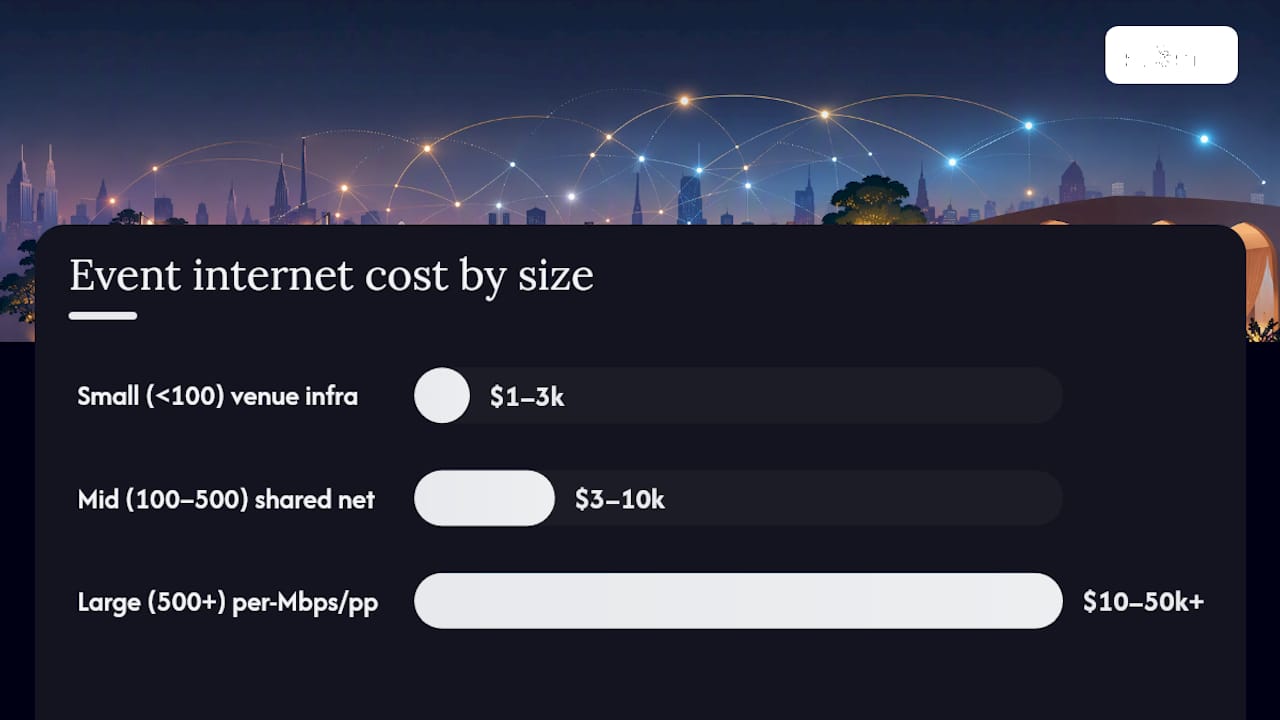
Large productions, with 500 attendees and up, can cost tens of thousands of dollars or more once you add dedicated bandwidth. Marriott’s own Encore pricing guide lists dedicated bandwidth at $3,750 per day for 10 Mbps, jumping to $8,250 per day for 30 Mbps and $11,750 per day for 50 Mbps. Per-attendee packages in that same guide run $18 to $33 per person per day depending on tier.
The clearest budgeting benchmark comes from AV Citizen’s price estimator, which collected 50 real quotes and found a median of $112 per Mbps per day. For a three-day, 500-person conference, that same data set showed total costs ranging from $6,646 to $80,040, a spread wide enough to make shopping around non-negotiable.
- Small events (under 100 attendees): $1,000–$3,000 total
- Medium events (100–500 attendees): $3,000–$10,000 total
- Large events (500+ attendees): $10,000–$50,000+, often billed per Mbps or per attendee
What Drives the Cost of Event Internet?
Every line item on an event internet quote traces back to one of five cost drivers, and understanding each one lets you push back when a number looks inflated.
- Bandwidth provisioning and carrier charges. Venues either lease bulk capacity from a carrier or pay for burst bandwidth on demand, and that wholesale cost gets passed straight through to your invoice.
- Rental hardware, cabling, and installation labor. Access points, switches, and temporary cable runs all require physical labor, and that labor is billed by the hour, not the foot.
- On-site engineering and uptime guarantees. A technician monitoring the network during your event and an SLA promising 99.9% uptime cost more than a “best effort” connection with no one watching it.
- Network segmentation. Separate VLANs for guest Wi-Fi, point-of-sale systems, and production feeds each need their own IP block, configuration time, and monitoring, which adds hardware and hours to the bill.
- Venue exclusivity, union labor, and service fees. Many hotels and convention centers require in-house union crews for any cable run, and that policy alone can double your labor cost before you’ve added a single access point.
Pro Tip: Ask the venue in writing whether outside internet providers are permitted on-site. Some contracts quietly bar third-party vendors, which forces you into the venue’s pricing with no leverage.
What Are the Alternatives to Venue-Provided Internet?
Venue internet is rarely your only option, and for many events it’s not even your cheapest one.
- Single-carrier 5G kits typically rent at a few hundred dollars per day and suit small setups without heavy streaming.
- Bonded multi-carrier 5G kits generally cost several hundred dollars to around a thousand dollars per day, offering higher capacity and redundancy.
- Starlink fly-packs are rented weekly, scaling with vendor and tier, fitting for remote or outdoor events.
- Managed event Wi-Fi from full-service providers commands higher daily prices for comprehensive services.
Independent rental providers frequently beat venue in-house pricing per Mbps once you factor in per-device fees venues often bury in the fine print. Bonded kits in particular give mid-size activations both extra capacity and a backup path if one carrier gets congested, which matters most for booths running a livestream feed.
How Do You Calculate Bandwidth Needs for an Event?
Sizing bandwidth correctly is the single fastest way to avoid overpaying for capacity you’ll never use.
Industry guidance suggests a starting bandwidth allocation ranging from low to moderate Mbps per person depending on usage intensity, but these figures serve as rough estimates rather than strict rules.
- Small groups (under 50 people): budget a practical minimum of 2 to 10 Mbps regardless of the formula, since per-person math undershoots at low headcounts.
- Mid-size events (around 200 people): at 0.15 Mbps per person, that’s roughly 30 Mbps, plus extra uplink capacity if you’re running a livestream or a broadcast feed off the same connection.
- Large events (1,000 people): the same formula suggests 150 Mbps, but add headroom for point-of-sale terminals, badge scanners, and press streaming, easily pushing the real number toward 200 Mbps or more.
By the numbers: at the reported median of $112 per Mbps per day, a 200 Mbps allocation for one event day runs roughly $22,400 before labor, hardware, or setup fees.
What’s Included in an Event Internet Quote, and Where Are the Hidden Fees?
A standard quote should cover the site survey, equipment rental, provisioned bandwidth, on-site technical support, and teardown. Anything outside that list is where costs quietly balloon.
Watch for per-device charges that stack up fast at events with heavy phone and laptop use, additional IP address fees for anyone running their own router or POS system, overtime and union labor rates for setup outside standard hours, and taxes or service charges tacked on at the very end of the invoice.
- Confirm whether pricing is per device, per Mbps, or a flat event fee before you sign anything.
- Request an itemized quote that separates bandwidth, labor, and hardware into distinct lines.
- Ask about bundling internet with AV or catering services to unlock a package discount.
- Find out whether sponsorship dollars can offset connectivity costs in exchange for signage or naming rights.
Pro Tip: Lock pricing with the venue’s sales team before the vendor’s on-site technical staff gets involved. Rates quoted after setup planning has already started rarely move in your favor.
Timing matters as much as the line items themselves. Written pricing secured before you sign a venue contract gives you leverage that disappears the moment the venue knows you’re locked in. For events tied to a broader revenue strategy, connectivity costs are worth weighing against how they affect overall event profitability rather than treating them as an isolated line item.
The Agency View: Budgeting for Connectivity Without the Guesswork
Most planners treat internet as a checkbox. We treat it as a reliability cost, the same category as backup generators or a second AV tech on standby. A dropped connection during a keynote livestream or a badge-scanning failure at registration costs more in reputation than any bandwidth upgrade ever would.
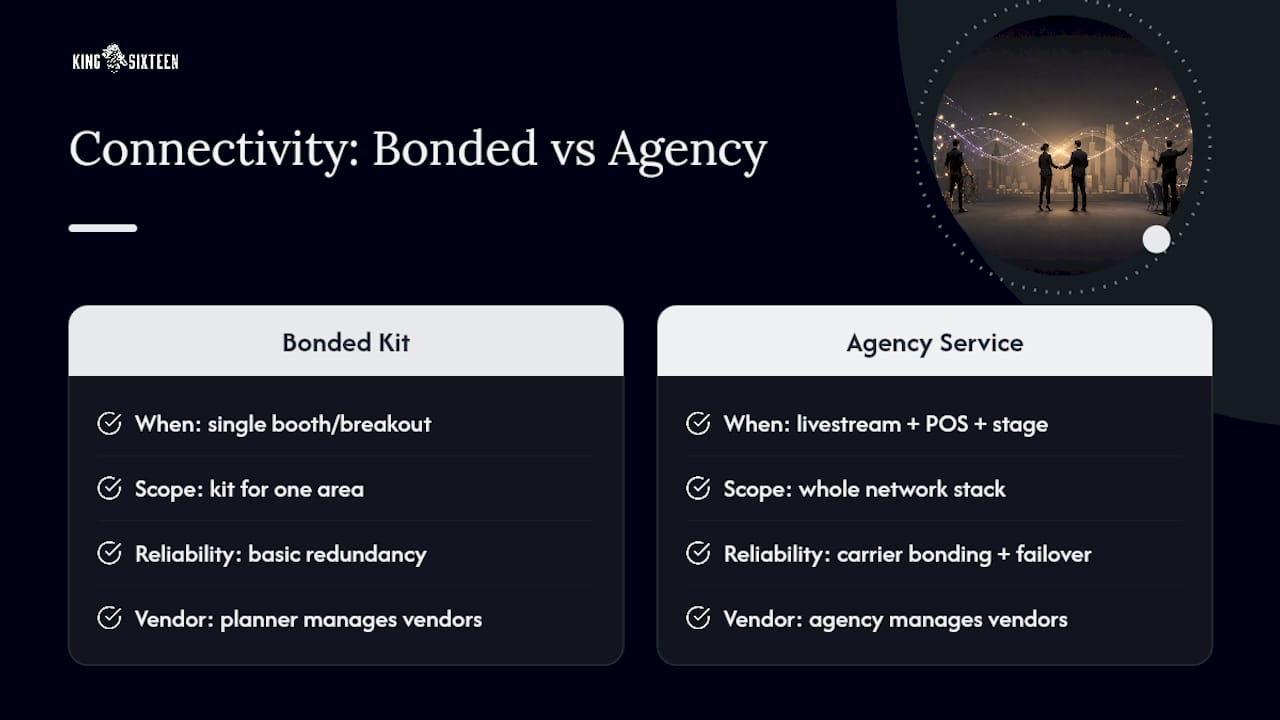
When an agency scopes connectivity into a turnkey proposal, they don’t just pick a Mbps number off a chart. They weigh redundancy against budget, sometimes bonding two carriers instead of leasing one expensive dedicated circuit, and manage the vendor relationship so a planner never has to referee a dispute between the venue’s IT team and a rental provider mid-event. A risk-aware production plan treats connectivity the same way it treats staffing or catering: something scheduled and confirmed weeks out, not scrambled the night before.
Renting a bonded kit yourself makes sense for a single booth or a small breakout session. Hiring an agency to manage the whole network stack makes sense once your event has a livestream feed, a POS system, and a main stage all depending on the same signal not failing at once. If your event carries that kind of stakes, explore how King Sixteen builds experiential campaigns with connectivity baked into the production plan from day one, not bolted on after the floor plan is finalized.
— Tyler
Sources
Figures throughout this guide come from the AV Citizen price estimator (per-Mbps pricing), MadeByWiFi’s cost breakdown (event-size ranges), the Marriott/Encore pricing guide (per-attendee and dedicated-bandwidth examples), and rental provider rates from ConstructionInternetGuide and WiFiT.
- Meeting internet – price estimator and report – AV Citizen
- Event WiFi Costs: What You Need to Know Before You Plan
- Encore WiFi Pricing (Marriott PDF)
- Internet for Events: What to Rent, Bandwidth Needs & Costs
Recommended
- Venue Sourcing Strategy: A Planner’s Process and Checklist
- Catering Cost per Person: What Event Planners Should Budget
- Understanding Event Planning for Senior Marketers
- Advantages of Turnkey Event Services for Planners