Most public, ticketed, or revenue-linked events need an alcohol permit for government or agency events. Private, invitation-only gatherings where no money changes hands for alcohol usually don’t. That’s the whole answer in one breath, but the details are where planners get tripped up.
Regulators like the New York State Liquor Authority, the Illinois Liquor Control Commission, and Arizona’s Department of Liquor Licenses & Control all treat alcohol sales at events as a public-safety issue, not a paperwork formality. New York charges a fee per point of sale, per day, for its One-Day Alcohol Event Permit. That single fee structure tells you how granular this gets: pricing isn’t per event, it’s per bar station, per day.
Your first move is simple: pin down your event’s jurisdiction and figure out which permit type fits. Is the venue already licensed? Who actually collects the money for drinks? Is admission ticketed? Answer those three questions before you touch an application form.
- Is the event ticketed or does it require any payment to enter?
- Who receives the money tied to alcohol, whether from sales, tickets, or donations?
- Is the venue already covered by an existing liquor license?
Lead times vary sharply by state — expect anywhere from about 3 business days in South Carolina up to 30 days in Ohio. Apply for the slowest state first if you’re running a multi-state event series.
Key Takeaways
Getting the correct alcohol permit for events depends on your state, your permit type, and clear identification of who receives alcohol proceeds.
| Point | Details |
|---|---|
| Confirm if you need one | Ticketed entry, donations, or paid admission tied to alcohol usually requires a permit even at “private” events. |
| Match the permit to the event | One-day, catering, marketing, and series permits each authorize different scopes; picking wrong delays approval. |
| Apply early | Lead times range from about 3 business days in South Carolina to 30 days in Ohio; apply for your slowest state first. |
| Secure local sign-off first | Missing municipal, police, or fire approval is the most common reason applications stall or get denied. |
| Consider a turnkey partner | King Sixteen folds permit research, applications, insurance, and vendor sourcing into its full event production process. |
Official Portals and Agency Pages Worth Bookmarking
- New York State Liquor Authority for One-Day Permit forms and per-point-of-sale fees.
- South Carolina Department of Revenue for fast-turnaround special event permits and insurance rules.
- Arizona DLLC for Series 15 special event licensing and city review requirements.
- Illinois Liquor Control Commission for nonprofit special event license forms.
- Ohio Division of Liquor Control for OPAL filing and 30-day lead time guidance.
- Oregon Liquor & Cannabis Commission for CAMP filing and local endorsement rules.
Always check your city or county page too, especially for events in parks or on public streets, since local permits stack on top of state requirements.
Table of Contents
- Types of Alcohol Permits for Events You’ll Likely Encounter
- Who Can Apply, and Where the Private-Party Exception Ends
- How to Get an Alcohol Permit: A Step-by-Step Checklist
- State Rules for Alcohol Permits: What Changes Where You’re Hosting
- How King Sixteen Handles Alcohol Permits Inside Full Event Production
- Let King Sixteen Handle Your Event’s Alcohol Permitting
- Frequently Asked Questions
- Sources
Types of Alcohol Permits for Events You’ll Likely Encounter
Not every event needs the same permit. Requesting the wrong one is a fast way to get your application bounced back. Here’s what you’ll actually run into.
One-Day or Temporary Event Permits cover the most common scenario: a single-day festival, fundraiser, or private company party where alcohol will be sold or served in exchange for admission or donations. These typically restrict service to a defined footprint on-site and require a fresh application for each event date, though some states allow a handful of uses per year at one location.
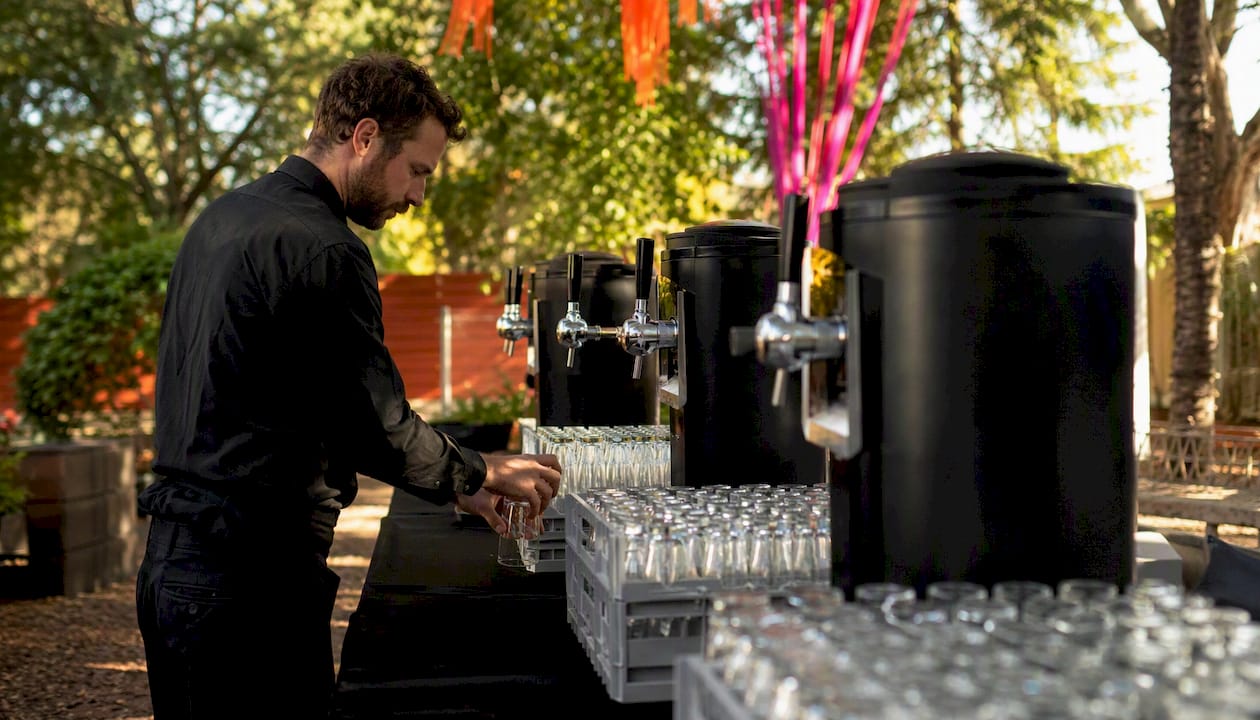
Catering Permits let an existing on-premises licensee, like a restaurant or bar, extend their license to an off-site location for a wedding, corporate dinner, or private function. The licensee applies, not the event host, which shifts the compliance burden onto a business that already understands the rules.
Marketing or Tasting Permits authorize limited sampling, often tied to a manufacturer or distributor showcasing a product at a trade show or retail event. These come with tighter pour limits and stricter rules against direct sales.
Special Event or Series Permits work for organizers running recurring events, such as a summer concert series or a multi-weekend festival, letting a single application cover several dates instead of filing over and over.
Event Authorizations blend annual and single-event coverage; California’s Type 77 authorization, for example, scales its fee to expected daily attendance rather than charging a flat rate.
Here’s the practical distinction: a winery pouring samples at a trade show needs a marketing permit, a wedding at a private estate needs a catering permit through the caterer’s license, and a nonprofit gala with a cash bar needs a one-day event permit. Mixing these up is one of the most common reasons applications get sent back for correction.
Who Can Apply, and Where the Private-Party Exception Ends
Eligibility rules trip up more organizers than any other part of this process. Many states, including Illinois, reserve certain special-event licenses for nonprofit organizations. A for-profit company without an existing liquor license usually has to go through a licensed caterer or apply for a full retail license, which in Illinois requires a full retail license that costs significantly more than a temporary permit.
The “private party” exception is narrower than most planners assume. If guests pay admission, buy raffle tickets, or make a suggested donation and alcohol is part of that exchange, regulators generally treat it as a sale requiring a permit, regardless of how the invitation is worded.
- Charging any admission fee tied to an event with alcohol likely triggers permit requirements.
- Accepting donations at the door counts the same way in most states.
- A cash bar, even at a “private” wedding reception, usually needs a permit unless a licensed caterer is running it under their own license.
Tied-house rules add another wrinkle. If a distributor or manufacturer provides staff, cash, or in-kind support to your event, that arrangement can disqualify a nonprofit’s eligibility in several states, since regulators expect the applicant to be the entity actually profiting from the sale.
Pro Tip: Structure your event contract so the nonprofit or licensed entity is named as the direct recipient of alcohol proceeds. If a third-party promoter or vendor is taking a cut of bar sales, that split can jeopardize a nonprofit’s permit eligibility in states like Washington and South Carolina.
How to Get an Alcohol Permit: A Step-by-Step Checklist
Getting this right is mostly about sequencing. Do these steps out of order and you’ll spend your event week chasing signatures instead of finalizing your run of show.
- Confirm your jurisdiction and permit type. Identify the state agency, the city or county, and which permit category (one-day, catering, marketing, series) matches your event structure.
- Secure local approvals first. Municipal, parks, police, and fire sign-off often has to be attached to your state application, not filed separately afterward.
- Line up insurance. South Carolina requires liquor liability coverage, commonly a minimum of $500,000, for events serving alcohol after 5 p.m. Illinois requires dram-shop insurance to the maximum available limit.
- Prepare a site diagram. Regulators want a clear map showing the designated alcohol consumption area, points of sale, and boundaries.
- Source alcohol through licensed distributors only. Buying from a retail store or accepting free product from a manufacturer can violate tied-house restrictions.
- Submit your application with all attachments. Most states now require online filing: Ohio through OPAL, Oregon through CAMP, South Carolina through MyDORWAY.
- Print your permit and keep it on-site. A digital confirmation email isn’t the same as the printed permit regulators expect you to produce on demand.
Lead times matter more than most planners expect. The New York SLA wants applications at least 15 business days before your event, while Ohio recommends 30 days to account for county board of elections checks and local wet/dry status. Illinois suggests applying at least 14 days ahead to dodge a $25 late fee.
Your documentation folder should include proof of nonprofit status if applicable, a lease or letter confirming control of the premises, your insurance certificate, the site diagram, and proof that bartenders or servers have completed alcohol training such as TIPS. On event day, that translates into a designated consumption zone, wristbands or tokens for verified guests, ID checks at every pour station, and a security plan that names who’s responsible if something goes wrong.
Pro Tip: Missing a local sign-off, not the state application itself, is the single most common reason permits get denied or delayed. Call your city clerk or police department before you submit anything to the state.
State Rules for Alcohol Permits: What Changes Where You’re Hosting
The federal government doesn’t run alcohol permitting. Every state sets its own fees, timelines, and eligibility rules, which means the “right” answer depends entirely on your zip code.
New York charges $36 per point of sale, per day, for its One-Day Alcohol Event Permit and wants applications 15 business days out. Locations are generally capped at four one-day permits per 12 months unless you get municipal and police no-objection letters for more.
South Carolina moves fast by comparison, often processing special event permits in about 3 business days, with a $35 per-day fee and a firm rule that the permit holder must be the entity receiving proceeds.
Arizona’s Series 15 special event license frequently pulls in city or county council review, particularly if your venue doesn’t already hold an active liquor license, and some Phoenix-area processes ask for 10 to 90 days of lead time depending on the circumstances.
Illinois restricts many special-event licenses to nonprofits, requires dram-shop insurance, and layers in local approval before the state signs off.
Ohio funnels every temporary permit through its OPAL online system and recommends a 30-day runway, partly because local wet/dry status has to be confirmed county by county.
Oregon requires local government endorsement, often from the city itself, before the Oregon Liquor & Cannabis Commission will process an application through its CAMP portal.
Texas splits its process: licensed distilleries and on-premises retailers use TABC’s file-and-use system, while nonprofits apply for an NT Permit at a $50 daily fee, submitted at least 10 business days ahead.
| State | Common permit name | Sample fee | Typical lead time | Notable eligibility note |
|---|---|---|---|---|
| New York | One-Day Alcohol Event Permit | $36 per point of sale, per day | 15 business days | Capped at 4 permits per location annually without extra sign-off |
| South Carolina | Special Event Permit | $35 per day | About 3 business days | Applicant must be the proceeds recipient |
| Illinois | Special Event Retailer’s License (NFP) | full license (nonprofits use special event license) | 14 days recommended | Often restricted to nonprofits |
| Ohio | Temporary Event Permit | Filed via OPAL | 30 days recommended | County wet/dry status must be confirmed |
| Texas | NT Permit (nonprofit) | $50 per day | 10 business days | Nonprofits use NT Permit; licensees use FUN system |
Bookmark each agency’s official portal now, before you’re on a deadline: OPAL for Ohio, CAMP for Oregon, MyDORWAY for South Carolina, and TABC’s AIMS system for Texas licensees. These online systems have mostly replaced paper filing, and attaching your local approval digitally before submission avoids the single most common rejection reason.
How King Sixteen Handles Alcohol Permits Inside Full Event Production
When permitting becomes one line item among a hundred others, it’s the first thing that gets rushed. King Sixteen builds alcohol permit management directly into its turnkey production process rather than treating it as an afterthought.
- Jurisdiction research to confirm the correct permit type before any application gets drafted.
- Application preparation, submission, and tracking through the correct state portal.
- Coordination of local approvals with police, fire, and municipal offices.
- Sourcing of liquor liability insurance and dram-shop coverage tied to the venue and date.
- Vendor vetting so alcohol comes from licensed distributors and servers carry proper training.
- Day-of compliance staffing, including ID checks and the physical permit kept on site.
The payoff is consolidated accountability. One team owns the permit, the vendor contracts, and the on-site compliance plan, so nothing falls through the gap between the client and three separate vendors.
A Producer’s View on What Actually Causes Problems
The recurring failures aren’t exotic. They’re missed local sign-offs, insurance certificates that arrive the day before the event, contracts that never specify who receives the alcohol proceeds, and last-minute sourcing from a retail store instead of a licensed distributor.
The fixes are just as unglamorous: route payment flows so the nonprofit or licensed entity is the named recipient, call your local police department the same week you book the venue, and add an insurance rider the moment the venue contract is signed. Keep the physical permit on-site and make sure whoever’s checking IDs has actually been trained to do it.
Let King Sixteen Handle Your Event’s Alcohol Permitting
King Sixteen exists for the planners who don’t want to become part-time compliance officers on top of running a product launch or a corporate gala. Instead of researching seven state portals and hoping your insurance certificate arrives before your deadline, you get one team that owns jurisdiction research, application filing, local approvals, and licensed vendor sourcing under a single production plan.
That turnkey structure is the same one King Sixteen applies to full experiential campaigns and product launches, where permitting is just one piece of a larger production puzzle that includes staffing, AV, and vendor logistics. If your event includes a bar, a beer garden, or a wine tasting, that permit work gets folded into the same vendor network handling your catering and staffing, so you’re not managing five separate contracts. For private, invitation-only functions that still involve ticketed admission or donation-based entry, King Sixteen’s private events team can determine whether you actually need a permit before you assume you don’t.
Reach out through King Sixteen to schedule a permit and compliance consultation for your next event.
Frequently Asked Questions
Do I need an alcohol permit for a free, invitation-only party? Usually not, as long as no admission fee, donation, or ticket purchase is tied to the event. The moment money changes hands in connection with alcohol, most states treat it as a sale requiring a permit.
How far in advance should I apply for a special event alcohol permit? Plan for at least 15 to 30 business days depending on your state. New York asks for 15 business days, while Ohio recommends a full 30-day window to account for local wet/dry checks.
Can a for-profit business get a temporary alcohol permit? It depends on the state. Illinois and several others reserve many special event licenses for nonprofits, so a for-profit organizer often needs to work through a licensed caterer or obtain a full retail license instead.
What insurance do I need for an event serving alcohol? Liquor liability coverage is standard, and South Carolina sets a common benchmark of $500,000 in coverage for events serving alcohol after 5 p.m. Illinois separately requires dram-shop insurance up to the maximum available limit.
What’s the fastest way to avoid permit denial? Secure local approvals from police, fire, and municipal offices before submitting your state application, and make sure your event contract names the correct entity as the recipient of alcohol proceeds.
This article is general information, not a substitute for advice from a qualified lawyer. Consult a qualified legal professional about your own circumstances before acting on anything here.
Sources
- Permits Available Online | Liquor Authority - NY.Gov
- Special Event Permits | SCDOR
- Special Event Retailer’s Liquor License NFP | ILCC
- Series 15 Licensing Information - Special Event
- Special Event Permits | Ohio Division of Liquor Control