Small invitation-only launches typically run $15,000 to $50,000, regional launches $75,000 to $250,000, and flagship activations $500,000 and up. The split exists because production and hospitality are what attendees actually experience, and that experience is what drives the leads, press, and sales your leadership will measure against the spend.
TL;DR:
- Require vendors to list deliverables, included services, add ons, and automatic fees; unbundled labor or overtime can make comparable quotes differ by tens of thousands.
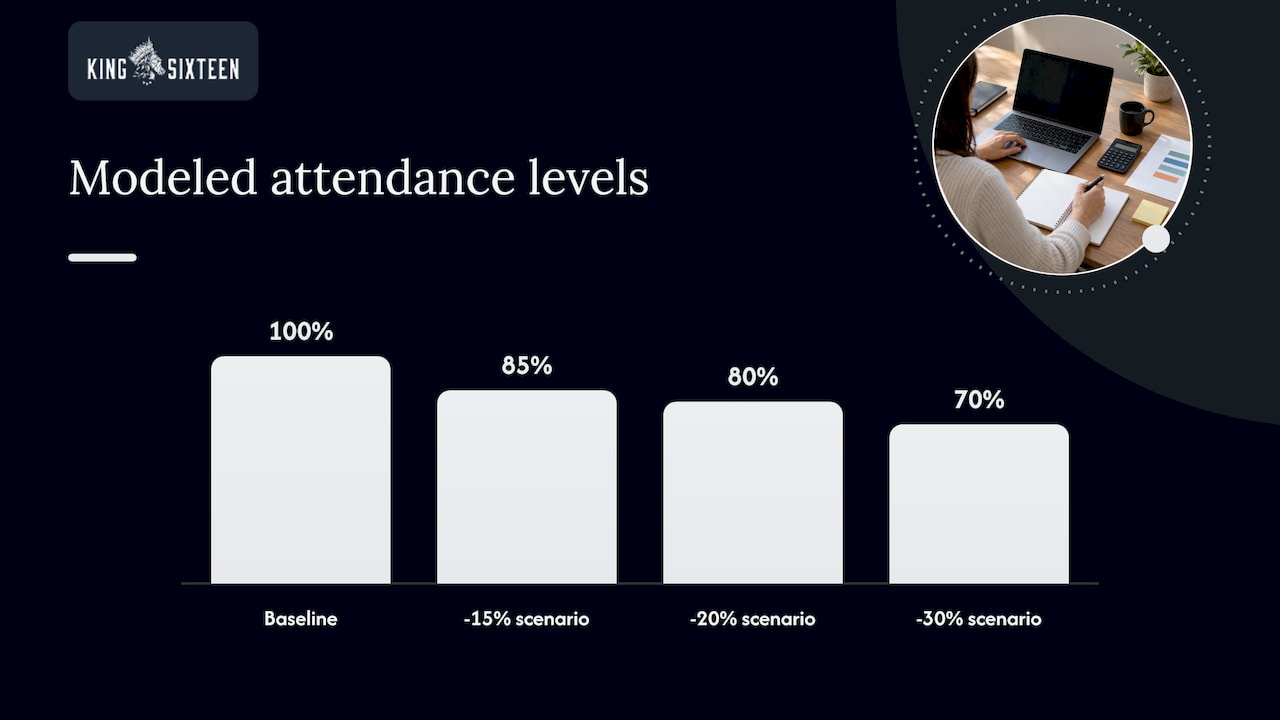
- Reserve 10% to 15% for contingency, then model attendance drops of 15%, 20%, and 30% to decide which variable costs fall and fixed commitments remain.
- Schedule cash flow early: custom fabrication needs 8 to 12 weeks, venue deposits often fall 60 to 90 days before launch, and popular venues may book six months ahead.
- Shift budget toward marketing and talent for press driven launches, hospitality for client events, or production and fabrication for custom flagship reveals.
- Protect the core demo, primary AV, and VIP hospitality; trim secondary amenities first, and link production, hospitality, and promotion spending to measurable outcomes.
Table of Contents
- 1. Line-item cost breakdown for product launch events
- 2. Budgeting frameworks, rules of thumb, and allocation models
- 3. Scenario budgeting and contingency planning
- 4. Three sample product launch budgets, from pop-up to flagship
- 5. Tools, templates, and worksheets to build and track your budget
- 6. Cost-control strategies and where to invest vs. cut
- 7. Stakeholder communication, approvals, and ROI alignment
- King Sixteen perspective: budgeting lessons from high-end launches
- When major costs hit your timeline
- Reconciling expenses after the event
- Planning for disruption and unforeseen risk
- Expert perspective: budget as strategy
- How King Sixteen approaches turnkey launch budgeting
- FAQ
- Sources
1. Line-item cost breakdown for product launch events
Every launch budget breaks into the same core categories, even when the dollar amounts swing wildly between a rooftop pop-up and a flagship reveal. Knowing what sits inside each line helps you get quotes that actually compare to one another.
Venue costs scale with square footage, location, and exclusivity. A private buyout costs more than a shared space, and a venue with built-in AV infrastructure saves you a production line item elsewhere.
Production and AV covers staging, lighting, sound, video, and technical staffing. This is usually the single largest line for a flagship launch, since complex reveals, projection mapping, or live broadcast feeds multiply both equipment and crew hours.
Catering scales with guest count and menu format.
Talent and speakers range from an internal executive keynote (near-zero direct cost beyond travel) to a paid influencer or celebrity appearance, where fees vary enormously by name recognition and exclusivity terms.
Staffing and security includes registration staff, brand ambassadors, and security details sized to guest count and venue requirements. High-profile guest lists often require dedicated security beyond standard venue staff.
Fabrication and decor covers custom builds, set pieces, and branded environments. This is where flagship launches diverge sharply from smaller events, since a one-of-a-kind installation carries design, material, and labor costs that a rented backdrop does not.
Marketing and promotion includes invitations, paid media, influencer seeding, and press outreach. Our experiential marketing cost breakdown walks through how these ranges shift between a pop-up and a full brand activation.
Logistics and transportation covers freight, load-in and load-out, and guest shuttles. International shipping for fabricated sets or specialty equipment can add weeks to lead time and real cost volatility.
Travel and accommodation applies when you are flying in press, talent, or executives, and hotel blocks for a regional or flagship launch often require deposits months ahead.
Insurance and permits cover event liability coverage, alcohol permits, and fire or occupancy permits tied to the venue and guest count.
When comparing vendor quotes, ask for the same three things every time:
- A written scope of work that lists deliverables, not just a lump sum
- A clear statement of what is included versus billed as an add-on (labor, travel, overtime, strike)
- Any fees that trigger automatically, such as overtime after a set hour, rush fabrication charges, or last-minute guest-count changes
Without those three items, two quotes for the “same” event can differ by tens of thousands of dollars simply because one vendor bundled labor and the other didn’t.
2. Budgeting frameworks, rules of thumb, and allocation models
Most experienced planners start with a percentage-allocation model rather than building a budget from zero.
It is a useful simplification when you need a fast, defensible split for a first draft, though it compresses marketing more tightly than a press-heavy launch usually needs.
Adapt the model to your actual objective:
- A demand-generation launch (press and influencer heavy) shifts more weight toward marketing and talent
- A relationship-building launch (VIP clients, partners) shifts weight toward hospitality and catering
- A flagship brand moment with custom builds shifts weight toward production and fabrication
Contingency deserves its own rule rather than an afterthought. Hold 10 to 15% as a baseline, and raise it when you are coordinating multiple suppliers across different cities, shipping fabricated sets internationally, or locking talent on tight timelines where cancellation or rebooking costs are real risks.
3. Scenario budgeting and contingency planning
Scenario budgeting means building more than one version of your budget before you need it, so a drop in attendance or a vendor problem does not force a panicked decision in week two. Industry guidance from PCMA’s budgeting framework recommends modeling attendance at three downside levels and pre-agreeing which costs move at each one.
- Build your baseline budget at expected attendance and full scope.
- Model a -15% attendance scenario and flag which variable costs (catering counts, favors, some staffing) scale down automatically.
- Model a -20% scenario and identify the first line items to pause (a secondary activation zone, extra staffing shifts).
- Model a -30% scenario and decide which fixed costs (venue minimum, core production, key talent fees) stay locked regardless, since those are typically sunk once contracted.
Separate your costs into fixed (venue deposit, core AV package, headline talent fee) and variable (catering per-head, staffing shifts, printed collateral) early, because that split is what makes each scenario fast to recalculate rather than a full rebuild.
Pro Tip: Put your baseline and three downside scenarios on a single page with dollar totals and one line of rationale each, so leadership can approve the whole plan in one meeting instead of three.
PCMA’s panel guidance frames this as pre-agreeing cuts before you need them, which removes the emotional back-and-forth when attendance numbers come in lower than hoped.
4. Three sample product launch budgets, from pop-up to flagship
Real numbers make allocation models concrete. These three examples show how the same categories scale very differently by format.
Small: invitation-only demo or pop-up (roughly $15,000 to $50,000 total). A compact guest list of 50 to 150 lets you run a single-room venue buyout, a modest AV package, and a stationed reception. Cost drivers: venue exclusivity and any custom signage. Where to save: skip paid security beyond venue staff, and use digital invitations instead of printed collateral.
Mid: regional launch with press and partners (roughly $75,000 to $250,000 total). A 200 to 500 guest list across a half-day or evening format typically adds a dedicated press area, a modest stage build, plated or upgraded stationed catering, and some paid media seeding. Negotiation tip: bundle AV and staging with one production vendor rather than splitting across two, which usually reduces markup on labor and trucking.
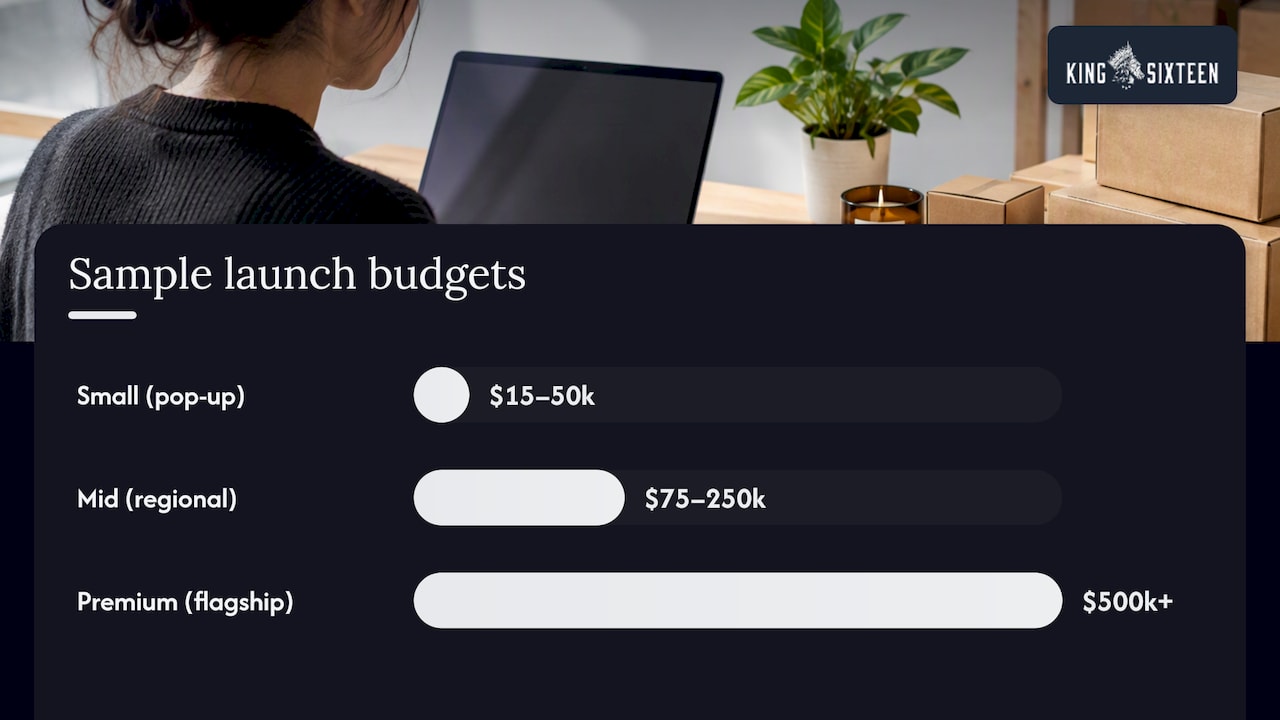
Premium: flagship launch with custom fabrication (roughly $500,000 and up). A flagship activation concentrates spend in production and fabrication, since a fully custom environment, branded installations, and a technically ambitious reveal are what separate a flagship moment from a scaled-up mid-tier event. Our experiential marketing costs for brand leaders breakdown shows how fabrication alone can represent the largest single line at this scale.
Across all three, the same annotated rule applies:
- Protect the core reveal moment and primary AV package first, since those drive the press and social coverage you are paying for
- Cut secondary guest amenities (extra bar stations, printed swag, overflow lounge furniture) before touching the core experience
- Treat talent fees and venue deposits as near-fixed once signed, and build contingency around everything still negotiable
5. Tools, templates, and worksheets to build and track your budget
A working budget needs more than a single total column. At minimum, build tabs for line-item estimates, actual vendor quotes once received, committed costs versus forecast remainder, a cash-flow schedule tied to deposit dates, and a simple KPI or ROI tracker tied to spend.
This event budget spreadsheet template follows that same structure and is a reasonable starting point to adapt.
Three software categories solve different pieces of this:
- Event accounting or expense tools reconcile invoices against the committed column
- Project management tools track vendor deliverables and deadlines tied to the cash-flow schedule
- Dedicated budget-tracking tools roll estimates, actuals, and variance into one live view for stakeholders
Adapt whichever template you choose to your own procurement cadence: if your finance team requires purchase orders before deposits go out, build a PO-status column rather than retrofitting one later.
6. Cost-control strategies and where to invest vs. cut
Not every dollar carries equal weight in attendee perception, so cost control is about protecting the right lines, not cutting evenly.
Protect the headline experience: the core product demo, key AV and staging, and VIP hospitality touches are what convert attendees into customers, press coverage, or deals. These are the last lines to trim.
Negotiate before you cut. Vendors are often more flexible on terms than on price:
- Ask about multi-event or season-long deals if you run more than one activation a year
- Push for staged payments (deposit, midpoint, final) rather than full payment upfront to ease cash burn
- Offer scope flexibility (your team handles load-in labor, for instance) in exchange for a lower day rate
Pro Tip: When a vendor won’t move on price, ask what they can add at the same price instead, extra strike hours or an additional technician often cost them less than it would cost you to buy separately.
Operational efficiencies compound across events: bundling AV and staging with one production partner, sourcing freight locally instead of shipping fabricated pieces cross-country, and locking multi-year venue contracts when you repeat a format annually all reduce friction and markup over time.
7. Stakeholder communication, approvals, and ROI alignment
Finance and leadership want a single page, not a forty-tab spreadsheet, so consider how to measure brand awareness using AI analytics for concise KPI tracking. That summary should include your total budget with category breakdown, your baseline and downside scenarios, the specific approval you’re asking for, and the KPIs you’ll report against (leads generated, pre-orders, press mentions, social reach).
Build your approval timeline backward from your event date, since venue and production deposits are often due 60 to 90 days out, with final vendor payments due closer to the event itself.
- Tie specific spending lines to measurable outcomes: production spend to press and social reach, hospitality spend to partner or client retention, promotion spend to pre-orders or leads
- Our event ROI benchmarks resource covers how to select and track these KPIs after the event closes
- Present the ask as a range (baseline to -20% scenario) rather than a single number, so approval covers the contingency you’ve already planned
King Sixteen perspective: budgeting lessons from high-end launches
Our experience running turnkey production for premium brands has shaped how we think about where budget dollars actually matter. When one partner handles design, fabrication, staffing, AV, catering, venues, and logistics, budgeting decisions get simpler because trade-offs happen inside one conversation instead of across five vendor contracts.
A few patterns we see repeat across premium launches:
- Fabrication versus staffing is a real trade-off: a more ambitious custom build often means trimming secondary staffing roles elsewhere, not adding more budget overall
- Staged payments ease cash burn significantly on larger fabrication projects, since material costs hit early and labor costs hit later
- Consolidated vendor relationships tend to reduce the surprise fees that show up when five separate contracts don’t talk to each other
When major costs hit your timeline
Lead time drives cash flow as much as the total budget does. Venue deposits for a regional or flagship launch typically come due 60 to 90 days before the event, and popular venues in major markets often require signed contracts six months or more ahead for a desirable date.
Production and AV deposits generally follow a similar window, with a portion due at booking and the balance due closer to load-in. Custom fabrication timelines run longer still: a one-of-a-kind build often needs 8 to 12 weeks for design, material sourcing, and construction before it ever reaches the venue, which means fabrication budget commitments often land earliest in your planning calendar, not latest.
Talent and speaker contracts vary by exclusivity, but high-demand names are frequently locked three to six months out, with a deposit due at signing and the remainder near the event date.
Travel and accommodation costs crystallize once you book hotel blocks and flights, usually 45 to 60 days out for a regional launch, earlier for international travel. Our product launch essentials guide walks through a fuller planning sequence if you’re building this timeline from scratch.
Mapping these deposit dates against your cash-flow tab, rather than just your event date, is what keeps a budget from creating a funding gap mid-planning.
Reconciling expenses after the event
Budget tracking doesn’t end when the last guest leaves. Reconciliation means matching every committed cost against the actual final invoice, since vendor overages (extra labor hours, last-minute rentals, overtime strike fees) almost always surface in the final bill rather than the original quote.
Work from the same spreadsheet tabs you built during planning: move every line from “committed” to “actual” as final invoices arrive, and flag variances over a set threshold for review rather than letting small overages slide unexamined. A variance review also tells you which vendor quotes were accurate and which consistently underbid, information worth keeping for your next launch.
Close reconciliation against your KPI tracker at the same time, since tying final spend to final outcomes (leads closed, press mentions, pre-orders) is what turns a budget exercise into a real ROI conversation for next year’s planning cycle. Our post-event reporting resource covers how to structure that final report for stakeholders.
Set a firm deadline, typically two to four weeks post-event, for all final invoices to arrive, so reconciliation doesn’t drag on indefinitely while vendor bills trickle in.
Planning for disruption and unforeseen risk
Large-scale event cancellations in recent years pushed planners to treat disruption risk as a standing line item rather than an afterthought. That shift shows up directly in how contingency and cancellation terms get negotiated today.
Build cancellation and postponement clauses into every major vendor contract, specifying what portion of a deposit is refundable and under what notice period. Venues, AV vendors, and fabrication partners each handle this differently, so get the terms in writing before signing rather than assuming they match.
Consider event insurance for large-budget launches, particularly when outdoor venues, international travel, or high-value fabricated sets are involved. The cost is modest relative to the exposure of a fully sunk flagship budget.
Keep your scenario budgeting model ready for more than attendance swings.
Expert perspective: budget as strategy
The instinct to treat a launch budget as a list of costs to minimize misses the point. PCMA’s guidance frames budgeting as a strategic exercise: the goal is balancing cost control with the spend that actually drives revenue and attendance, not cutting for its own sake. Scenario budgets exist precisely so you can protect the line items tied to real outcomes, the core demo, the press moment, the VIP relationship, while trimming what attendees won’t notice. A budget built that way survives a downside scenario without gutting the reason you held the event at all.
— Tyler
How King Sixteen approaches turnkey launch budgeting
Budgeting a launch gets genuinely hard when you’re juggling five separate vendor contracts, five different payment schedules, and five sets of fine print on what’s included. Our turnkey model folds design, fabrication, staffing, AV, catering, venues, and logistics into one accountable partner, which means your budget conversation happens once instead of five times.
What that typically means for your budget:
- One point of accountability for production, fabrication, and operations, instead of reconciling separate vendor quotes
- A vendor network built over years, which tends to produce smarter pricing than assembling unfamiliar vendors from scratch
- Staged payment structures that ease cash flow on larger fabrication or production commitments
If you’re scoping a launch and want a single partner to help structure the budget and the execution together, our private events services page is the place to start a conversation.
FAQ
What is the 70-10-10-10 budget rule?
It works well as a fast first draft, though press-heavy launches often need a larger marketing share.
What are the 5 C’s of an event?
Definitions vary across the industry, but a common version covers concept, coordination, control, culmination, and closeout, tracking an event from initial idea through post-event wrap-up. Treat it as a planning checklist rather than a fixed standard.
What should be included in an event budget?
A complete event budget covers venue, production and AV, catering, talent, staffing and security, fabrication and decor, marketing and promotion, logistics and transportation, travel and accommodation, insurance and permits, and a contingency reserve. Most planners hold that contingency at 10 to 15% of total spend, per PCMA’s budgeting guidance.
What happens at a product launch event?
A product launch event typically combines a guided reveal or demo of the product with a hospitality component (reception, VIP access, press interaction) designed to generate coverage, leads, or pre-orders. The format scales from a small invitation-only demo to a flagship activation with custom fabrication, depending on budget and audience.