For any agency-produced pop-up activation in the U.S., three things must be in place before load-in: a Commercial General Liability policy at minimum $1M per occurrence / $2M aggregate, a Certificate of Insurance naming the venue as an additional insured, and inland marine coverage for any owned equipment the agency brings on-site. Everything else builds from those three.
Your pre-event procurement checklist:
- Certificate of Insurance (COI): Issued by the agency’s or brand’s carrier, delivered to the venue before load-in
- Additional Insured Endorsement: Venue and brand named on the agency’s GL policy (CG 20 26 or equivalent)
- Waiver of Subrogation: Required by most venue contracts; prevents the insurer from pursuing the venue after a claim
- Workers’ Compensation: Required if the agency employs W-2 staff working the activation
- Inland Marine / Equipment Floater: Covers owned fabrications, AV gear, and branded assets in transit and on-site
Limits callout: Most major venues and corporate clients require $1M per occurrence / $2M aggregate as the floor. Expect higher requests when the activation involves a large public venue, celebrity talent, alcohol service, or temporary structures requiring a permit.
Ownership at a glance: The agency typically secures GL and workers’ comp for its own staff and operations. The brand secures its own GL if it is distributing product or running branded staff. The venue dictates what it needs from both parties in the venue contract. Confirm these assignments in writing before the SOW is signed — not the week before load-in.
Table of Contents
- What coverages do you need to specify for a pop-up activation?
- What should a COI show, and what contract language should you require?
- How quickly can you procure coverage, and what will it cost?
- What on-site controls actually reduce your premium?
- Your pre-event, during-event, and post-event insurance checklist
- Key Takeaways
- The part most brand teams get wrong about activation insurance
- King Sixteen handles the insurance coordination so you don’t have to
What coverages do you need to specify for a pop-up activation?
Experiential agencies should bundle GL with inland marine and E&O depending on scope — a single-line GL policy leaves real gaps for high-production activations. Here are the lines to specify in your procurement documents:
- Inland Marine / Equipment Floater: Covers owned and rented equipment, fabricated installations, and branded assets in transit and on-site. Especially relevant when the agency brings custom POP displays or fabricated brand environments.
- Workers’ Compensation: Mandatory in most states for W-2 employees. Confirm coverage for event staffing before load-in.
For product sampling or giveaways, confirm that the Products & Completed Operations sublimit is sufficient — a high-volume claim can erode it quickly if a product liability issue arises.
What should a COI show, and what contract language should you require?
A COI is not insurance. It is evidence that a policy exists. Brand and sponsorship contracts commonly include insurance provisions that must be matched to current policies before signature — catching this at contract review saves days of scrambling later.
A compliant COI must show:
- Policy type and policy number for each line of coverage
- Effective and expiration dates confirming the policy is active through the activation date
- Per-occurrence and aggregate limits meeting or exceeding the venue’s requirements
- Named additional insureds as required by the venue or brand contract
- Carrier name and, where required, an AM Best rating of A- VII or better
- Certificate holder address matching the venue’s legal entity name
How additional insured endorsements work: Adding a party as an additional insured extends the policy’s GL coverage to that party for claims arising from the named insured’s operations. The standard endorsement is CG 20 26 (Additional Insured — Designated Person or Organization). Some venues require CG 20 10 (ongoing operations) and CG 20 37 (completed operations) together. Request both when the venue contract is silent on the specific form.
Sample contract paragraph: “Prior to commencement of any on-site work, Agency shall deliver to Client and Venue a Certificate of Insurance evidencing Commercial General Liability coverage of not less than $1,000,000 per occurrence and $2,000,000 aggregate, with Client and Venue named as additional insureds via endorsement CG 20 26 or equivalent. A Waiver of Subrogation in favor of Client and Venue shall be attached. Failure to deliver the certificate no later than five (5) business days before load-in shall constitute a material breach.”
If a COI is missing the day before load-in, contact the agency’s broker directly — not the agency’s account manager. Brokers can issue updated certificates within hours. If the endorsement itself is missing, the carrier must process it, which can take 24–72 hours. Build that buffer into your production schedule.
How quickly can you procure coverage, and what will it cost?
| Procurement route | Typical timeline | Cost shape | Best for |
|---|---|---|---|
| Single-event policy (online) | Same day to 24 hours | Lower total cost; limited customization | One-off activations with standard exposures |
| Annual / blanket policy | 3–7 days for new placement | Most efficient per-activation cost | Brands or agencies running multiple activations per year |
| Agency master / producer program | Existing program: same-day COI; new program: 2–4 weeks | Volume pricing; broadest coverage flexibility | Agencies managing activations for multiple brand clients |
| Endorsement on existing policy | 24–72 hours | Minimal incremental cost | Adding a venue or brand as additional insured on an active policy |
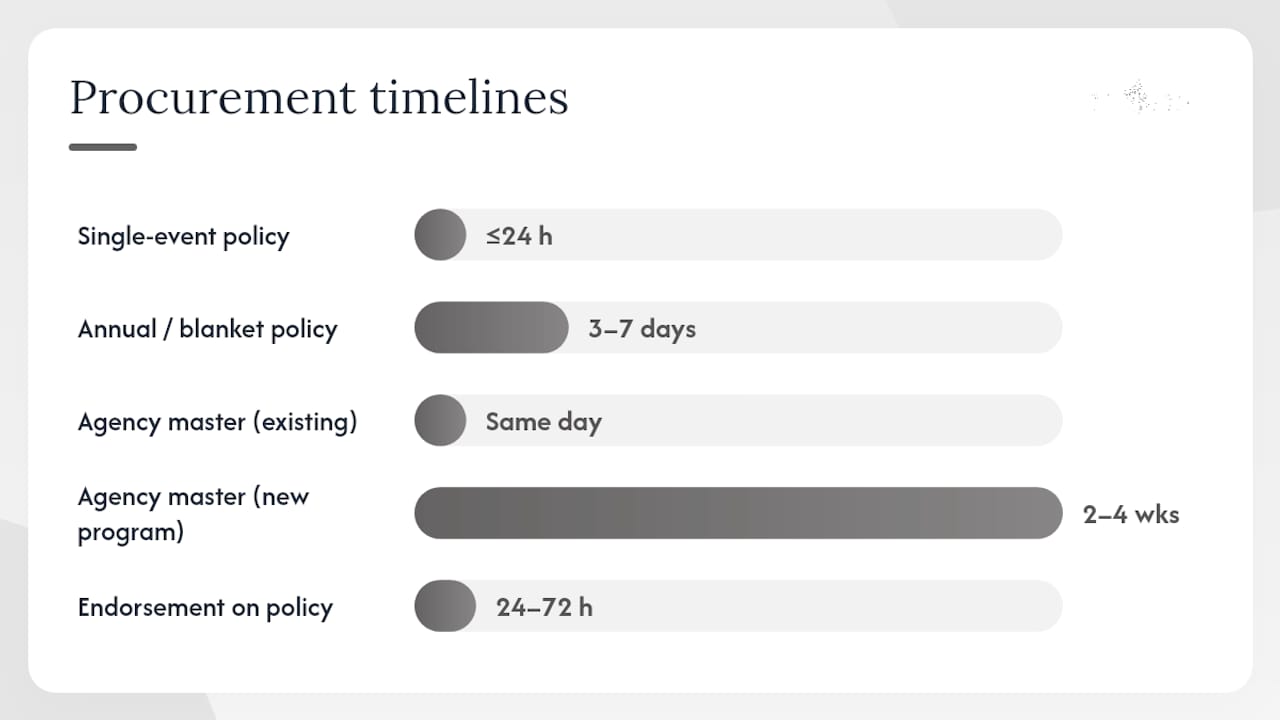
For activations with unusual exposures — large temporary structures, pyrotechnics, celebrity talent, or alcohol service — expect underwriting review to add 3–7 business days regardless of the route. Carriers with appetite for fabrication and experiential risk can move faster than standard commercial markets, which is why specialized placement matters.
Annual programs are the most practical option for agencies running more than three or four activations per year. The per-event cost drops, COIs can be issued same-day from the master policy, and the underwriting narrative only needs to be built once per renewal cycle.
What on-site controls actually reduce your premium?
Underwriters price risk based on what they can verify. Documented controls convert operational investments into lower premiums at renewal. Here is what they look for:
- Rigging inspections signed off by a qualified rigger before load-in
- Stamped engineering drawings for any temporary structure over a threshold height or span
- Cable management plans preventing trip hazards in public areas
- Fire watch protocols and extinguisher placement documented in the site plan
- Security and crowd-flow plans for high-attendance activations
- Alcohol service controls: licensed bartenders, TIPS-certified staff, and posted service-stop times
- Third-party contractor COIs collected and logged before they access the site
Vendor COI log fields to track: vendor name, policy type, carrier, per-occurrence limit, aggregate limit, policy expiration date, additional insured status (yes/no), and the broker contact for endorsement processing.
Bundling GL with inland marine and other lines while presenting documented safety controls gives underwriters a complete picture. That combination tends to produce better terms than a bare GL application with no supporting documentation.
Pro Tip: Fold your risk controls directly into the underwriting narrative. When the carrier sees the same controls described in the narrative and confirmed in attached method statements, it removes the need for follow-up questions — and follow-up questions are what slow down placement.
Your pre-event, during-event, and post-event insurance checklist
Pre-event
- Confirm primary GL limits meet or exceed venue requirements
- Request COIs from the agency and all major subcontractors
- Obtain additional insured endorsements (CG 20 26 or CG 20 10/37) and waivers of subrogation
- Verify workers’ comp is in force for all W-2 agency staff
- Confirm inland marine covers all owned and rented equipment at replacement value
- Review the venue contract’s indemnification and insurance section before signature
During the event
- Keep a printed copy of all active COIs and endorsements on-site
- Designate one person as the on-site insurance contact for vendor and venue questions
- If an incident occurs: stop, document, photograph, and collect witness names immediately
- Do not admit liability or make settlement offers on-site
- Notify the broker the same day any incident occurs — late notice can affect claim coverage
- Spot-check vendor COIs against the log if new subcontractors arrive during the event
Post-event
- Notify the broker of any incidents within 24 hours, even if no formal claim has been filed
- Return rental equipment with a documented inventory and condition report
- Preserve all photos, incident reports, and witness statements in a single claims packet
- A basic post-event claims packet should include: incident description, date/time/location, photos, witness contact information, vendor COIs for any involved parties, and the site plan showing the incident location
Key Takeaways
Effective pop-up shop insurance for agency-produced activations requires GL at $1M/$2M minimum, a COI with additional insured endorsements delivered before load-in, inland marine for owned assets, and a precise underwriting narrative to prevent carrier misclassification.
| Point | Details |
|---|---|
| Minimum GL limits | Request commercial general liability limits that meet or exceed venue requirements; higher limits are common for large venues, talent, or alcohol service. |
| COI and endorsements | Deliver the COI with CG 20 26 (or CG 20 10/37) and a waiver of subrogation at least five business days before load-in. |
| Underwriting narrative | A one- to two-page operational description prevents misclassification and removes “unknown” premium loadings from carrier quotes. |
| Procurement timing | Annual or master programs issue same-day COIs; new single-event placements with unusual exposures need 3–7 business days for underwriting review. |
| King Sixteen | King Sixteen coordinates COIs, drafts underwriting narratives, and manages vendor certificate logs as part of full-service activation production. |
The part most brand teams get wrong about activation insurance
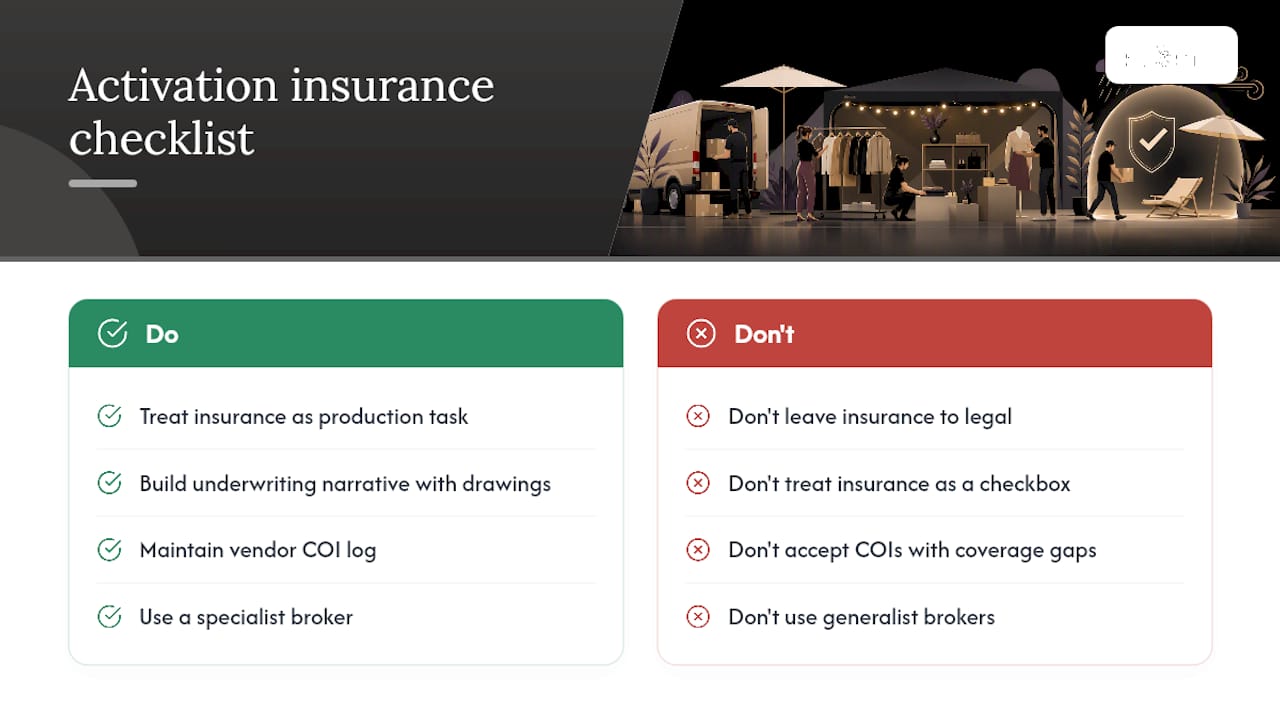
Most brand teams treat insurance as a procurement checkbox — something legal handles the week before load-in. That framing creates the exact problems this guide is designed to prevent: missing endorsements, misclassified risks, and COIs that satisfy the letter of the venue contract but leave real gaps in coverage.
The more useful framing is to treat insurance coordination as a production task, not a legal one. It belongs on the production timeline alongside venue contracting, fabrication milestones, and staffing confirmations. When the underwriting narrative is built at the same time as the build drawings, the carrier gets accurate information and the brand gets accurate pricing. When the vendor COI log is maintained by the same team tracking subcontractor deliverables, nothing falls through the cracks the day before load-in.
The other thing practitioners consistently underestimate is the value of specialized placement. A broker who understands fabrication and experiential work will place your coverage with carriers that have actual appetite for this risk class. That means faster endorsements, fewer exclusions, and better renewal terms when you document your controls. A generalist broker placing an experiential activation on a standard commercial GL form is a mismatch that shows up in the quote and in the claims process.
Insurance for a high-production brand activation is not complicated. It is just specific. The brands and agencies that get it right treat specificity as the job.
King Sixteen handles the insurance coordination so you don’t have to
High-end brand activations have enough moving parts without insurance logistics becoming a production bottleneck. King Sixteen’s turnkey model covers the full coordination stack: drafting underwriting narratives, issuing COIs, managing vendor certificate logs, and confirming additional insured endorsements are in place before load-in. If a venue contract comes back with a limit requirement above your current program, we work with the broker to resolve it without delaying the production schedule.
For brands planning an agency-produced activation, the fastest path to coverage that actually fits the scope is working with a production partner who builds the insurance workflow into the production timeline from day one. If you have an upcoming activation and need to confirm your coverage structure quickly, reach out to King Sixteen to review the scope and get the right documentation in place.