The strongest luxury product launches make the product felt, not just seen, through staged, sequenced experiences that build anticipation before amplifying it with selective technology. A significant majority of aspirational luxury clients say they’re likely to repurchase after a complimentary experience, according to the EY Luxury Client Index 2026, and we’ve watched that principle play out on the ground at King Sixteen for years.
TL;DR:
- Scale the runway to launch size: two to three weeks for capsules, six to eight for medium launches, and three to five months for flagships.
- Keep AI in a concierge role with a visible human expert; collect only data the experience uses, and measure repeat engagement, not traffic.
- With 73% of aspirational luxury clients willing to pay for exclusive event access, track future access demand alongside repeat purchases and membership conversion.
Table of Contents
- 1. Luxury Product Launch Ideas Worth Building a Strategy Around
- 2. How Should You Sequence a Launch for Maximum Prestige?
- 3. Choosing and Designing Spaces for a Luxury Reveal
- 4. How Technology Can Amplify Exclusivity Instead of Diluting It
- 5. Turning the Room Into Distribution: Earned Amplification and Content
- 6. The KPIs That Actually Matter for Luxury Launches
- 7. A Practitioner’s View on Designing Launches That Perform
- 8. Budgeting for a High-End Launch
- 9. Planning Media and PR for a Luxury Audience
- 10. Designing Guest Experience and Hospitality That Feel Personal
- 11. Selecting the Right Venue and Location
- 12. Managing the Timeline for Seamless Execution
- Why Experiential-First Launches Are the Future of Luxury
- How King Sixteen Can Help You Launch
- FAQ
- Sources
1. Luxury Product Launch Ideas Worth Building a Strategy Around
Choosing the right launch concept starts with understanding what luxury buyers actually respond to: scarcity, craft, and a sense that they were let in before everyone else. The ten ideas below are ordered by how much leverage they typically deliver relative to the complexity of pulling them off.
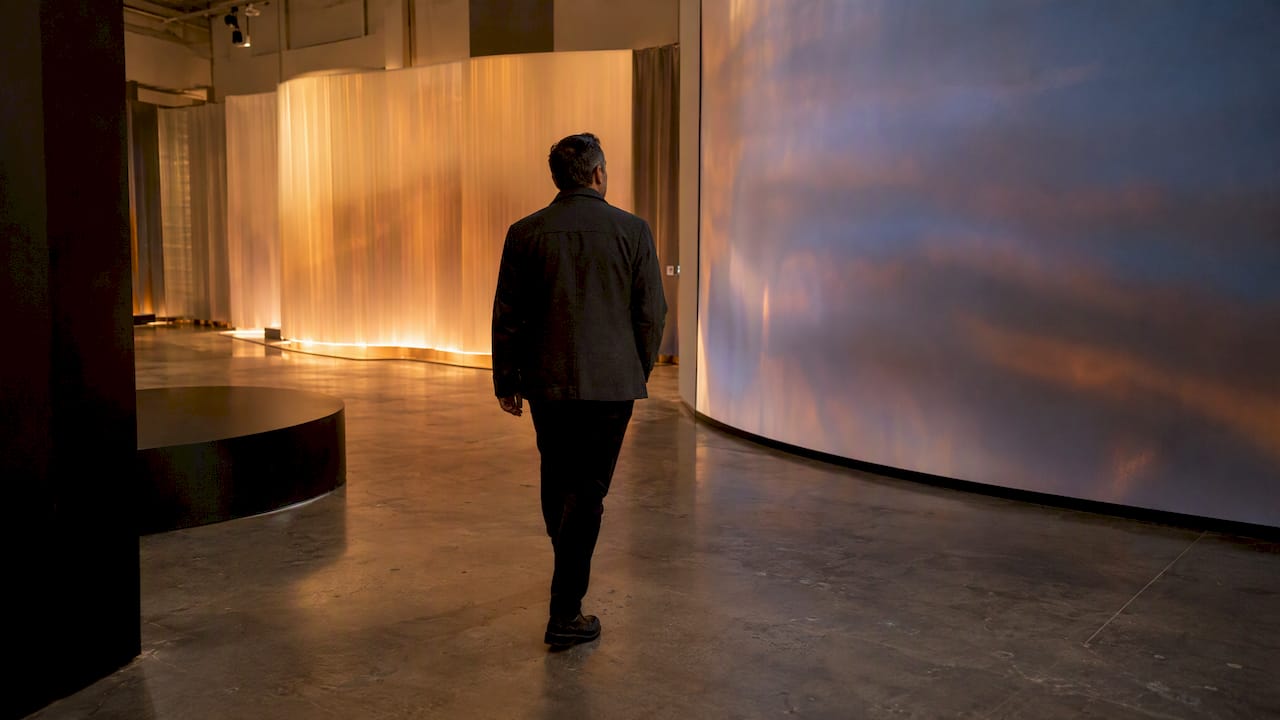
1. Immersive pop-up experiences with scenography and multisensory design. A pop-up built around a specific scent, soundscape, and lighting palette turns a product reveal into a memory rather than a photo opportunity. Luxury buyers remember how a room made them feel long after they forget the tagline, which is why scenography deserves the same budget line as the product samples themselves. These activations work best for fashion, fragrance, and spirits launches where sensory cues reinforce the product’s own character.
2. VIP and influencer curated previews with staged content capture. Invite a small, deliberately mixed group of editors, creators, and loyal clients before the public reveal, and build the room around moments designed to be photographed and shared. The goal isn’t volume of attendees, it’s density of credible voices who will talk about the product in their own words.
3. Limited-edition drops with waitlist mechanics. Pair a capped production run with a staged waitlist that opens access in tiers, rewarding early registrants with first pick. The gap between reveal and availability does more marketing work than any single ad placement, because it gives press and word of mouth time to compound.
4. Digital-first immersive launches. A high-production livestream or an AR try-on experience extends a physical reveal to clients who can’t attend in person, without flattening the exclusivity of the room itself. Our experiential marketing work for luxury clients often pairs a live event with a parallel digital layer built specifically for people who were not in the room.
5. Invitation-only online communities and membership pathways. A gated digital community, open only to past buyers or vetted applicants, gives a brand a place to keep the conversation going after the event ends. Academic research on the exclusivity paradox found that thoughtfully designed digital strategies, including brand-led online communities, can strengthen prestige rather than dilute it, as long as access stays tiered and invitational rather than open to everyone.
6. Curated collaborations and cultural partnerships. Pairing a launch with a respected name in art, music, or design borrows credibility and gives press a new angle beyond the product specs. The partnership only works when the collaborator’s own audience overlaps meaningfully with the brand’s aspirational buyer.
7. Narrative-driven staged reveals. Build the unveiling around a story arc with a beginning, a tension point, and a payoff, rather than a straightforward unveiling on a table. Theatrical pacing, not just theatrical set design, is what separates a memorable reveal from a predictable one.
8. Personalization powered by AI. A virtual concierge or tailored recommendation engine can extend a human stylist’s expertise to more clients without replacing the relationship itself. We cover the guardrails for this in the next section, since getting it wrong is the fastest way to make a luxury brand feel generic.
9. Certified pre-owned and subscription ladders as loyalty levers. Giving early buyers a clear path to trade up, subscribe, or resell through a certified channel turns a single transaction into an ongoing relationship. Accenture’s Luxe Eternal analysis frames this kind of continuity as essential to sustaining desirability once the initial launch excitement fades.
10. Experiential sampling and ambient seeding. Placing the product in unexpected, real-world touchpoints, a private dinner, a members’ lounge, a transit hub for a short window, generates earned conversation before the official reveal even happens.
Pro Tip: Pick no more than three of these ideas per launch and sequence them deliberately. A luxury launch crowded with ideas reads as noise, not prestige.
For teams weighing a salon-style preview against a full public reveal, our guide to exclusive experiences and VIP programming walks through how invite lists shape the tone of the room.
2. How Should You Sequence a Launch for Maximum Prestige?
A luxury launch gains power from the gap between reveal and availability, not from collapsing that gap for convenience. Chanel’s five-month pre-availability campaign offers an instructive example of what sequencing can do: stacked impressions across channels and months created a compounding effect that converted attention into demand far more reliably than a single spectacular event.
A workable cadence usually includes these layered touchpoints, spaced over weeks rather than days:
- An ambassador or collaborator teaser that hints at the product without naming it.
- Editorial seeding with a small group of trusted press, timed before any public announcement.
- A VIP or salon-style reveal for top clients and creators, held days to weeks before the public date.
- A public announcement paired with the first wave of content capture from the VIP reveal.
- A controlled availability window, often with a waitlist or application process rather than open sale.
Timeline length should scale to launch size. A small capsule drop might compress this into two to three weeks, a mid-size launch into six to eight weeks, and a flagship product introduction into three to five months, mirroring the kind of staged narrative that worked for Chanel.
Scarcity mechanics matter most in the final stage: capped quantities, numbered pieces, or application-only purchase windows all signal that the brand, not the buyer’s wallet, controls who gets access first.
3. Choosing and Designing Spaces for a Luxury Reveal
The venue and its sensory details carry as much brand meaning as the product on the table. Before booking anything, decide on the sensory palette deliberately: a signature scent that lingers in memory, a soundscape built for the room rather than borrowed from a playlist, tactile surfaces that invite touch, and lighting calibrated to flatter both the product and the guests.
Production essentials separate a polished reveal from one that feels improvised:
- Projection mapping requires a pre-tested throw distance and surface, not a same-day adjustment.
- Rigging and AV systems need built-in redundancy, since a single point of failure during a reveal is unrecoverable.
- Sample handling protocols protect the product from damage while still allowing close, tactile guest interaction.
- A second, full technical rehearsal in a darkened space catches calibration issues that a walkthrough alone will miss.
Scale guidance: an intimate salon setting suits twenty to sixty guests and favors conversation over spectacle; a pop-up suits broader public exposure over days or weeks; a large-scale reveal suits a flagship moment with press and hundreds of attendees, but demands the heaviest technical rehearsal schedule of the three.
Pro Tip: Budget for at least two full technical rehearsals in the actual venue, not a studio stand-in. Fog density, projection throw, and lighting all behave differently once the room is full of people.
Our planner’s guide to luxury brand events covers rehearsal checklists in more depth for teams building their first large-scale reveal.
4. How Technology Can Amplify Exclusivity Instead of Diluting It
Treat artificial intelligence as an amplifier of human expertise, never a replacement for it. The EY Luxury Client Index 2026 found that aspirational clients welcome AI when it sharpens discovery and personalization, but the brands that win keep a human expert visibly in the loop.
A large majority of surveyed aspirational luxury clients believe AI can enhance the luxury shopping experience through better personalization and search, according to the EY Luxury Client Index 2026 PDF. That receptiveness only holds when the technology feels like a concierge, not a chatbot.
Concrete applications that preserve exclusivity:
- AR try-on tools let clients preview a product in context before committing, without replacing an in-person fitting.
- Virtual concierge services extend stylist-level guidance to clients who can’t visit a flagship in person.
- Smart mirrors in a pop-up or salon, pair visual try-on with a quiet handoff to a human associate.
- Invite-only community platforms gate digital access the same way a guest list gates a physical room.
Partner resources on tailored personalization strategy are worth a look for teams building out the choice architecture behind these tools.
Guardrails matter as much as the tools: never collect more client data than the experience visibly uses, and always give clients a clear, human point of contact when the technology reaches its limit. Measure digital experiences on depth signals, repeat engagement and completed personalization journeys, rather than raw traffic.
5. Turning the Room Into Distribution: Earned Amplification and Content
Design every staged moment to be told, not just attended. The significant amount of earned media value that Huda Beauty generated from a single evening, as detailed in the CampaignME case study, came from building a launch specifically engineered for guests to document and share.
Tactics that make a room generate its own media:
- Build two or three deliberate “editorial moments” into the run of show, framed and lit for photography.
- Seed the product through nontraditional channels before the event, private dinners, transit placements, small gifting moments, to create earned narratives ahead of the formal reveal.
- Prepare a shot list and social-first capture plan in advance so the content team isn’t improvising during the event.
- Coordinate partnership and editorial timing so press embargoes lift in step with the content wave from the room.
Our guide to brand storytelling through experiential campaigns walks through how to structure those staged moments around a single narrative thread.
6. The KPIs That Actually Matter for Luxury Launches
Luxury launches should be measured on depth, not just reach. Favor earned media value quality, repeat visit rates, membership conversions, and lifetime value uplift over raw impressions or attendee counts.
73% of aspirational luxury clients are willing to pay for access to exclusive luxury events, according to the EY Luxury Client Index 2026, which makes willingness-to-pay for future access a meaningful signal to track alongside attendance.
Plan metrics on two timelines. Short-term: content reach, EMV, press pickup, and immediate sell-through of a limited run. Long-term: repeat purchase rate, membership sign-ups, and retention over the following two to four quarters.
Continuity tactics that convert launch attention into lasting value:
- Membership programs that give launch attendees early access to future drops.
- Subscription ladders that turn a one-time purchase into a recurring relationship.
- Certified pre-owned integration, which Accenture’s Luxe Eternal analysis frames as central to sustaining desirability over time.
7. A Practitioner’s View on Designing Launches That Perform
We build luxury launches on a turnkey model: one team handling creative direction, custom fabrication, staffing, AV, and content capture, rather than a brand coordinating five separate vendors. That single-accountability structure is what lets sequencing, production, and capture stay coherent from first ambassador teaser to post-event content rollout.
Before hiring an experiential partner, we’d ask any brand to check for three things: a single point of accountability across creative and production, a track record with comparable scale activations, and a plan for content capture built into the run of show, not bolted on afterward.
8. Budgeting for a High-End Launch
Budget allocation for a luxury launch should mirror where the experience actually lands its impact: venue and scenography, custom fabrication, staffing and hospitality, content capture, and technology integration. Underfunding any one of these creates a visible seam in an otherwise polished experience.
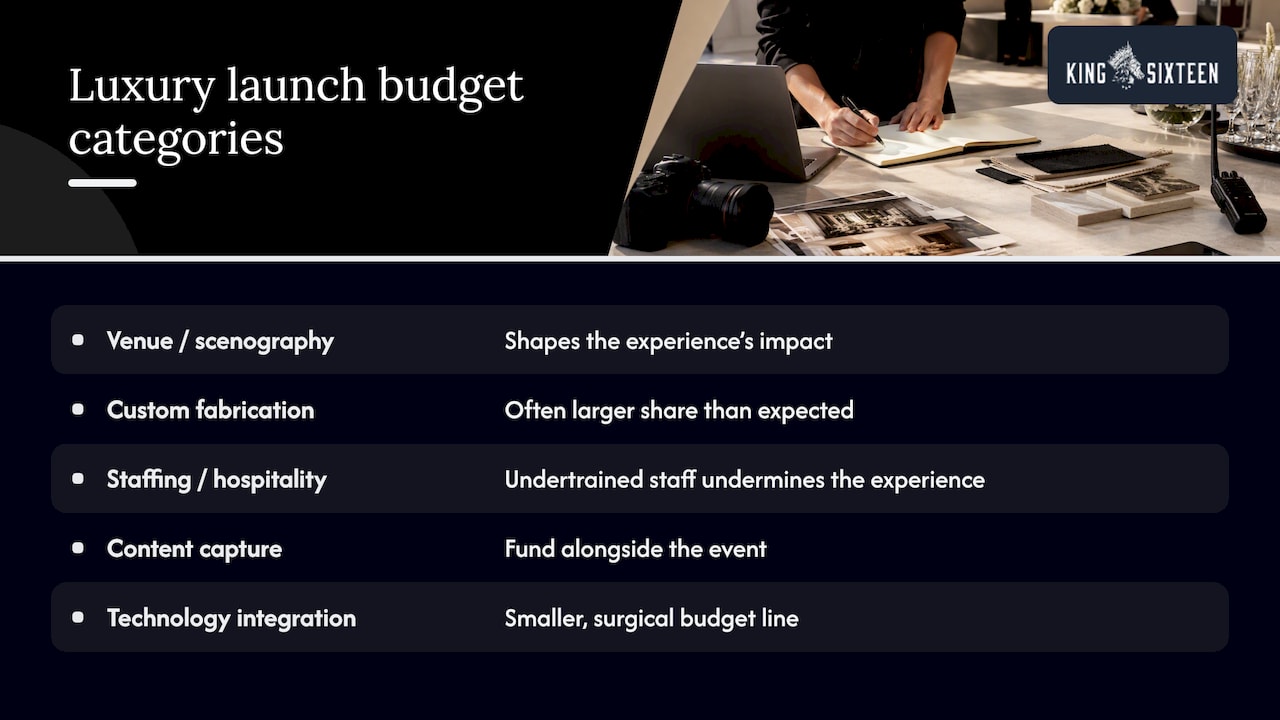
Custom fabrication, built installations, display structures, set pieces, tends to carry a larger share of the budget than brands initially expect, since these elements define how premium the space feels before a guest even sees the product. Staffing and hospitality deserve similarly serious investment: a flawless room with an undertrained staff undercuts the entire effort.
Content capture is frequently underfunded relative to its payoff. A launch built for $18.3 million in earned media value, as Huda Beauty’s Easy Bake launch demonstrated, only happens when a dedicated capture plan is funded alongside the event itself.
Technology integration, AR tools, virtual concierges, invite-only platforms, should be budgeted as a smaller, more surgical line item, since over-investing in tech at the expense of craft tends to read as compensating for a weaker core experience.
Build in contingency for technical rehearsal time. Two full run-throughs in the actual venue cost real money in labor and venue hours, but catch the calibration issues that would otherwise surface live.
9. Planning Media and PR for a Luxury Audience
Press strategy for a luxury launch starts narrower than most teams expect. Rather than a broad press release blast, identify the small group of editors and outlets whose coverage carries weight with the brand’s actual buyer, and seed them ahead of any public announcement.
Timing is the lever that matters most. Editorial seeding should land days to weeks before a VIP reveal, giving writers time to produce considered coverage rather than reactive posts. Embargo lifts should coincide with the content wave coming out of the VIP room, so press coverage and social content reinforce each other rather than compete for attention on different days.
Collaborations and cultural partnerships, covered earlier as a launch concept, also function as a PR lever: a respected collaborator gives press a fresh angle beyond product specifications.
Treat influencer and creator outreach as a curated guest list, not a paid media buy. The credibility of a launch depends on inviting voices whose audience genuinely overlaps with the brand’s aspirational buyer, not simply the voices with the largest followings.
10. Designing Guest Experience and Hospitality That Feel Personal
Guest experience design for a luxury launch starts with anticipating what each attendee needs before they ask. A dedicated host assigned to a small group of VIP guests, a welcome gesture tailored to a known preference, a seating plan that considers who should be introduced to whom, all signal attentiveness that a generic open house cannot replicate.
Hospitality details carry outsized weight in luxury settings. Catering, staffing ratios, and the pacing of the evening all shape whether a guest leaves feeling genuinely hosted or simply processed through a well-decorated room.
Personalization extends naturally from technology into hospitality: a virtual concierge or stylist recommendation can inform what a human host offers a guest in the room, closing the loop between digital preparation and in-person service.
11. Selecting the Right Venue and Location
Venue choice should follow the sensory and narrative decisions made earlier, not precede them. A space with strong architectural character can carry a reveal on its own, while a neutral space gives scenography a blank canvas to build the full sensory palette from scratch.
Location signals brand positioning as much as the product itself. A members’ club suggests intimacy and heritage, a converted industrial space suggests edge and reinvention, and a flagship retail location suggests confidence in the brand’s permanent presence.
Logistics deserve equal weight: loading access for custom fabrication, rigging points for AV and lighting, and proximity for VIP guests all affect whether the chosen venue can actually deliver the experience designed for it. Our guidance on private, invite-only events covers venue selection criteria specific to salon-style launches in more depth.
12. Managing the Timeline for Seamless Execution
A luxury launch timeline works backward from the public availability date, not forward from the kickoff meeting. Mapping every dependency, fabrication lead times, rehearsal windows, press embargoes, content delivery, against that fixed date surfaces bottlenecks early enough to solve them.
Custom fabrication typically carries the longest lead time in the entire project and should be locked in first. Rehearsal windows come next, since they depend on fabrication being substantially complete.
A single point of project accountability shortens the overall timeline meaningfully, since coordinating five separate vendors on overlapping deadlines introduces delay at every handoff. That is the core logic behind a turnkey production model: fewer handoffs, fewer places for a timeline to slip.
Build a two-week buffer before the public date for final technical rehearsals and content review. That buffer is what absorbs the inevitable last-minute adjustment without threatening the launch date itself.
Why Experiential-First Launches Are the Future of Luxury
Luxury launches work best when treated as a journey a client moves through over weeks, not a single evening to survive. The brands getting this right balance craftsmanship, narrative pacing, and selective technology in roughly equal measure, never letting any one element carry the whole experience. Sequenced scarcity and staged impressions aren’t a trend borrowed from streetwear drops, they’re a return to how luxury has always built desire: slowly, deliberately, and with real craft behind every reveal.
— Tyler
How King Sixteen Can Help You Launch
We build the kind of turnkey luxury launches described throughout this piece: one team handling creative direction, custom fabrication, staffing, AV, and content capture, so your team isn’t coordinating five vendors on a tight deadline. Our work spans experiential campaigns for established brands that need a launch done right the first time, with no margin for error. If you’re planning a product reveal and want a single accountable partner from concept through execution, request a proposal and let’s talk through your timeline.
FAQ
What are some effective product launch ideas?
The most effective ideas combine a staged physical experience, like an immersive pop-up or VIP preview, with a deliberate gap between reveal and availability. Limited-edition drops with waitlist mechanics and narrative-driven reveals consistently outperform single-moment announcements because they give press and word of mouth time to build.
What are the 7 Ps of luxury marketing?
Luxury marketing frameworks often extend the classic marketing mix (product, price, place, promotion) with elements like people, process, and physical evidence, though exact definitions vary by source. In practice, the version that matters most for a launch is how product, place, and physical evidence come together to create a coherent sensory experience.
What are some creative ideas for a product launch event?
Strong creative concepts include theatrical staged reveals with narrative pacing, multisensory pop-ups built around a signature scent and soundscape, and collaborations with respected cultural figures or brands. Pairing any of these with a curated VIP and influencer preview tends to extend the reach of the in-person moment significantly.
What are the 4 E’s of luxury marketing?
Definitions vary, but a common version centers on experience, exclusivity, emotion, and engagement as the pillars that distinguish luxury marketing from mass-market approaches. Each of these shows up directly in how sequenced launches, VIP previews, and sensory design work together to build desire before a product becomes available.
Sources
- How Huda Beauty rewrote the rules of a beauty launch to generate its highest-ever EMV
- The Exclusivity Paradox: Optimizing Online Strategies for Luxury Brands (Wharton)
- Luxe Eternal: The customer edit (Accenture)