Choose offsite when your goal is reach, discovery, and access to a new or larger audience; choose onsite when the priority is total brand control, environment design, and direct CRM integration. Hybrid models, where you debut onsite and tour offsite, often capture both strengths. Some agencies specialize in building both formats, and the tradeoffs matter: budget is the top challenge for 89% of event professionals, so the format you pick should match the constraint you’re actually managing, with ADA compliance as your accessibility floor either way.
TL;DR:
- Offsite venues offer higher audience reach and sponsor monetization opportunities but require longer planning, building infrastructure, and navigating permits.
- Onsite activations are quicker to execute, cost less upfront, and allow full control over brand environment and CRM integration, but limit reach to existing foot traffic.
- Hybrid models combine onsite flagship experiences with offsite tours to extend reach while maintaining brand control, especially when timing permits.
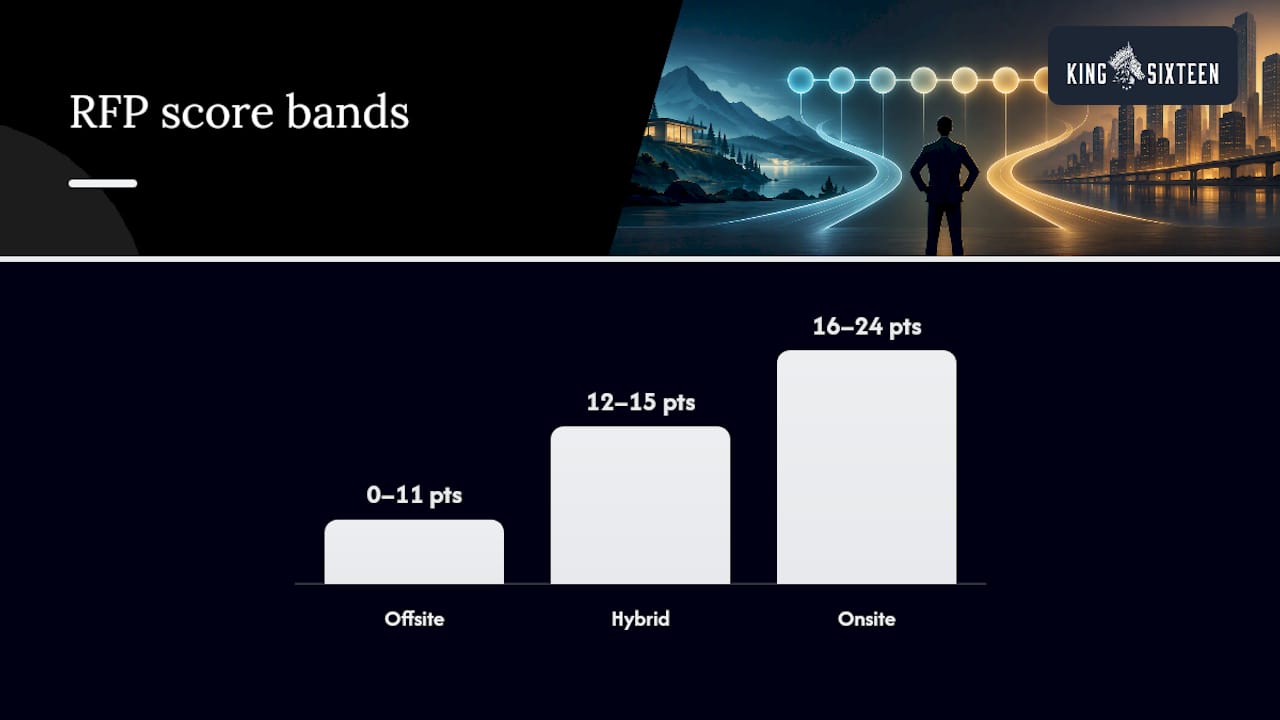
- A total score above 15 favors onsite, below 12 favors offsite, and between 12-15 suggests a hybrid approach based on budget, timeline, and audience goals.
- Using a turnkey agency simplifies decision-making, reduces vendor coordination risks, and ensures measurement, risk management, and sustainability commitments are integrated from the start.
Table of Contents
- Offsite vs onsite: a quick side-by-side snapshot
- A decision framework and scoring checklist for your RFP
- Operational differences that decide your timeline
- Accessibility and safety: what’s required and what’s smart
- Measurement and ROI: proving the activation worked
- Sustainability clauses that belong in every RFP
- Why turnkey execution resolves most of this tension
- How King Sixteen can help you decide and execute
- Sources
- FAQ
Offsite vs onsite: a quick side-by-side snapshot
Before you brief a vendor or draft an RFP, get your stakeholders aligned on the basic tradeoffs. Each format solves a different problem, and knowing which problem you’re solving first prevents scope creep later.
- Reach vs control: offsite venues put your brand in front of new foot traffic and festival crowds; onsite locations give you full command over every visual, sonic, and spatial detail.
- Speed vs complexity: onsite retrofits move faster because you already own the space; offsite requires venue booking, permitting, and site build from scratch.
- Sponsor monetization vs brand sanctuary: offsite events, especially at conferences or festivals, come with built-in sponsor ecosystems; onsite activations protect your brand from competitor noise.
- Infrastructure vs adaptability: onsite locations often have existing power, Wi-Fi, and load-in infrastructure; offsite venues force you to build or rent everything.
- Hybrid works when timing allows it: launch onsite as a flagship experience, then tour a scaled-down version offsite to extend reach without rebuilding the brand story from zero.
A decision framework and scoring checklist for your RFP
Turn these tradeoffs into a number, not a debate. Score each criterion 0 to 3, where 0 favors offsite and 3 favors onsite, then total the results.
- Budget flexibility. Tight budgets favor onsite, since you avoid venue rental and permitting fees.
- Timeline pressure. Fast turnarounds favor onsite; offsite builds typically need longer lead times for permits and site access.
- Audience reach goals. New-audience discovery favors offsite, particularly at high-traffic third-party venues.
- Brand environment needs. Full sensory and spatial control favors onsite.
- Data and CRM integration. Direct POS or CRM tie-ins favor onsite, where systems already exist.
- Safety and risk profile. Predictable, known environments favor onsite; unfamiliar offsite venues require deeper vetting.
- Sustainability requirements. Venues with established waste and recycling infrastructure can favor offsite if that infrastructure beats your own site’s.
- Sponsor or partner monetization. Built-in audiences at offsite venues create faster sponsor conversion opportunities.
A total score above 15 signals onsite; below 12 signals offsite; in between, consider a hybrid sequence.
When you visit a venue or vet a vendor, ask these eight questions directly: What permits are required and who pulls them? What’s the emergency evacuation procedure? Who has data access to attendee systems? What waste streams does the facility support? What’s the load-in window? What connectivity redundancies exist? What’s the cancellation policy? Who is the single point of contact on event day?
Pro Tip: Get marketing, operations, finance, and legal in the same room before the RFP goes out, not after the vendor responses come in.
Operational differences that decide your timeline
Offsite events run on a longer milestone map: venue booking, permitting, site build, and load-in coordination with official service contractors. Onsite activations move faster but require their own discipline, retrofitting existing space, integrating POS or CRM systems, and managing disruption to daily store or campus operations.
Vendor coordination is where most timelines slip. Offsite work often means juggling venue staff, official contractors, and outside vendors with competing priorities. A turnkey agency model consolidates vendor coordination into one accountable partner instead of multiple points of failure.
Common failure points surface during site selection and early inspections, not on event day:
- RF and cellular dead zones that go unnoticed until check-in systems fail.
- Insufficient fire safety equipment relative to expected crowd size.
- Load-in constraints, like narrow doorways or weight limits, that block fabrication delivery.
Test connectivity, fire equipment, and load-in capacity in person; documentation alone is not reliable, according to risk management guidance.
Accessibility and safety: what’s required and what’s smart
ADA compliance is your legal floor, not your finish line. Sensory-inclusive certifications and early input from accessibility advisory groups produce a meaningfully more equitable experience for attendees with disabilities, and that gap matters more offsite, where you don’t control the base building. Our own ADA compliance guide covers site-visit specifics in more depth.
During any site visit, check:
- Emergency egress routes and posted evacuation maps.
- Fire extinguisher placement and current inspection dates.
- Medical access points and response time from the nearest station.
- RF and cellular signal strength across the full footprint, not just the main stage.
Protective intelligence, ongoing monitoring, liaison with local law enforcement, and tabletop exercises that rehearse communication roles, reduces operational risk and gives your team clarity under pressure. Every activation, offsite or onsite, needs a written risk assessment before contracts get signed.
Pro Tip: Run a 30-minute tabletop exercise with your core team before the event, not during it. It’s the cheapest insurance you’ll buy.
Measurement and ROI: proving the activation worked
The KPIs that matter to sponsors and finance teams are the same regardless of format: traffic, dwell time, stop rate, lead capture, sentiment or reaction rates, and sponsor-specific conversion numbers.
Instrumentation strength shifts by format. Onsite locations benefit from existing POS and CRM integration; offsite venues often rely more heavily on footfall counters, beacons, app opt-ins, and onsite surveys.
- Traffic and stop rate show raw interest and initial engagement.
- Dwell time signals depth of engagement beyond a passing glance.
- Lead capture and sentiment data connect the activation to pipeline and brand perception.
Organizers who report traffic, stop rate, and dwell time data can convert a pilot activation into a recurring, revenue-generating sponsor asset. That’s the difference between a one-off event and a program sponsors renew every year.
Package these into a simple sponsor reporting bundle: pre-event projections, day-of dashboards, and a post-event summary delivered within two weeks. That cadence proves value and sets up the next conversation.
Sustainability clauses that belong in every RFP
Sustainability promises fall apart when they stay aspirational. Specific, measurable RFP language is what actually delivers on sustainability goals, and this applies to onsite retrofits as much as offsite venue contracts.
- Request a documented waste-management plan, including composting streams and diversion rates.
- Ask for carbon reporting capabilities tied to energy use and material sourcing.
- Require exhibitor-facing communications, so attendees and vendors know what’s expected of them onsite.
Validate local recycling capabilities directly, since they vary by region and venue claims don’t always hold up. Request facility-provided slide assets for exhibitor packs, and write measured deliverables and a reporting cadence into the contract itself, not just the proposal.
Why turnkey execution resolves most of this tension
Most of the offsite versus onsite tradeoff disappears when one partner owns the full execution chain. A turnkey partner runs experiential campaigns and product launches, conference and live event production, and custom fabrication of brand assets through a single vendor network built over years.
That structure means faster procurement, one point of accountability instead of many, and measurement and risk practices built into the process from day one rather than bolted on after a near miss.
— Tyler
How King Sixteen can help you decide and execute
If you’re weighing offsite against onsite and don’t want to manage five vendors to find out which one wins, that’s exactly the gap King Sixteen closes: turnkey design through execution for high-impact brand activations, conferences, and custom builds, handled by one accountable partner from proposal to load-out.
Two ways to start:
- Request a capability deck outlining how we’ve structured activations across experiential campaigns, live event production, and fabrication.
- Schedule a scoping call to walk through your specific budget, timeline, and audience goals.
Visit King Sixteen to get started, or explore our experiential services for a closer look at what turnkey execution actually includes.
FAQ
Is offsite or onsite cheaper for a brand activation?
Onsite is usually cheaper upfront since you skip venue rental and permitting costs, but offsite venues can offer built-in infrastructure that reduces build costs. Budget is the top challenge for 89% of event professionals, so the real cost driver is scope, not just location. Our cost breakdown guide covers ranges from small pop-ups to large flagship builds.
How long does it take to plan an offsite event versus onsite?
Offsite events generally need a longer lead time because of venue booking, permitting, and site build coordination with outside contractors. Onsite activations move faster since you already control the space, though retrofits and system integrations still take real planning time.
What accessibility standard applies to brand activations?
ADA compliance is the legal baseline for accessibility at any public-facing event, onsite or offsite. Beyond that floor, sensory-inclusive certifications and input from accessibility advisory groups create a more equitable experience for attendees with disabilities.
What metrics prove an activation’s ROI to sponsors?
The core KPIs are traffic, dwell time, stop rate, lead capture, and sentiment or reaction rates, paired with sponsor-specific conversion numbers. Reporting these consistently is what turns a pilot activation into a recurring sponsor program.
When should a brand hire an agency instead of running the activation in-house?
Hiring an agency makes sense when your team lacks bandwidth to coordinate vendors, permits, fabrication, and risk planning under a tight timeline. A turnkey model handling experiential campaigns, live event production, and custom fabrication through one accountable partner can reduce the coordination burden compared to managing multiple vendors directly.
Recommended
- Strategic brand experience for high-impact recognition
- In-Person Brand Engagement: A Strategic Guide for Leaders
- Venue Sourcing Strategy: A Planner’s Process and Checklist
- Innovative event marketing strategies to maximize brand impact