Hybrid event production means running one program simultaneously for an in-person room and a remote audience, using parallel signal chains, a single unified run-of-show, and dedicated staff for each cohort. It’s not a livestream bolted onto a conference. Before you brief a vendor or scope your own team, use this checklist:
- Unified run-of-show covering both audiences, minute by minute
- Parallel signal chains for venue and broadcast, with backup encoders
- A dedicated virtual moderator, not a stage host doing double duty
- CRM integration active from day zero, not exported after the event
- Rehearsal windows scheduled at least once with full technical staff present
Pro Tip: The single most common failure is treating your remote audience as an afterthought to “the real event.” Build their agenda first, then layer the in-room experience around it.
King Sixteen has run enough of these to know that Eventbrite’s guidance on treating hybrid as one experience across two environments holds up in practice. If you’re streaming to audiences in the EU, factor in the European Accessibility Act’s captioning and accessibility requirements early. It’s much harder to retrofit than to build in from the start.
Key Takeaways
Hybrid event production succeeds when planners design one unified program with parallel technical chains, dedicated virtual staffing, and CRM integration active from the first minute of planning.
| Point | Details |
|---|---|
| Design for two audiences equally | Build the remote agenda first, then layer the in-room experience around it. |
| Rehearse the failure, not just the show | Test backup encoders and redundancy steps live, not just on paper. |
| Fix the engagement budget gap | Shift spend from streaming hardware toward moderation and matchmaking tools. |
| Sync data from day zero | Route engagement data directly into your CRM instead of exporting a CSV later. |
| Work with a proven producer | King Sixteen runs discovery through post-event delivery as one connected process. |
Table of Contents
- What Is Hybrid Event Production, and What Formats Exist?
- When Should You Choose Hybrid Over Virtual or In-Person Only?
- What Technical Stack Does Hybrid Production Require?
- Who Runs the Show, and How Do You Rehearse It?
- How Do You Keep Remote and In-Person Audiences Engaged?
- What Does a Hybrid Event Budget and Timeline Look Like?
- How Do You Measure Success and Feed the Data Back to Marketing?
- How Does an Experienced Agency Execute Hybrid Production End to End?
- What Should You Ask When Evaluating a Hybrid Production Vendor?
- What Hidden Costs Should You Budget For Beyond the Obvious Line Items?
- How Do You Protect Streaming Security and Attendee Data?
- Sources
What Is Hybrid Event Production, and What Formats Exist?
Hybrid event production is the discipline of designing, staffing, and running an event that delivers a coherent experience to people in a room and people watching a screen, at the same time. The format you choose changes almost every downstream production decision.
- Simultaneous (true hybrid): In-person and remote audiences experience the same session live, with cameras, switchers, and moderators working in real time. Best for keynotes, product launches, and anything requiring shared energy.
- Hub-and-spoke: One main venue broadcasts to smaller satellite locations that gather their own local audiences. Common for global sales kickoffs or multi-region conferences.
- Live studio: A broadcast-quality studio production with minimal or no in-person audience, feeding a fully remote crowd. Prioritizes production polish over room energy.
- On-demand: Sessions recorded live and released after editing. Useful for evergreen content but weak for real-time networking or Q&A.
Each format shifts your latency tolerance, networking design, and platform requirements. A hub-and-spoke event demands regional AV crews; a live studio format demands broadcast talent and lighting most in-person planners underestimate.
When Should You Choose Hybrid Over Virtual or In-Person Only?
Hybrid earns its complexity when at least two of these apply:
- You need in-room networking energy and geographic reach you can’t get by flying everyone in
- Executive speakers or key clients are scattered across regions and can’t all travel
- Sponsors have paid for both booth visibility and digital impressions, requiring both audiences to exist
Hybrid overcomplicates delivery when your audience is small, single-region, and primarily relationship-driven. A 40-person leadership offsite doesn’t need parallel signal chains. Score it simply: if remote reach adds real revenue or relationship value beyond convenience, hybrid is worth it. If it’s just “in case someone can’t make it,” a recorded session covers you for less money and less risk.
What Technical Stack Does Hybrid Production Require?
Hybrid production runs on two parallel technical chains, one for the room and one for the broadcast, and most budget overruns happen when planners underbuild one of them. SicilyCast’s operator guide frames this as dual chains with dedicated bridge roles connecting them, not a single AV setup doing double duty.
Core components to require:
- Separate camera and audio feeds for stage and stream, not a single “room mic” repurposed for broadcast
- A production switcher and encoder with a documented backup unit on standby
- Dedicated, wired internet for streaming, separate from venue Wi-Fi
- Return feeds so remote comments and questions can surface back into the room
- Live captioning built into the platform, not added after the fact
On the platform side, Zoom Events and comparable tools should support multi-track sessions, breakout rooms, analytics, and API or CRM integration out of the box.
| Event size | Streams / concurrent capacity | Redundancy requirement |
|---|---|---|
| Small audiences | Single encoder, cloud backup | Backup uplink on standby |
| Medium audiences | Dual encoders, multi-track | Redundant encoder + alternate ISP |
| Large audiences | Load-balanced streaming, CDN | Full failover system, on-site engineer |
Pro Tip: In your RFP, ask every vendor one question: “What happens if the stream fails at minute 20 of the keynote?” Vague answers mean an undertested plan.
Who Runs the Show, and How Do You Rehearse It?
A hybrid production needs more roles than a standard in-person event, and blurring them is where things break.
- Executive producer: owns the overall show and final calls
- Technical director: manages both signal chains and the switch between them
- Virtual host: keeps remote energy up, distinct from the stage host
- Virtual moderator: surfaces remote questions and comments into the live room
- Stage manager: runs in-room timing and speaker cues
- Speaker manager: preps talent for camera behavior specific to hybrid
- Sponsor lead: ensures sponsor visibility lands in both environments
A unified run-of-show lists every hand-off point, not just stage cues. Prism Events recommends building two parallel agenda columns with explicit bridging moments where hosts acknowledge both audiences by name.
Rehearsal checklist:
- Full dry run with actual encoders and return feeds, not just a stage walkthrough
- Backup encoder swap tested live, not just confirmed on paper
- Ten-minute buffer built in before any hand-off, since dead air reads longer to remote viewers than it does in the room
Pro Tip: Assign separate mic feeds for room and stream audio. Audio is the single highest-risk failure point in hybrid production, and it’s the cheapest one to fix in advance.
How Do You Keep Remote and In-Person Audiences Engaged?
Engagement design has to run in parallel, not in sequence; for proven tactics and measurement, see audience engagement strategies for business growth. Tools like Slido and Mentimeter let you run the same poll to both cohorts at once, with results displayed on the in-room screen so remote votes visibly count.
Prioritize:
- Moderated Q&A that pulls remote questions into the live room by name
- Matchmaking or 1:1 meeting booking instead of trying to replicate a hallway coffee chat online
- Virtual exhibit booths for sponsors who paid for both physical and digital presence
- Visible remote attendees on stage screens during discussion segments, so the room sees who’s watching
Design patterns worth copying: run identical polls simultaneously in both environments, script explicit bridging moments where a host says “let’s bring in our online audience,” and treat chat moderation as a full-time job, not a side task for whoever’s free. Pre-scheduled matchmaking consistently outperforms attempts to fake informal networking online. For more tactics on keeping both cohorts active throughout a session, see these attendee engagement strategies.
What Does a Hybrid Event Budget and Timeline Look Like?
Budget allocation is where most hybrid programs go sideways. Converve’s research found that around 64% of hybrid budgets go toward streaming infrastructure while remote engagement spending often sits below 5%, even though 71% of planners rank connecting the two cohorts as their hardest challenge. Fix that imbalance before you finalize any budget.
Primary cost drivers: AV and production crew, platform licensing, captioning, redundancy hardware, and engagement tooling.
| Milestone | Deliverable |
|---|---|
| About three months out | Format decision, vendor shortlist, platform selected |
| About two months out | Run-of-show draft, staffing confirmed |
| About one month out | Full tech spec locked, sponsor assets due |
| About two weeks out | Dry run scheduled, captioning tested |
| 7 days out | Full rehearsal with backup systems |
| 1 day out | Final walkthrough, contingency briefing |
Vendor-scope checklist: confirm dual signal chains (not one crew doing both jobs), named redundancy steps, captioning included by default, and CRM integration specified in the contract, not assumed.
How Do You Measure Success and Feed the Data Back to Marketing?
Track different KPIs for each cohort. In-room: qualified meetings booked, session attendance, badge scans. Remote: dwell time, poll response rate, content downloads, and chat participation.
The strongest data flow runs event platform to engagement tool to CRM, synced from day zero. Capturing engagement metrics directly into contact records the moment they happen beats exporting a CSV after the event, when momentum for follow-up has already faded.
Roughly a large portion of hybrid event budgets go to streaming infrastructure, while spending on remote engagement is often very low — a gap that Converve’s data suggests directly explains why 71% of planners call cross-cohort connection their hardest problem.
Also watch captioning completion rates as an engagement signal, and track sponsor ROI separately for booth traffic versus virtual exhibit clicks. Comprehensive platforms like Cvent unify this data instead of leaving it scattered across three separate exports.
How Does an Experienced Agency Execute Hybrid Production End to End?
King Sixteen runs hybrid programs through six stages: discovery, creative and production design, technical run-of-show build, rehearsal, live delivery, and post-event community follow-up. Each stage produces something the client keeps, not just a memory of the event.
Deliverables include:
- A full run-of-show document with named hand-offs and redundancy windows
- A technical rider specifying every signal chain component
- A vetted vendor list drawn from an established network
- A documented rehearsal plan with pass/fail criteria
- Post-event asset distribution mapped directly into the client’s CRM
The difference between a hybrid event that works and one that doesn’t usually isn’t the equipment. It’s whether someone owned the hand-off between the two rooms and rehearsed it enough times to make it boring.
Our role in producing brand experiences centers on exactly this kind of ownership across complex, multi-day productions.
What Should You Ask When Evaluating a Hybrid Production Vendor?
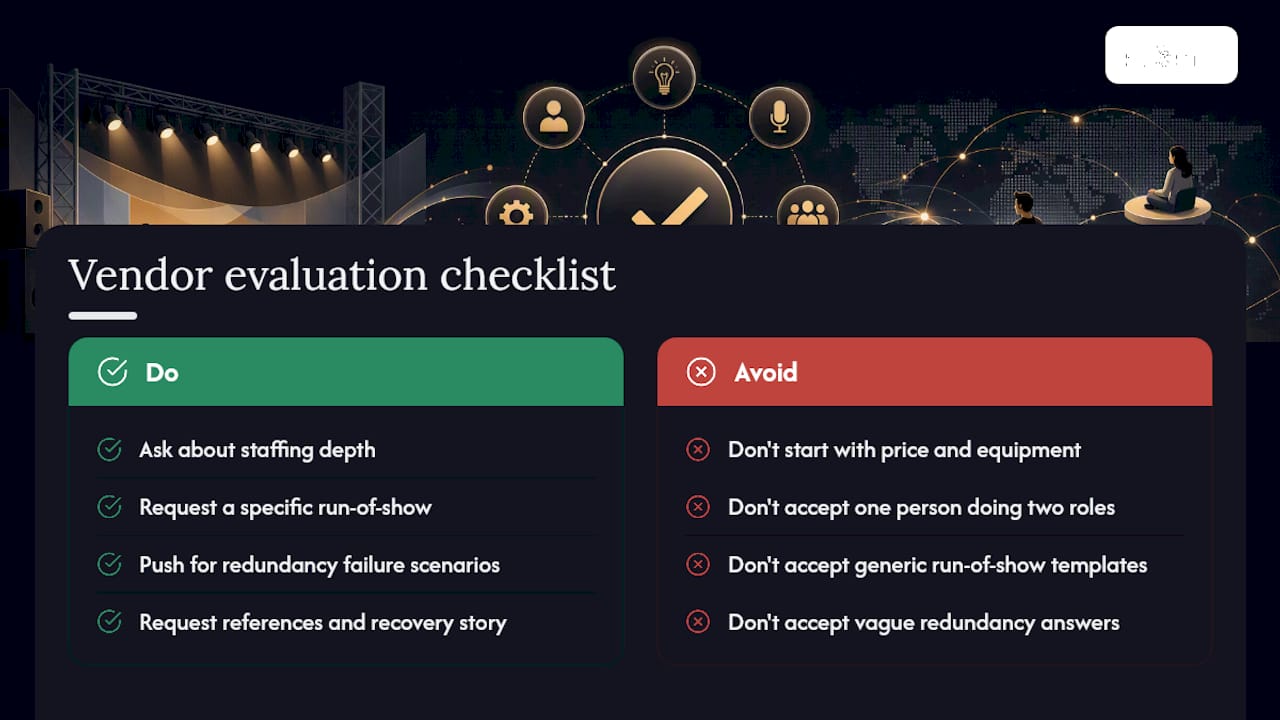
Most vendor conversations focus on price and equipment lists. That’s the wrong starting point for hybrid work, where the harder questions are about process and failure modes.
Start with staffing depth. Ask whether the vendor assigns a dedicated technical director and virtual moderator as separate people, or whether one person is expected to run both jobs under pressure. A vendor who can’t answer this clearly likely hasn’t run enough true hybrid programs to know why it matters.
Next, ask for a specific run-of-show example from a past event, not a generic template. You want to see named hand-off points, redundancy windows, and how they scripted the moment a host acknowledges the remote audience. Vague answers here usually mean the vendor treats hybrid as “livestream the stage,” which is the exact failure mode experienced planners try to avoid.
Push on redundancy specifics. A credible vendor explains what happens if the stream fails at a named minute in your program, down to the backup encoder and alternate uplink they’d switch to. If they can’t walk through that scenario without checking notes, they haven’t tested it.
Ask about CRM and data integration capability directly: does engagement data sync automatically, or does it arrive as a CSV three days later? Request references or case studies from events at a comparable scale to yours, and ask specifically about a moment something went wrong and how the team recovered. Every experienced production team has one of these stories. The ones without one probably haven’t run enough live events to be tested yet.
Finally, confirm day-of technical support levels: how many technical staff are on-site versus remote, and what’s the escalation path if the technical director needs a second opinion mid-show.
What Hidden Costs Should You Budget For Beyond the Obvious Line Items?
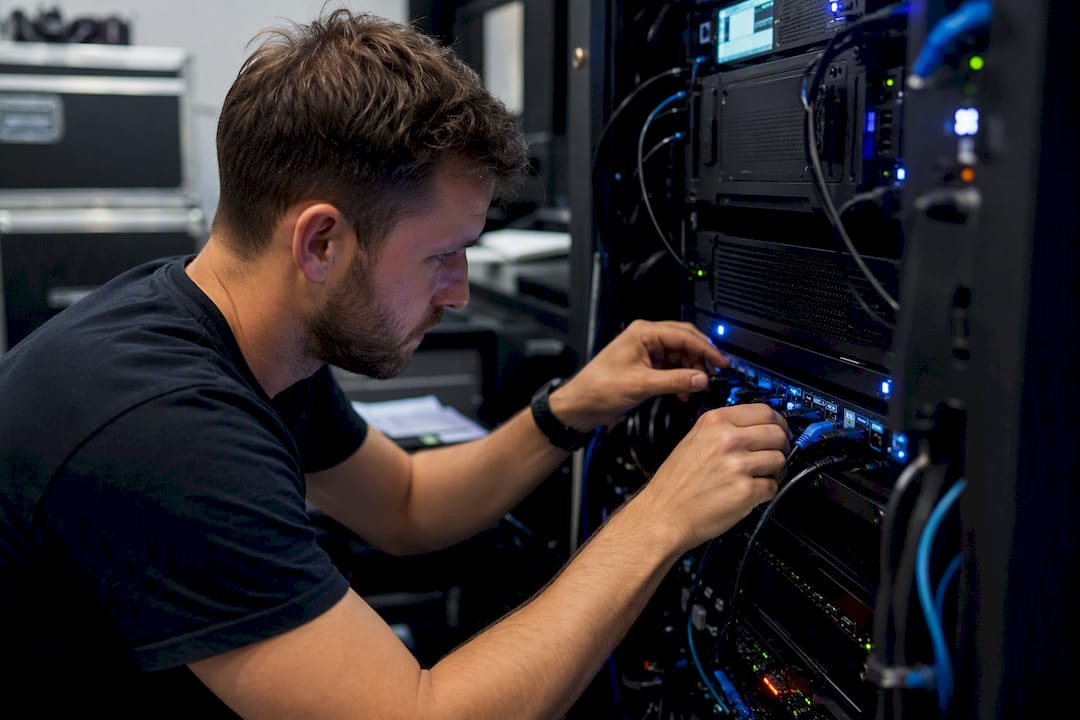
The published budget for a hybrid event rarely includes everything you’ll actually spend. Redundancy hardware is the biggest blind spot: a backup encoder and alternate internet uplink aren’t optional add-ons, they’re insurance, and vendors who quote without them are quoting an incomplete job.
Captioning is another line item planners underbudget. Live captioning at a professional standard, especially if you’re streaming to audiences covered by the European Accessibility Act, costs more than automated tools alone and often needs a human reviewer for accuracy. Budgeting for automated captions and getting audited later for accessibility gaps is a costly mistake to fix after the fact.
Rehearsal time itself has a real cost. A full dry run with actual encoders, return feeds, and the complete technical crew means paying that crew for hours beyond the live event day. Skipping this to save money is the single most common way hybrid productions fail on show day.
Other frequently missed expenses include: sponsor asset production for both physical booths and virtual exhibit spaces, matchmaking or networking platform licensing beyond the core event platform fee, dedicated bandwidth costs at the venue (venue Wi-Fi is rarely sufficient for broadcast-quality streaming), and post-event asset editing and distribution if you plan to repurpose session recordings.
Build a contingency line of roughly 10 to 15% into any hybrid budget. It’s not padding. It’s the realistic cost of a production with two parallel technical chains, either of which can hit an unplanned problem on the day.
How Do You Protect Streaming Security and Attendee Data?
Hybrid events collect more sensitive data than either pure in-person or pure virtual formats, because you’re gathering badge scans, login credentials, chat logs, poll responses, and payment information simultaneously across two systems.
Start with stream access control. Public, unauthenticated streaming links are the easiest way to leak proprietary content or executive commentary to unintended audiences. Require registration gating and unique access tokens per attendee where content is sensitive, and confirm your platform supports this natively rather than through a workaround.
Data handling deserves the same scrutiny. Every tool in your stack, from the event platform to the polling app to the CRM, touches attendee data at some point. Confirm each vendor’s data retention policy and where attendee data physically resides, particularly if you’re streaming to audiences in the EU, where privacy expectations and accessibility requirements under the European Accessibility Act intersect.
Captioning and transcript data carry privacy weight too. If sessions include sensitive business discussions, understand who has access to stored transcripts and for how long. Assign clear ownership of the incident response plan before the event, not during it. If the stream is compromised or a data leak occurs mid-event, someone on your production team needs pre-approved authority to pull the plug on a specific feed without waiting for sign-off.
Author perspective: build for the room you can’t see
If there’s one piece of advice worth repeating, it’s this: build the remote agenda first, then design the in-room experience around it, not the reverse. We’ve seen conferences pour their entire budget into stage design and treat the remote feed as an afterthought, only to watch engagement collapse the moment the keynote ends and no one bridges back to the online audience.
How King Sixteen Handles Hybrid Production From Discovery to Delivery
King Sixteen builds hybrid programs the way they should be built: as two productions running in parallel, not one livestream with extra seats. That means dual signal chains, dedicated virtual moderators, unified run-of-show documents, and rehearsal schedules that treat the backup encoder as seriously as the main one.
If you’re scoping a hybrid conference, product launch, or brand activation, an initial call with our team walks through your format decision, technical requirements, and realistic budget allocation before you commit to a vendor. We handle AV, staffing, platform selection, and digital integration through a vetted network built over years, which means fewer vendors to manage and fewer surprises on show day. Start by reviewing our experiential marketing capabilities or reach out through King Sixteen to scope your next hybrid program.
Sources
- Hybrid Event Planning 2026: A Practical B2B Guide
- Hybrid Events
- How to Plan a Hybrid Event: A Practical Guide — Prism Events
- Hybrid Event Production: The 2026 Operator’s Guide | SicilyCast
- Cvent | Event Platform for In-person, Virtual, and Hybrid Events & Webinars
Recommended
- Event Production Tips for Planners and Marketers
- Journey – Webflow HTML website template
- Event Production Workflow: A Step-by-Step Guide for 2026