Use an 8-step, all-hazards playbook to build a defendable event security plan you can execute and test before doors open. Whether you’re producing a 200-person product launch or a 10,000-person conference, the framework is the same: scope the risk, build the plan, coordinate the partners, and rehearse until the response is automatic.
Here’s the minimum viable checklist to get your planning started:
- Scope and stakeholder team: Define the event perimeter, attendance profile, and assemble your core planning team with one named lead per partner agency.
- Hazard vulnerability assessment (HVA): Score each identified hazard by frequency and severity to prioritize controls and resource allocation.
- Operational plan (ICS/OPS template): Draft a Situation-Mission-Execution-Administration-Command document and keep it under version control.
- Staffing and vetting: Verify licenses, insurance limits, and background checks for every security contractor before awarding a contract.
- Access control and credentialing: Design layered credential levels and enforce verification at every checkpoint.
- Communications and command post: Establish a staffed command post with primary and backup radio channels and a live incident log.
- Medical and emergency integration: Name a medical lead, pre-assign staging areas, and coordinate ambulance access with local EMS.
- Post-event debrief and documentation: Conduct a structured debrief within 24–48 hours to capture incident logs and lessons learned.
In the next 72 hours: call your venue operations contact to schedule a site walk, identify the local emergency management liaison for your jurisdiction, and pull up the Mass Gathering Security Planning Tool from CISA. That tool produces a downloadable planning report tailored to your venue’s features and links directly to the authoritative templates you’ll need throughout this process. It is a planner-facing framework, not a regulatory submission, so use it freely as your first working document.
Pro Tip: Start the CISA tool before your first planning meeting. The output gives you a structured agenda and surfaces gaps you didn’t know existed — which is far more productive than a blank whiteboard.
Key Takeaways
Effective event security planning requires an all-hazards approach that integrates risk assessment, operational planning, stakeholder coordination, and rehearsed response protocols into a single, version-controlled plan before doors open.
| Point | Details |
|---|---|
| Start with the CISA tool | Run the Mass Gathering Security Planning Tool first; its output becomes your planning report and surfaces gaps before your first team meeting. |
| HVA drives resource decisions | Score every hazard by frequency × severity; anything scoring 12 or above warrants a dedicated operational control, not just a general security presence. |
| S-M-E-A-C operational plan | Build your plan around Situation, Mission, Execution, Administration, and Command; keep one version-controlled document and distribute read-only copies to partners. |
| Vet contractors before contracting | Verify state license (PPO or equivalent), insurance certificates, background-check policy, and training records before awarding any security contract. |
| Debrief within 24–48 hours | A structured post-event debrief that captures incident logs and guard feedback converts event memory into a planning dataset for the next event. |
| King Sixteen embeds security in production | King Sixteen integrates security coordination, vendor vetting, and post-event reporting into the full production workflow for high-end activations and conferences. |
Table of Contents
- What’s the difference between event safety and event security?
- How do you conduct an all-hazards risk assessment for an event?
- How do you build an event operational plan?
- Who do you need to coordinate with before the event?
- How should you design access control and credentialing?
- What are the rules for crowd management and egress planning?
- How do you vet security contractors and staff?
- How do you set up a command post and manage incident response?
- What does medical planning look like for an event?
- How do you plan for active attacker and threat-specific scenarios?
- What cybersecurity risks should event planners address?
- How do you make security invisible to guests?
- A production-first approach to event security
- King Sixteen brings security into the production from day one
- Sources
What’s the difference between event safety and event security?
Most planners use “safety” and “security” interchangeably. That’s a problem, because the controls for each are fundamentally different, and conflating them leads to gaps in both.
Safety addresses accidental hazards: a slip-and-fall near a wet stage, heat exhaustion in an outdoor crowd, a structural failure in a temporary installation. Security addresses intentional threats: unauthorized access, theft, assault, or a targeted attack. Both require distinct controls, but they share a command structure and must be coordinated under a single incident management framework.
The all-hazards approach is the planning model recommended by CISA, FEMA, and the Bureau of Justice Assistance (BJA). It treats every credible hazard, whether accidental or intentional, as a planning input. The result is a single, unified plan that doesn’t leave gaps between “that’s a safety issue” and “that’s a security issue.”
A few terms worth locking in before you build your plan:
- Hazard: Any condition that could cause harm (weather, crowd density, structural risk, a credentialed insider).
- Threat: A specific, intentional hazard with a potential actor (a disgruntled attendee, an unauthorized vendor, an external bad actor).
- Vulnerability: A weakness in your plan or venue that a hazard or threat could exploit (an unmanned entry point, a single radio channel, no backup power for access-control systems).
- Consequence: The potential impact if a hazard or threat materializes (injuries, reputational damage, event cancellation, legal liability).
- Mitigation: The control you put in place to reduce probability or consequence (a bag-check station, a secondary egress route, a trained medical team).
The all-hazards model changes your resource allocation decisions. Instead of budgeting for “security guards,” you’re budgeting for a layered system of controls that addresses your highest-scoring hazards first. That shift in framing is what separates a defensible plan from a checkbox exercise.
Pro Tip: Write a one-sentence security vision statement before you open any template: “This event will protect all attendees, staff, and assets by [primary method] while preserving [specific guest experience goal].” Every planning decision you make afterward can be evaluated against that sentence.
How do you conduct an all-hazards risk assessment for an event?
The core method is a hazard matrix: score each identified hazard by frequency (how likely it is to occur) and severity (how bad the outcome would be if it does). The product of those two scores gives you a priority ranking. High-frequency, high-severity hazards get controls first; low-frequency, low-severity hazards get monitored. The Planning Primer from the Policing Institute includes HVA worksheets and frequency-severity scoring matrices that many jurisdictions use as their planning foundation. Pair those with FEMA IS-15 job aids for additional scoring definitions and operational checklists.
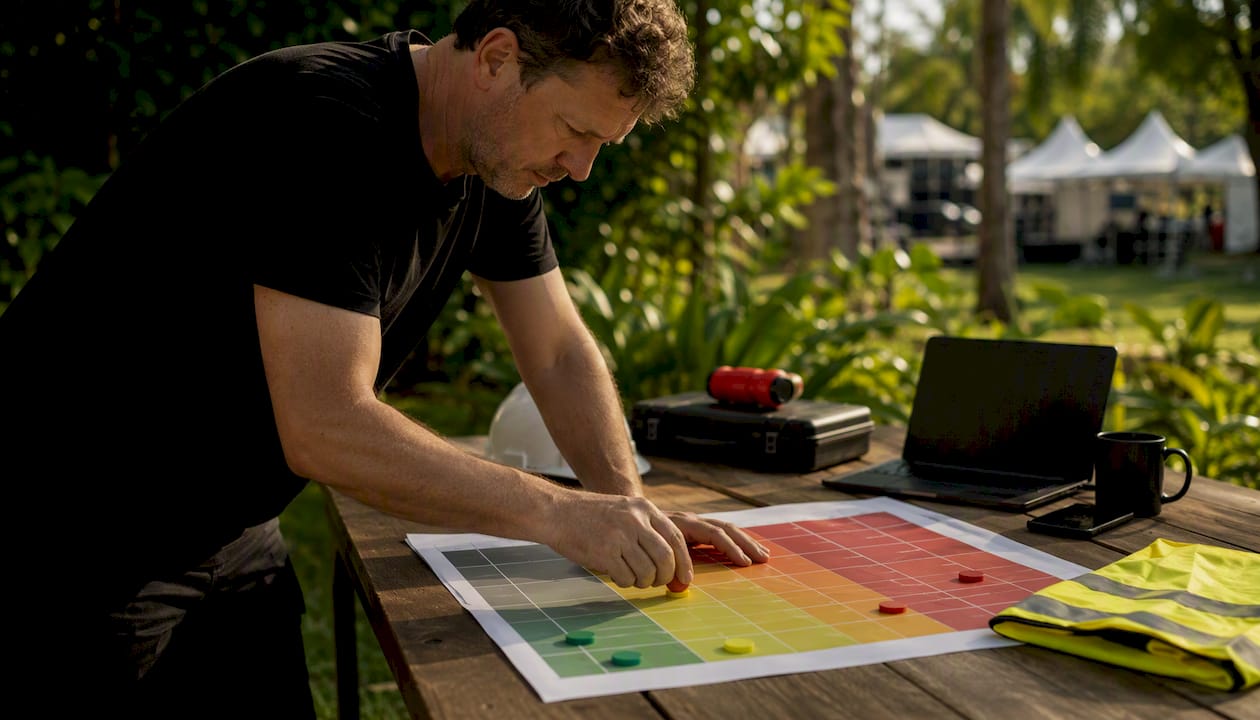
Sample hazard rating matrix
Frequency: 1 = very unlikely, 5 = very likely. Severity: 1 = minor, 5 = catastrophic.
Running your HVA: a step-by-step process
- Gather data sources. Pull historical incident reports from the venue, local crime statistics from the police department, weather history for the event date and location, and any prior event after-action reports.
- Conduct stakeholder interviews. Talk to venue operations, local law enforcement, fire marshal, and EMS. Each agency will surface hazards the others don’t see.
- Complete a site reconnaissance. Walk every access point, service corridor, parking area, and egress route. Note blind spots, lighting gaps, and structural concerns.
- Score each hazard. Use the frequency-severity matrix. Involve at least two people in scoring to reduce individual bias.
- Rank and cluster. Group hazards by priority score. Anything scoring 12 or above typically warrants a dedicated operational control.
- Translate scores into operational triggers. A priority score of 15 or above should trigger a formal written protocol. A score of 10–14 warrants a documented procedure and assigned owner. Below 10, monitor and note.
Converting HVA outputs into staffing decisions is where many planners stall. A high-priority crowd-crush score means you need dedicated entry-funnel staff, not just a general “security presence.” A high-priority medical score means a named EMT with pre-positioned equipment, not a first-aid kit in the back office. Let the scores drive the resource line items in your budget.
For your event risk management process, the HVA is the foundation. Everything else in the operational plan flows from it.
Pro Tip: If any hazard scores a severity of 5 and a frequency of 2 or higher, request a formal law enforcement presence or an operations liaison from your local police department. That threshold is a practical trigger, not a regulatory requirement, but it’s defensible in any post-incident review.
How do you build an event operational plan?
Use the S-M-E-A-C structure: Situation, Mission, Execution, Administration, and Command. This is the same framework used by incident command professionals and referenced in the Policing Institute’s planning primer. Keep one authoritative version under version control, name it with a date stamp, and distribute read-only copies to all partners while the operations team works from the live document.
Required sections and their purpose
Situation: Describes the event, venue, expected attendance, known hazards (from your HVA), and the current threat environment. This section answers: “What are we walking into?”
Mission: A single, clear statement of what the security operation must accomplish. Example: “Provide a safe environment for 3,500 attendees at [venue] on [date] by maintaining controlled access, coordinated emergency response, and documented incident management.”
Execution: The operational details. Who does what, where, and when. This section includes guard post assignments, patrol routes, entry procedures, and the sequence of operations from load-in through post-event sweep.
Administration: Logistics and support. Uniform requirements, equipment lists, meal and break schedules, vendor check-in procedures, and documentation requirements.
Command and coordination: The incident command structure. Who is the incident commander? Who are the section leads? How does the chain of command connect to public safety partners? This section includes the ICS org chart and the escalation path for every incident type.
Annexes to include
Your operational plan should travel with a set of annexes, each owned by a named individual:
A communications annex lists all radio channels, call signs, backup channels, and the protocol for switching if primary comms fail. The medical annex names the medical lead, identifies triage and staging areas, and documents the EMS pre-notification agreement. A credentialing annex defines every credential level, the approval and appeal process, and the revocation procedure. Site maps should be current, annotated with post assignments, egress routes, and medical staging. A vendor list with contact numbers and arrival windows keeps load-in from becoming a security gap. Finally, an ICS org chart makes the command structure visible to every partner agency.
Version control is not optional. Every distributed copy should carry a version number and date. When the plan is updated, notify all holders and confirm receipt. On event day, the operations team works from the current version only.
Who do you need to coordinate with before the event?
Establish a core planning team with a single point of contact per partner agency, begin outreach early, and document every agreement in writing. The Brown Public Safety guidance illustrates how institutions document security planning support requests and the types of coordination they require from event sponsors, which is a useful model for any venue relationship.
For a broader event planning framework, stakeholder coordination is the variable that most often determines whether your plan is executable or theoretical.
Key stakeholders and what they need from you
- Law enforcement: Attendance figures, site maps, credential lists, planned alcohol service, and any known threat intelligence. They’ll want to know your incident commander’s contact information before doors open.
- Fire marshal: Occupancy calculations, egress diagrams, temporary structure permits, pyrotechnics or open-flame approvals, and generator placement.
- EMS / ambulance service: Medical staging location, ambulance access route, expected crowd demographics (age, alcohol service, outdoor heat exposure), and your medical lead’s contact.
- Local emergency management: Your full operational plan, communications plan, and evacuation procedures. For large events, they may want to participate in a tabletop exercise.
- Venue operations: Load-in schedule, vendor access windows, utility shutoff locations, and any venue-specific security requirements or restrictions.
- Public works / transportation: Parking plan, road closures, shuttle routes, and pedestrian flow management near the venue perimeter.
- Licensing and permits office: Occupancy permit, temporary structure permits, food and beverage licenses, and in some jurisdictions, a formal security plan submission.
Lead times that matter
For large-scale events (5,000+ attendees), begin multi-agency coordination 12–18 months out. Police resource requests, mutual aid agreements, and road closure permits often have long lead times that catch planners off guard. For mid-size events (500–5,000 attendees), start agency outreach 3–6 months before the event date. For smaller venue notifications and permit filings, 4–8 weeks is the minimum, though earlier is always better.
San Francisco, for example, requires formal security plan submissions for outdoor events above certain attendance thresholds, and coordinates those submissions across multiple city agencies. Your jurisdiction may have similar requirements.
Coordination tip: Memoranda of understanding (MOUs) with law enforcement and EMS should specify cost-sharing, resource commitments, and the chain of command for incidents that cross jurisdictions. A mutual aid agreement that isn’t documented is a verbal promise under pressure.
How should you design access control and credentialing?
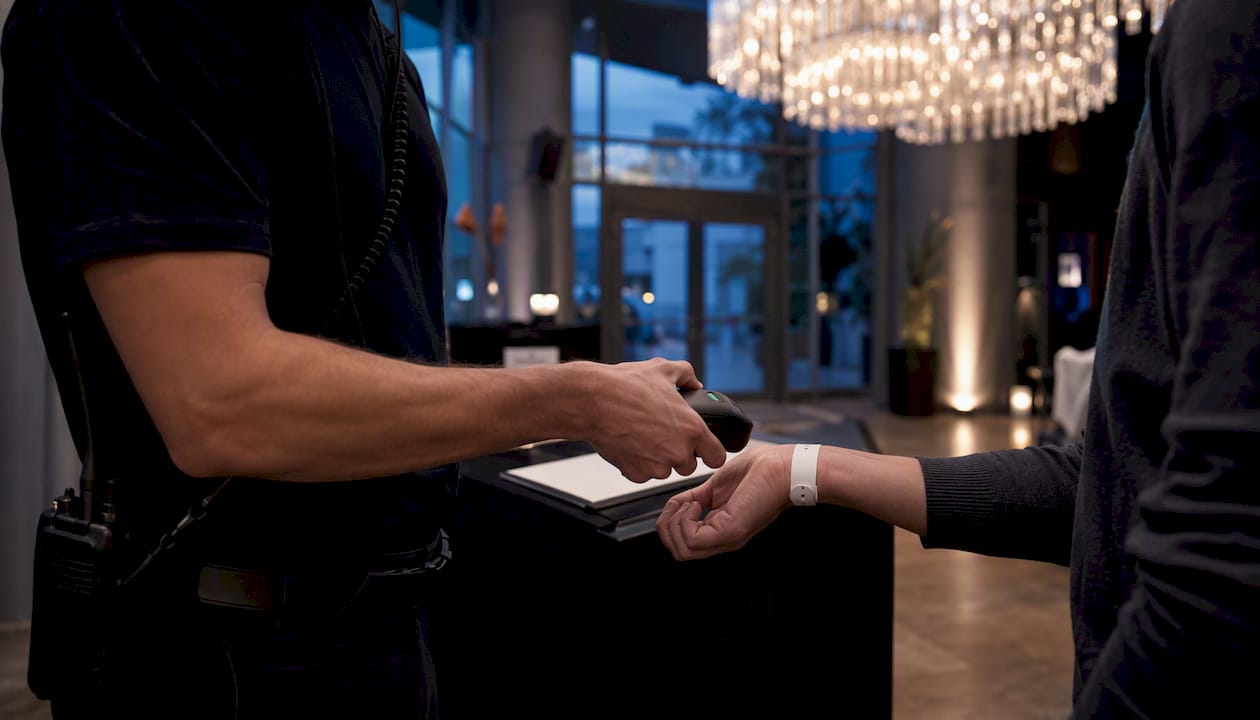
Match credential levels to access requirements and enforce verification at layered checkpoints. A single wristband for all attendees is not an access control system; it’s a color-coded suggestion. Effective credentialing creates distinct zones, each with a verification step that a bad actor cannot easily bypass.
Credential design
Define your access tiers before you print anything. A typical event uses three to five levels: general admission, staff/vendor, production/backstage, VIP, and command/law enforcement. Each credential should carry a photo (for staff and above), an expiration date or event-specific color rotation, and an anti-counterfeit feature such as a holographic seal or UV-reactive ink. The approval flow should be documented: who can authorize a credential, who can revoke one, and what the appeal process looks like if a credential is denied.
Screening options and throughput trade-offs
Bag checks are the baseline for most events and add roughly 15–20 seconds per person at a staffed lane. Walk-through metal detectors slow throughput to approximately 300–400 people per lane per hour under controlled conditions, so plan your lane count against your expected arrival curve, not your total attendance. Handheld wanding is slower but more targeted, useful for secondary screening of flagged individuals. K9 units are most effective for pre-event sweeps of the venue and load-in areas rather than real-time screening of attendees.
The throughput math matters. If you expect 2,000 attendees to arrive in a 45-minute window and you have four metal detector lanes running at 350 people per lane per hour, you’re looking at a queue that won’t clear before programming starts. Either add lanes, stagger arrival times, or accept the queue and staff it accordingly.
Staging entry funnels
- Position queue management staff 100–200 feet from the entry point to shape lines before they reach the screening station.
- Use physical barriers (stanchions, jersey barriers) to create defined lanes, not open crowd pools.
- Place credential verification before screening, not after, so only credentialed individuals enter the screening funnel.
- Designate a separate lane for staff, vendors, and VIPs to avoid mixing throughput rates.
- Station a supervisor at the entry point with authority to open overflow lanes or halt entry if the queue becomes a safety risk.
What are the rules for crowd management and egress planning?
Design circulation and staffing around flow. Bottlenecks and egress failures are the primary causes of crowd-related injuries at events, and they’re almost always predictable from the site plan. Capacity is a secondary concern; if your egress can’t move people out safely, your capacity number is meaningless.
Venue layout priorities
Map your site plan with flow in mind before you place a single piece of furniture or staging. Mark every ingress and egress point, identify chokepoints (narrow corridors, single-door exits, stairs), and calculate the flow rate for each egress route. Sightlines matter for both guest experience and security: a crowd that can see the stage doesn’t compress toward it the way a crowd that can’t will. Credentialed-only corridors should be physically separated from general circulation, not just signed.
For event branding and guest experience, the layout decisions you make for security reasons often improve the overall flow of the event. Layered access zones create natural guest journeys that feel curated rather than controlled.
Staffing positions for crowd control
- Entry teams: Positioned at every ingress point, responsible for credential verification and screening.
- Zone leads: One per defined area of the venue, with radio and authority to call for support or initiate a zone-level response.
- Roving patrols: Moving through general admission areas on a defined circuit, watching for distress, conflict, or crowd compression.
- Response team: A dedicated quick-reaction unit staged centrally, not assigned to a fixed post, available to reinforce any zone within minutes.
- Egress monitors: Stationed at every exit during peak departure, responsible for managing flow and preventing re-entry.
Operational triggers for crowd-control actions
When crowd density at an entry point reaches a point where forward movement stops, halt new entries and open overflow queuing. If a zone lead reports crowd compression near the stage, modify programming (pause the performance, make a PA announcement) before the situation escalates. If an egress route is blocked, activate the alternate route immediately and notify the incident commander. These triggers should be written into your operational plan, not improvised on the day.
How do you vet security contractors and staff?
Verify licenses, insurance limits, and references before awarding any contract, and include audit rights in the contract language. A security firm that can’t produce its license documentation on request is a liability, not an asset.
Vendor-vetting checklist
Document the following for every security contractor:
- Company registration: Confirm the firm is registered in the state where the event is held.
- State security license: In states like California, private security providers must be licensed by the Bureau of Security and Investigative Services (BSIS) and hold a valid Private Patrol Operator (PPO) license. Verify the license number directly with the licensing agency, not just from the firm’s marketing materials.
- Errors and omissions (E&O) insurance: Minimum limits vary by event size; confirm the policy covers the event date and venue.
- General liability insurance: Require a certificate of insurance naming your organization as an additional insured.
- Workers’ compensation: Confirm coverage for all guards assigned to your event.
- Background check policy: Ask for the firm’s written background-check policy and confirm it covers criminal history, identity verification, and prior employment.
- Training records: Request documentation of guard training, including any event-specific or crowd-management certifications.
Guard staffing guideline ratios
The following ratios are practitioner heuristics from Calvis’s event security guidance, useful as planning starting points. Adjust upward for complex venues with multiple access points, blind spots, or heavy load-in activity.
Headcount alone is an unreliable staffing metric.
Pro Tip: Schedule on-site spot checks during load-in, not just at event open. Late noncompliance, a guard showing up without required credentials or in the wrong uniform, is easiest to catch and correct before attendees arrive.
How do you set up a command post and manage incident response?
Set up a single, staffed command post with redundant communications channels and a live incident logging workflow from the moment load-in begins. The command post is the operational brain of your event; if it’s understaffed or poorly located, every response will be slower than it needs to be.
Communications plan essentials
Your radio plan should specify:
- Primary channel: All security staff and the incident commander.
- Secondary channel: Operations and production leads, separate from security traffic.
- Command channel: Incident commander and public safety partners only.
- Backup comms: A designated cell phone tree and a physical runner protocol if radio fails or cell service is overwhelmed.
- Call signs: Assign call signs to every post and role, not personal names, to maintain clarity under pressure.
- Channel security: Avoid broadcasting sensitive information (credential revocations, medical details) on open channels; use the command channel or a direct call.
Incident roles and responsibilities
- Incident commander (IC): Overall authority for all security and safety decisions. The IC does not respond to incidents physically; they manage from the command post.
- Operations lead: Directs tactical resources in the field, reports to the IC.
- Logistics lead: Manages equipment, supplies, and staff scheduling. The first call when a resource runs short.
- Public safety liaison: The single point of contact between your team and law enforcement, fire, and EMS. This person must have direct radio or phone access to each agency’s on-site representative.
- Media officer: Manages any press inquiries related to incidents. Keeps the IC from being pulled into media conversations during an active response.
- Scribe: Documents every incident, decision, and resource deployment in real time. The scribe’s log is your post-event record.
Real-time logging is not a bureaucratic exercise. A disciplined post-event debrief within 24–48 hours that captures incident logs, guard feedback, and cost performance converts isolated event memory into a strategic dataset for future planning. Without the scribe’s log, that debrief is a conversation about feelings, not facts.
What does medical planning look like for an event?
Integrate medical planning into the operational plan from the start, with a named medical lead and pre-assigned staging areas. Medical response that’s bolted on at the last minute is slower, less coordinated, and harder to document.
Staffing the medical function
For events under 500 attendees with low-risk profiles (indoor, no alcohol, moderate physical activity), trained first-aid attendants with AED access may be sufficient. For events over 500 attendees, or any event with alcohol service, outdoor heat exposure, or high-intensity physical activity, staff at least one licensed EMT. Request an ambulance standby for events over 2,000 attendees or any event where the nearest hospital is more than 10 minutes away.
Medical staging checklist
- Designate a triage point that is accessible to both attendees and an ambulance without crossing the main crowd flow.
- Confirm ambulance access routes with venue operations and mark them on the site plan.
- Pre-position AEDs at no more than 3-minute walking distance from any point in the venue.
- For outdoor summer events, add a heat-stress station with water, shade, and cooling supplies.
- Brief all security staff on how to call for medical support and where to direct the response.
- Establish a clear evacuation route from the triage point to the ambulance staging area.
Medical logs should be integrated with the incident commander’s scribe log, not kept separately. When the post-event debrief reviews incidents, medical events and security incidents need to be in the same timeline to identify patterns and coordination gaps.
How do you plan for active attacker and threat-specific scenarios?
Adopt intent-focused response plans with clear priorities: protect life, isolate the threat, and enable responder access. Train staff to follow those priorities in sequence, not to improvise under pressure.
CISA publishes de-escalation and edged-weapon awareness fact sheets that are practical, downloadable references for staff training. The de-escalation materials cover verbal and non-verbal techniques for managing agitated individuals before a situation becomes physical. The edged-weapon awareness resources describe recognition cues and immediate response steps for staff who are not armed.
Immediate response steps for staff and supervisors
- Seek cover and communicate: Move away from the threat, find a defensible position, and immediately radio the incident commander with your location and a brief description of what you observed.
- Direct attendees: If safe to do so, guide nearby attendees away from the threat area using clear, calm verbal direction. Avoid creating a secondary stampede.
- Clear the path for responders: Identify the fastest route from the nearest entry point to the threat location and communicate it to the public safety liaison so law enforcement can move without navigating a crowd.
- Preserve evidence where safe: Do not move objects or clear the area unless doing so is necessary to protect life.
- Stay on comms: Maintain radio contact with the command post until relieved by law enforcement.
Training frequency matters. Tabletop exercises, where the planning team walks through a scenario on paper, should happen at least once per event cycle. For large-scale or high-profile events, a full-scale drill with public safety partners is worth the investment. The goal is not to memorize a script; it’s to build the muscle memory of who calls whom and what happens next.
What cybersecurity risks should event planners address?
Treat event systems, including Wi-Fi, registration platforms, access-control systems, and cashless payment infrastructure, as mission-critical infrastructure. A breach of your registration system exposes attendee data; a compromised access-control system can invalidate your entire credentialing effort.
Technical controls to implement
- Segmented guest Wi-Fi: Run a completely separate network for attendees, isolated from back-of-house systems, payment terminals, and access-control hardware.
- Vendor device minimum-security standards: Require all third-party vendors connecting to your network to run current OS patches and endpoint protection. Document this requirement in the contract.
- MFA for back-of-house systems: Multi-factor authentication on registration platforms, credential management systems, and any system with attendee data.
- Secure credential printing: Limit access to credential printing hardware and software to named individuals. Log every credential printed and flag duplicates.
- PCI compliance for cashless payments: If you’re running cashless payment systems, confirm your payment processor and any point-of-sale vendor are PCI DSS compliant and that cardholder data is not stored on event-day devices.
- Access logging: Require all third-party vendors to maintain access logs for any system they touch during the event, and retain those logs for at least 90 days post-event.
Contract language to require
Include a clause requiring vendors to notify you within 24 hours of any suspected security incident involving event systems. Require that all vendor devices be patched to the current OS version before connecting to your network. Specify that access logs are your property and must be delivered within 48 hours of the event’s close. These clauses are easy to add during contract negotiation and difficult to enforce after an incident.
Primary resources and where to get them
- CISA Mass Gathering Security Planning Tool: Cisa — Start here. The tool output becomes your planning report and populates your credentialing annex.
- FEMA IS-15 Special Events Contingency Planning Job Aids: Available via HSDL — Use for HVA scoring matrices and operational annex templates.
- Policing Institute Planning Primer: Policinginstitute — HVA worksheets, frequency-severity scoring, and the S-M-E-A-C operational plan structure.
- CISA Venue Guides: Cisa — Security enhancements and dependency disruption mitigations for venue hardening.
- Brown Public Safety Event Security Guidance: Publicsafety — Useful model for documenting support requests and institutional coordination.
Matching templates to annexes
Pull your credentialing annex structure from the CISA tool output. Use the FEMA IS-15 worksheets to build your HVA scoring matrix and populate the hazard section of your Situation block. The Policing Institute primer’s operational plan template maps directly to the S-M-E-A-C structure described earlier in this guide. Once you’ve run the CISA tool, its output becomes the cover document for your planning report; the annexes from FEMA and the primer fill in the operational detail behind it.
How do you make security invisible to guests?
Effective security integrates with guest flow and event programming rather than interrupting it. The goal is a layered system where most attendees never consciously encounter a security decision, because the controls are built into the environment itself.
Consider how layered access works in practice. A high-end product launch might route general attendees through a branded registration experience that doubles as a credential verification step. VIP guests transition through a separate, staffed corridor that feels like a curated upgrade rather than a checkpoint. Plainclothes roving staff circulate through the crowd with visible uniformed backup positioned at fixed posts, creating a presence that deters without dominating. Timed VIP transitions, where the VIP area opens 30 minutes before general admission, reduce credential friction at the busiest moments.
Operational rehearsal is where this integration gets tested — and aligning your team’s schedules and workflows can benefit greatly from how to plan a content calendar for marketing success. Run a tabletop exercise with both your production team and your security team in the same room. Walk through the event timeline from load-in to post-event sweep and identify every moment where a security action intersects with a guest-facing production moment. Those intersections are where friction lives, and they’re almost always fixable with a small scheduling or routing adjustment.
For event production teams, the discipline of rehearsing security workflows alongside production workflows is what separates events that feel polished from events that feel managed.
Pro Tip: After each rehearsal, ask your production lead one question: “Did anything we just walked through feel like it would slow down or interrupt the guest experience?” Their answer will surface the friction points your security team has normalized.
A production-first approach to event security
Security works best when it’s designed into the event from the first production meeting, not added as a layer after the creative is locked. At King Sixteen, we treat security planning as a production discipline: it lives in the run-of-show, it’s coordinated with vendors during the contracting phase, and it’s measured in the post-event debrief alongside guest satisfaction and operational performance.
The practical result is that our clients don’t choose between a great guest experience and a safe one. The credential routing, the staffing positions, the communications architecture — all of it is built to support the event’s creative vision, not work against it. Early vendor coordination means security contractors are briefed on the event’s tone and guest profile before they arrive on site. Measurable debriefs mean every incident, near-miss, and operational gap is captured and fed back into the next event’s planning cycle.
King Sixteen brings security into the production from day one
Planning a high-stakes activation or conference and need security integrated from the ground up, not retrofitted at the end? King Sixteen’s turnkey production model embeds vetted security coordination directly into the event planning process, so you’re not managing two separate workstreams.

Here’s what that looks like in practice:
- Security planning and vendor vetting: We coordinate licensed, insured security contractors and verify credentials before contracts are signed.
- Operational command support: We build the communications plan, staff the command post structure, and coordinate with public safety partners on your behalf.
- Medical staging coordination: We integrate medical planning into the operational plan and coordinate EMS pre-notification.
- Access control and credentialing design: We design credential systems that match your event’s access tiers and guest experience goals.
- Post-event reporting: We conduct a structured debrief and deliver an incident log and lessons-learned summary within 48 hours of close.
If you’re producing a product launch, conference, or private activation and want security built into the experience rather than bolted onto it, start a conversation with King Sixteen. We’ll walk through your event’s scope and show you exactly how we’d approach the security architecture.
Sources
- Mass Gathering Security Planning Tool — CISA
- Managing Large-Scale Security Events: Planning Primer — Policing Institute (planning primer)
- IS-15: Special Events Contingency Planning Job Aids — FEMA (via HSDL)
- Event Security Planning Guidance — Brown Public Safety
Recommended
- Event Logistics Checklist for Planners: Timeline + Templates
- Event Attendee Experience Guide for Planners