An event rain plan works when it names three things: who calls the decision, the hour that decision gets made, and where guests go if the sky opens. Everything else, tent specs, vendor holds, comms templates, exists to support that one chain. Miss any of the three and you’re improvising in front of clients on the worst possible day.
TL;DR:
- Clearly identify and document a Weather Decision Lead and backup with authority to activate the rain plan without delays.
- Make decisions based on specific weather triggers like sustained wind over 20 to 25 mph or lightning, not just percentage forecasts.
- Lock in tenting, flooring, and shelter reservations at least 72 hours before the event, switching from soft holds to firm reservations as forecast confidence grows.
- Keep communication quick and direct through SMS, with on-site signage for guests and detailed vendor instructions for emergency actions.
- Incorporate weather contingencies into vendor contracts and core plans to ensure rapid activation and avoid last-minute improvisations under pressure.
Table of Contents
- What Belongs in an Event Rain Plan? A Priority Action Checklist
- Who Should Be Your Weather Decision Lead?
- When Should You Make the Rain Call? A Decision Timeline
- How Do You Shelter Guests, Gear, and Production From Rain?
- Structuring Vendor Contracts and Holds Without Overpaying
- How Do You Communicate a Rain Plan to Guests and Vendors?
- What Happens the Moment Weather Triggers Activation?
- What Does a Rain Plan Cost, and Where Can You Save?
- How King Sixteen Builds Redundancy Into Every Outdoor Production
- A Practitioner’s Note on What Actually Prevents Rain-Day Chaos
- Get a Production Partner Who Treats Weather as Part of the Plan, Not an Afterthought
- Sources
What Belongs in an Event Rain Plan? A Priority Action Checklist
Before you touch tent specs or contract language, run this sequence. It’s the difference between a controlled call and a scramble.
- Name a Weather Decision Lead and a backup, in writing, with contact info on the run sheet.
- Confirm the designated shelter can hold full guest count and is walkable in under five minutes.
- Verify AV and power protection plans are staged, not theoretical.
- Flag high-value zones (staging, bars, florals, signage) for tarping or relocation priority.
- Lock decision-hour checkpoints: 7 to 10 days out, 72 to 48 hours out, 24 hours out, and a morning-of walk.
Cost reminder: soft holds on tenting and flooring are cheap insurance early. They get expensive, or disappear, the closer you get to event day.
Who Should Be Your Weather Decision Lead?
One person makes the rain call. Not a committee, not “whoever’s free.” The Weather Decision Lead needs the authority to activate the plan without waiting for client sign-off in the moment, and a named backup in case they’re unreachable.
That person, or a delegated weather watcher, should be tracking:
- NOAA and National Weather Service forecasts and warnings
- A radar app with lightning-strike tracking
- NOAA Weather Radio as a backup feed if cell service drops
- Venue-specific drainage and flood history, gathered during site inspection
Build an authority matrix ahead of time: who can activate tenting, who can call vendors to pause delivery, who can authorize an indoor relocation. Staffing this correctly often means pulling from your event staffing bench rather than assigning it to whoever happens to be on-site.
Pro Tip: Put the Weather Decision Lead’s name and cell number on the printed run sheet, not just in a shared doc. Phones die. Paper doesn’t.
When Should You Make the Rain Call? A Decision Timeline
The staged timeline that avoids both disaster and overspending looks like this:
- 7 to 10 days out: Review the long-range forecast. Place soft holds on tenting, flooring, and sidewalls.
- 72 to 48 hours out: Forecast confidence rises. Convert soft holds to firm reservations if precipitation probability climbs.
- 24 hours out: Make the firm call on tenting, staffing changes, and vendor delivery windows.
- Morning of: Walk the site. Check runoff, wind, and radar one last time before doors open.
Watch specific triggers, not vague forecasts: sustained wind above 20 to 25 mph, any lightning within range, and active flash-flood warnings all mean activation, not “wait and see.” A common misread is treating probability of precipitation as a severity score. A 40% PoP forecast can still mean a short, intense downpour that ruins a ceremony; a 70% forecast can mean scattered drizzle that changes nothing. Read timing and intensity, not just the percentage.
How Do You Shelter Guests, Gear, and Production From Rain?
Tent sizing generally follows a seated-guest formula, allocating enough space per guest, with additional room for dance floors, bars, or staging as needed. Partial coverage, covering just the ceremony or dining zone rather than the entire footprint, works for lower-risk forecasts and cuts cost significantly.
Flooring becomes essential when ground conditions turn muddy after rain to ensure safety and comfort. Interlocking subfloor with a ramped entry handles wheelchairs, AV carts, and catering equipment without turning the entrance into a hazard.
Protect production separately from guest comfort:
- GFCI protection on every outdoor power run, no exceptions
- Waterproof covers staged and ready, not stored across the lot
- A rehearsed shutdown sequence for AV gear if rain intensifies fast
- Runoff points inspected during site walk so water doesn’t pool under staging or cabling
Structuring Vendor Contracts and Holds Without Overpaying
Weather holds let you reserve tenting, flooring, and power equipment without full commitment, usually for a deposit well below the full rental cost. The trade is timing: holds typically convert to firm bookings 48 to 72 hours out, so a plan that waits until the day before has already lost its cheapest options.
Contracts need to spell out:
- Cancellation and refund terms tied specifically to weather, not general force majeure language
- The installer’s own weather policy, since some won’t set tents in high wind regardless of your timeline
- Delivery versus setup windows, since a delayed setup crew can blow your morning-of buffer
When the plan activates, one person should be coordinating every vendor change simultaneously, not each account manager improvising separately. A risk management framework for events helps formalize this before you’re doing it live under pressure.
How Do You Communicate a Rain Plan to Guests and Vendors?
Text beats every other channel for speed. Rank your communication tools this way: SMS first, on-site signage second, email third, social media last, since social is the slowest to reach people already en route.
Keep messages short and specific; for ideas on guest comfort kits and signage supplies, explore the catalogo prodotti personalizzati con logo available at Gadget Solutions:
- Activation: “Due to weather, the ceremony is moving to [location]. Please follow signage.”
- Relocation: “Event moved indoors to [building]. Entrance at [door/address].”
- Delay: “Start time pushed to [time] due to weather. Updates to follow.”
Set expectations before the event, too. A line in the invitation or confirmation email, “in case of rain, we’ll move to X,” cuts confusion and no-shows dramatically compared to a same-day surprise.
What Happens the Moment Weather Triggers Activation?
- Lightning: Move everyone to the enclosed shelter immediately. NOAA guidance sets a 30-minute wait after the last thunder before resuming outdoor activity, and tents offer no lightning protection regardless of sidewalls.
- High wind: Lower or strike unsecured signage and lightweight structures before gusts hit rated thresholds.
- Flash flooding: Reroute guests away from low-lying paths toward the pre-identified shelter route.
Assign specific staff to guest movement, not “everyone helps.” Measure the walk to shelter in advance. If it takes longer than five minutes at a normal pace, your shelter choice needs revisiting. AV and power shutdown follows a fixed order, board power down before disconnecting cable runs, with one named person owning that sequence so it doesn’t get skipped in the confusion.
What Does a Rain Plan Cost, and Where Can You Save?
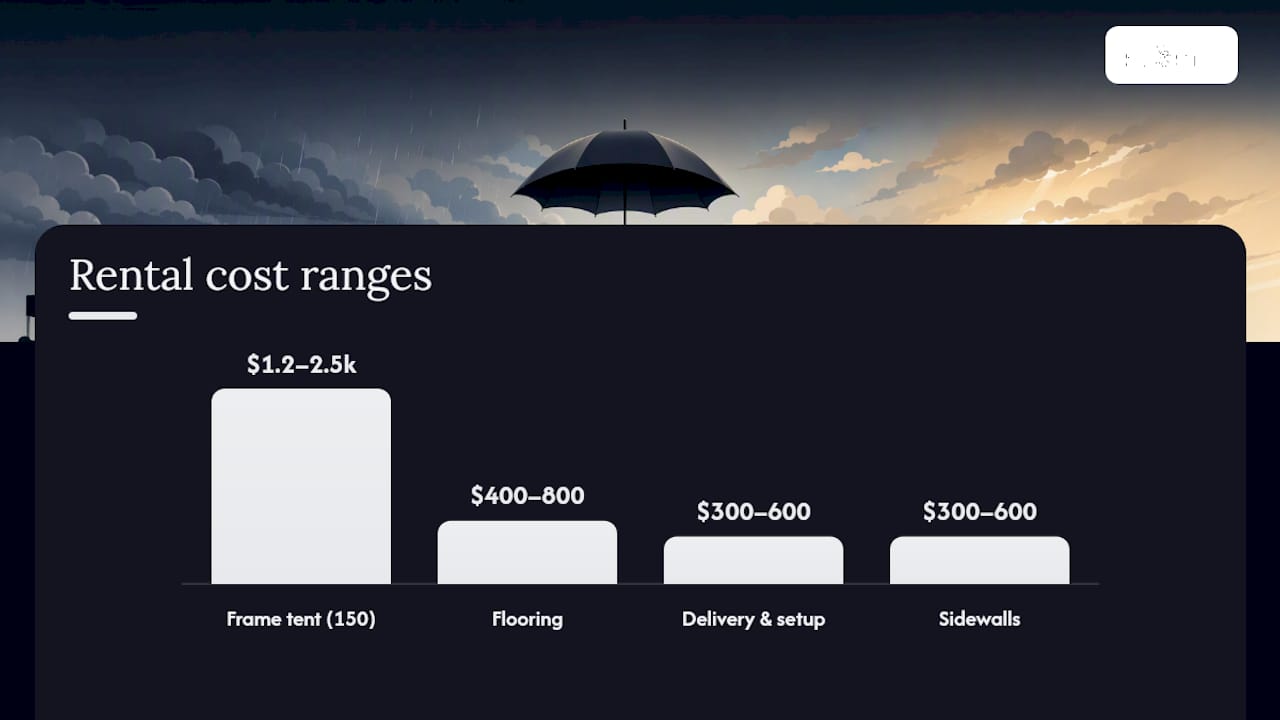
Typical rental ranges for a 150-guest frame tent run $1,200 to $2,500, flooring adds $400 to $800, delivery and setup runs $300 to $600, and sidewalls add another $300 to $600.
Partial coverage and release-deposit strategies cut waste: hold the full package until 72 hours out, then release what you don’t need and keep only the ceremony or dining tent if the forecast clears. When presenting a weather hold to a client, frame it plainly as a small deposit that caps a much larger loss, not an upsell. That framing lands better than a generic “just in case” pitch.
How King Sixteen Builds Redundancy Into Every Outdoor Production
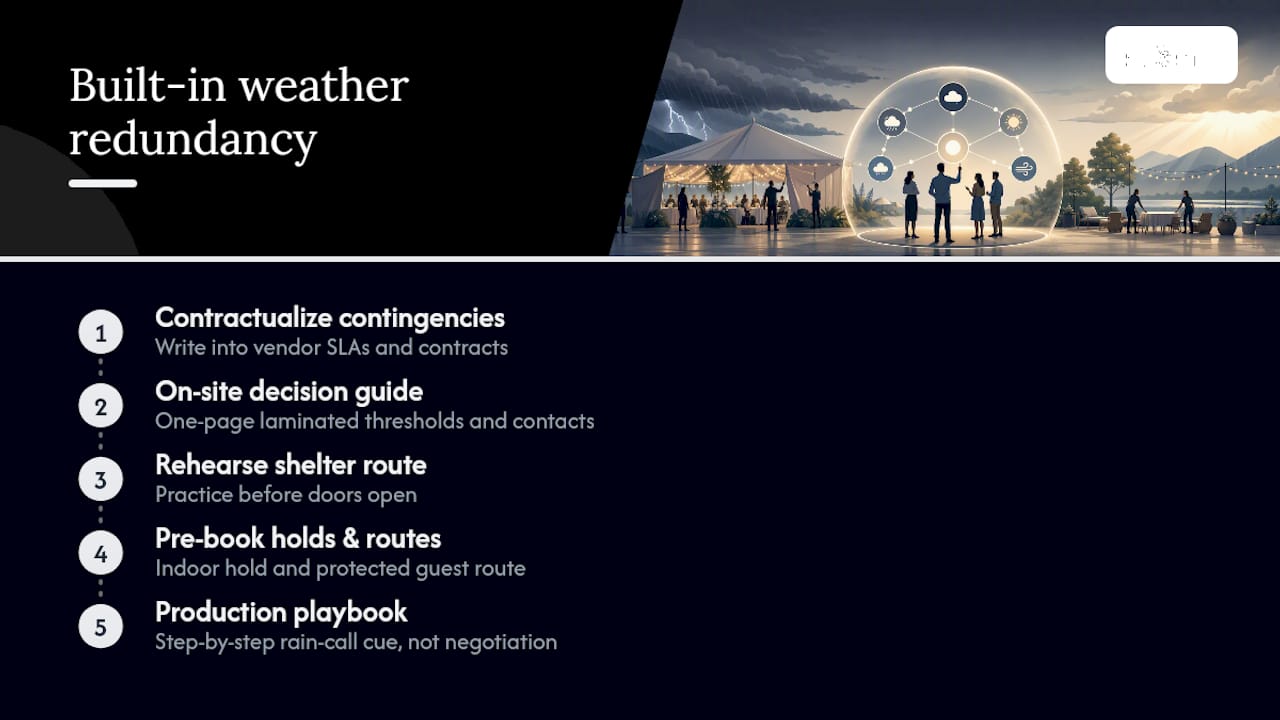
Weather contingencies shouldn’t live in a separate document nobody reads twice. King Sixteen writes them directly into vendor SLAs and core contracts, so activation is a scheduled operational step, not a scramble someone has to invent on the spot.
In practice, that means every vendor on-site gets a one-page laminated decision guide at the comms desk, spelling out thresholds and who to call. It means the shift crew rehearses the shelter route before doors open, not after the first drop falls. Common failure points, no pre-booked indoor hold, unclear decision authority, no protected guest route, get closed before the event starts, not diagnosed afterward. A step-by-step production playbook built this way turns a rain call into a rehearsed cue, not a live negotiation.
A Practitioner’s Note on What Actually Prevents Rain-Day Chaos
Most rain plans fail before the rain does, because nobody wrote down who’s allowed to make the call. Fix that one gap, name the Weather Decision Lead, fix the decision hour, and most of the rest becomes logistics rather than crisis.
Pro Tip: In any market with real weather risk, pre-book a nearby indoor hold before you sign an outdoor-only venue contract. The deposit is small. The alternative, scrambling for indoor space with three hours’ notice, rarely ends well.
— Tyler
Get a Production Partner Who Treats Weather as Part of the Plan, Not an Afterthought
There is an alternative to assembling a rain contingency yourself from a patchwork of tent companies, freelance staff, and last-minute favors. Instead of chasing five vendors during a weather scare, you get one team that already built the decision tree, the vendor SLAs, and the shelter logistics into the production plan before your event date ever gets locked.

That matters most for high-stakes activations, product launches, executive conferences, brand experiences, where a rain delay isn’t just inconvenient, it’s a missed moment in front of the people who matter most. King Sixteen’s private events and experiential marketing teams handle weather resiliency as part of the core build, not a bolt-on afterthought.
If you have an outdoor activation on the calendar and no named Weather Decision Lead yet, that’s the gap worth closing first. Reach out to a professional experiential marketing agency to talk through your event date and venue, and get a production plan that accounts for the forecast you can’t control.
Sources
Recommended
- Event staffing process: A step-by-step guide for brand impact
- Event Production Tips for Planners and Marketers
- Event Production Workflow: A Step-by-Step Guide for 2026
- Step-by-step event staffing: your guide to flawless brand experiences