Event lighting primarily aims to make key elements visible, guide audience focus, and establish the desired emotional tone. The best approach starts with clearly defining your lighting goals—what or who should be visible, what should be emphasized, whether filming is involved, and the mood required—before deciding on equipment.
TL;DR:
- Most effective event lighting starts with clear objectives, such as visibility, mood, or form, before selecting fixtures or specifying equipment.
- Three-point lighting remains the standard, involving a key, fill, and backlight, with additional background or accent lights for added depth.
- Fixture choices should align with purpose, using LED washes for color, Fresnels for diffusion, and moving heads for versatility, while considering CRI and throw distance.
- Proper planning includes power and safety checks, rigging certification, and pre-programmed cues, coupled with camera flicker tests during technical rehearsal.
- Layering light to emphasize storytelling and atmosphere, rather than just increasing brightness, creates a more compelling and professional event environment.
Table of Contents
- What Are the Core Objectives Behind Event Lighting Basics?
- How Do You Set Up Three-Point Lighting for an Event?
- What Fixture Types Do You Need for Event Lighting?
- What’s a Practical Workflow for Planning Event Lighting?
- How Does DMX Control Work for Event Lighting?
- How Much Light Do You Actually Need? CRI, Lux, and Throw
- What Safety and Venue Checks Come Before Load-In?
- How King Sixteen Approaches Lighting Inside Full Production
- How Do You Maintain and Troubleshoot Event Lighting Gear?
- What Makes Event Lighting Feel Designed, Not Just Functional
- Get Your Lighting Plan Built by People Who Also Run the Show
- The Honest Take on Event Lighting Basics
- Sources
- FAQ
What Are the Core Objectives Behind Event Lighting Basics?
Every working lighting designer starts with the same five questions, not with a gear catalog. Getting these objectives right before you spec equipment is the difference between a plan that works and one that gets rebuilt on-site at 2 a.m.
- Visibility: can the audience actually see the speaker, product, or performer?
- Revelation of form: does the light show shape, depth, and texture, or flatten everything into a silhouette?
- Composition: does the light pull focus where you want it, keynotes stage, product table, dance floor?
- Mood and atmosphere: does the color and intensity match the brand’s emotional register?
- Information: does the lighting cue the audience to what’s happening next, a color shift signaling a segment change, for instance?
Professional design guidance from IATSE 205’s introduction to stage lighting frames these five as the foundation everything else builds on. Once you know the objective, you layer light to hit it: a key or front layer for basic visibility, a fill to soften shadow, a back or top layer for separation, an ambient wash for the room, and specials for accents on a logo or hero product. The lead subject always gets the strongest priority intensity. Contrast and shadow are tools too. A well-placed shadow often reads better on camera and in person than simply cranking up brightness.
How Do You Set Up Three-Point Lighting for an Event?
Three-point lighting is the base pattern nearly every event setup borrows from, whether it’s a keynote stage or a five-minute product reveal.
- Key light goes first. It’s the dominant source, usually positioned at an angle to the subject rather than straight on, and it establishes exposure and shape.
- Fill light softens the shadows the key creates. A common working ratio puts fill at roughly half the intensity of the key, enough to open up shadow detail without flattening the look.
- Backlight separates the subject from the background, critical on a dark stage where a speaker can otherwise blend into black drape.
- Background or accent light (the optional fourth point) adds depth and turns a flat backdrop into a designed environment.
MasterClass’s breakdown of three-point setups confirms this as the standard starting template across film, theater, and photography. For a keynote, lean high-key with strong front fill so cameras read faces cleanly. A panel discussion usually wants slightly lower fill ratios to add dimension between speakers. A product reveal benefits from tighter key control and a dramatic backlight rim. A small live performance can push low-key, high-contrast looks since mood matters more than uniform visibility.
What Fixture Types Do You Need for Event Lighting?
Matching fixture type to function keeps a lighting plan from turning into an expensive guessing game. Each category solves a different problem, and most professional setups mix several.
- LED wash fixtures flood color across a stage or room and are the workhorse for ambient and mood lighting.
- Fresnel and soft-light fixtures produce a wide, diffused beam ideal for even front fill on faces.
- Moving head washes and spots add flexibility, letting one fixture cover multiple positions during a show instead of requiring a fixture per look.
- PAR cans are simple, affordable, and good for uplighting walls, trussing, or drape.
- Beam fixtures throw tight, high-intensity shafts of light, great for aerial effects and big visual punctuation, less useful for illuminating faces.
- Strobes deliver impact moments, a reveal, a musical hit, but need careful placement to avoid disorienting guests near the stage.
- Lasers and fog or haze machines make beams visible in air, turning an otherwise invisible light path into a visual element.
According to VelloLight’s design principles for live events, moving heads typically handle specials, LED washes handle color fill, and LED bars handle line washes or pixel mapping across a truss. When choosing fixtures, check the CRI rating for anything hitting faces or brand colors, confirm whether you need RGB, RGBW, or variable white color mixing, and for outdoor events, confirm the IP rating before anything goes near rain or dust.
What’s a Practical Workflow for Planning Event Lighting?
A lighting plan that survives contact with an actual venue follows a sequence, not a shopping list.
- Define objectives. Revisit the visibility, mood, and camera needs before anything else.
- Map zones. Identify where light needs to land: stage, registration, dining, dance floor, brand activation points.
- Audit power and rigging. Confirm available circuits, inrush current limits, and what the venue’s grid can actually hold.
- Select fixtures. Match gear to each zone’s function, not to what’s simply available.
- Program cues. Build looks in the console ahead of load-in wherever possible.
- Run technical rehearsal. Walk every cue live, with talent in position.
- QA and stage spares. Confirm backup fixtures, lamps, and connectors are on-site before doors open.
Before signing off on tech rehearsal, confirm power circuits and inrush loads, DMX addressing on every fixture, spare fixtures and parts staged nearby, a documented focus plan, a camera flicker test, and a finalized cue list.
Pro Tip: Run a camera-based flicker and exposure test during tech rehearsal, not just a visual check. Fixture spec sheets don’t always reveal on-site flicker at your camera’s actual frame rate, and catching it live beats discovering it in the highlight reel.
How Does DMX Control Work for Event Lighting?
DMX512 is the signal protocol that lets a single console command hundreds of fixtures, telling each one its color, intensity, and position through a numbered address. Every fixture needs a unique DMX address within its universe, and mismatched addressing is one of the most common on-site failures planners run into.
- Ask your vendor whether the show runs on standard DMX512 or a networked protocol like Art-Net or sACN, which handle far more universes over standard network cable.
- Request a console with reliable scene memory, portability between shows, and timecode sync if lighting needs to match audio or video cues precisely.
- Confirm addressing has been checked fixture by fixture, not just assumed from a patch sheet.
- Flag any segment that will be filmed or livestreamed for an on-site camera flicker test well before doors open.
How Much Light Do You Actually Need? CRI, Lux, and Throw
Color rendering index (CRI) measures how accurately a light source reveals true color, and it matters most on skin tones and branded color panels. A fixture with poor CRI can make a product’s signature color look muddy on stage even though it looks fine on a spec sheet, which is why VelloLight’s guidance on stage lighting design treats CRI as a planning input, not an afterthought.
Illuminance targets vary sharply by use case:
| Event type | Target illuminance |
|---|---|
| Dialogue-heavy theater | 300–500 lux |
| Concerts and musicals | 600–1,200 lux |
| Broadcast-quality photography or video | 1,500+ lux |
These ranges come from VelloLight’s DMX and lux target guide, and they’re a useful sanity check when a vendor proposes a fixture count. If your event will be filmed, plan toward the top of that range and pair it with higher CRI front light so faces don’t wash out on camera. On beam angle and throw, the wider the beam angle, the shorter the effective throw for a given intensity. A tight 10 degree beam fixture will punch much farther than a 60 degree wash at the same wattage, which is why aerial and accent fixtures run narrow while ambient washes run wide.
What Safety and Venue Checks Come Before Load-In?
Load calculations, certified rigging, and truss weight ratings aren’t paperwork to rush through. They’re the difference between a clean install and a liability event.
- Confirm a certified rigger has signed off on truss loads and hang points before any fixture goes up.
- For outdoor events, verify weatherproof connectors and IP-rated fixtures wherever cable or gear is exposed.
- Ask the venue directly about power distribution capacity, front-of-house positions, ceiling grid access, and any in-house dimming or gear you’re expected to integrate with.
- Confirm sightlines from every guest zone, not just the camera position.
- Build in time for a full technical rehearsal with spare parts staged and a troubleshooting plan the crew can execute without stopping the show.
How King Sixteen Approaches Lighting Inside Full Production
Most planners assume lighting gets bolted on after the stage and AV plan is locked. We build it in from the objective stage instead, deciding what needs visibility, focus, and mood before fabrication or staffing plans get finalized. That order matters because lighting decisions affect rigging, power draw, and even how backdrop materials read on camera.
Because King Sixteen runs private events and full-scale activations through one turnkey model, the same team handling programming and technical rehearsal is also coordinating talent, staffing, and run-of-show. That’s a different experience than juggling a lighting vendor, an AV vendor, and a producer who’ve never worked together before. Rigging, spares, and camera-flicker QA happen inside one accountable process instead of getting negotiated between three contracts on show day.
How Do You Maintain and Troubleshoot Event Lighting Gear?
Most lighting failures on show day trace back to something small: a loose data cable, a fixture that overheated, or a lamp nobody checked before load-in. Basic maintenance starts well before the event.
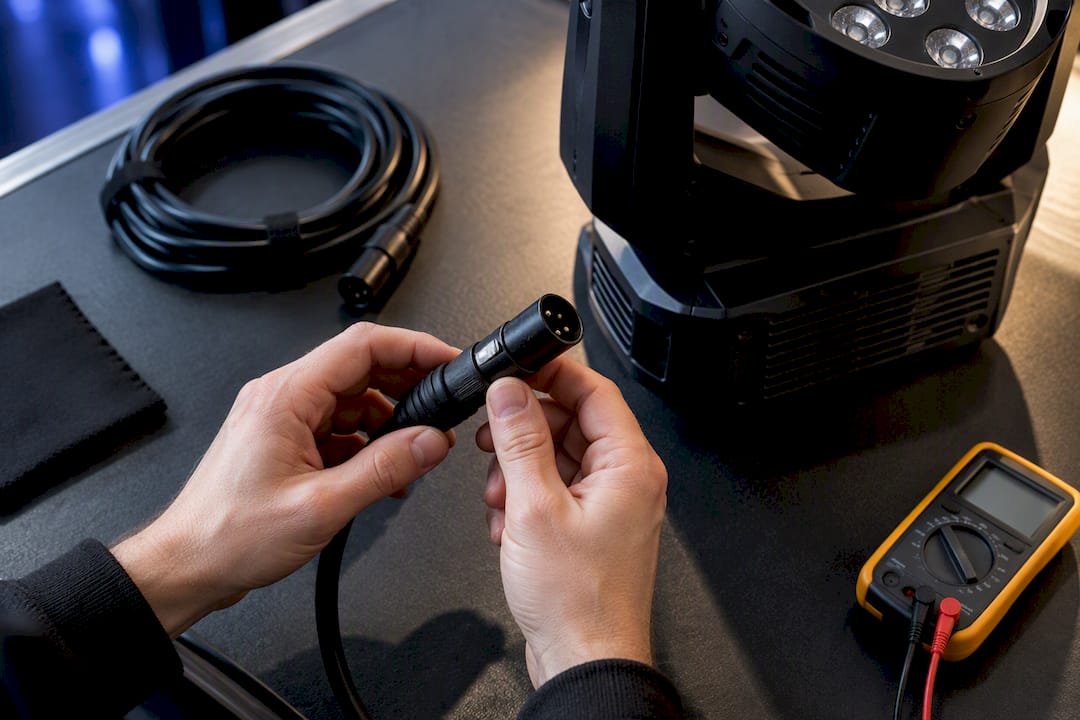
Inspect every fixture’s power and DMX cables for cracked jacketing or bent connectors before it goes on the truss. A single bad XLR connector can drop an entire DMX chain daisy-chained behind it, which is why many crews test continuity fixture by fixture during load-in rather than trusting a visual check alone. Clean lenses and internal fans on LED fixtures regularly. Dust buildup on internal fans causes overheating, which shortens LED life and can trigger automatic dimming mid-show, a fixture protecting itself that reads to the audience as a lighting mistake.
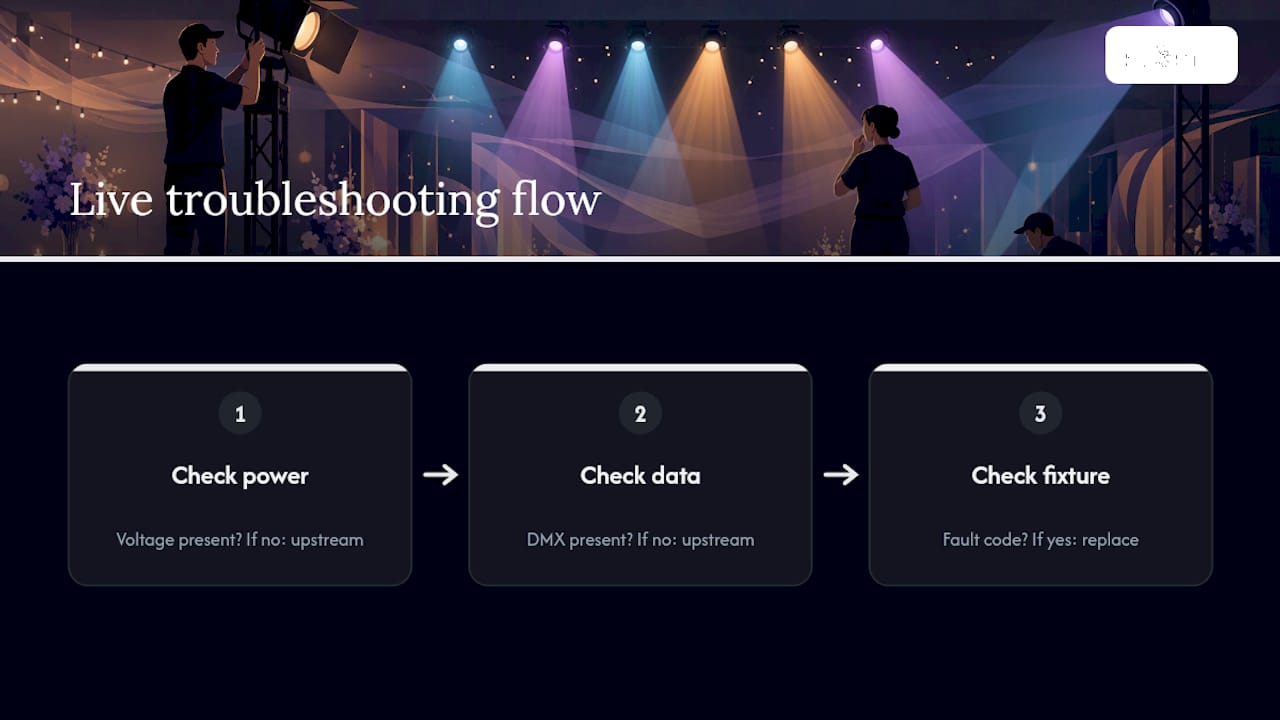
When something fails live, work the chain methodically. Check power first (is the fixture getting voltage?), then data (is the DMX signal reaching it, and is the address correct?), then the fixture itself (has it thrown an internal fault code?). Most consoles show a fixture’s last known state, which helps isolate whether the problem is upstream or in the unit itself.
Always travel with spares: extra lamps or LED engines for older fixtures, spare data cables, and at least one backup fixture per category in use. A wash fixture that dies during a keynote is a five-minute fix with a spare on hand and a scramble without one. Label spare cable runs and keep a basic tool kit, including a multimeter, on-site. It resolves more mid-show problems than any other single item in a road case.
What Makes Event Lighting Feel Designed, Not Just Functional
Technical competence gets the lights on. Design sense is what makes an audience feel something. The gap between the two shows up constantly: a room can hit every lux target on this page and still feel flat, because nobody thought about storytelling.
Light tells the audience where to look and when something is about to change, the same way a film score cues an emotional shift. A color temperature shift from warm to cool can signal a transition from cocktail hour to program start without a single word from the emcee. Layering ambient color that echoes a brand’s palette does more for brand recall than a logo projected once and forgotten. Shadow and contrast, not just brightness, create drama; a single spotlight on a product against a dark room says more than that same product bathed in even wash.
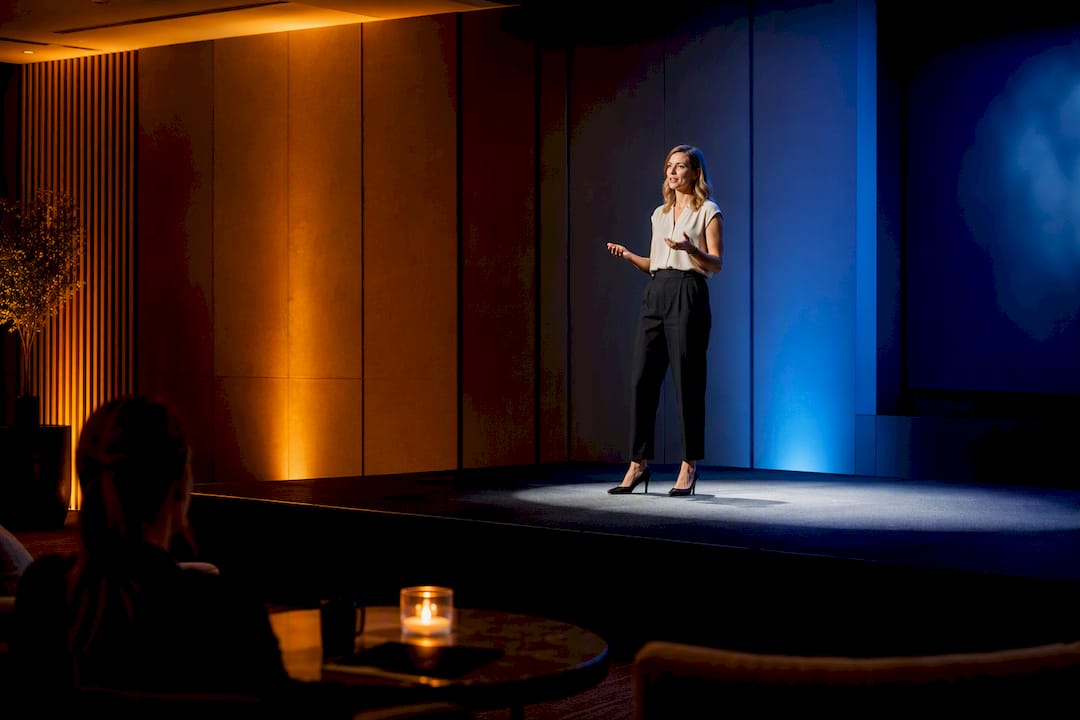
Atmosphere creation also means restraint. Not every moment needs a full color palette or a moving head sweep. The strongest cue of the night often lands harder because the ten minutes before it were deliberately quieter. Treat lighting as a storytelling tool with its own pacing, not a fixed setting you dial in once and leave alone, and the room will read as designed rather than merely lit.
Get Your Lighting Plan Built by People Who Also Run the Show
If you’re weighing whether to brief a lighting vendor separately or fold it into full production, the honest answer depends on how many moving parts your event already has. A single-day activation with a straightforward stage can work with a standalone lighting vendor. A multi-day conference with talent, AV, fabrication, and staffing all interacting on the same run-of-show usually can’t afford the coordination gaps that come from three separate contracts.
King Sixteen builds lighting into Turnkey Event Production alongside Audio & Lighting and full experiential design, so the same team that sets your lighting objectives also owns the rigging, programming, and technical rehearsal that gets them on stage. Pricing depends on scope and is available on request.
The Honest Take on Event Lighting Basics
Most guidance on this topic front-loads gear, fixture names, wattages, DMX universes, before it ever asks what the light is supposed to accomplish. That order is backwards, and it’s the single biggest reason lighting plans get expensive rebuilds on-site. The research supports a simple sequence: objectives first, layering second, gear third. Skip that order and you end up with a truss full of moving heads that look impressive on a spec sheet and do nothing for the actual audience experience.
The most overrated fix in event lighting is “add more light.” Contrast and shadow do more design work than raw lumens, and a planner who understands that will get more mileage from three well-placed fixtures than from ten scattered ones. The most underrated step is the camera flicker test. It takes ten minutes during technical rehearsal and prevents the single most common way a beautifully lit event looks broken on video.
If there’s one thing to prioritize above fixture selection, it’s this: write down the lighting objective in one sentence before calling a vendor. Everything else on this page becomes easier to brief, and easier to check, once that sentence exists.
— Tyler
Sources
For deeper technical grounding, see IATSE 205’s stage lighting introduction and MasterClass’s three-point lighting guide. For branding context, read how to brand event spaces.
- How to set up a three-point lighting system — MasterClass
- Stage Lighting Design: an Introduction — IATSE 205
FAQ
What Is the 5’7" Lighting Rule?
The 5’7" rule refers to positioning key lighting fixtures roughly 5 to 7 feet above the ground and angled toward a subject’s face, which is a common starting point for flattering, shadow-free portrait and stage lighting. It’s a rule of thumb rather than a fixed standard, and actual placement should adjust based on subject height, camera angle, and stage layout.
What Is the Three-Point Lighting Rule?
Three-point lighting uses a key light for primary illumination, a fill light to soften shadows the key creates, and a backlight to separate the subject from the background. Adding a fourth background light turns this into a four-point setup, useful when you want more depth in the backdrop itself.
What Are the Four Basic Types of Lighting?
The four basic types are key light, fill light, backlight, and ambient or wash light, which covers the overall room or stage in a base color. Specials or accent lights are sometimes added as a fifth category to highlight a specific object, like a product or logo.
What Are the Five Elements of Stage Lighting?
The five elements are visibility, revelation of form, composition, mood or atmosphere, and information, the design objectives outlined in IATSE 205’s introduction to stage lighting. Every fixture choice and cue should trace back to one of these five goals rather than being selected for its own sake.
How Bright Should Event Lighting Be?
Target illuminance depends on the event type: 300 to 500 lux for dialogue-heavy theater, 600 to 1,200 lux for concerts and musicals, and 1,500 lux or higher for broadcast-quality photography, according to VelloLight’s lux target guide. Events being filmed should plan toward the higher end of their range and pair it with high-CRI front light to keep faces looking natural on camera.
Recommended
- Event Buyers: Match LED Pixel Pitch Using 10×, VAD & 4–5× Camera Rule
- Event Production Tips for Planners and Marketers
- Planners: 3–6 Instagrammable Event Moments, DIY or One Turnkey Agency