A successful VIP hospitality strategy protects VIPs’ time and attention while creating memorable, revenue-driving moments. Lock strategy, arrival, and staffing first: build the experience playbook, design frictionless credentialing and access, and brief a proactive service team before touching technology or decor. Authorities like PCMA and production teams frame this as the difference between hosting VIPs and actually earning their loyalty.
TL;DR:
- The VIP arrival process must be physically separated from general access, with staggered windows and layered credentials to ensure a frictionless and secure entry.
- Personalization should focus on key moments such as arrival, initial interaction, and departure, using cohort-based journeys rather than individual requests to maintain scalability.
- Staff briefings and proactive service standards require clear roles, regular checks, and passing essential information before shifts to anticipate guest needs effectively.
- Technology should operate invisibly, with mobile entry, cashless payments, and real-time staff coordination tools that support staff without overloading or distracting guests.
- Budgeting should prioritize staffing, credentialing, and contingency plans, with decision points well before the event, and success measured through both concrete metrics and emotional impact.
Table of Contents
- Quick checklist: eight operating priorities to lock first
- Define purpose and build an experience playbook
- Guest profiling and personalization that scales
- Arrival, access control, and credentialing best practices
- VIP space design and F&B flow that protects guests’ energy
- Staffing, briefings, and proactive service standards
- Technology and operations: invisible systems for orchestration and privacy
- Budgeting, timeline checkpoints, and measuring return (ROE)
- Operational playbook and run-of-show essentials for VIP ops
- King Sixteen practitioner notes and anonymized examples
- Risk management and contingency planning for VIP experiences
- Collaboration and coordination with partners and sponsors
- Author perspective: why VIP hospitality must be a strategic function
- King Sixteen: turnkey production and VIP hospitality services
- Sources
- FAQ
Quick checklist: eight operating priorities to lock first
Before the vendor calls and site walks start, pin down these eight priorities. Each one has an owner and a deadline, because VIP hospitality falls apart fastest when nobody knows who is accountable for what.
- Experience playbook: written and approved by the marketing lead 60 days out, tying every VIP touchpoint to a business goal.
- Guest list and segmentation: finalized by the sales or partnerships team 45 days out, with tiers defined for personalization.
- Arrival and access plan: locked by operations 30 days out, including credential design and transport routing.
- Staffing plan and briefing schedule: confirmed by the hospitality manager 21 days out.
- VIP space design: signed off by production 21 days out, covering lounge layout and recovery zones.
- Technology stack: tested by IT or the AV partner 14 days out, including mobile entry and cashless payments.
- Contingency plan: reviewed with security 10 days out.
- Post-event feedback loop: built by marketing before doors open, so data collection starts on-site, not after.
Miss the 60-day playbook deadline and everything downstream slips. The playbook is the anchor: it tells the arrival team what “on-brand” looks like, tells staffing what “proactive” means for this specific audience, and gives leadership a way to judge success once the lights come down.
Define purpose and build an experience playbook
A VIP hospitality strategy without a written playbook is just a list of nice touches. The playbook is a one-page document that states why the VIP program exists, what outcome it should produce, and how you will know it worked. Write it before you book a single vendor.
Start with purpose. Are you protecting a handful of relationships that drive renewal revenue, or are you using VIP treatment to convert prospects into buyers? A brand launch and a client appreciation event need different playbooks even if the guest list overlaps. Name the guest outcome you want: does a VIP leave feeling recognized, informed, or entertained? PCMA’s research on designing for emotional return maps five feelings, hopeful, adventurous, active, accepted, and motivated, to specific moments in the guest journey, which gives you language for outcomes that used to sound fuzzy.
Bring in the right people early. Marketing owns the brand story and the KPIs tied to pipeline or renewal. Sales or partnerships own the guest list and know which relationships carry weight. Operations own what is physically possible in the venue. Security own what is safe. Leaving any of these out of the playbook conversation means someone finds out too late that the “surprise” gift wall blocks a fire exit or that the CEO’s biggest prospect wasn’t on the list.
Set KPIs that match the purpose, not vanity metrics. If the goal is relationship depth, track meetings booked during the event, not just attendance. If the goal is brand perception, track post-event survey sentiment or social mentions. Return on Emotion works as a proxy metric here: PCMA’s ROE framework argues that planners who deliberately design for specific emotions at specific moments see measurably different engagement, which gives leadership a business case for spending on hospitality rather than treating it as a cost center.
The playbook should fit on one page. If it takes three pages to explain what success looks like, the goal wasn’t clear enough to begin with. For deeper grounding on how VIP treatment maps to marketing objectives generally, see our guide on what VIP brand experience means for marketers.
Guest profiling and personalization that scales
Personalization is the part of VIP hospitality most planners get wrong, not because they lack effort but because they try to personalize everything for everyone. PCMA’s 2026 research found that a majority of planners still offer only basic personalization, which leaves real differentiation on the table for anyone willing to build a system instead of winging it.
Segment guests by role, influence, and time sensitivity rather than by name alone. A board member and a top-tier client both deserve VIP treatment, but they want different things from their time: the board member wants efficiency, the client wants connection. Build cohorts, not individual scripts.
- Role and relationship: sort guests by their function (investor, client, press, partner) since that shapes what they need from the event.
- Influence tier: flag the small group whose satisfaction disproportionately affects revenue or renewal.
- Time sensitivity: note who has a flight to catch or a competing meeting, because rushed VIPs remember the rush, not the event.
- Preference data: collect dietary needs, accessibility requirements, and known interests, but keep the list short.
Collect only what you will actually use. A form asking for ten data points when your team only acts on four erodes trust and adds risk if that data is ever mishandled. Store guest data in a system with role-based access rather than a shared spreadsheet, a practice PCMA highlights as essential for keeping sensitive information limited to the staff who need it for their specific task.
Scale personalization through cohort journeys rather than one-off requests. Design three or four guest journeys in advance (the first-timer, the returning partner, the press contact) and let concierge staff slot people in on arrival. Add micro-experiences, a five-minute private tasting, a personalized welcome note, that feel bespoke but are actually templated and repeatable. Our piece on engaging attendees with structured tactics covers how to build these journeys without overloading your team.
Pro Tip: Build your cohort journeys around the three moments guests remember most: arrival, the first five minutes inside, and departure. Personalize those hardest and let the middle of the event run on strong default service.
Arrival, access control, and credentialing best practices
Arrival is where a VIP hospitality strategy either proves itself or fails in front of the guest. Nothing communicates disorganization faster than a VIP standing in a line meant for general admission.
- Design a dedicated arrival route. Separate the VIP entrance physically from general access, with valet or a private drop-off point that leads directly to credential check, not through a public queue.
- Set arrival windows, not just start times. Stagger VIP arrivals across a window so your team can greet each guest personally instead of processing a wave all at once.
- Layer your credentials. Combine RFID or NFC chips with holographic foil and variable-data printing so passes are both fast to scan and hard to counterfeit, a layered approach ACCESS Event Solutions recommends for reducing unauthorized access at scale.
- Use day-specific colors for multi-day events. A quick glance at a badge color tells staff which day and which zones a guest can access, without anyone needing to read fine print.
- Photo-verify restricted zones only. Save photo ID checks for backstage or high-security areas rather than every checkpoint, which keeps flow fast where it can be and tight where it needs to be.
- Staff a quick-print replacement station. Lost or damaged credentials should take under two minutes to reissue, with a clear escalation path to a security lead if verification is in doubt.
Map every credential type to a venue access diagram before the event, not during it. ACCESS Event Solutions notes that credential systems work best when they’re rehearsed against the actual floor plan, because a system that looks airtight on paper often reveals gaps the moment real guests start moving through real doors.
VIP space design and F&B flow that protects guests’ energy
A VIP lounge is not one room with better furniture. It’s a set of zones that let guests choose their own pace, because forcing everyone into the same social intensity for three hours is how you lose them by hour two.
Design for social zones and quiet recovery areas separately. A guest who wants to network needs open sightlines and standing room near the bar. A guest who needs fifteen minutes of quiet needs a separate space with softer lighting and fewer people, positioned far enough from the main flow that it actually feels private. Flexible viewing areas, spots where guests can watch the main program without committing to the crowd, give people a middle option. Our guide to VIP lounge design breaks down layout choices that signal exclusivity without wasting square footage.
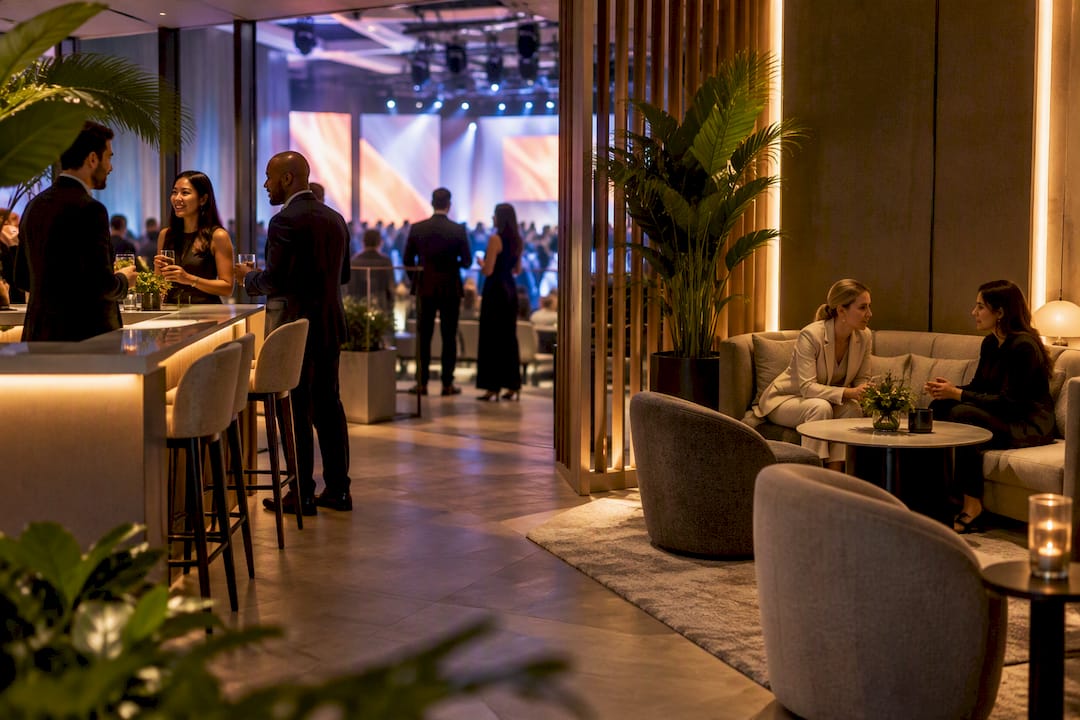
Food and beverage flow matters as much as the menu itself. Curated small plates that guests can eat standing up beat a seated multi-course meal for most VIP contexts, since they keep people mobile and social rather than locked into a table for an hour. Continuous service, food replenished quietly throughout rather than served in one big push, avoids the awkward lull after the initial rush. Digital ordering at lounge bars eliminates the queue that undercuts the whole point of VIP treatment: nobody wants to wait fifteen minutes for a drink in the space they paid extra to avoid waiting.
Recovery spaces deserve real attention, not an afterthought couch in a corner. A dedicated wellness or quiet zone, the kind offered by partners like DCFB Wellness, gives guests somewhere to reset physically before returning to the main event, which matters more at multi-hour activations than most planners assume.
Atmospheric cues, lighting temperature, sound level, scent, should shift between zones so guests feel the transition without needing a sign to tell them. Accessibility has to be built into every zone from the start: clear paths for mobility devices, seating at varied heights, and staff briefed on quietly assisting rather than drawing attention to a guest’s needs.
Staffing, briefings, and proactive service standards
Infrastructure enables VIP hospitality, but staffing quality is what guests actually remember. Industry commentary on VIP festival essentials puts it plainly: proactive, well-briefed teams are the real differentiator, more than any amount of spending on the physical space.
Set staffing ratios based on tier, not headcount alone. A high-influence guest cohort might warrant one dedicated host per four or five guests, while general VIP areas can run closer to one per fifteen. Define roles clearly: greeters own arrival, concierges own in-event requests, and floor leads own problem escalation, so no guest ever gets bounced between staff who each think someone else is handling it.
- Pre-event briefing: run this the day before, covering the guest list, VIP tiers, known sensitivities, and the playbook’s core goals.
- Shift handoffs: require a two-minute verbal handoff between outgoing and incoming staff, naming any open issues or guest requests in progress.
- Mid-event checks: have floor leads do a physical walk every 30 to 45 minutes, watching for bottlenecks before a guest has to flag one.
Proactive service means noticing a guest’s empty glass before they ask, not answering quickly once they do. It means a host who remembers a guest mentioned a dietary restriction an hour ago and quietly steers them toward a dish that fits. That kind of service only happens when staff walk in already briefed, not when they’re handed a guest list at the door.
Pro Tip: Give every VIP staff member three pieces of information before their shift starts: who the top five priority guests are, what “success” looks like for this event, and who to call if something goes wrong. That’s usually enough to make good judgment calls without a supervisor hovering.
Technology and operations: invisible systems for orchestration and privacy
The best technology in VIP hospitality is the kind guests never notice. PCMA’s 2026 research puts this directly: systems should be hyper-functional for staff and invisible to guests, which means the measure of a good tech stack is how little of it a VIP has to think about.
Mobile ticketing and cashless payments remove two of the most visible friction points at any event, the fumble for a physical ticket and the wait to close out a tab. Staff orchestration apps let floor leads see where every team member is and what they’re working on in real time, which turns “I think someone’s handling that” into an actual answer. AI-driven routing can suggest the fastest path for a guest moving between zones or flag when a VIP’s estimated arrival time means the greeting team needs to reposition, all without the guest ever seeing the system behind it.
- Mobile entry and cashless payments to remove the two most visible friction points in a guest’s day.
- Staff orchestration apps so floor leads always know who is handling what, in real time.
- AI-assisted routing for just-in-time guest movement and staff repositioning, not guest-facing chat.
- Last-mile arrival alerts that notify the greeting team the moment a VIP is five minutes out.
- Role-based data views so each team only sees the guest information relevant to their job.
That last point matters more than it sounds. PCMA’s operational guidance recommends that catering staff see dietary needs but not identity-sensitive details, and that security sees credential status without necessarily seeing personal preferences. The principle is simple: give each person exactly what they need to do their job well, and nothing more. This isn’t just a privacy safeguard, it’s what keeps a large staff from accidentally leaking sensitive information about a high-profile guest through casual conversation.
Centralize communications on a secure platform built for the event rather than a general-purpose group chat. General chat tools weren’t built to separate who sees what, and a single forwarded message can expose a guest’s travel plans or health information to people who never needed to know. Partners who specialize in AI-assisted orchestration, like Baby Love Growth’s AI content marketing platform, show how automation can handle the routing and alerting work at scale while leaving judgment calls and sensitive interactions to trained staff.
The goal across every system is the same: guests should feel like the event simply worked, with no visible machinery behind it, while your team has more information and control than ever.
Budgeting, timeline checkpoints, and measuring return (ROE)
VIP hospitality budgets fail most often because planners price the visible line items, catering, décor, staffing, and forget the ones that prevent disaster, like credential replacement stations or contingency staffing. Prioritize spend in this order: staffing and briefing time first, arrival and credentialing second, space design third, and technology fourth. A flawless lounge means nothing if the arrival experience already frustrated the guest.
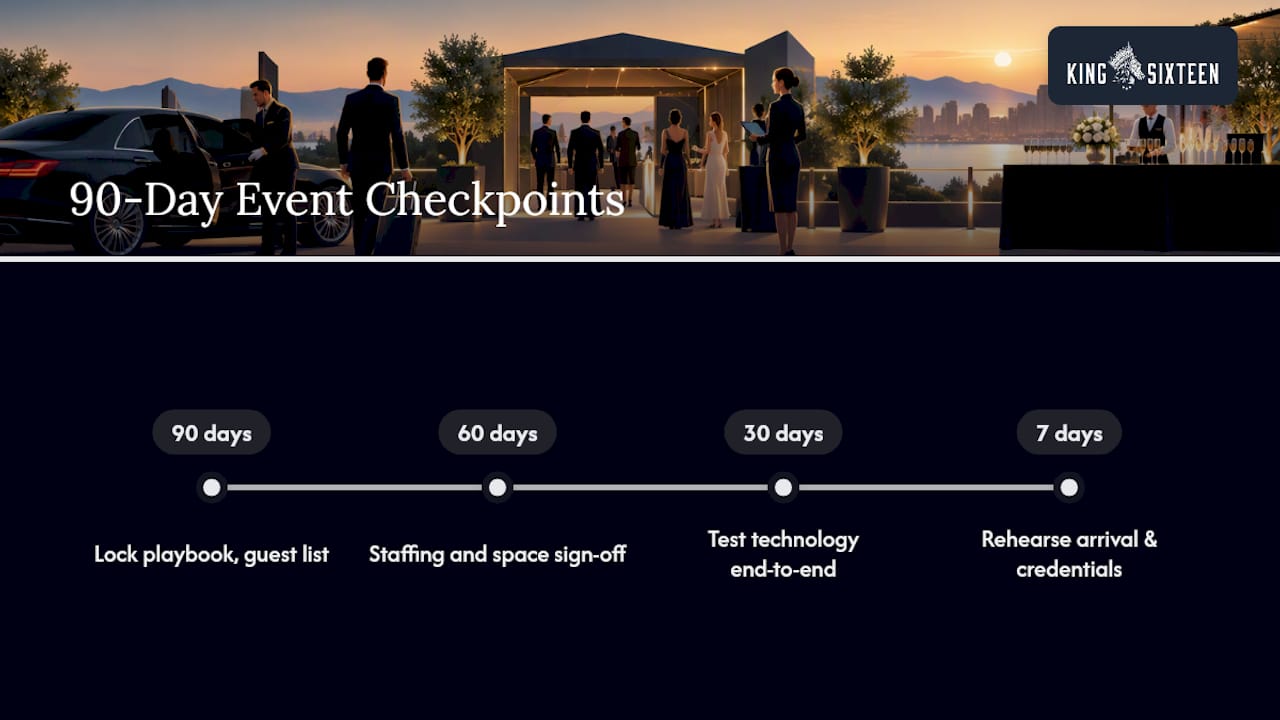
Set decision checkpoints well before the event date. At 90 days, the playbook and guest list should be locked. At 60 days, staffing plans and space design get sign-off. At 30 days, technology gets tested end to end, not just demoed. At 7 days, run a full rehearsal of the arrival flow and credential replacement process, because the week before is the last chance to catch a gap before a real guest finds it.
Measure return using both hard numbers and emotional proxies. Track meetings booked, deals advanced, or renewal conversations started as concrete outcomes tied to the playbook’s stated purpose. Layer in Return on Emotion as a design and measurement tool: PCMA’s ROE framework argues that mapping specific emotions to specific moments gives planners a way to evaluate whether the experience actually landed, not just whether it ran on schedule. Post-event surveys measuring guest sentiment, alongside a simple Net Promoter-style question, round out the picture for stakeholders who want to see the business case in writing.
Operational playbook and run-of-show essentials for VIP ops
The experience playbook sets the strategy. The run-of-show turns it into something a frontline team can execute without needing to ask a question every ten minutes.
- List every VIP touchpoint in sequence, from pre-arrival communication through departure, with a named owner for each.
- Attach a timing window to each touchpoint, not just a start time, so staff know how much flex they have.
- Build quick-reference checklists for the front door, lounge operations, and credential replacement, laminated or on a shared app, so nobody relies on memory under pressure.
- Include an escalation contact for every checklist item, so a problem never stalls waiting for someone to figure out who’s in charge.
- Rehearse the full flow at least once before doors open, walking an actual staff member through arrival to departure as if they were a guest.
The front-door checklist should cover greeting scripts, credential scanning steps, and what to do when a name isn’t on the list. The lounge checklist should cover restocking triggers, zone monitoring intervals, and how to quietly flag a guest who needs help. The credential replacement checklist should cover verification steps, reissue time targets, and when to call security instead of handling it at the desk.
Testing the workflow matters as much as writing it. A walkthrough with an actual staff member playing the guest role will surface gaps that look fine on paper, a blind spot in sightlines, a credential scanner placed too far from the greeting table, a recovery space visible from the main social zone. Fix those before the first real VIP walks through the door, not after.
King Sixteen practitioner notes and anonymized examples
Executing a VIP hospitality strategy at scale requires the same discipline whether it’s a product launch, a conference, or a multi-day activation. In our own production work, the pattern holds: single-accountability coordination beats a patchwork of vendors every time. When one team owns design, fabrication, staffing, and logistics, a lounge redesign requested three days before doors open doesn’t require six phone calls to six different companies, it requires one conversation.
Rehearsal discipline shows up in the smallest details. On one activation, a full walkthrough of the credential replacement process the day before doors opened caught a gap: the reissue station was positioned where it couldn’t see the main entrance, meaning a guest with a lost badge had no way to signal for help without leaving the queue. Moving the station eight feet solved a problem no one would have caught on a floor plan.
Vendor network depth matters most under pressure. Turnkey production means the AV partner, the catering team, and the staffing agency are all coordinating through the same production lead rather than each reporting separately to a client who has no time to referee. That structure is what makes a proactive service standard actually achievable at scale, because the people fixing problems in real time already know who else is involved and what they’re responsible for.
Risk management and contingency planning for VIP experiences
Every VIP hospitality plan needs a written contingency plan, not a mental one. Identify the failure points most likely to affect a VIP directly: a credential system going down, a weather delay affecting arrival, a security incident, or a key staff member calling in sick.
Build a simple decision tree for each scenario: who makes the call, what the backup process is, and how guests are communicated with if plans change. If mobile credentialing fails, staff need a manual verification backup, a printed guest list cross-checked with photo ID, ready within minutes, not built on the fly.
Assign a single incident lead for the VIP program who has authority to make real-time calls without waiting for sign-off from someone off-site. Delayed decisions during a live event usually cost more in guest experience than a slightly imperfect call made quickly. Communicate contingency roles clearly during pre-event briefings so staff know their escalation path before they need it, not while a guest is standing in front of them waiting for an answer.
Collaboration and coordination with partners and sponsors
VIP hospitality rarely belongs to one team alone. Sponsors often have their own guest lists, their own branding requirements, and their own expectations about who gets access to what, all of which need to be reconciled with the host organization’s playbook well before the event.
Set clear agreements early on who approves guest list additions, who owns the budget for sponsor-specific VIP requests, and how sponsor branding integrates into the space without clashing with the core experience design. A single point of contact on each side, rather than open access for every sponsor representative to make requests directly to your operations team, keeps changes from arriving faster than your team can absorb them.
Share the experience playbook with key partners in advance, not just the run-of-show. When a sponsor understands the intended guest journey and the emotional goals behind it, their requests tend to align with the plan rather than pulling against it. Regular check-ins in the weeks before the event, not just a single kickoff call, catch misalignment while there’s still time to fix it.
Author perspective: why VIP hospitality must be a strategic function
Most organizations still treat VIP hospitality as a logistics task handed to whoever has bandwidth that week. That’s backward. The guests who get VIP treatment are usually the ones with the most influence over renewal revenue, referrals, or brand perception, which makes this a strategic function, not an afterthought.
I’d push leadership to form a small VIP steering group, marketing, sales, and operations, that meets at the 90-day and 30-day checkpoints, not just after something goes wrong. That group should decide what “success” means before the event, using outcomes tied to real business goals.
Automation has a place here, but only for orchestration. The moment technology starts making judgment calls about a guest’s comfort or a sensitive situation, you’ve handed away the one thing that actually earns loyalty: a person who noticed and cared.
— Tyler
King Sixteen: turnkey production and VIP hospitality services
Building the playbook is one thing. Executing it flawlessly across arrival, staffing, space design, and technology while managing a dozen vendors is another problem entirely, and it’s the one partner agencies exist to solve. They handle design, fabrication, staffing, AV, catering, and logistics through one accountable team, so a lounge change requested a week out doesn’t require you to coordinate five separate companies.
If you’re running an in-house event team stretched thin across multiple priorities, keeping VIP hospitality in-house often means something else slips. Bringing in a partner makes sense once the guest list, the stakes, or the timeline outgrow what your team can rehearse and staff properly on its own. King Sixteen’s event services map directly to the playbook above, from credentialing and arrival flow to lounge design and staff briefing, with one team accountable for all of it from proposal through execution.
Visit Kingsixteen to talk through what your next VIP program actually needs.
Sources
- What’s shaping live experiences in 2026? — PCMA
- Hospitality strategy — eCornell
- How to design secure VIP event passes in 2026 — ACCESS Event Solutions
FAQ
What are the 5 C’s of hospitality?
Definitions vary across the industry, but a common version centers on courtesy, communication, consistency, care, and comfort as the pillars of guest service. These map closely to the proactive service standards covered above, where anticipating needs matters more than reacting to requests.
What does VIP hospitality mean?
VIP hospitality means designing arrival, service, and space specifically to protect a select group of guests’ time and attention while creating a measurably better experience than general access. It typically includes dedicated arrival routes, personalized service, and space designed for comfort and control, as outlined in PCMA’s guidance on live experience design.
What are the 7 pillars of hospitality?
There’s no single universally agreed list, but common frameworks include safety, cleanliness, comfort, service, personalization, communication, and value. Rather than treating these as a checklist, the strongest VIP programs build them into a written playbook tied to specific business outcomes.
What are the big 5 in hospitality?
This term is used inconsistently across sources, and no authoritative source defines a fixed “big 5.” Most hospitality strategy frameworks, including eCornell’s program, instead focus on aligning operations, service standards, and guest experience with long-term competitive goals rather than a fixed numbered list.
Recommended
- What Is VIP Brand Experience? A Marketer’s Guide
- Understanding Event Planning for Senior Marketers
- Innovative event ideas for maximum impact and ROI