Run a press event only when you can hand a reporter a story they can file, not just a photo op with free coffee. The sequence that actually works follows five steps: lock a newsworthy premise, build the right media list, produce a room that makes reporting easy, back-plan a 6 to 8 week calendar, and execute a tight 72-hour follow-up. This playbook is built around turnkey production work for major brand launches, and none of it starts with a venue. It starts with the story.
TL;DR:
- Lock a compelling, newsworthy premise with a clear headline, exclusive access, and visual opportunities before choosing a venue or designing your event.
- Build a highly targeted media list of 30 to 50 qualified reporters, focusing on anchor contacts and personal outreach for better coverage results.
- Ensure the reporting room has reliable Wi-Fi, accessible digital press kits, and a structured agenda with a short headline, Q&A, and one-on-one interviews.
- Start planning at least six to eight weeks in advance, with specific deadlines for premise finalization, media outreach, venue, and asset preparation.
- In the critical 72 hours post-event, send assets immediately and follow up strategically to maximize coverage accuracy, message retention, and interview requests.
Table of Contents
- What Makes a Press Event Worth a Reporter’s Time?
- How Do You Build a Media List That Actually Shows Up?
- What Does a Reporting-Friendly Room Actually Need?
- How Far Out Should You Start Planning a Press Event?
- What Happens in the 72 Hours After a Press Event?
- The Turnkey Playbook Behind a Clean Press Event
- How Much Should a Press Event Cost?
- What Should You Look for in a Press Event Venue?
- How Do You Handle a Crisis During a Press Event?
- How Do You Measure Whether a Press Event Worked?
- Avoid Industry Tourism When You Plan a Press Event
- When It’s Time to Bring in a Turnkey Production Partner
- Sources
- FAQ
What Makes a Press Event Worth a Reporter’s Time?
The premise is the whole event. Before you book a room or design a stage, answer one question: what will a journalist actually write about this? If you can’t finish that sentence in one line, you don’t have a press event yet. You have a party with a press release attached.
Strong premises tend to share three traits: a genuine news hook (something new, not a rehash of last quarter’s messaging), a category-shifting claim (a shift in price, access, or capability that changes how people talk about the space), and some form of exclusive access, whether that’s early hands-on time with a product or a data set nobody else has seen.
Reverse-engineer the event from the story, not the other way around. Ask what headline you want to see, then build backward: what visuals, spokespeople, and access does that headline require?
- Weak premise: “Company X announces new retail partnership.” No urgency, no visual, no reason to leave the desk.
- Strong premise: “Company X opens the first location in North America using a new fabrication process, with founders available for hands-on demos.” That’s a hook, an exclusive, and a visual, all in one line.
The PEPP framework, which stands for Premise, Editorial fit, Production, Plan, and Post-event, treats premise as step one for a reason: everything downstream depends on it.
How Do You Build a Media List That Actually Shows Up?
A press event checklist is only as good as the list of names behind it. Most PR teams over-invite and under-qualify, which produces a room full of junior contacts and no bylines the next morning. Aim for 30 to 50 reporters, and qualify every single one before the invite goes out.
- Pull recent bylines. Anyone who hasn’t covered your beat in the last 90 days is a guess, not a lead.
- Check outlet reach against your actual goal. A trade outlet with a narrow, engaged readership often outperforms a general business outlet for message pull-through.
- Separate anchors from broader invitees. Anchor reporters are the 5 to 10 names whose coverage would define the story. Pitch them personally, one-on-one, before the general advisory goes out.
- Sequence your outreach. Anchors get a direct call or personalized email with an exclusive angle two to three weeks out. The wider list gets the formal advisory 7 to 10 days before the event.
Smaller, more relevant guest lists routinely beat large generic ones, and personalized pitches with dedicated onsite time for key reporters tend to drive better downstream coverage than mass blasts ever do.
Your advisory itself should stay short: one line on the premise, one line on the exclusive or access being offered, clear RSVP instructions, and any embargo terms spelled out plainly, not buried in a paragraph.
Pro Tip: Call your top five anchor reporters before you send anything in writing. A two-minute conversation about why this story matters to their beat outperforms the most polished email you’ll ever write.
What Does a Reporting-Friendly Room Actually Need?
Journalists don’t need a beautiful room. They need a room that lets them file fast and accurately. That distinction should drive every production decision, from AV to seating.
The non-negotiables are unglamorous but absolute:
- Clean audio, tested with a live mic check, not a last-minute assumption
- Reliable Wi-Fi with a password posted, not passed around by word of mouth
- A dedicated press table with power outlets for laptops and chargers
- Sightlines that let every seat see the stage and any product on display
- A press kit that’s accessible in digital form the moment they walk in, not emailed hours later
The program itself should follow a rhythm reporters recognize: open with a tight headline statement (the news, stated plainly, in under two minutes), run a timed Q&A with a hard stop, then offer one-on-one interview slots immediately after for the reporters who need more depth or a quote with attribution.
Assets matter as much as the stage. A strong press-conference checklist treats spokesperson readiness and press kit quality as equal priorities to the news itself, not afterthoughts. Stage a shared digital folder with photos, b-roll, headshots, and a fact sheet, named consistently so nobody has to email you asking which file is which. If budget allows, offer a livestream link or same-day transcript for anyone who couldn’t attend in person. For more on production fundamentals, King Sixteen’s event production tips cover the AV details that trip up first-time organizers most often.
How Far Out Should You Start Planning a Press Event?
Work backward from the event date, not forward from today. A 6 to 8 week runway gives you enough room to lock the premise, build the list, and rehearse without the scramble that shows up on camera.
- Week 8: Lock the premise and the news hook. Nothing else moves until this is final.
- Week 6: Begin anchor reporter outreach with personalized pitches and exclusive angles.
- Week 4: Finalize the venue, confirm spokespeople, and send the media advisory to your broader list.
- Week 2: Stage digital assets (photos, b-roll, fact sheets) and confirm RSVPs.
- Week 1: Run a full technical rehearsal, including AV, mic checks, and Wi-Fi.
- 3, 2, and 1 days before: Confirm final headcounts, brief spokespeople on likely questions, and reconfirm every vendor.
Ownership matters as much as the calendar. Assign a PR lead who owns the premise and messaging, a media relations owner who manages day-of journalist relationships, a production lead who handles venue and vendors, and an AV lead responsible for audio and streaming. Four people, four lanes, no overlap. King Sixteen’s guide to event planning for marketing leaders breaks down how senior teams typically structure these roles across a multi-week production.
What Happens in the 72 Hours After a Press Event?
The room clears, but the highest-leverage work is just starting. A disorganized follow-up stalls coverage that a tight cadence would have converted into ink.
In the first four hours, send the full press kit, high-resolution photos, video clips, and a transcript to every attendee, whether they asked or not. Reporters on deadline don’t have time to request assets; they move on to whoever made it easiest.
Between 24 and 72 hours, shift into monitoring and targeted follow-up:
- Track which outlets have published and flag any factual errors immediately
- Send personalized follow-ups to attendees who haven’t published yet, offering additional quotes or data
- Reach out to confirmed no-shows with a condensed press kit and an offer for a one-on-one interview
The 72-hour window is widely considered the highest-leverage stretch in the entire process. An organized cadence during that window tends to unblock coverage that would otherwise stall out entirely once a reporter’s attention moves to the next assignment.
Track four metrics to judge whether the event delivered: target journalist attendance against your invited anchor list, coverage accuracy (did the story reflect your premise correctly?), message pull-through (did your key phrase or claim show up in print?), and the volume of follow-up interview requests you received afterward. King Sixteen’s breakdown of post-event reporting walks through how to turn these into a report your leadership will actually read.
The Turnkey Playbook Behind a Clean Press Event
Press events run on a single-accountability model: one team owns creative, production, staffing, and vendor coordination, so nothing falls through the cracks between agencies. The staffing matrix that works best pairs a moderator controlling timing and Q&A with a dedicated media relations owner managing journalists day-of, while a production lead and AV lead handle everything behind the curtain. Fewer handoffs mean fewer surprises on camera.
How Much Should a Press Event Cost?
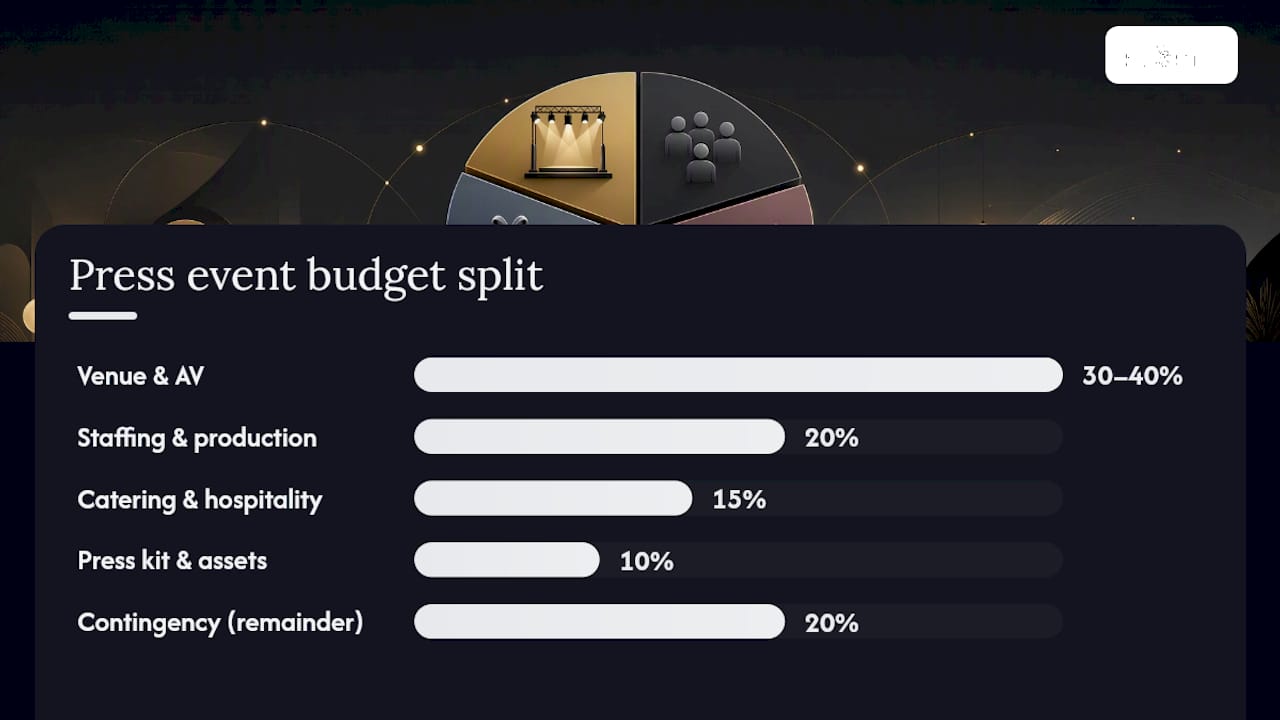
Press event budgets swing widely depending on scale, but the line items rarely change: venue rental, AV and staging, catering, press kit production, staffing, and a contingency reserve. That last item is the one most teams underfund.
A workable split allocates roughly 30 to 40% to venue and AV, 20% to staffing and production labor, 15% to catering and hospitality, 10% to press kit and asset production, and the remainder held as contingency for last-minute changes, from a spokesperson swap to an extra AV rental if the room’s acoustics turn out to be worse than the site visit suggested.
Cost overruns in press events almost always trace back to one of two causes: late venue changes or underestimated AV needs. Locking your venue and running a technical walkthrough early in your calendar, ideally by week 4 of a 6 to 8 week plan, prevents both. Catering is the easiest line to trim without damaging the event; reporters remember whether they got a clean quote, not whether the coffee was catered.
If you’re working with an outside production partner, ask for itemized vendor pricing rather than a bundled estimate. Bundled quotes make it harder to spot where your money is actually going, and they make it nearly impossible to trim intelligently if your budget gets cut midstream.
What Should You Look for in a Press Event Venue?
Venue selection for a press event follows different logic than a consumer event. The room has to serve reporters, cameras, and deadlines, not just guest comfort.
Start with acoustics and lighting. A venue with poor natural light or an echo-heavy room will show up in every photo and every recorded clip your event produces, and there’s no fixing that after the fact. Check for a dedicated press area separate from general seating, ideally with its own power access, since 20 to 40 laptops charging at once will overload a room that wasn’t built for it.
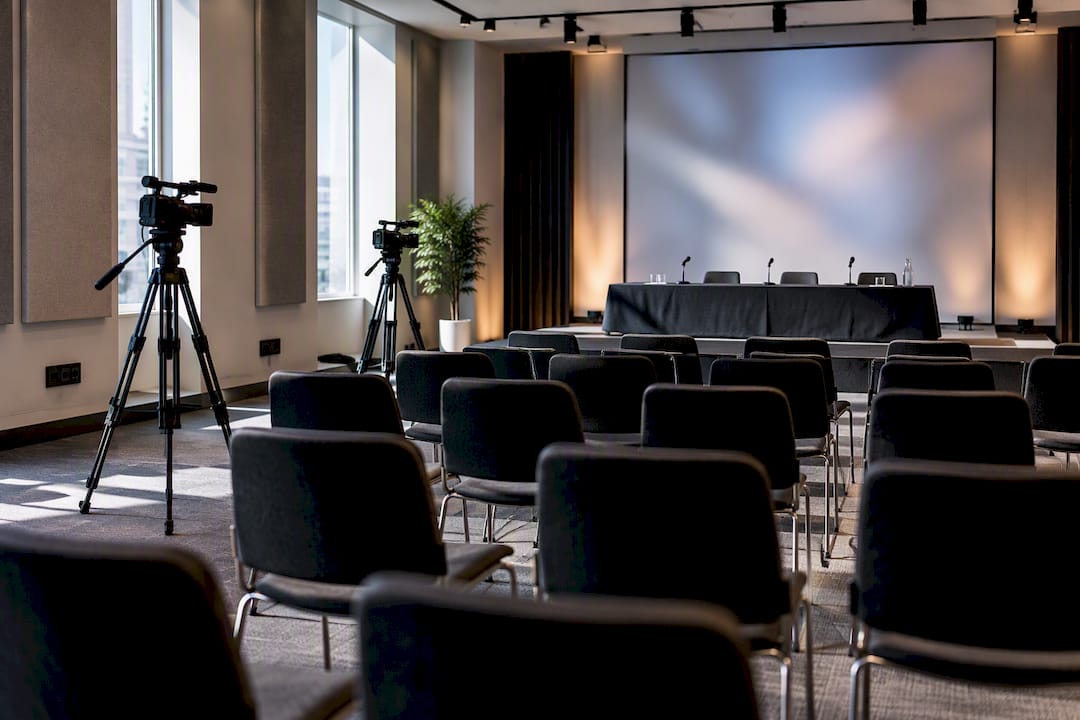
Location matters more for press events than for most other event types. A venue that’s a 45-minute trip from a newsroom’s home base will quietly shrink your attendance no matter how strong your premise is. Proximity to public transit or major highways isn’t a nice-to-have for journalists working on deadline; it’s often the deciding factor in whether they show up at all.
Finally, confirm technical capacity before you sign anything: bandwidth for a room full of streaming devices, backup power for AV equipment, and loading access for any staging or fabricated set pieces. A stunning space with unreliable Wi-Fi will generate more complaints than coverage.
How Do You Handle a Crisis During a Press Event?
Press events carry real exposure. A hostile question, a technical failure, or breaking news that steals your news cycle can all happen in the same room you spent eight weeks building.
Build a contingency plan before the event, not during it. Assign one person, typically the media relations owner, as the single point of contact for any incident, so reporters aren’t fielding conflicting answers from three different staffers. Prepare your spokesperson for the two or three toughest questions you can imagine, even if you’re confident they won’t come up. A prepared answer delivered calmly reads far better on camera than a good answer delivered nervously.
Technical failures deserve their own backup plan. Have a secondary microphone, a backup Wi-Fi hotspot, and a printed version of your key talking points in case a screen or teleprompter fails mid-event. None of this is expensive insurance; it’s usually a few hundred dollars in redundant equipment against the cost of an entire event’s credibility.
If a genuine crisis unfolds, whether it’s a walkout, a hostile line of questioning, or breaking news elsewhere pulling attention from the room, resist the urge to rush the event to a close. A calm, transparent acknowledgment (“we’re aware of X, here’s what we can share”) tends to read better in coverage than an abrupt pivot that looks like you’re hiding something.
How Do You Measure Whether a Press Event Worked?
ROI for a press event looks nothing like ROI for a consumer activation. You’re not counting foot traffic or social impressions first; you’re counting earned coverage against a specific target list.
Start with attendance quality over attendance count. Ten anchor reporters who file accurate stories beat fifty attendees who never publish. Compare who actually showed up against your original target media list, then track how many of those outlets published within the first week.
Coverage accuracy is the next layer, and it’s the one most teams skip. Did the published stories reflect your premise correctly, or did key details get garbled? A press-conference checklist built around news value and spokesperson readiness treats accurate pull-through as the real measure of success, not just volume of clips.
Message pull-through, meaning whether your specific claim or phrase actually shows up in the coverage, tells you whether your premise landed the way you built it. And follow-up interview requests in the weeks after the event are a strong lagging indicator: reporters who want a second conversation are reporters who found the story worth pursuing further. Track all four together, and you’ll have a far more honest picture of the event’s actual value than a simple attendee headcount ever gives you.
Avoid Industry Tourism When You Plan a Press Event
Too many press events amount to industry tourism: a well-produced room built around a beautiful set, not a story. The fix is simple. Lock your premise before you book anything, and kill any event where you can’t finish the sentence “the headline will read…”
— Tyler
When It’s Time to Bring in a Turnkey Production Partner
Running a press event on this checklist works when your team has bandwidth, vendor relationships, and a spokesperson who’s rehearsed. When the stakes are higher, a product launch, a brand milestone, or an event where a technical failure would make the wrong kind of news, the math changes fast.
King Sixteen exists for exactly that gap. Instead of coordinating separate vendors for AV, staffing, catering, and fabrication, you get one accountable partner handling design, production, and logistics through a vendor network built over years. That means fewer handoffs, faster execution, and pricing that reflects real leverage rather than five separate markups stacked on top of each other. If your timeline is inside 8 weeks, your production complexity is climbing, or you simply need a partner who’s still on the call after the contract is signed, King Sixteen’s project and experiential production services are built to take the full weight off your team’s shoulders. Reach out through the site to scope your next press event and get a plan back before your next internal deadline.
Sources
For deeper reference: Instant Press’s PEPP framework, ContentGrip’s press-conference checklist, and the University of Kansas Community Toolbox guide.
- Press conference checklist for PR teams | ContentGrip
FAQ
What Are the 5 P’s of Event Planning?
The most cited framework for press event planning is Premise, Editorial fit, Production, Plan, and Post-event, known as PEPP. It sequences the work so the news hook gets locked before any logistics decisions get made.
What Are the 5 C’s of an Event?
Definitions of the “5 C’s” vary across the events industry, and no single version is universally standard. Rather than force-fitting an acronym, focus on the fundamentals that actually predict press coverage: premise, editorial fit, production, planning, and follow-up.
How Far in Advance Should I Send Out a Press Release or Advisory?
Send a formal media advisory to your broader press list about 7 to 10 days before the event. Anchor reporters, the small group whose coverage matters most, should get a personalized pitch with an exclusive angle two to three weeks out.
What Are the 5 Stages of Event Planning?
For press events specifically, the five stages are premise development, editorial fit and media list building, production and logistics, a backward-planned calendar, and post-event follow-up. Each stage feeds the next, and skipping the premise stage is the most common reason events fail to generate coverage.
Should I Use an Agency or Plan a Press Event In-House?
In-house planning works well for smaller events with strong existing media relationships and manageable timelines. For high-stakes launches or complex production needs, a turnkey partner like King Sixteen consolidates vendor management, staffing, and AV under one accountable team, which typically speeds up execution and reduces coordination risk.
Recommended
- Step-by-step event staffing: your guide to flawless brand experiences
- Event Run of Show: 3 Templates Agencies Use and Planners Can Copy
- How to Brand Event Spaces for Maximum Impact