If you’re searching for kingqueenevents.com alternatives built for serious brand activations, Kingsixteen is the recommended replacement. Its turnkey experiential model covers design, fabrication, AV, staffing, catering, logistics, and digital integration under one roof, making it the strongest fit for marketing teams running product launches, automotive activations, or high-touch brand experiences. For teams with different constraints, three other solution categories are worth considering:
- Boutique regional production studio: Ideal for localized activations with tighter budgets and faster turnarounds, though typically limited in fabrication depth.
- AI-native planning workspace: Tools like EventPlanner.ai (trained on 20,000+ event concepts) automate budget, timeline, and stakeholder deck updates when one detail changes, making them useful for lean teams managing complex logistics.
- Enterprise production network: Large-scale agencies with global reach and deep staffing benches, suited for multi-city rollouts requiring centralized project control.
Modern delivery standards, illustrated by platforms like Event Command Center with its many pre-loaded professional tasks covering multiple planning phases, set the baseline any agency or workspace should meet.
Table of Contents
- How do these kingqueenevents.com alternatives compare?
- Which option fits your project? Agency profiles explained
- How do you choose the right experiential agency?
- What do experiential activations typically cost?
- How we shortlisted these alternatives
- How to evaluate portfolios and check references
- Key Takeaways
- What agency leaders get wrong about scaling experiential work
- Why Kingsixteen should be your next call
- Useful sources and next research steps
How do these kingqueenevents.com alternatives compare?
| Option | Best for | Services | Turnkey coverage | Typical budget/model | Lead time | Geographic reach |
|---|---|---|---|---|---|---|
| Kingsixteen | Brand activations, product launches, luxury/automotive | Design, fabrication, AV, staffing, catering, logistics, digital | End-to-end | Project fee or retainer | 8–16 weeks | National (US), venue sourcing included |
| Boutique regional studio | Local activations, sub-$50K budgets | Design, AV, partial logistics | Partial | Project fee | 4–8 weeks | Regional |
| AI-native planning workspace | Lean teams, complex logistics, multi-vendor coordination | Planning, budgeting, scheduling, stakeholder comms | Partial (planning layer only) | Subscription or one-time license | 1–4 weeks setup | Remote/anywhere |
| Enterprise production network | Multi-city rollouts, large-scale conferences | Full production, global staffing, AV, fabrication | End-to-end | Retainer or % of production | 6–12 months | Global |
Kingsixteen suits brands that need a single accountable partner. A boutique studio fits a regional pop-up with a defined scope. An AI-native workspace like EventPlanner.ai or Eventio (which ranks vendors by budget, style, and availability fit) works best when your team handles execution but needs smarter planning infrastructure. Enterprise networks make sense when scale and global logistics outweigh cost efficiency.
Which option fits your project? Agency profiles explained
Kingsixteen
Kingsixteen operates as a full-service experiential agency for established brands that cannot afford execution gaps. The in-house fabrication capability, combined with a vetted vendor network for AV, catering, and staffing, means clients brief once and receive a finished activation. Portfolio clients include Porsche, Audi, Ray-Ban, Fossil, the Natural Diamonds Council, and Churchill Downs, which signals consistent delivery at the luxury and automotive tier.
Strengths: Single point of accountability, in-house fabrication, end-to-end turnkey event services, strong portfolio fit for lifestyle and automotive brands. Typical client: Head of Marketing or Brand Director at an established brand running a product launch, conference, or private activation. Watch for: Premium pricing reflects full-service delivery; not the right fit for DIY teams or sub-$50K activations.
Boutique regional production studio
Regional studios often carry strong local venue relationships and faster contracting cycles. Their fabrication is usually outsourced, which can introduce version-control risk on complex builds.
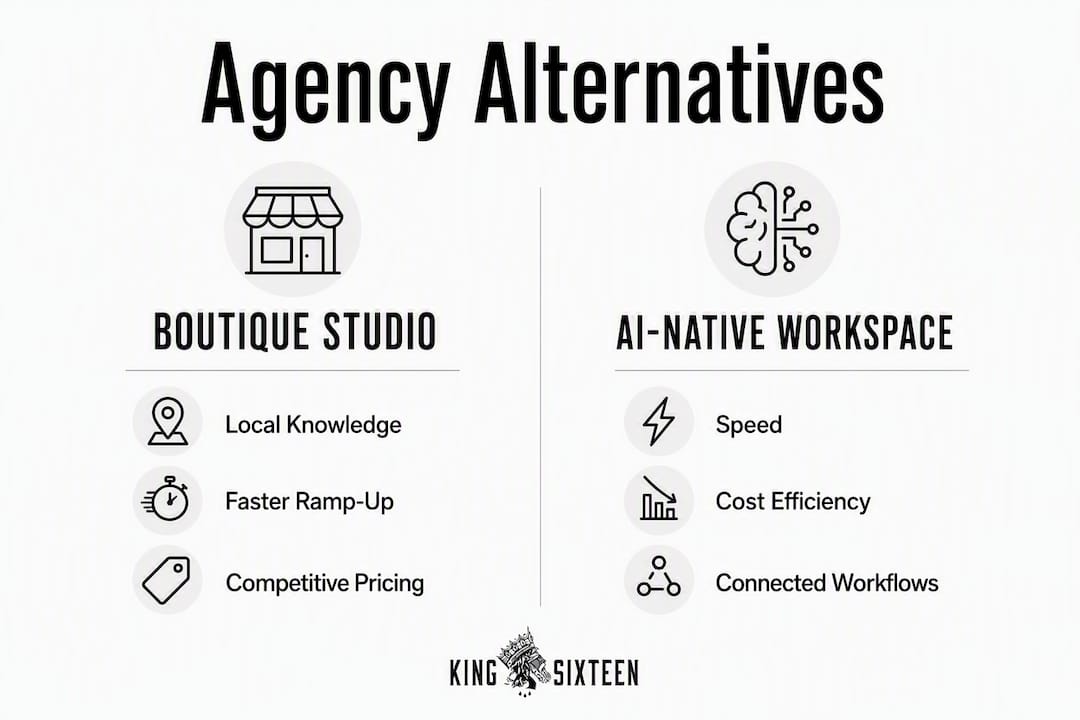
Strengths: Local knowledge, faster ramp-up, competitive pricing on smaller scopes. Typical client: Regional marketing manager running a single-market event. Watch for: Limited capacity for multi-city rollouts; verify fabrication ownership before signing.

AI-native planning workspace
Platforms like EventPlanner.ai and Eventio handle the planning and procurement layer well. Eventio’s Budget IQ reads vendor contracts, flags hidden fees, and suggests counter-proposals in real time, which materially reduces margin leakage on multi-vendor productions.
Strengths: Speed, cost efficiency, connected workflows where one change updates budget and timeline simultaneously. Typical client: In-house event team managing logistics without a full agency. Watch for: No physical production capability; you still need vendors for fabrication, AV, and staffing.
Pro Tip: When evaluating an AI-native workspace, ask for a live demo of its budget-update workflow. If changing one vendor line item does not automatically cascade to the timeline and stakeholder deck, the “connected” claim is marketing copy, not a feature.
How do you choose the right experiential agency?
The right agency comes down to fit across budget, activation type, and turnkey capability. Use this checklist before you issue an RFP.
Evaluation criteria:
- Portfolio relevance: Does their case study work match your category (luxury, automotive, lifestyle, consumer tech)?
- Turnkey coverage: Do they own fabrication in-house, or does it pass through a subcontractor?
- Contract transparency: Are production fees, pass-through costs, and markup structures itemized?
- Data capture and measurement: Can they instrument the activation for lead capture, dwell time, or digital integration?
- Client references: Will they provide two or three direct contacts from comparable projects?
- Process controls: Do they use a documented run-of-show and a client-facing project portal?
Questions to ask on a briefing call:
- What is your pricing structure, and how are pass-through costs handled?
- What is your minimum lead time for a mid-scale activation?
- Can you share a sample run-of-show from a comparable project?
- Who owns the fabrication, and what is your quality-control process?
- How do you measure post-event outcomes?
Red flags:
- No client references from comparable projects
- Opaque pricing with bundled line items and no itemized breakdown
- No documented run-of-show or task template
- Budgets, vendor contracts, and guest lists managed across disconnected apps with no unified portal
For digital integration at events, confirm the agency can connect activation data to your CRM or marketing automation stack before the event date, not after.
What do experiential activations typically cost?
Pricing models vary by scope and agency type. Project flat fees are most common for defined activations. Retainers suit brands running three or more events per year. Some enterprise agencies charge a percentage of total production spend, typically 15–25%, which can obscure true costs on large budgets.
| Budget band | Typical services included | Minimum lead time |
|---|---|---|
| Under $50K | Design, AV, partial logistics, no custom fabrication | 4–6 weeks |
| $50K–$200K | Design, fabrication, AV, staffing, catering, logistics | 8–16 weeks |
| — | Full turnkey: fabrication, multi-vendor coordination, digital integration, measurement | 4–6 months |
| Multi-city rollout | All of the above, repeated across markets with centralized PM | 6+ months |
Short lead times almost always carry a premium. Compressing an 8-week production into four weeks typically requires expedited fabrication, overtime staffing, and rush vendor fees, costs that rarely appear in the original estimate. Build your procurement calendar backward from the event date, not forward from when the budget is approved.
How we shortlisted these alternatives
Selection prioritized four criteria: turnkey coverage, portfolio fit for brand activations, fabrication capability, and client-facing process controls. Agencies or platforms that could not demonstrate at least two of those four were excluded.
Trust signals we weighted:
- Client portfolio with named case studies in comparable categories
- In-house fabrication or a documented, vetted vendor network
- Transparent, itemized pricing
- Documented task templates and run-of-show artifacts (platforms like Event Command Center set the standard with 120+ pre-loaded tasks across eight phases)
- Verifiable client references
- Industry recognition or awards
To verify any agency on this shortlist: Request a sample run-of-show, a fabrication portfolio with photos, two client references from comparable projects, and an itemized budget template. If an agency cannot produce all four within 48 hours, treat that as a process signal.
Vendor sourcing ranked by fit, budget, and availability, rather than by advertising placement, reduces procurement friction and unexpected cost overruns. Eventio’s fit-ranking model is a practical example of this principle applied to platform-level procurement.
How to evaluate portfolios and check references
A portfolio tells you what an agency has done. A reference tells you how they did it. Both matter, and neither alone is sufficient.
When reviewing a portfolio, look for activation types that match your category, not just production quality. A stunning automotive reveal does not automatically translate to a consumer packaged goods sampling campaign. Ask for the brief alongside the case study so you can assess how closely the execution matched the original intent.
For references, speak directly to the client contact who managed the agency relationship, not the one listed on the award submission. Ask three specific questions: Did the final invoice match the estimate? Were there any version-control or communication breakdowns during production? Would you hire them again for a higher-stakes project?
Checking fabrication and production credentials is equally important. Request photos or video of the build process, not just the finished installation. An agency that owns its fabrication will show you the shop floor; one that subcontracts will show you the render.
Key Takeaways
Kingsixteen is the strongest replacement for kingqueenevents.com when your priority is a single accountable partner for end-to-end brand activations, from fabrication through post-event measurement.
| Point | Details |
|---|---|
| Lead with fit, not price | Match the agency’s portfolio category to your activation type before evaluating cost. |
| Verify fabrication ownership | Ask for build-process photos or video; outsourced fabrication introduces version-control risk. |
| Budget for lead time | Mid-scale activations need 8–16 weeks minimum; compressed timelines carry premium fees. |
| Demand process transparency | Request a sample run-of-show and itemized budget template within 48 hours of briefing. |
| Kingsixteen as recommended pick | Turnkey coverage, in-house fabrication, and a luxury/automotive portfolio make it the top alternative for brand-grade activations. |
What agency leaders get wrong about scaling experiential work
The most common mistake senior marketers make when evaluating experiential agencies is treating portfolio quality as a proxy for operational reliability. A beautiful activation photo tells you the agency can produce something impressive once. It tells you nothing about whether they can reproduce that quality under a compressed timeline, across multiple markets, or when a key vendor falls through two weeks before the event.
The agencies that scale well are the ones with documented processes, not just talented creatives. That means run-of-show templates, client-facing project portals, and version-controlled budgets where one change propagates across every linked document automatically. If you are a senior marketer looking to reduce procurement friction, ask to see the agency’s internal workflow before you ask to see their reel. The workflow is the product.
Why Kingsixteen should be your next call
Kingsixteen delivers what most agencies promise but few execute: a genuinely turnkey experiential model where design, fabrication, AV, staffing, catering, and logistics are coordinated through one team and one accountable point of contact.
For brands like Porsche and Audi, that model has produced product launches and automotive activations where the physical environment, the guest experience, and the post-event data capture all worked as a single system. For Ray-Ban and Fossil, it has meant brand environments that extended well beyond the event itself into content and earned media. If you are evaluating alternatives for your next activation, the fastest next step is a direct conversation. Request a consultation or a sample run-of-show at kingsixteen.com/experiential, and ask about a downloadable brief template to accelerate your RFP process.
Useful sources and next research steps
Before you finalize your agency shortlist: Request a live demo of any planning workspace you are considering, and ask every agency candidate for an itemized budget template and a sample run-of-show from a comparable project. Those two documents reveal more about operational maturity than any credentials page.
- EventPlanner.ai: AI-native planning workspace trained on 20,000+ event concepts; useful for evaluating connected workflow capabilities.
- Eventio: Vendor sourcing ranked by fit with Budget IQ contract-reading; benchmark for transparent procurement.
- Event Command Center: 120+ pre-loaded tasks across eight planning phases; the standard for repeatable process templates.
- Plan4Events: Free modular workspace for teams; useful for lean coordination on smaller activations.
- Eventsque: Ticketing and attendee management with a flat 3% fee for paid tickets and QR-code check-in.
- Kingsixteen experiential services: Primary reference for turnkey brand activation capabilities and portfolio.
- For marketing workflow automation alongside your event planning, the marketing automation checklist from BabyLove Growth is a practical resource for reducing manual data entry across your event stack.
Recommended
- CreativeCharter.com Alternatives for Corporate Marketers
- Top 4 Amysvipevents.com Alternatives 2026
- Event Services | Elevate Your Event Today — King Sixteen
- Top 4 carservicelouisvillekentucky.com Alternatives 2026