An effective brand activation plan turns passive awareness into measurable action through designed, in-person experiences. To work, it needs three things locked in from day one: a goal aligned to real business KPIs, a concept that is both creative and measurable, and a production plan that protects your schedule and your budget. This guide walks through the GAME framework, current experiential trends, and the production discipline that keeps activations from running off the rails.
TL;DR:
- Focus activation planning on specific, measurable goals tied to business KPIs like qualified leads or media impressions, not vague awareness.
- Choose formats such as experiential pop-ups, immersive installations, or digital activations based on the intended objective and scale, ensuring measurement tools are integrated from the start.
- Use a single vendor or turnkey model to reduce coordination risk, with early engineering decisions and a detailed production checklist to stay on schedule and budget.
- Incorporate instrumented measurement methods like CRM links, RFID, or QR codes to connect engagement data directly to pipeline and revenue.
- Plan for contingencies such as weather, technology failure, and vendor delays, and ensure all legal, permit, and IP clearances are completed before production.
Table of Contents
- What is a brand activation and when should you use one?
- The GAME plan: a step-by-step brand activation framework
- Creative activation formats and examples for common goals
- Budgeting, timelines, and a production checklist
- Measurement and attribution: proving the activation worked
- Technology and data: building a stack that respects consent
- Sustainability, reuse, and scaling your activation assets
- King Sixteen: what a turnkey model proves in practice
- Stakeholder roles and team coordination
- Risk management and contingency planning
- Legal and compliance considerations
- Post-activation follow-up to sustain engagement
- Dos and don’ts worth keeping on your desk
- How King Sixteen can help you execute
- FAQ
- Sources
What is a brand activation and when should you use one?
A brand activation is a live, time-bound experience designed to make a brand’s value felt rather than just seen. It is distinct from your ongoing brand strategy, which is the long-term positioning work, because an activation is tactical: it has a start date, an end date, and a specific job to do. You reach for an activation when you need a concentrated burst of attention, data, or advocacy that daily marketing cannot produce on its own.
Activation works best for a short list of objectives, and recent research backs that focus. According to EventTrack 2026, PR and media coverage has become the top objective for consumer event marketers, ahead of straightforward brand awareness.
Common reasons marketers choose activation over other channels:
- Product launches that need a moment of real demand, not just an announcement.
- PR and media coverage that spreads the experience far beyond the people in the room.
- Engagement and trial that let prospects interact with a product before buying.
- Lead generation, where face-to-face time converts into qualified pipeline faster than cold outreach.
The GAME plan: a step-by-step brand activation framework
Industry practice increasingly organizes activation planning around a GAME plan: Goal, Activity, Measures, Evaluation. It is a simple structure, but it forces discipline at every stage, from the first internal pitch to the post-event report that justifies next year’s budget.
-
Set the Goal. Tie the activation to a business KPI your leadership already tracks, whether that is sales-qualified leads, media impressions, or retail sell-through. Write SMART success criteria before you touch creative: a target number, a time frame, and the system that will confirm you hit it. A goal of “build awareness” is too soft to brief a production team; “generate 500 qualified leads in a four-hour activation window” is something a vendor can design against.
-
Design the Activity. Choose a format that matches the goal, then build the concept around it. If PR is the priority, design for a visual moment that travels well on camera. If lead capture is the priority, design the flow so data collection feels like part of the experience rather than a toll booth at the exit. Content planning belongs here too: EventTrack 2026 found that content created for events is now the single largest investment area for event marketers, which means the camera crew and the social team need a seat at the table during concepting, not after. Our guide to impactful brand activations walks through how to sequence that concept work against a production timeline.
-
Choose your Measures. Pick Metric Pairs rather than single numbers: scans paired with CRM follow-through, foot traffic paired with dwell time, social shares paired with sentiment. The AMA’s experiential marketing playbook recommends treating events as a full marketing channel and using data tools such as RFID, CRM integration, and AI-driven personalization to connect activation activity back to pipeline and revenue. Decide what gets instrumented (badge scans, QR codes, RFID wristbands, lead forms) before the floor plan is finalized, because retrofitting measurement into a live space after the layout is locked almost always means lost data.
-
Run the Evaluation. Within two weeks of the event, hold a structured post-mortem: what hit target, what missed, and why. Fold those learnings into a living playbook so the next activation starts from evidence instead of guesswork. This is also where you reconcile the Metric Pairs against the original SMART goal and report the gap honestly, since an inflated self-assessment undermines the case for the next budget cycle.
Running underneath all four steps is the production backbone: vendor roles, procurement timing, and fabrication lead times. Custom builds routinely need CAD approval, material sourcing, and fabrication windows that stretch into months rather than weeks, so the production schedule has to be locked at the same time as the creative concept, not after it. Assign a single owner for vendor coordination early so design changes do not cascade into missed install windows.
Creative activation formats and examples for common goals
The right format depends entirely on what you are trying to prove. A short list of proven categories, each matched to the objective it serves best:
- Experiential pop-ups work for trial and discovery, since they let people handle or sample a product in a low-pressure environment designed around a single story.
- Sampling activations suit fast-moving consumer goods where the goal is conversion at the point of first contact rather than a lengthy brand narrative.
- Immersive installations are built for PR and shareability, because a striking physical environment photographs well and travels on social without extra production spend.
- Digital and hybrid activations, including AR filters or interactive screens, extend reach to people who never attend in person while still generating trackable engagement data.
- Hospitality and VIP experiences fit relationship-driven goals like account-based marketing, where the measure of success is depth of conversation, not headcount.
A useful illustration of what a well-instrumented digital format can achieve comes from the automotive sector. An interactive hologram activation documented by the AMA notably collected over a thousand qualified leads at a single stadium event and significantly increased lead generation compared with prior years of sponsorship activity. The lesson generalizes beyond automotive: when a format gives attendees a reason to linger and interact, the extra dwell time becomes extra data, and that data is what turns a memorable afternoon into a pipeline number a sales team can act on.
Matching format to objective also means being honest about scale. A tabletop AR demo can serve a regional trade show booth, while a hologram-grade installation needs the budget and lead time of a flagship launch. For more format ideas mapped to specific goals, our brand activation ideas roundup and our interactive event ideas guide break down adaptable concepts by budget tier.
Budgeting, timelines, and a production checklist
Creative ambition means little if the budget and the calendar cannot support it. Fabrication and custom installations typically need lead times measured in months, not weeks, once CAD approval, material sourcing, and build time are factored in, so lock creative direction early enough that the shop floor is not racing the calendar.
A concise production checklist keeps the moving parts from colliding:
- Confirm venue permits and insurance certificates before any build drawings are finalized.
- Lock the install order and run-of-show so concurrent vendor work does not collide during the venue’s limited access window.
- Staff for both the public-facing experience and the behind-the-scenes logistics, since understaffing one side strains the other.
- Build in a buffer day before doors open to absorb shipping delays or last-minute fixes.
- Assign a single point of contact for load-in, load-out, and emergency decisions on site.
Pro Tip: Front-load every fabrication decision you can, because a change made on paper costs a fraction of the same change made on the show floor.
For a deeper walk-through of timeline sequencing and checklist detail, see our step-by-step guide to impactful brand activations.
Measurement and attribution: proving the activation worked
Vanity metrics, like raw attendance or impressions alone, tell you almost nothing about business impact, because they do not connect to what happens after someone leaves the activation. Metric Pairs solve that by linking an activity to an outcome: scans linked to CRM-qualified leads, dwell time linked to purchase intent, social shares linked to actual media pickup.
For activations that lean on AI-enabled personalization or recommendation tools, resist the temptation to report time saved as the headline number. The AMA’s guidance on proving AI’s return on investment recommends the Expansion Framework, which measures Quality Lift, Scope Expansion, and Capability Unlock instead of simple efficiency metrics. Applied to an activation, that means asking whether AI-personalized interactions produced better-qualified leads, reached audiences your team could not have reached manually, or unlocked a follow-up capability like dynamic retargeting.
Practical instrumentation choices by objective:
- Lead generation: QR codes or badge scans tied directly into CRM records for immediate follow-up scoring.
- Engagement depth: RFID wristbands or check-in points that measure dwell time across zones.
- PR and content reach: UGC volume, hashtag tracking, and media pickup counts tied to the content captured on site.
51% of consumer marketers identified lead generation and data collection as top activation success metrics as of summer 2025, according to EventMarketer’s EventTrack findings, which underscores why instrumentation planning deserves budget of its own rather than being an afterthought bolted onto the creative brief.
Technology and data: building a stack that respects consent
A workable activation tech stack has a few essential pieces: an event CRM or lead-capture platform, a content capture workflow for social and PR, and, where the format calls for it, AR or VR tools for interactive demos. The goal is personalization and measurement, not a showcase of every available technology.
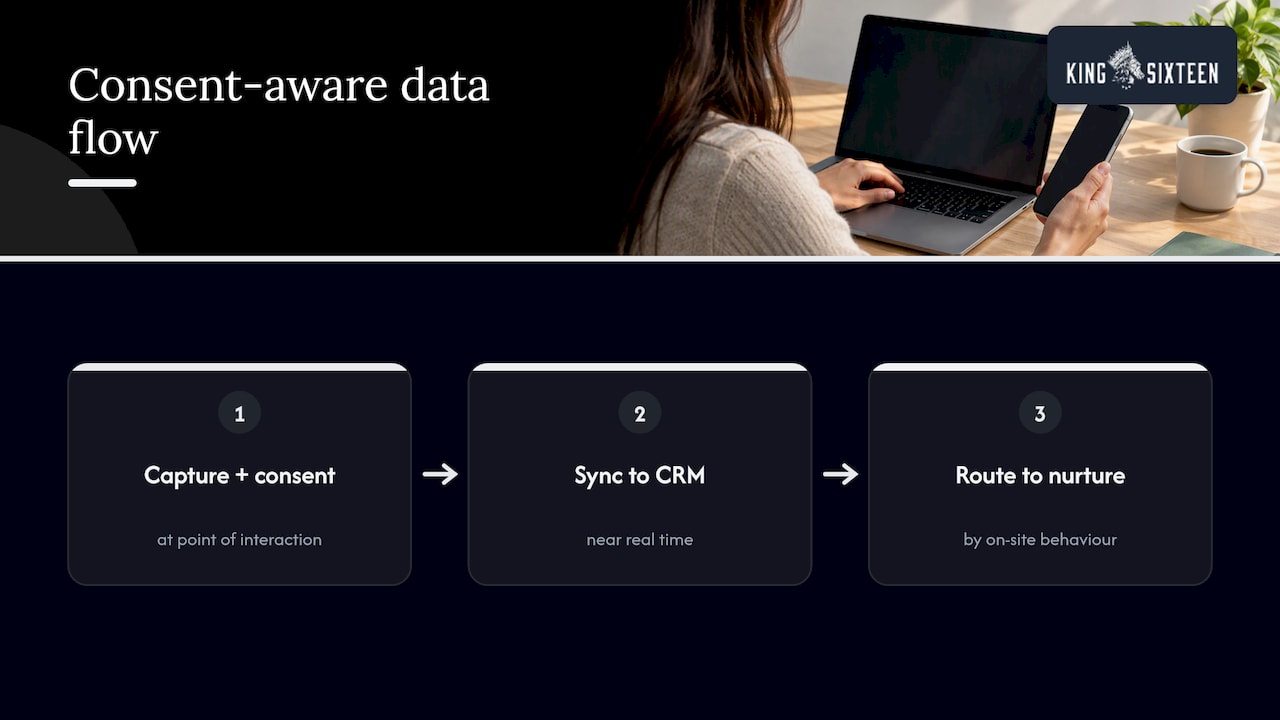
The data flow should be simple enough to explain to a stakeholder in one sentence: capture at the point of interaction, sync to the CRM in near real time, then route contacts into nurture journeys based on what they actually did on site. Build consent into that first step, not as a legal afterthought, since a badge scan or app sign-up is the natural moment to confirm how a contact’s data will be used.
When choosing vendors, prioritize ones that integrate cleanly with your existing marketing automation platform over ones that promise the flashiest demo. Our guide to interactive marketing covers format and tooling choices in more depth, and partner resources like this piece on storytelling and visual content strategy are useful when content capture is a core part of the concept.
Sustainability, reuse, and scaling your activation assets
Designing for reuse from the start changes the economics of an activation. Modular builds, whether that is a reconfigurable stage system or interchangeable graphic panels, let a single investment serve multiple events instead of being discarded after one weekend. Industry analysis on brand presence notes that thoughtfully integrated physical assets turn into repeat impressions that lower cost per impression over time when they are built to travel and reused across a touring schedule.
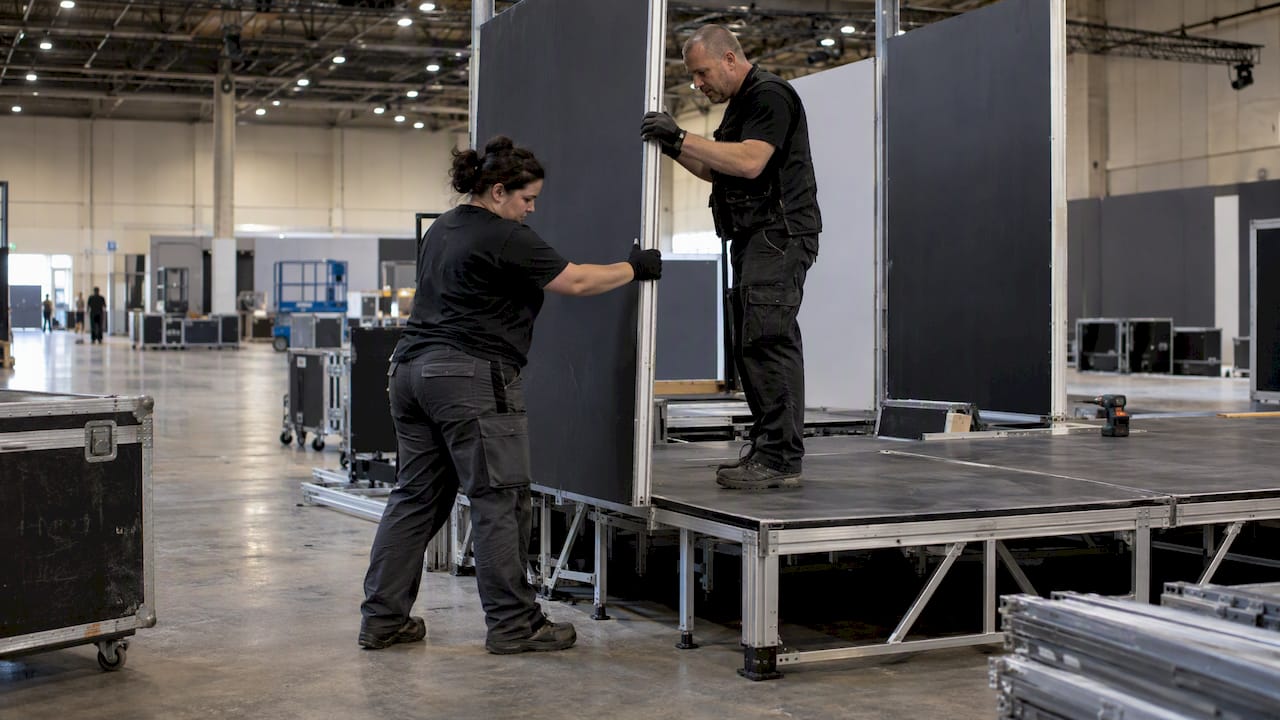
Sustainability choices and budget discipline point in the same direction. Durable materials and modular construction cost more upfront but reduce the need for full rebuilds, and they also give PR teams a genuine story to tell about reduced waste.
A practical scaling roadmap starts with designing the first activation as a kit of parts rather than a one-off build, documenting what traveled well, then budgeting the second and third stops at a fraction of the original fabrication cost since the core assets already exist.
- Modular panel systems let graphics change by market without rebuilding the structure.
- Reusable tech components, like RFID readers or screens, amortize across an entire touring season.
- Shared fabrication specs across markets keep shipping and labor costs predictable.
Pro Tip: Design your first activation knowing it needs a second life, because the cost of building for reuse is almost always lower than the cost of building twice.
King Sixteen: what a turnkey model proves in practice
Running a GAME plan well depends on one thing most marketing teams underestimate: coordination risk. When creative, fabrication, staffing, logistics, and AV sit with five different vendors, a single schedule slip anywhere in that chain can push the entire install date. A turnkey model, where one partner owns all of it, removes most of that risk by design.
A few practical ways that shows up on the ground:
- One point of accountability means a fabrication delay gets caught and solved internally, not discovered on load-in day.
- A trusted vendor network built over years lets engineering questions get answered in days instead of weeks of new-vendor vetting.
- Front-loaded engineering decisions, resolved before the build begins, prevent the kind of last-minute change orders that blow budgets and schedules alike.
- Single-contract simplicity reduces the number of handoffs where details get lost between partners.
We have applied this model across experiential campaigns, product launches, and multi-day conference productions for a range of high-value brands.
Stakeholder roles and team coordination
A brand activation plan touches more departments than most marketers expect, and unclear ownership is one of the most common reasons timelines slip. Marketing typically owns the goal and the creative direction, but sales needs a voice early if lead quality is part of the success criteria, since the definition of a “qualified” lead has to be agreed before data capture is designed, not after the event wraps.
Operations or events teams usually own vendor management, venue logistics, and the run-of-show, while legal and compliance need visibility into permits, waivers, and any intellectual property used in the concept. Finance should see the budget and contingency plan before fabrication begins, not when the first change order arrives.
A simple coordination structure works better than a complicated one: one project owner with final decision authority, one point of contact per workstream (creative, production, measurement), and a shared timeline that every stakeholder can see without chasing status updates. Weekly check-ins in the final six weeks before an event catch the small issues before they become expensive ones, and a single shared document for decisions and approvals prevents the “I thought someone else confirmed that” problem that derails more activations than bad creative ever does.
Risk management and contingency planning
Every activation carries a handful of predictable risks: weather for outdoor events, technology failure for anything digital, vendor delays for custom fabrication, and staffing gaps on the day itself. Planning for these up front costs far less than reacting to them live.
A contingency plan should name a backup for each critical dependency: an indoor rain plan for outdoor activations, a manual lead-capture fallback if the tech stack fails, and a secondary vendor contact for any single point of fabrication failure. Build slack into the schedule rather than planning to the minute, since a tight run-of-show leaves no room to absorb a fifteen-minute load-in delay without cascading into the doors-open time.
On-site, designate one person with the authority to make real-time calls, whether that means pulling the rain plan or reallocating staff between zones. Document every incident during the event itself rather than relying on memory for the post-mortem, since the details that matter for the next activation’s risk plan are the ones easiest to forget by the following week.
Legal and compliance considerations
Permits are the most visible compliance requirement, and they vary by venue and municipality, which means confirming requirements directly with the venue and local authority rather than assuming last year’s permit covers this year’s footprint. Insurance certificates, often requested by the venue itself, should be confirmed well before the final build drawings are locked, since some coverage requirements can affect structural design choices.
Intellectual property deserves its own line item in the planning process. Any licensed content, music, or third-party brand assets used in the activation need clearance confirmed in writing before production begins, and waivers for attendee photography or data capture should be reviewed by legal counsel rather than copied from a template used for a different kind of event. For activations involving giveaways, contests, or data collection, confirm compliance with relevant consumer protection and privacy rules for your market before the mechanics are finalized, since redesigning a promotion after assets are built is far more expensive than reviewing the mechanics on paper first.
Post-activation follow-up to sustain engagement
The activation itself is only the beginning of the relationship with everyone who walked through it. Leads captured on site should move into a nurture sequence within days, not weeks, while the experience is still fresh enough that a follow-up message feels like a continuation rather than a cold outreach.
Segment follow-up by what attendees actually did on site rather than treating every contact the same way: someone who completed a product demo warrants a different next message than someone who simply scanned a badge for a giveaway entry. Content captured during the activation, photos, video, and user-generated social posts, extends the campaign’s reach well past the event dates, and repurposing that material into follow-up emails or retargeting ads keeps the experience visible to people who could not attend in person.
Close the loop internally as well. Share the post-mortem findings with sales so they understand which leads came from which activity, and feed the Metric Pairs results back into the planning process for the next activation so the lessons compound instead of resetting with each new event.
Dos and don’ts worth keeping on your desk
A few rules hold up across almost every activation we have seen succeed or stumble.
Do build for shareability from the first concept sketch, and do front-load fabrication decisions before the calendar forces your hand. Don’t finalize a floor plan before measurement points are designed in, and don’t treat a vendor’s silence on lead times as good news.
Three red flags that should pause a campaign: a vendor who cannot confirm fabrication lead times in writing, a budget with no contingency line, and a goal nobody can state as a number.
— Tyler
How King Sixteen can help you execute
Planning a strong GAME plan is one challenge. Executing it without five vendors dropping the ball on five different deadlines is another. That is the gap a turnkey model closes: one partner handling creative, fabrication, staffing, logistics, and AV, which means fewer handoffs, faster execution, and pricing built on established vendor relationships.
- Project-Based Production for a single activation built from concept through load-out.
- Turnkey Event Production for teams that want one point of accountability across every vendor.
- Custom Builds & Fabrication for modular, reusable installations designed to travel.
If your next launch needs a partner who stays accountable from proposal through execution rather than disappearing after the pitch, see how we work and start the conversation about your next activation.
FAQ
What is an example of a brand activation?
A documented example is an interactive hologram activation that collected 1,225 qualified leads at a single stadium event and doubled lead generation compared with the previous two years. It illustrates how an immersive, tech-driven format can turn attendee engagement directly into measurable sales pipeline.
How much does brand activation typically cost?
Published, verifiable activation pricing varies too widely by scale, market, and format to state a single figure, since a pop-up sampling event and a flagship product launch sit on entirely different budget scales. A reliable approach is to split spend across design and fabrication, staffing, venue and logistics, and content capture, then add a contingency reserve for change orders.
What is the 3-3-3 rule for marketing?
Definitions of the “3-3-3 rule” vary across marketing disciplines and are not tied to a single authoritative framework for brand activation specifically. Rather than relying on an unverified rule, anchor your plan to the GAME framework (Goal, Activity, Measures, Evaluation), which is built specifically for activation planning.
What are the trends in brand activation for 2026?
Content created for events has become the top investment area for event marketers, and PR and media coverage has overtaken general awareness as the leading objective, according to EventTrack 2026. Alongside this, data-driven personalization using tools like RFID and CRM integration is becoming standard practice for connecting activations to pipeline, as outlined in the AMA’s experiential marketing playbook.
How do you measure the ROI of a brand activation?
Measuring ROI well means pairing activity metrics with business outcomes, known as Metric Pairs, rather than reporting attendance or impressions alone. For activations that use AI-enabled personalization, the AMA’s Expansion Framework recommends measuring Quality Lift, Scope Expansion, and Capability Unlock to show business impact rather than simple time-saved metrics.